How to Create an Awesome Veggie Garden Layout: Ideas for Raised Beds and Small Spaces
I planted my first vegetable garden in random clumps wherever there was space. Tomatoes here, lettuce there, peppers in that corner. Total chaos.
The result? Half my vegetables died from poor spacing, I couldn’t reach plants without stepping on others, and weeds took over everything.
Then I learned that layout actually matters more than plant choice. Same plants, better layout, triple the harvest with half the work.
Let me show you layouts that actually work for raised beds and small spaces instead of the messy disaster I started with.
Why My First Garden Layout Failed Badly
Three huge mistakes killed my harvest:
- Plants too close together (competed for nutrients)
- No clear paths (stepped on roots constantly)
- Tall plants shading short ones (everything stunted)
I thought cramming 40 plants in a 4×8 bed would give me more food. Instead, everything struggled and most plants produced nothing.
What I learned: Space and organization matter more than quantity.
The Tomato Disaster
I planted 6 tomato plants in a 4×4 bed. They grew into a tangled jungle I couldn’t even walk through.
Problems:
- Couldn’t reach center plants to harvest
- No air circulation = disease spread
- Shaded each other = fewer tomatoes
- Total harvest: Maybe 10 tomatoes from 6 plants
Same bed, better layout (next year):
- 3 tomato plants properly spaced
- Clear access paths
- Good air flow
- Harvest: 60+ tomatoes from 3 plants
Less plants, better layout, way more food.
The 4×8 Raised Bed Layout (Most Popular Size)
This is the standard raised bed size and what I use for 90% of my garden.
Why 4×8 feet works perfectly:
- Reach middle from either side (4-foot width)
- Fits standard lumber (8-foot boards)
- Big enough to grow variety
- Small enough to maintain easily
My proven 4×8 layout:
Layout Option 1: Three Sections
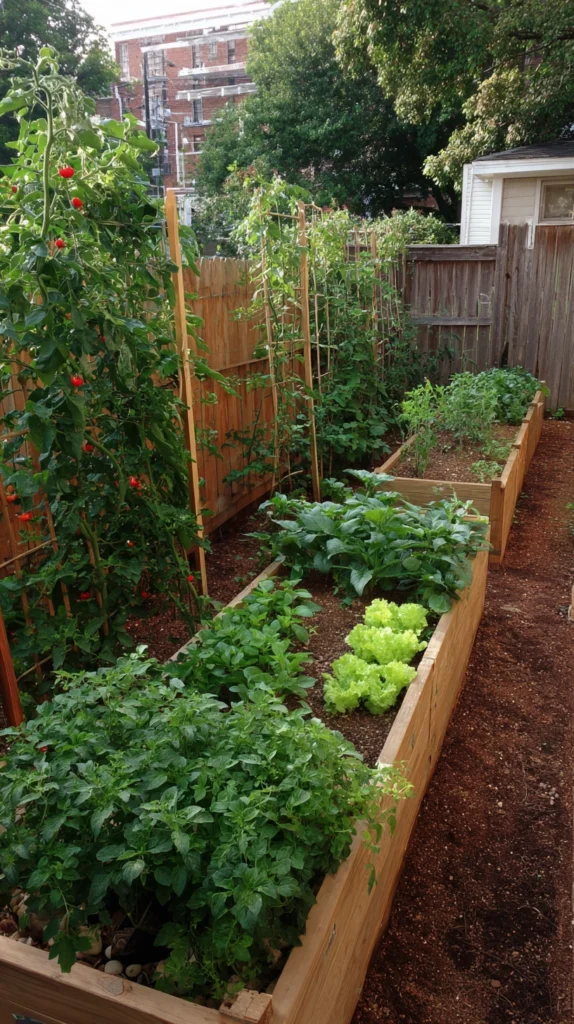
Divide into thirds (2.6 feet each):
Section 1: Tall trellised crops (north end)
- 3 tomato plants
- Train up 6-foot trellis
Section 2: Medium height crops (middle)
- 4 pepper plants
- 6 eggplants
Section 3: Low-growing crops (south end)
- Lettuce (succession planted)
- Radishes between lettuce
- Herbs on edges
This prevents tall plants from shading short ones. North-to-south height gradient lets everything get sun.
Layout Option 2: Grid System
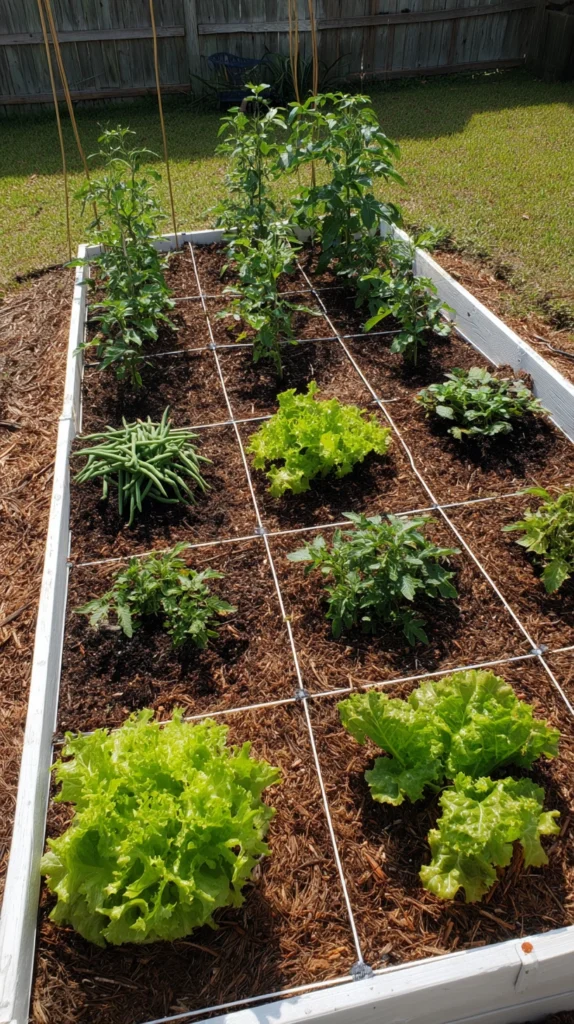
Mark bed into 2-foot squares (8 squares total):
| Square | Plants | Spacing |
| 1-2 | Tomatoes | 1 per square |
| 3-4 | Peppers | 2 per square |
| 5-6 | Bush beans | 9 per square |
| 7-8 | Lettuce/greens | 4 per square |
Benefits of grid layout:
- Easy to plan and visualize
- Consistent spacing
- Know exactly what fits where
I draw this on graph paper in winter. Take guesswork out of planting day.
Layout Option 3: Companion Planting
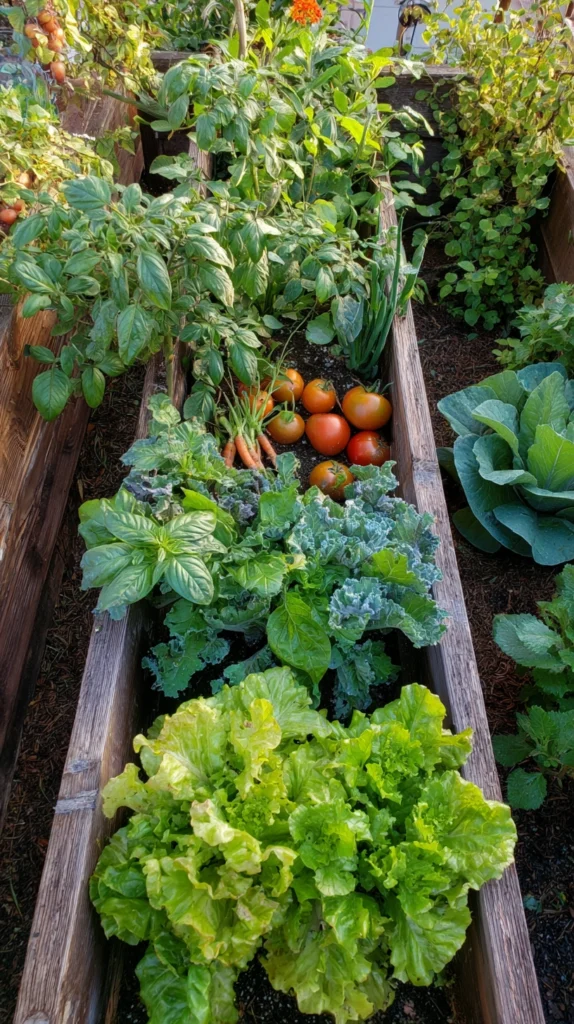
Group plants that help each other:
North side:
- 3 tomatoes
- Basil planted between (repels pests)
Middle:
- Carrots and onions alternating rows
- Onions repel carrot flies
South side:
- Lettuce under taller plants (likes partial shade in summer)
- Radishes (ready before others need space)
My favorite layout because plants actually help each other grow better.
Small Space Layout: 4×4 Square Foot Garden
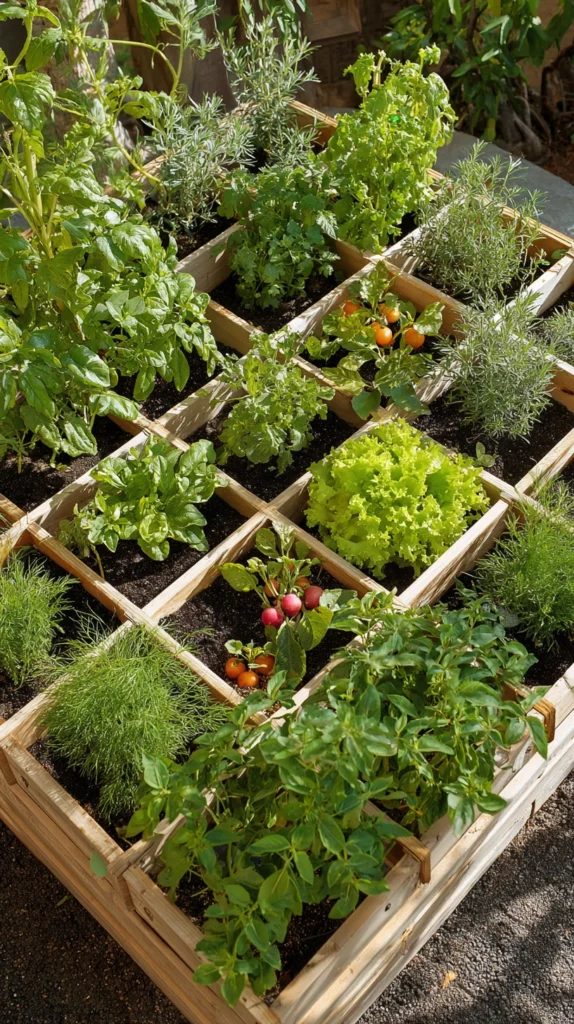
Perfect for tiny yards or beginners. One 4×4 bed feeds one person in salad greens all summer.
Square foot gardening method:
- Divide into 16 one-foot squares
- Plant different amounts per square based on size
- Intensive planting (no wasted space)
Planting density guide:
| Plant | Per Square Foot | Total Squares Needed |
| Tomato | 1 | 2 squares |
| Pepper | 1 | 2 squares |
| Lettuce | 4 | 4 squares |
| Radishes | 16 | 2 squares |
| Carrots | 16 | 2 squares |
| Herbs | 1-4 | 4 squares |
This 4×4 bed grows:
- 2 tomatoes
- 2 peppers
- 16 lettuce plants (succession planted)
- 32 radishes
- 32 carrots
- 4+ herb varieties
All in 16 square feet. Way more than traditional row spacing.
Building the Grid
I used vinyl blind slats to mark the grid. Cost $2 at thrift store.
Setup:
- Cut slats to 4-foot lengths
- Lay across bed at 1-foot intervals
- Creates visible grid
- Remove after planting or leave
Makes planting dead simple. Each square gets specific plants, no measuring needed.
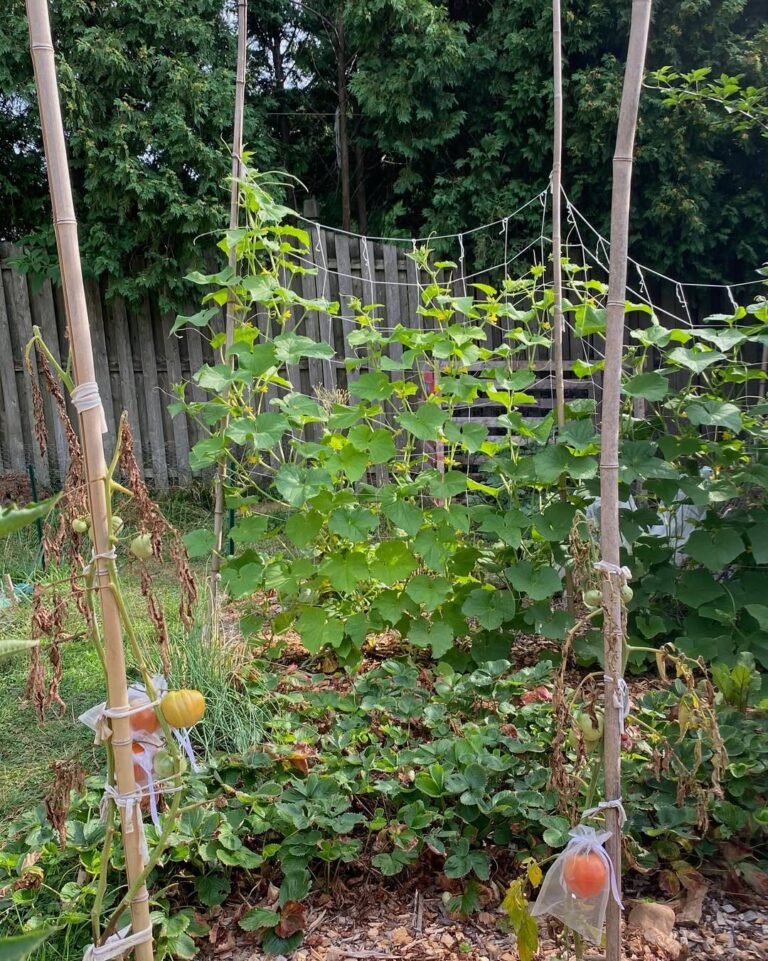
Vertical Trellis Layout (Double Your Space)
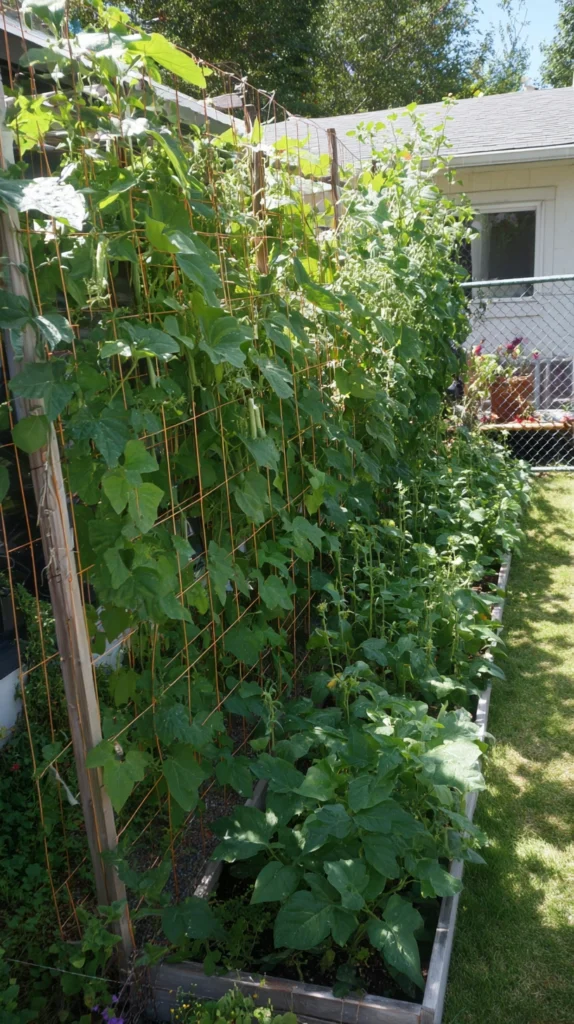
Growing up instead of out saves tons of space. I grow 15 plants in the footprint of 5 by going vertical.
My vertical bed setup (4×8):
Back of bed (north side):
- 6-foot trellis attached to bed
- Pole beans climbing up
- 8 plants in 8 feet of space
Front of bed (south side):
- Short crops not shaded by trellis
- Lettuce, spinach, herbs
- Full sun access
This layout uses height dimension instead of just flat space. Effectively doubles the growing area.
What Climbs Well
Best vegetables for trellising:
- Pole beans (produce all summer)
- Cucumbers (way easier to harvest)
- Peas (both snap and snow peas)
- Small squash (compact varieties)
- Cherry tomatoes (indeterminate types)
What doesn’t work:
- Bush beans (short, don’t climb)
- Lettuce (ground crop)
- Peppers (too heavy for vines)
- Determinate tomatoes (don’t keep growing)
I switched from bush beans to pole beans. Same space, triple the harvest from vertical growing.
Trellis Construction
My cheap trellis system:
Materials:
- Cattle panel (4×16 feet, $25)
- Two T-posts ($8 each)
- Wire or zip ties
Installation:
- Drive T-posts at ends of bed
- Attach cattle panel to posts
- Curve panel slightly for strength
- Plant at base
Lasts 10+ years. One $40 investment, infinite harvests.
Keyhole Garden Layout (Maximum Access)
Circular bed with path to center. Can reach all plants without stepping in a growing area.
Layout specs:
- 6-foot diameter circle
- Wedge-shaped path to center
- Compost basket in middle
- Plant in curved beds around center
Why it’s awesome:
- Reach everything from center path
- Compost feeds plants directly
- Unique focal point in yard
- Water-efficient design
Planting zones:
Outer ring: Tall plants (tomatoes, peppers)
Middle ring: Medium plants (bush beans, chard)
Inner ring: Low plants (lettuce, herbs)
Center: Compost basket or water reservoir
I built one keyhole bed as an experimental zone. It’s my most productive bed per square foot.
Building a Keyhole
My construction:
- Stacked bricks in 6-foot circle
- Left 2-foot wedge opening
- 3 feet tall walls
- Wire basket in center for compost
Total cost: $50 in bricks (bought used), $5 for wire basket
Holds 30+ plants in the same footprint as a standard 4×8 bed. More edges = more planting area.
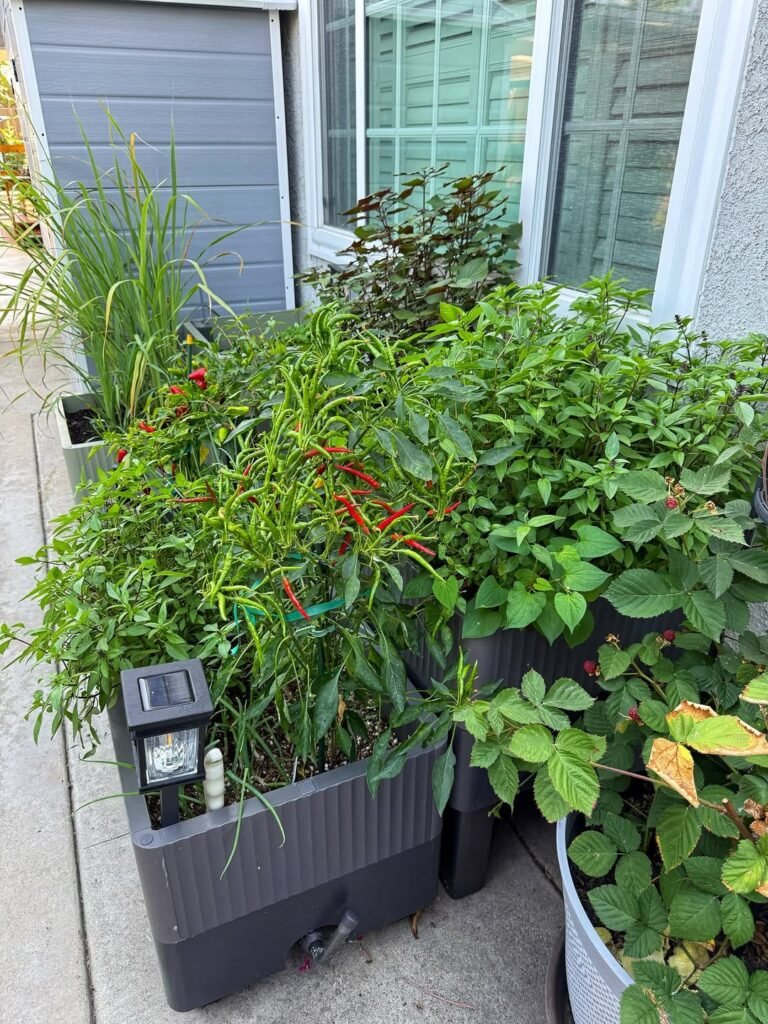
Container Garden Layout (No Ground Space)
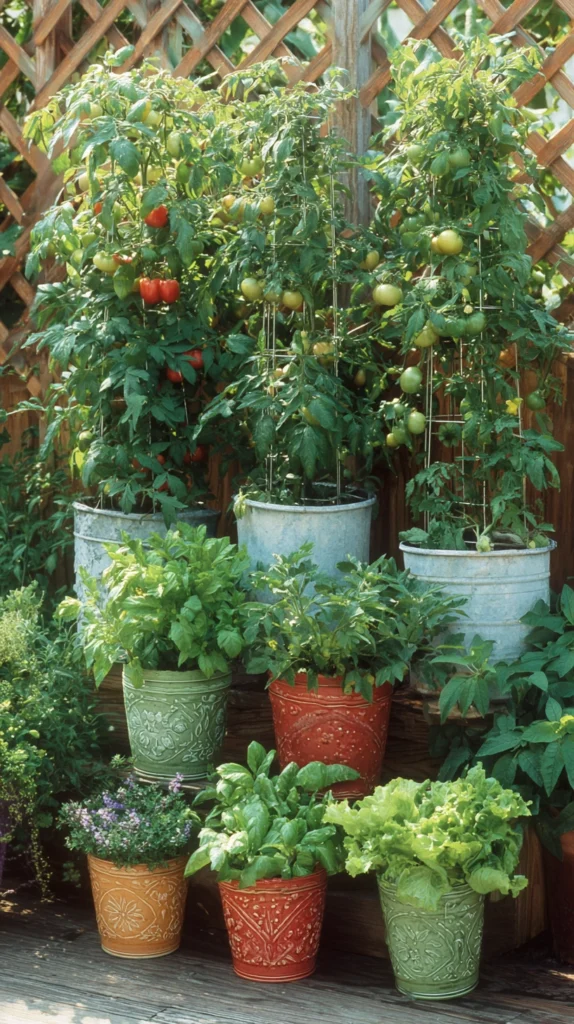
I have 12 containers on my patio producing as much as a 4×8 bed.
Container arrangement by height:
Back row (against fence):
- 3 tomatoes in 5-gallon buckets
- Tallest plants
- Against trellis or cages
Middle row:
- 4 peppers in 3-gallon pots
- Medium height
- Decorative containers
Front row:
- 5 herbs and lettuce in smaller pots
- Easy to reach and harvest
- Most-used plants up front
This creates depth instead of flat row. Looks better, functions better.
Container Size by Vegetable
Minimum sizes for production:
| Vegetable | Container Size | Plants Per Container |
| Tomatoes | 5 gallons | 1 |
| Peppers | 3 gallons | 1 |
| Lettuce | 12″ wide, 6″ deep | 4-6 |
| Herbs | 8-10″ pot | 1-3 |
| Cucumbers | 5 gallons | 1 with trellis |
| Beans | 10″ deep | 3-4 |
Don’t use tiny pots. Plants get root-bound and produce nothing. Bigger is always better for containers.
Succession Planting Layout (Continuous Harvest)
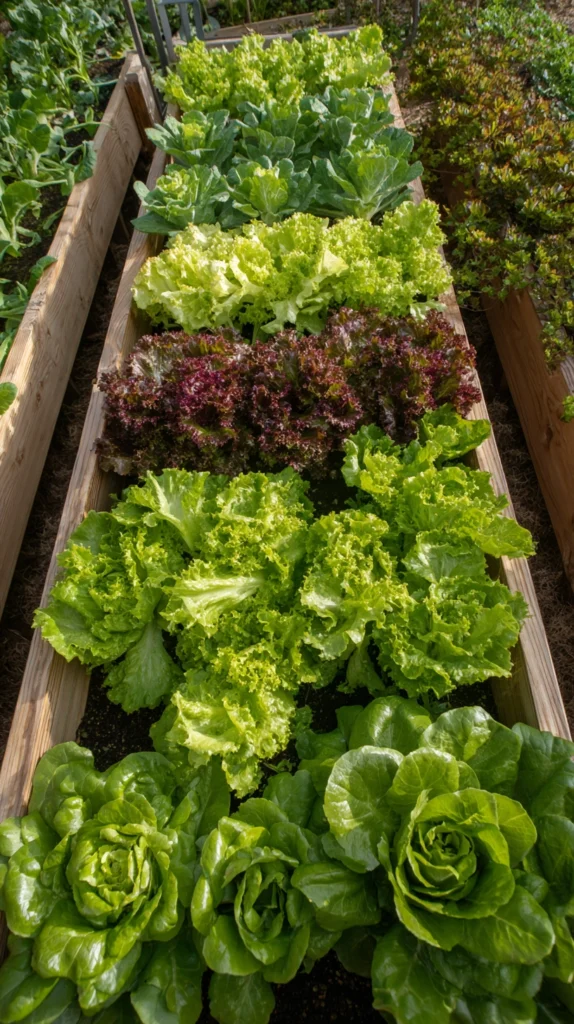
One bed is divided into 4 sections. Plant the same crop every 2 weeks in different sections for continuous harvest.
Example: Lettuce bed (4×8)
Section A (2×8): Plant week 1 Section B (2×8): Plant week 3 Section C (2×8): Plant week 5
Section D (2×8): Plant week 7
Result:
- Week 5: Harvest section A, replant immediately
- Week 7: Harvest section B, replant
- Week 9: Harvest section C, replant
- Continuous lettuce April through October
Instead of one big harvest then nothing, get steady supply all season.
Best Crops for Succession
Fast-growing vegetables:
- Lettuce (30 days)
- Radishes (25 days)
- Arugula (40 days)
- Bush beans (50 days)
- Carrots (60 days)
I succession plant lettuce and radishes only. Other crops I plant once because I don’t eat them as often.
Intensive Block Planting (No Rows)
Forget rows. Plant in solid blocks with minimal spacing between plants.
Traditional row spacing:
- Rows 3 feet apart
- 60% of space is empty paths
- Grows maybe 15 lettuce in 4×8 bed
Block planting:
- Plants 6 inches apart all directions
- Plants fill entire bed
- Grows 60+ lettuce in same bed
My lettuce block:
- 4×4 bed
- 6-inch spacing
- 64 lettuce plants
- Harvest outer plants, inner keep growing
Advantages:
- 3-4× more plants same space
- Plants shade out weeds
- Soil stays moist (leaf coverage)
- Looks like professional garden
Making It Work
Requirements for success:
- Excellent soil (plants compete)
- Consistent water (drip irrigation best)
- No walking in bed (compacts soil)
- Good fertility (fertilize regularly)
Can’t do this in poor soil or with hand watering. Needs proper setup to work.
Three Sisters Layout (Traditional Companion)
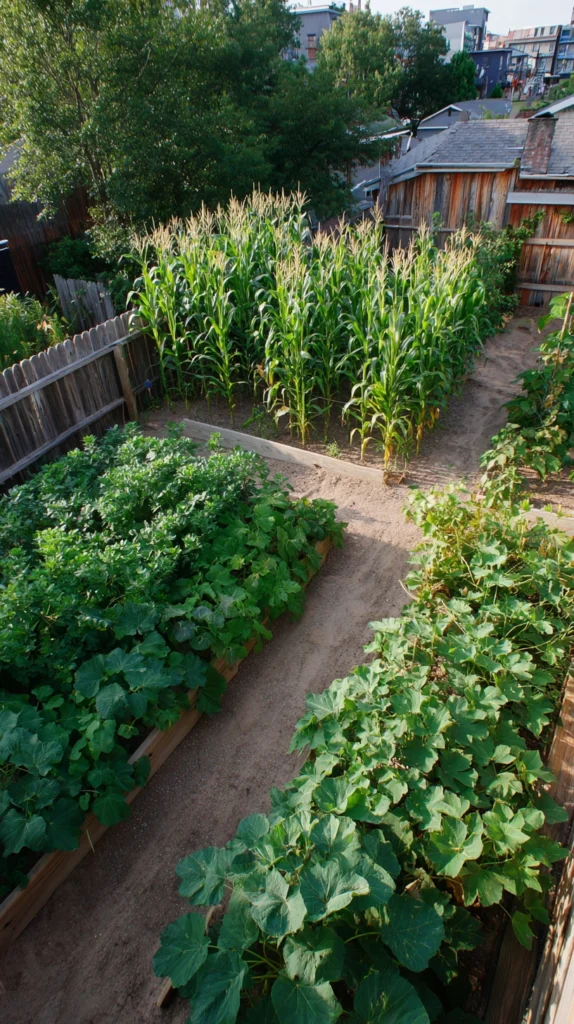
Native American method: Corn, beans, squash together. Each helps the others.
Layout in 4×8 bed:
North end (4×3 section):
- 6 corn plants in two rows
- Spaced 18 inches apart
Middle (growing around corn):
- Pole beans planted at base of each corn
- Climb corn stalks
South end (4×5 section):
- 2 squash plants
- Vines spread south (won’t shade corn)
How it works:
- Corn = support for beans
- Beans = nitrogen for corn and squash
- Squash = ground cover, prevents weeds
I tried this once. Worked okay but took lots of space. Better for large gardens than small beds.
My Results
Harvest from one 4×8 bed:
- 12 ears of corn
- 2 pounds of beans
- 6 squash
Decent harvest but I prefer:
- More tomatoes and peppers
- Higher value crops
- Better space efficiency
Interesting experiment. Not my go-to layout for production.
Shade Garden Layout (North Side)
My north-facing bed gets 3-4 hours of sun. Most vegetables need 6+ hours.
What actually grows in partial shade:
Leafy greens (thrive with less sun):
- Lettuce (actually prefers some shade)
- Spinach (bolts in full sun)
- Arugula (less bitter in shade)
- Kale (tolerates shade well)
Herbs:
- Parsley
- Cilantro
- Mint (loves shade)
- Chives
My 4×8 shade bed layout:
All sections: Greens and herbs only
- North: Kale and chard
- Middle: Lettuce (succession planted)
- South: Herbs (parsley, cilantro, mint)
No tomatoes, peppers, or fruiting crops. They need sun. Embrace what works in your conditions.
Making Shade Work Better
Maximize available light:
- Paint nearby walls white (reflects light)
- Use light-colored mulch
- Prune tree branches above if possible
- Accept lower yields than full sun
My shade bed produces 60% of what a full-sun bed does. But it’s still food from otherwise useless space.
Season Extension Layout (Year-Round Growing)
One bed with a cold frame extends the season by 6-8 weeks spring and fall.
My setup:
4×8 bed with removable cold frame:
- Bed built 18 inches tall
- Old windows laid on top as lid
- Vents for hot days
- Grow cool-season crops late
Fall planting (August-September):
- Kale, spinach, lettuce
- Carrots, beets, turnips
- Cover with cold frame in October
Result: Harvest fresh vegetables through December (I’m in zone 7).
Cold Frame Construction
My easy version:
Materials:
- Four old windows (free from Craigslist)
- Hinges to attach to bed
- Prop stick for venting
Cost: $15 for hinges and hardware
Extends season from:
- May-September (5 months) to
- March-November (9 months)
Almost double the growing time for $15 investment.
Companion Planting Layout Combinations
Plants that help each other when planted together.
Tomato Section
Main crop: Tomatoes (3 plants)
Planted with:
- Basil between plants (repels aphids)
- Marigolds at corners (repels nematodes)
Benefits: Fewer pest problems, better tomato flavor (people claim basil does this).
Carrot and Onion Section
Alternating rows:
- Row of carrots
- Row of onions
- Row of carrots
Why: Onion smell confuses carrot flies, protects carrots.
Three Sisters (Already Covered)
Corn, beans, squash together.
What I Actually Use
Tomatoes with basil: Yes, this works noticeably.
Carrots with onions: Haven’t noticed the difference honestly.
Marigolds everywhere: They look pretty, unsure about pest control.
My take: Plant what you’ll eat in spaces that work. Companion planting is a bonus, not a requirement.
Layout for Wheelchair or Mobility Access
Raised beds at table height make gardening accessible.
Specifications:
- Bed height: 24-30 inches (wheelchair accessible)
- Width: 2-3 feet (reach from wheelchair)
- Paths: 4 feet wide (wheelchair turning)
- Length: Any (8 feet common)
Layout example:
Two 2×8 beds with 4-foot path:
- Both beds at 28 inches high
- Wide path between
- All plants reachable from seated position
Materials:
- Tall raised bed kits or custom built
- Strong support (holds lots of soil weight)
- May need help building
My neighbor built these for his wife. She gardens independently now despite mobility issues.
Planning Your Layout on Paper
I spend 2-3 hours in January planning. Saves countless hours and mistakes in spring.
My Planning Process
Step 1: Measure beds accurately
- Write down exact dimensions
- Note sun exposure
- Mark permanent features
Step 2: Graph paper sketch
- 1 square = 1 foot
- Draw all beds to scale
- Add paths and features
Step 3: List what you want to grow
- Prioritize favorites
- Check days to maturity
- Note space requirements
Step 4: Assign plants to beds
- Tall plants north
- Match sun requirements
- Plan rotations
Step 5: Calculate planting dates
- Work backward from first frost
- Succession planting schedule
- Make calendar
This planning prevents:
- Planting tomatoes where tomatoes were last year
- Shade problems
- Running out of space mid-season
- Forgetting to start things
Free Planning Tools
What I use:
- Graph paper ($3 at office store)
- Pencil and eraser
- Vegetable spacing chart (free online)
- Last year’s garden notes
What others use:
- Garden planning apps
- Computer software
- Detailed spreadsheets
I’m old school. Paper and pencil work fine.
Common Layout Mistakes to Avoid
Mistake 1: Beds Too Wide
I built a 5-foot wide bed. Couldn’t reach the middle without stepping in it.
Fix: Maximum 4 feet wide for access from both sides.
Mistake 2: Paths Too Narrow
Made 12-inch paths between beds. I had to walk sideways, constantly stepping on plants.
Fix: Minimum 18 inches, 24 inches better.
Mistake 3: No Rotation Plan
Planted tomatoes in the same bed 3 years straight. Disease built up, plants died.
Fix: Rotate plant families between beds yearly.
Mistake 4: Wrong Plant Heights
Tall plants on the south side shaded everything behind them.
Fix: Tall plants always on north, short on south.
Mistake 5: No Succession Planning
Planted all the lettuce the same day. I had 30 heads ready at once, most bolted before I could eat them.
Fix: Plant 1/4 of lettuce every 2 weeks.
Layout Maintenance Tips
Keep paths clear:
- Mulch with wood chips (prevent weeds)
- Edge beds clearly (visual organization)
- Remove weeds immediately
Maintain access:
- Prune overhanging plants
- Keep paths at full width
- Don’t let plants sprawl into paths
Monitor and adjust:
- Some plants grow bigger than expected
- Remove underperformers
- Fill gaps with quick crops
I walk my garden daily. Quick 5-minute check catches problems before they become disasters.
Starting Your Layout This Weekend
Don’t overthink it. Start with one bed and expand.
Weekend 1: Plan
- Measure your space
- Sketch basic layout
- Buy materials if building beds
Weekend 2: Build
- Construct beds
- Fill with soil
- Mark sections/grid
Weekend 3: Plant
- Follow your layout plan
- Label everything
- Water and mulch
Week 4 onward: Maintain, observe, adjust for next year.
My first layout was terrible. The second year was better. The third year is excellent. You learn by doing, not by planning perfectly.
The One-Bed Test
Not sure if you’ll like gardening?
Build one 4×8 raised bed ($60 in materials). Grow:
- 3 tomatoes
- 4 peppers
- Lettuce
- Herbs
This bed provides:
- Fresh salsa ingredients all summer
- Learning experience
- Low commitment
- Room to expand if you love it
I started with one bed. Now I have six because I couldn’t stop expanding.
My Current Layout (What Actually Works)
Six 4×8 beds in grid pattern:
Bed 1: Tomatoes and basil (main crop) Bed 2: Peppers and eggplant Bed 3: Lettuce and greens (succession planted) Bed 4: Beans on trellis, lettuce below Bed 5: Root vegetables (carrots, beets, radishes) Bed 6: Herbs and experimental plants
Plus:
- 12 containers on patio
- One keyhole bed
- Vertical trellis along fence
Total growing space: About 250 square feet
Feeds a family of 4 in tomatoes, peppers, greens, and herbs all summer. Still buy: potatoes, onions, corn from farmers market.
This layout took 3 years to develop. Started with one bed, expanded what worked, eliminated what didn’t.
Now go sketch your layout and start building!
Quick Summary:
Best beginner layout:
- One 4×8 raised bed
- 4 feet wide (reach middle easily)
- Tall plants north, short south
- Clear access on all sides
Maximum production layouts:
- Square foot gardening (intensive spacing)
- Vertical trellising (uses height)
- Block planting (no wasted rows)
- Succession planting (continuous harvest)
Layout principles that always work:
- Beds 3-4 feet wide maximum
- Paths 18-24 inches minimum
- Tall plants on north
- Short plants on south
- Rotate crops annually
Space-saving strategies:
- Grow up (trellises)
- Plant intensively (blocks not rows)
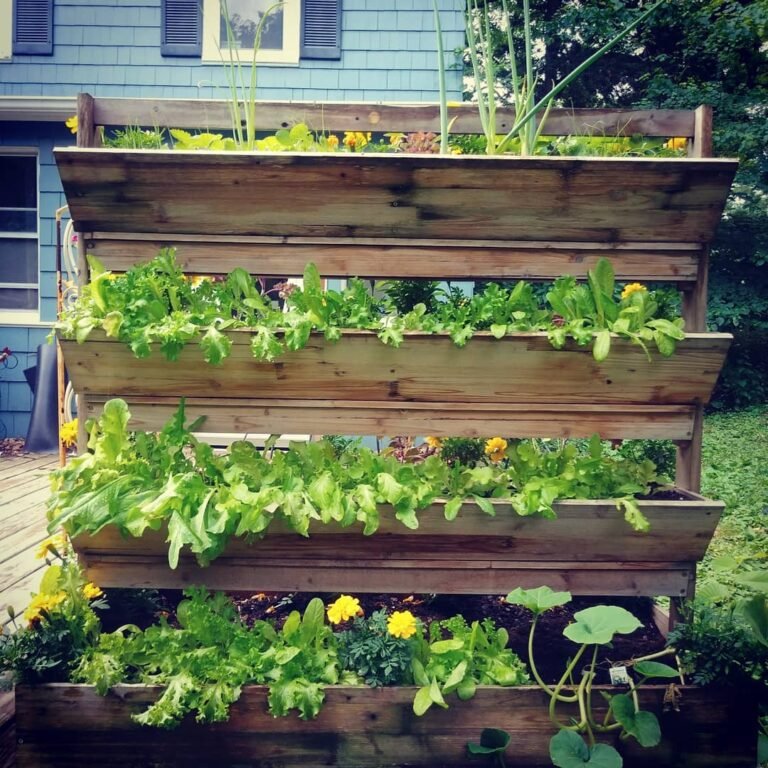
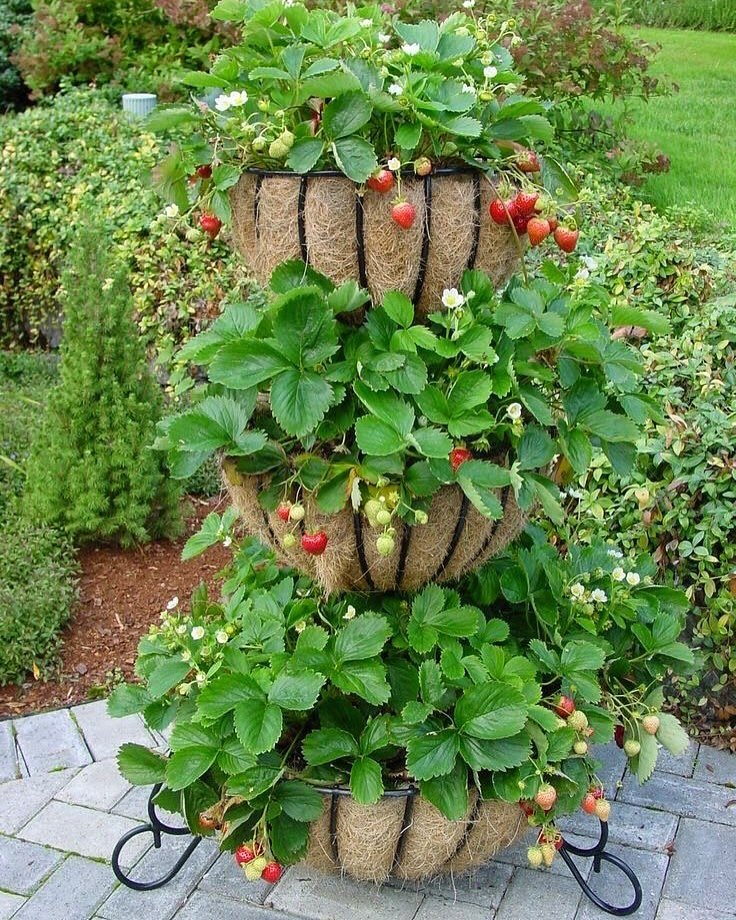
- Use containers (vertical stacking)
- Succession plant (continuous use)
- Intercrop fast/slow crops
Container arrangement:
- Back row: tall plants
- Middle: medium plants
- Front: herbs and greens
- Looks better, functions better
Planning tips:
- Sketch on graph paper first
- 1 square = 1 foot scale
- Plan rotations in advance
- Mark sun exposure
- Start small and expand
Common mistakes to avoid:
- Beds too wide (can’t reach middle)
- Paths too narrow (can’t walk)
- Tall plants shading short
- No rotation plan
- Planting everything same day
Time investment:
- Planning: 2-3 hours in winter
- Building beds: One weekend
- Planting: One weekend
- Maintenance: 30 minutes daily