14 Fall Console Table Styling Ideas
The console table is the most overlooked surface in most homes. Not the dining table — everyone pays attention to that. Not the coffee table — it collects enough magazines and cups to get noticed regularly. The console table in the hallway or behind the sofa: the surface that exists primarily to hold the keys and the post.
In autumn it has a different potential. The console table is one of the first things seen on entering the home — the hallway console — or the most-seen surface in the living room — the sofa-back console. Both positions: maximum visibility, minimum seasonal attention.
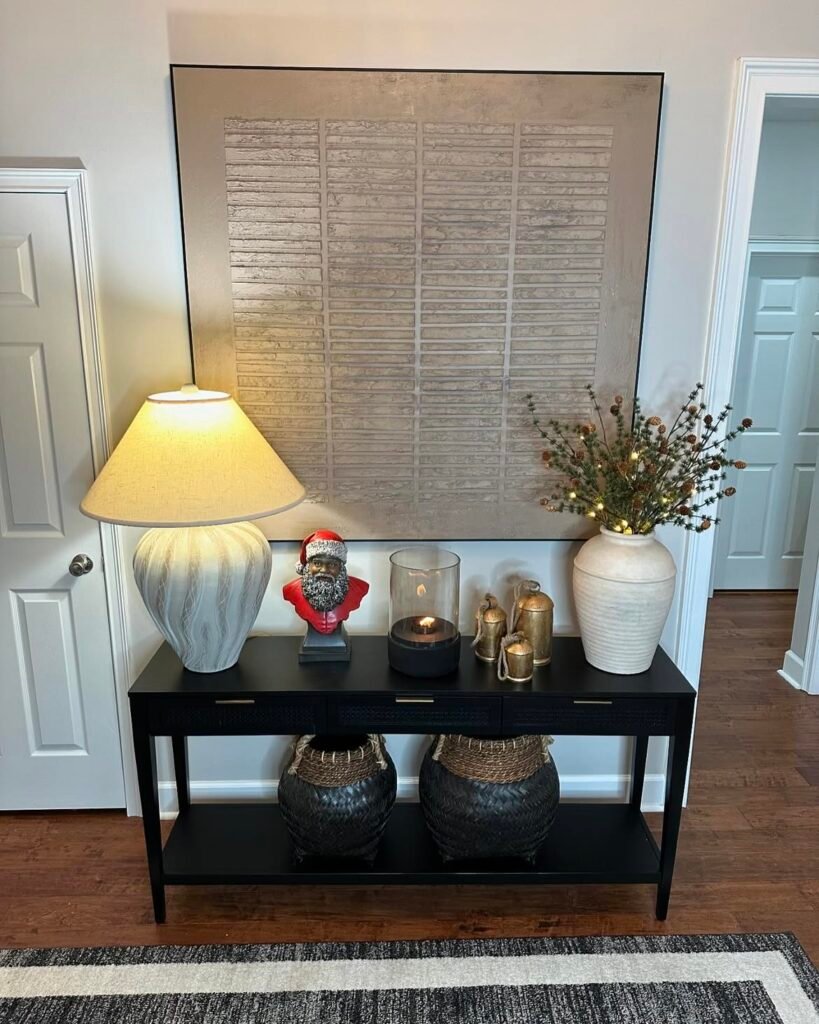
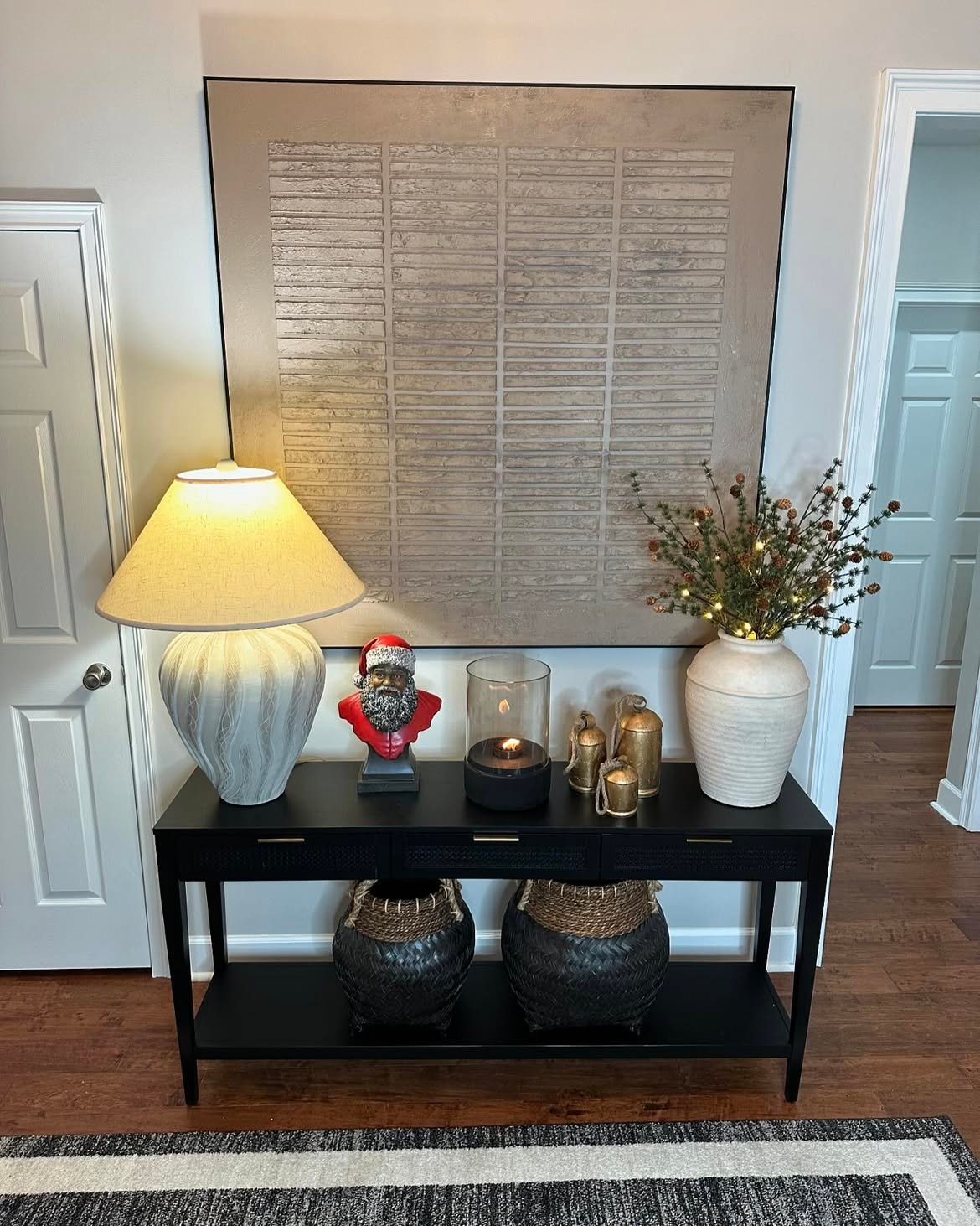
The styled autumn console table is the welcome before the welcome. The first thing a visitor sees. The room’s visual anchor that people notice without being aware they are noticing it. The surface is done well: the room reads as considered and seasonal. The surface is done carelessly or not done at all: the room still works, but something is missing.
Here are 14 ways to dress the console table for autumn.
The Console Table as a Design Problem
Why styling a console table is harder than it looks:
The depth:
- Most console tables: 10–15 inches deep
- Shallow: limits what can be placed on it
- Objects too large for the depth: stick out into the room
- The shallow depth: the primary constraint
The height:
- Console tables: typically 28–32 inches
- At or slightly below standard table height
- At this height: the arrangement is seen from above (the top view matters) and straight on (the front view matters)
- Two viewing angles: both must work
The backdrop:
- What is directly behind the console table
- A blank wall: an opportunity (art, mirror, gallery wall)
- A window: a challenge (the objects in front of the window become silhouettes)
- The backdrop: informs every styling decision
The three-layer principle:
- Back layer: the tallest objects (art, mirror, tall vases, architectural pieces)
- Middle layer: medium objects (candlesticks, medium vases, stacked books)
- Front layer: the small details (a small pumpkin, a candle, a single object that rewards close inspection)
- The three layers within 10–15 inches of depth: the styling challenge and the skill
The Autumn Console Palette
The colours for autumn console styling:
The warm neutrals (the foundation):
- Cream, warm white, warm grey, natural linen
- These: the backdrop against which the autumn accents read
The autumn accents:
- Deep rust and burnt orange
- Copper and aged brass
- Deep burgundy
- Forest and olive green
- Warm gold and amber
The rule:
- Two to three colours maximum on one console table
- Not: one of every autumn colour
- The restraint: the composition
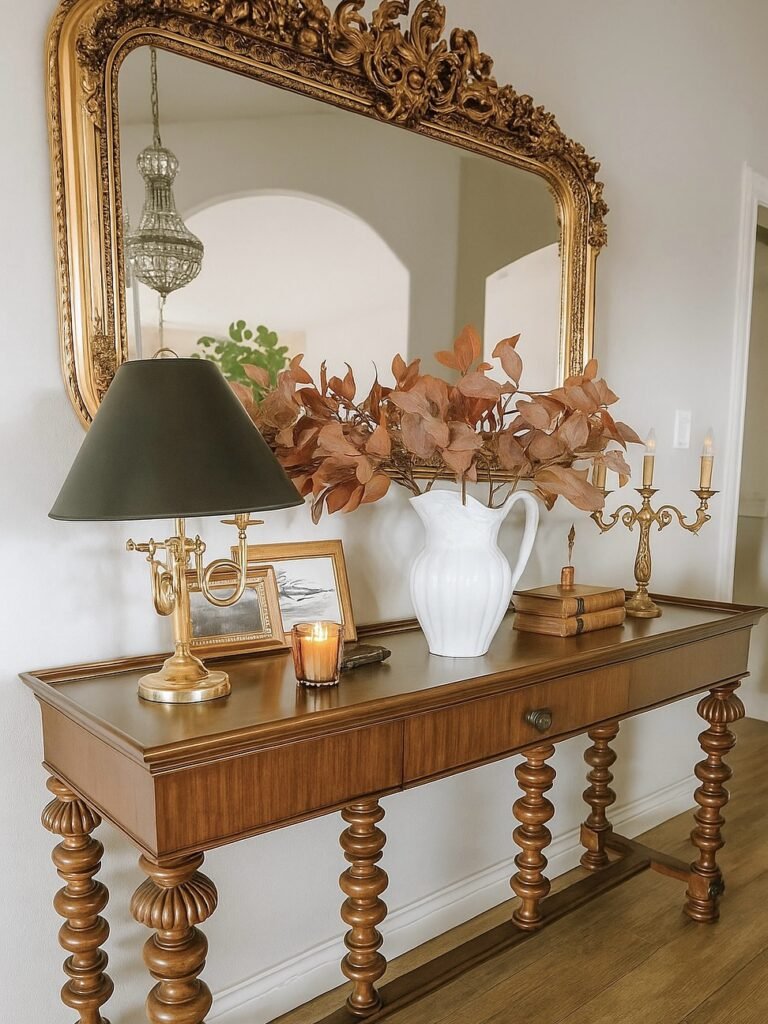
1. The Mirror and Botanical Arrangement (The Classic Console)
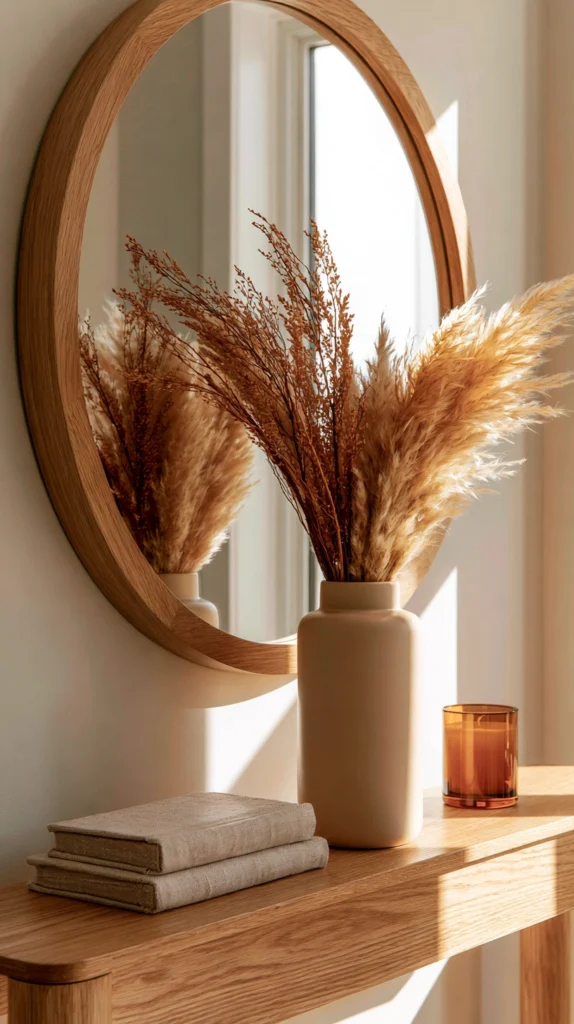
A mirror as the backdrop, with a botanical arrangement in front — the console table composition that works in every interior style.
Why the mirror is the console table’s best backdrop:
The depth illusion:
- A mirror behind the console: doubles the apparent depth of the arrangement
- The objects in front of the mirror: and their reflections behind
- The arrangement: more complex and richer than it actually is
- In a narrow hallway: the mirror opens the space significantly
The autumn botanical arrangement:
In front of the mirror:
- A vase of dried autumn botanicals (miscanthus plumes, dried hydrangea, seed heads)
- The arrangement visible: and its reflection
- Two arrangements for the visual price of one
The mirror choice:
The autumn mirror:
- An aged or antiqued mirror (the slightly foxed glass): more atmospheric than a perfectly clear one
- A warm-toned frame (wood, aged gold, copper): complements the autumn palette
- Round mirror: the organic form against the linear console
- Rectangular mirror: the extension of the console’s own geometry
The mirror height:
The golden rule:
- The bottom of the mirror: 6–8 inches above the console surface
- This gap: allows objects on the console to read against the mirror without the mirror cutting through them at an awkward point
- The mirror: the backdrop, not the shelf
The arrangement in front:
A three-object vignette:
- Tall vase with dried botanicals: the back-left (or back-right, not centred)
- A stack of two or three autumn-toned books: the middle
- A small object (a pumpkin, a candle, a stone or shell): the front right
- The asymmetrical triangle: the most composed console vignette
Cost breakdown:
- Mirror (secondhand): $30–80
- Dried botanical arrangement: $0 (from the garden) to $25 (purchased)
- Books already owned: $0
- Total: $30–105
The hallway console with a mirror: the first impression of the home. In autumn — with the dried grasses and the warm reflection — the most welcoming version of that first impression.
Mirror Placement Tips
The centring question:
- The mirror centred above the console: the symmetrical approach (works for symmetrically styled consoles)
- The mirror slightly off-centre: the contemporary approach (more dynamic, suits asymmetric arrangements)
- The centred mirror with an off-centre arrangement: the combination that creates the most interest
The height:
- Eye level for the person approaching: the ideal centre of the mirror
- The mirror too high: feels disconnected from the console
- The mirror too low: the arrangement on the console cuts across the mirror face
2. The Autumn Book Stack (The Foundation of Every Console Vignette)
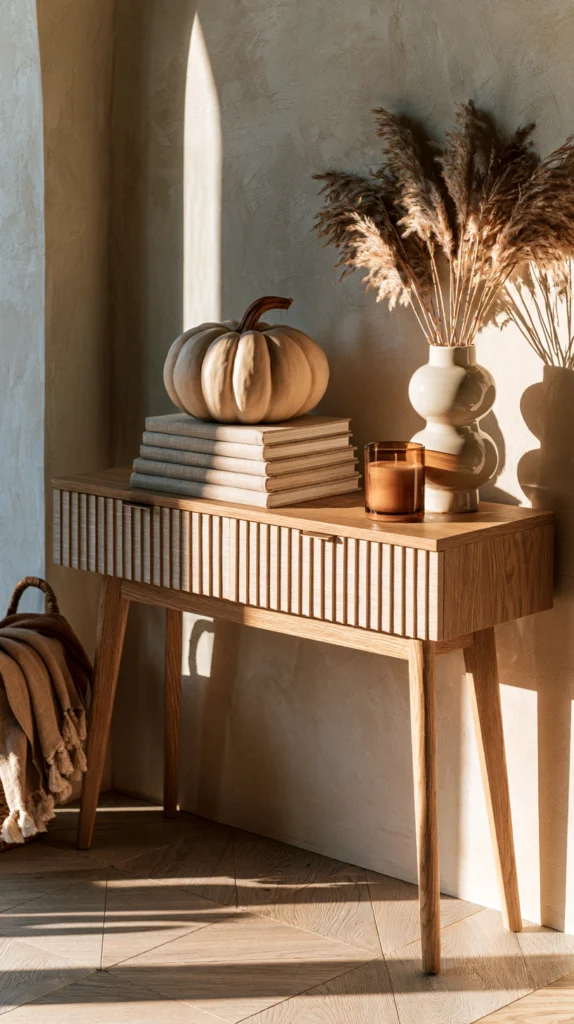
A curated stack of books in autumn-toned or neutral covers as the primary structural element — the book stack that is both decoration and invitation.
Why books belong on the console table:
The cultural signal:
- Books on a surface: this household reads
- Books chosen for their covers: this household notices design
- The curation: the invisible effort that makes the difference
The autumn book stack:
The colour selection:
For autumn:
- Cream, tan, and brown spines: the warm neutral stack
- One book with a deep burgundy or forest green cover: the accent
- The art and photography book (often the largest): at the base of the stack
- The paperback or thinner volume: near the top
Spine-in (a styling technique):
- Books turned so the pages face out (spine against the stack)
- The result: a cream or off-white texture instead of a spine
- When the spine colour is wrong for the palette: spine-in makes any book usable
- The spine-in stack: looks like a styled bookshelf photograph
The stack height:
For a console table:
- Three to five books
- Approximately 6–8 inches tall
- Tall enough to be noticed, not so tall as to compete with taller elements
What goes on top:
The topper:
- A small object balanced on the top book
- A small gourd or pumpkin: the autumn choice
- A candle in a simple holder
- A small plant in a terracotta pot
- The topper: the object that rewards the eye that follows the stack upward
Incorporating books with other elements:
Beside the candle:
- A stack on the left, a candlestick on the right
- The asymmetry: the books and the candle not competing — each requiring different height
Under the vase:
- A vase or vessel elevated on a book stack
- The book stack as a plinth
- The elevation: the vase at a slightly unexpected height
Cost breakdown:
- Books already owned: $0
- Or: thrift store books in appropriate cover colours: $5–15
- Total: $0–15
3. The Single Statement Vase (The One Beautiful Object)
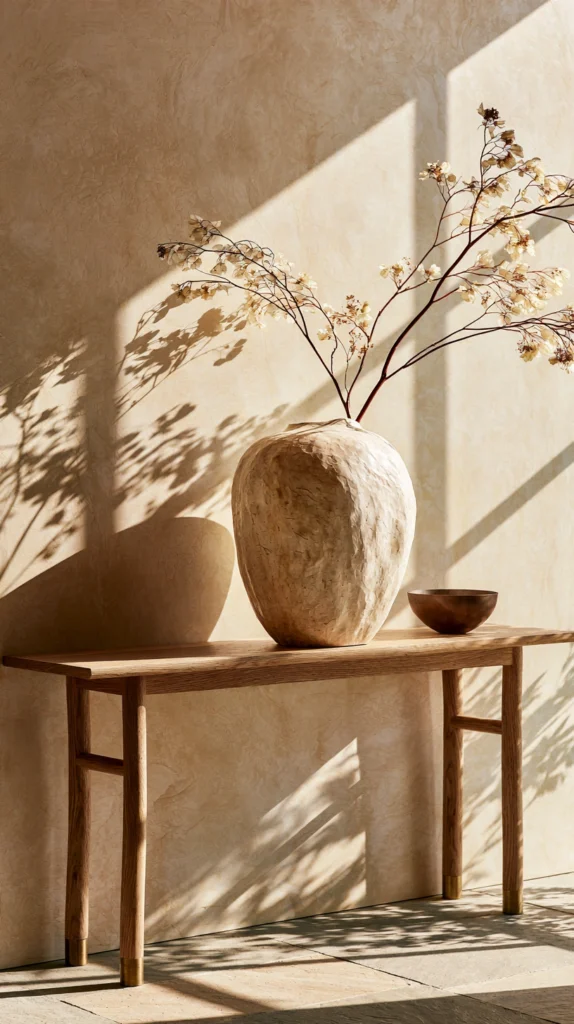
A large, beautiful vase as the primary feature of the console table — the commitment to one object that does all the work.
Why a single significant vase works on a console:
The confidence:
- One statement object: the design confidence
- Multiple small objects competing: the insecurity
- The single vase: says this is the object worth looking at
- Everything else: in service of this one thing
The autumn vase choice:
For fall specifically:
Dark glazed ceramic:
- Near-black or deep navy glaze
- The dark vessel: the opposite of the autumn palette colours in the arrangement
- The contrast: the arrangement glows against the dark vessel
Terracotta (large):
- The warm orange-clay colour: the autumn palette itself
- A large terracotta vessel: architectural and warm
- Without flowers: still beautiful as a sculptural object
- With dried botanicals: the most autumnal combination
Wabi-sabi ceramic:
- The handmade ceramic with irregular form
- Drip glaze, natural ash glaze, or simple earth tones
- The imperfection: the design quality
- More interesting than a perfectly uniform manufactured vase
Raku:
- The fired ceramic with unpredictable, smoky effects
- Metallic and matte surfaces
- Each piece: completely unique
- The most appropriate single ceramic for a statement console
What goes in the vase:
For the autumn console vase:
- One or two large stems (the simplest and most elegant)
- A single large branch of rosehips or crab apples
- A bunch of dried miscanthus plumes
- The vase half-full of botanicals: the casual abundance
- Or: nothing — the beautiful vase empty is still a beautiful vase
The positioning:
Not centred:
- The single statement vase: off-centre (one-third from the left or right)
- The empty two-thirds: negative space
- The vase: more present for the space around it
Cost breakdown:
- A quality ceramic vessel: $30–80
- Dried botanicals (from garden): $0
- Total: $30–80
4. The Candle Composition (The Autumn Evening Console)
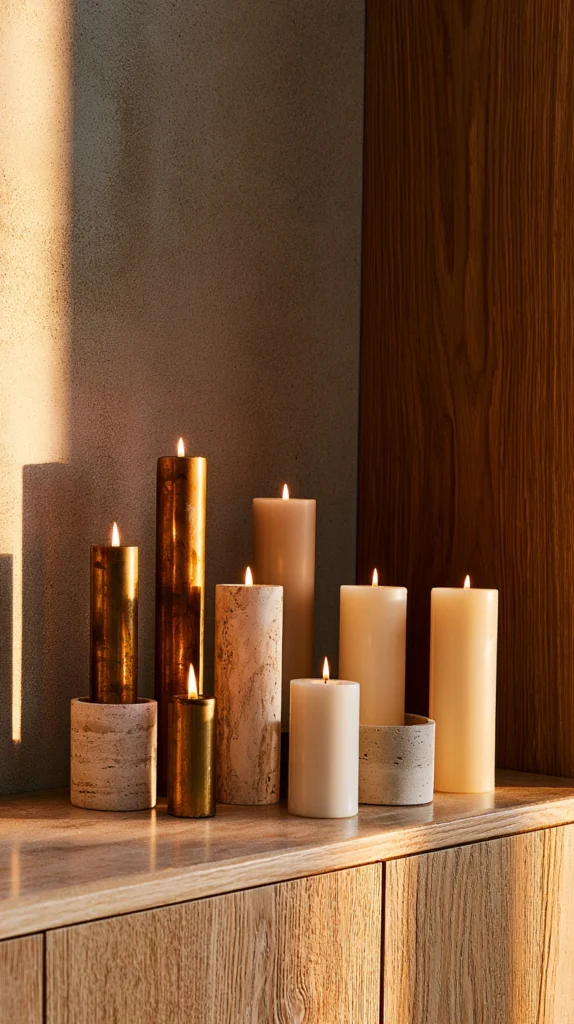
A grouping of candles in varied heights and holders — the console table that transforms the room at dusk.
Why candles on the console table:
The evening function:
- The console table in the morning: a practical surface
- The console table in the evening: lit by candles
- The lit candles: the room at its most atmospheric
- The autumn evening: when the room is dark by 5pm, the candles from 4:30
The candle composition:
The height hierarchy:
- Three candle heights minimum (the rule of three applied vertically)
- Tall taper candle in a candlestick: the height
- Medium pillar candle: the mid-point
- Small votives: the ground level
- The three heights: the composition reads as designed
The holder variety:
For autumn:
- Aged brass candlestick (the most autumn-appropriate metal for candlesticks)
- Terracotta candle holder (the warm material)
- A hurricane glass (protecting the flame, diffusing the light)
- The varied holder materials: visual interest within the composition
The candle colour:
For the autumn console:
- Cream and beeswax (warm amber when lit): always
- One deep burgundy or forest green candle: the autumn accent
- No cool-toned candles (white-white, grey): these read as cold on an autumn console
- The warm light from warm-coloured candles: the effect that cannot be replicated by cool candles
The botanical complement:
Around the candle composition:
- Dried seed heads and leaves pressed around the base of the candles
- A small cluster of pine cones between the candleholders
- The botanical: the connection between the candle composition and the seasonal theme
The safety:
- Candles on a console table: always attended when burning
- Nothing flammable immediately adjacent (dried botanicals: maintain 4-inch clearance)
- The arrangement: beautiful, and safe
Cost breakdown:
- Aged brass candlestick (secondhand): $10–20
- Additional candle holders: $10–20
- Candles (set): $12–20
- Total: $32–60
5. The Autumn Tray Styling (The Contained Composition)
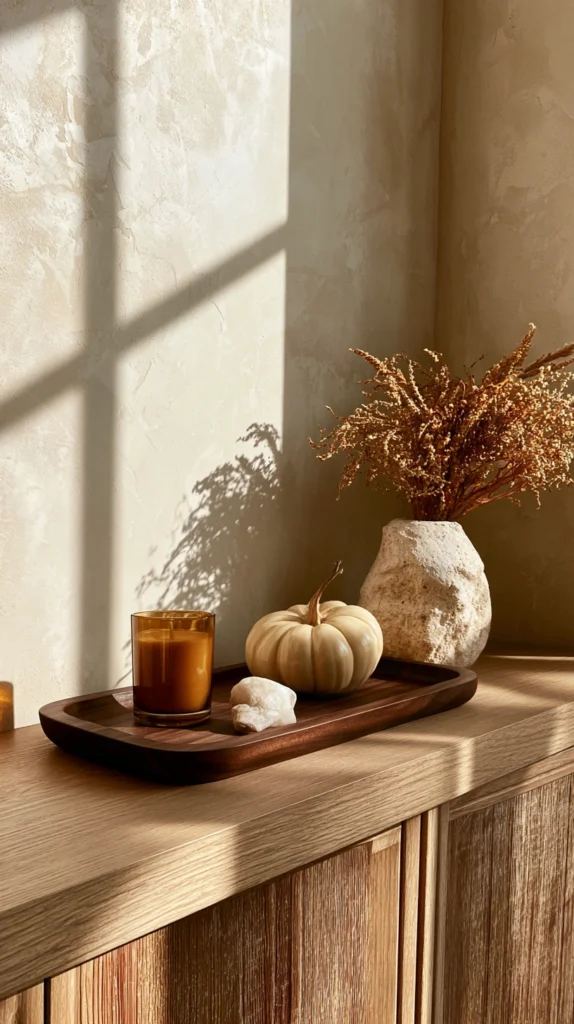
A decorative tray on the console table, with the autumn arrangement contained within it — the styled console that has a defined boundary.
Why the tray changes the styling approach:
The contained composition:
- The tray: defines the edge of the arrangement
- The arrangement: exists within the tray
- The tray surface: the frame for everything inside it
- The console beside the tray: clear and functional
The tray itself:
For autumn:
- Dark wood tray (walnut or ebony stain): the warm dark wood
- Aged brass tray: the metallic autumn accent
- Black lacquer: the graphic backdrop
- Natural rattan or wicker tray: the organic texture
The tray size:
Proportional to the console:
- The tray should occupy approximately one-third to one-half of the console surface
- Too large: the tray IS the console surface
- Too small: the arrangement within reads as too small for the table
- The proportion: the critical decision
Inside the tray:
The autumn tray collection:
- A small votive candle (always one candle in the tray)
- A small pumpkin or gourd (the seasonal object)
- One object with personal significance (a stone from a favourite place, a small sculpture)
- A tiny vase with one stem
- The tray: the small world within the larger console composition
The number:
- Three objects in the tray: the minimum (two is a pair, one is lonely)
- Five: the generous version
- More than seven: the tray becomes cluttered
- The tray as a constraint: the discipline that produces the best result
The tray and the rest of the console:
Beside the tray:
- A stack of books (Idea #2): behind and to one side of the tray
- Or: the tray beside a taller arrangement (the vase from Idea #3)
- The tray: the detailed section of the console
- The other elements: the structural section
Cost breakdown:
- Aged brass or dark wood tray: $15–35
- Objects for inside: mostly already owned
- One small seasonal element (a mini pumpkin, a candle): $5–8
- Total: $20–43
6. The Framed Art Rotation (The Console as Gallery)
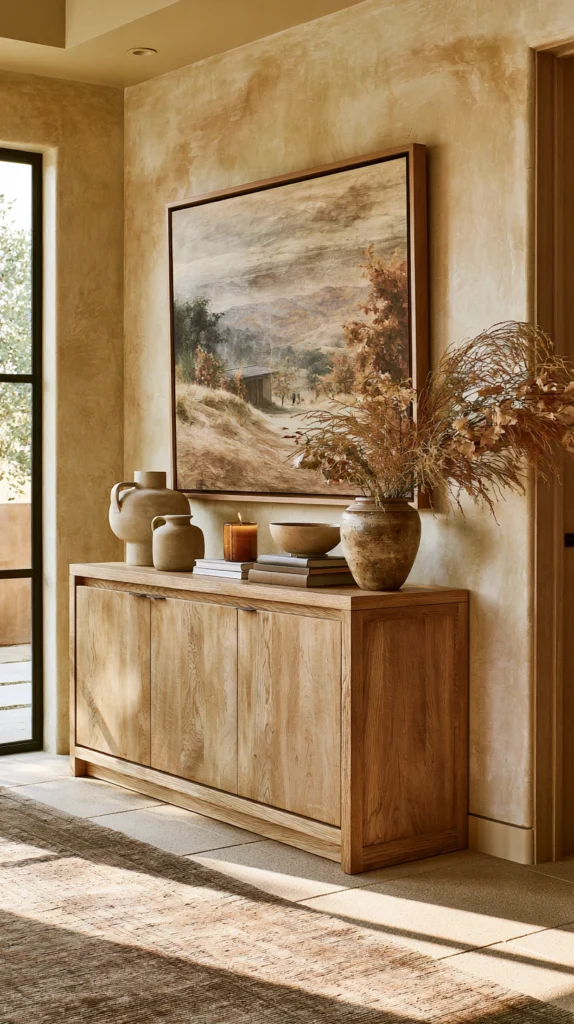
A piece of art propped on the console rather than hung on the wall — the gallery in the home that changes with the season.
Why propped art on the console:
The flexibility:
- Hung art: permanent (or semi-permanent — the holes remain)
- Propped art: changed in 30 seconds
- The seasonal rotation: each season, the art appropriate to the season
- Autumn: a different piece than summer
The autumn art:
What to look for:
Botanical illustration:
- A printed botanical illustration (widely available as prints)
- The autumn plant: seed heads, dried grasses, fungi, autumn foliage
- The scientific illustration: beautiful and specific
- Framed simply in a dark or natural wood frame
Landscape photography:
- An autumn landscape
- Personal travel photograph of an autumn place
- The most personal possible art choice
Abstract in autumn colours:
- An abstract that pulls the autumn palette
- Deep rust, copper, forest green
- The abstract: adding the colour without the literal reference
The print format:
For a console table (10–15 inch depth):
- A print up to 16×20 inches: works proportionally
- Larger: the print is too tall to lean comfortably (risk of tipping)
- The stand-alone easel behind the print: for very large prints
- Multiple smaller prints propped together (a mini gallery): an alternative to one large
Propping method:
Stable:
- Against the wall (the primary support)
- The base: resting flat on the console surface
- Two supporting objects on either side at the base (small books or objects): for stability
- The propped print: stable without any fixing
Cost breakdown:
- Botanical or landscape autumn print: $15–45
- Frame: $10–25
- Total: $25–70
7. The Harvest Collection (The Gathered Abundance)
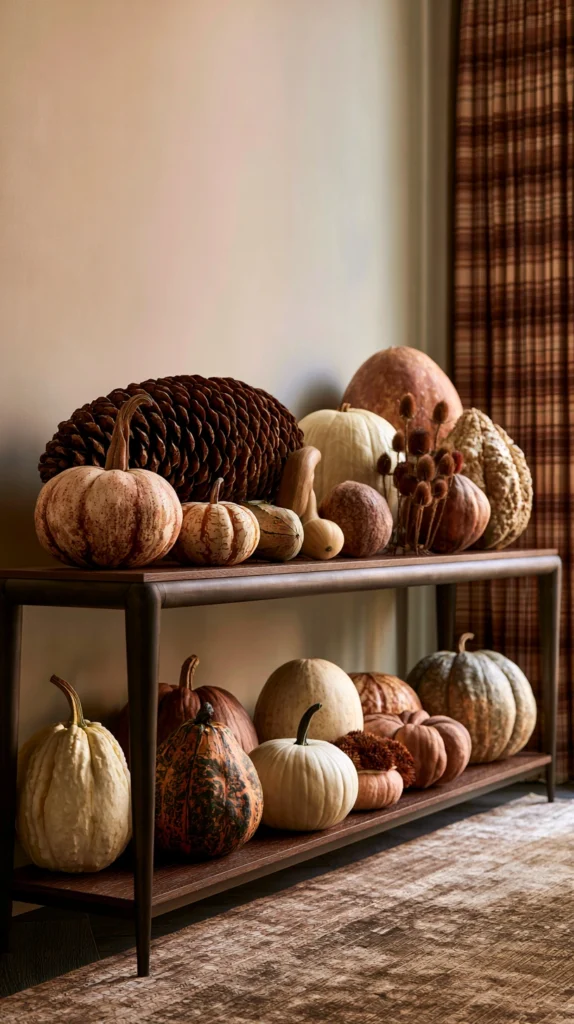
A directly assembled collection of autumn’s harvest objects — the console table that says the season is here.
Why the harvest collection approach:
The abundance signal:
- The harvest table: the oldest autumn display tradition
- Objects gathered and placed: the season made visible
- No arrangement principle more specific than: more is more, and all of it is autumn
The objects:
From the garden:
- Small pumpkins (three to five, varied colours)
- Ornamental gourds
- A few late apples or pears from the fruit tree
- A quince (the golden, fragrant, irreplaceable autumn fruit)
- Dried corn husks or a small dried corn cob
- A gathering of nuts (walnuts, hazelnuts) in a small bowl
- Rosehips on a stem in a simple vase
The botanical additions:
- Dried miscanthus or pampas plume in a tall vessel
- A bundle of dried wheat tied with twine and leaned against the backdrop
- Eucalyptus branches in a vase of water
- The botanicals: the tall back layer of the harvest console
The arrangement:
The harvest arrangement:
- Not arranged: gathered
- The pumpkins: placed as if just brought in
- The nuts: tumbled into the bowl
- The botanicals: in a vessel nearby but not arranged with precision
- The abundance: the design
The organic principle:
Some touching, some not:
- Not evenly spaced objects
- The small pumpkins: some touching each other
- The gourd: leaning against the pumpkin
- The organic grouping: the natural quality
Cost breakdown:
- Pumpkins and gourds: $15–25 (farmers market)
- Apples or quince (from the garden): $0
- Dried grasses and botanicals (from the garden): $0
- Small bowl for nuts: already owned
- Total: $15–25
8. The Lantern and Botanical Pairing (The Warm Light Anchor)
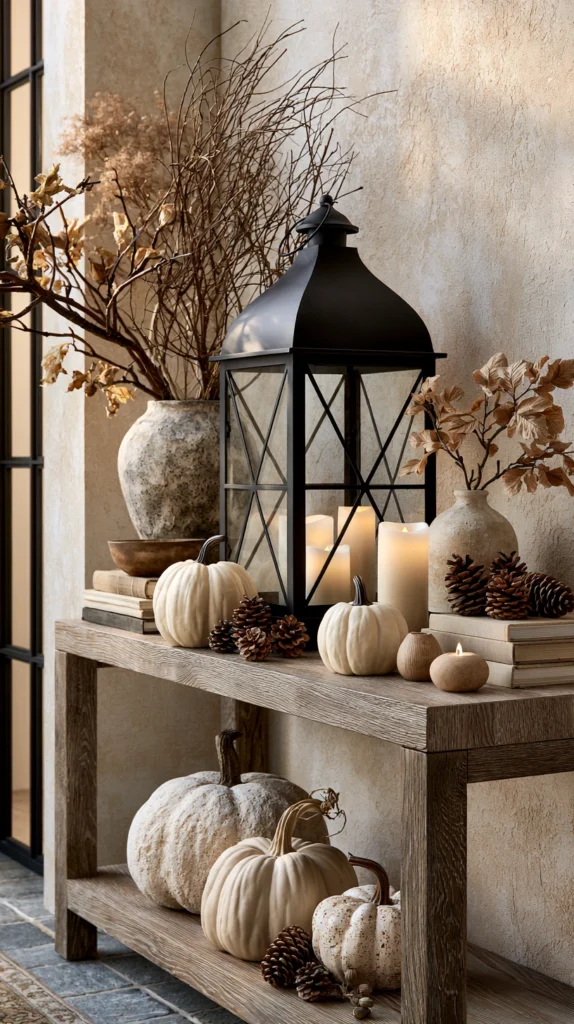
A lantern as the central feature, with autumn botanicals arranged around it — the console table that is lit from within its own arrangement.
Why a lantern anchors the autumn console:
The warm light:
- The autumn console at dusk: needs a light source
- The lantern: both the decoration and the light
- The botanical arrangement around the lantern: the decoration the light is set within
- The console: the lit display
The lantern choice:
For the autumn console:
- Matte black lantern: the most contemporary
- Aged copper: the most warm and autumnal
- Dark wood and glass: the warmest material combination
- The size: proportional to the console (a small lantern on a wide console: lost)
Inside the lantern:
The flameless LED candle:
- Always for an attended decoration inside the home
- The safety: no risk of fire
- The quality: the better flameless LED options (warm, with a realistic flicker) are convincingly candle-like
- The timer: set to come on at dusk
Or: a real candle:
- For occasions when the lantern is attended
- The real flame: irreplaceable in warmth and movement
- The attended lantern: the evening ritual
The botanical arrangement:
Around the base of the lantern:
- Dried moss or lichen-covered branches spread around the base
- Three small pumpkins grouped beside the lantern
- A few pine cones scattered at the lantern base
- Dried seed heads leaned against the lantern
- The lantern: the centre from which the arrangement radiates
The height extension:
Above the lantern:
- A tall dried stem in a thin vase behind the lantern
- Or: the lantern sits on a stack of books (elevated from the console surface)
- The elevation: allows the arrangement around the lantern base to extend lower
Cost breakdown:
- Quality lantern: $20–45
- Flameless LED candle: $8–15
- Botanical surrounds (from garden): $0
- Total: $28–60
9. The Autumn Terrarium or Cloche (The Protected Garden)
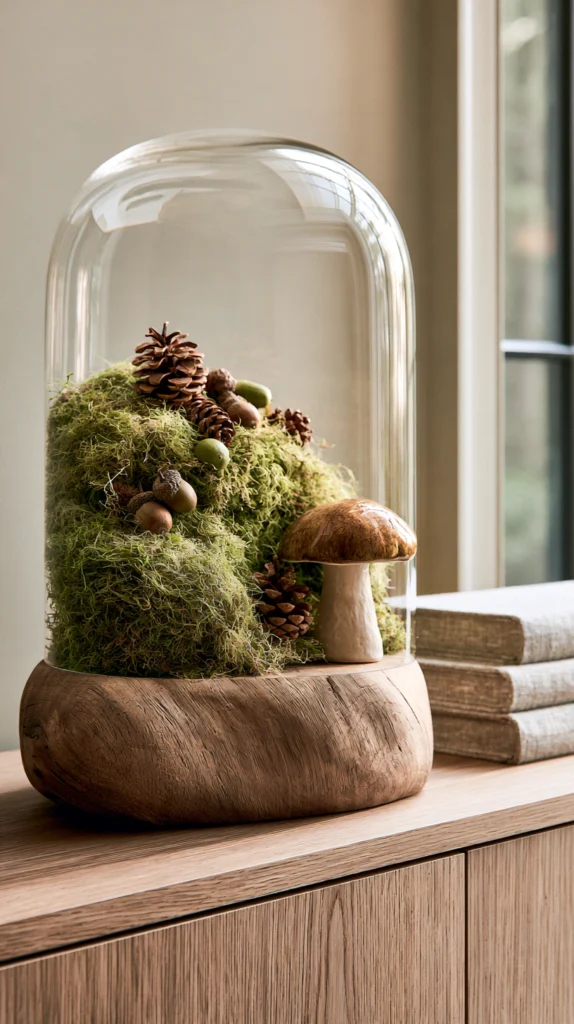
A glass cloche or terrarium containing an autumn scene — the miniature garden inside the glass.
Why a cloche works on the autumn console:
The transparency:
- Glass: reflects and refracts light
- The autumn morning light through the cloche: the arrangement inside illuminated
- The glass cover: protecting the delicate dried elements from dust
- The cloche: also beautiful empty — add a single perfect object
What goes inside a cloche:
The autumn cloche:
- A single perfect mushroom (dried or fake — the natural toadstool form)
- A small pumpkin (sized to fit inside the cloche)
- Preserved moss as the base
- A few acorns and small pine cones
- One small dried flower
- The miniature scene: the autumn garden in miniature
The glass cloche types:
Bell jar:
- The most elegant
- Available in various heights (from 4 inches to 18 inches)
- For console table use: 8–12 inches
- The taller the cloche: the more impressive the contained scene
Square terrarium:
- More contemporary than the bell jar
- Allows for multiple objects in a spread arrangement
- The open terrarium (no lid): for objects that don’t need the cloche drama
The base:
Under the cloche:
- A piece of natural slate (the base within the base)
- Or: a wooden slice (the organic base)
- Or: a small terracotta saucer
- The base: specific to the contained world
The surrounding console:
Beside the cloche:
- The cloche: the detailed, miniature element
- The other console elements: appropriately scaled (not competing in detail)
- A single tall stem in a thin vase: the height beside the miniature
- The contrast: the tiny detailed world beside the simple tall stem
Cost breakdown:
- Glass cloche (8–12 inch): $15–30
- Inside objects (preserved moss, acorns, small pumpkin): $5–10
- Total: $20–40
10. The Foliage and Branch Arrangement (The Bold Natural Statement)
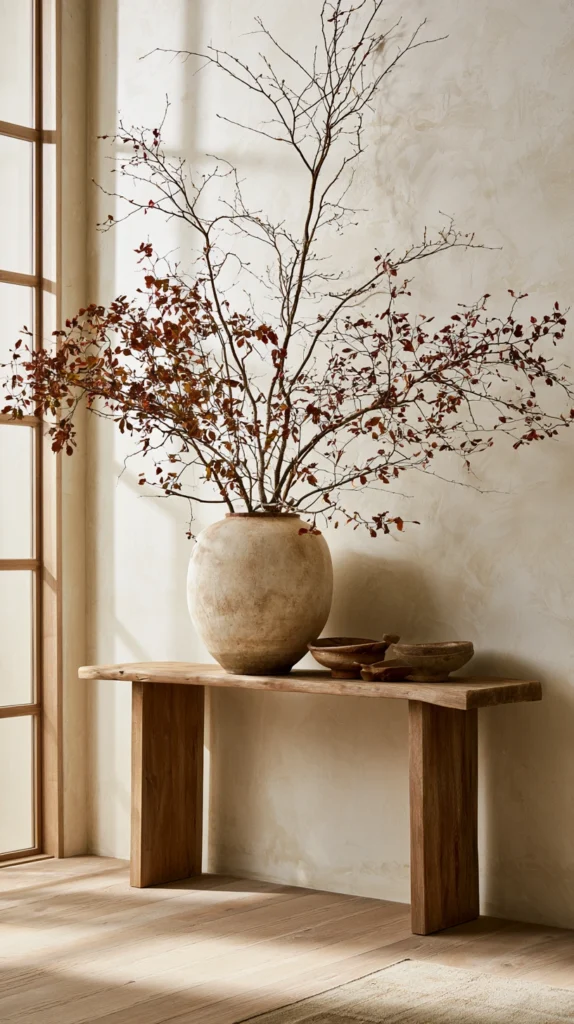
A dramatic arrangement of autumn branches and foliage in a tall floor vase positioned at the console — the oversized natural statement.
Why oversized natural elements work:
The scale shift:
- Most console table styling: small to medium objects
- A tall vase with branches that extend 3–4 feet above the console: the dramatic departure from scale
- The effect: the room notices this arrangement before anything else
The branch choices:
For autumn specifically:
Berries still attached:
- Rosehip branches (large, vivid red)
- Pyracantha (orange or red berries)
- Cotoneaster
- The berry branch: the most vivid natural colour available in November
Structural bare branches:
- Twisted willow or contorted hazel: the natural spiral
- The hawthorn with haws still attached
- Bare branches: the winter structure beginning
The vase:
For an oversized branch arrangement:
- A floor vase (18–24 inches tall): the vase scaled to the branches
- Or: a tall ceramic vessel that will not tip under the weight
- The vase: heavy enough to anchor the branches without the arrangement tipping
- Dark or natural: the vessel not competing with the branches
The supporting elements:
The floor beside the console:
- A large pumpkin placed at the floor beside the console
- The oversized branch arrangement coming out of the vase above the console
- The large pumpkin at floor level
- The arrangement: from the floor to above head height
The restraint:
With large branches:
- Three branches maximum in the vase
- The space between the branches: as important as the branches themselves
- The open, airy arrangement: more striking than a crowded bunch
- The single branch: sometimes the most dramatic
Cost breakdown:
- Rosehip or berry branches (from garden): $0
- Tall floor vase: $25–60
- Large pumpkin at floor level: $5–8
- Total: $5–68
11. The Natural Texture Study (The Touch-Based Console)
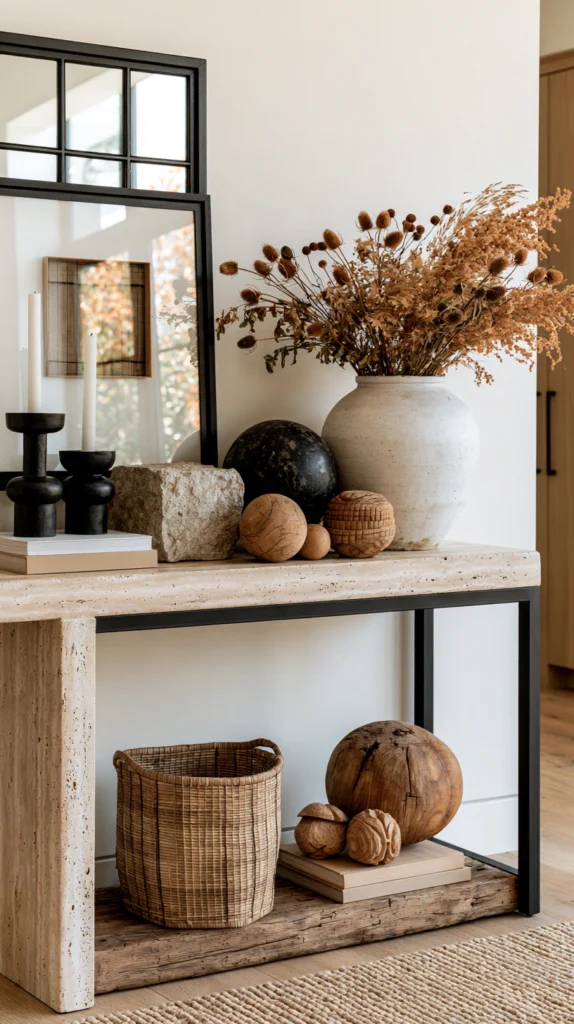
A console table arranged entirely around the contrast of natural textures — the arrangement that rewards a tactile as much as a visual response.
Why texture is an underrated console element:
The visual texture:
- Not colour but surface quality
- The rough bark beside the smooth river stone
- The soft feathery grass beside the hard pine cone
- The matte ceramic beside the gloss of a berry
- The contrast of textures: the arrangement with depth
The autumn textures:
Rough:
- Bark (a piece of interesting bark as an object)
- Rough terracotta (the handmade pot)
- A piece of driftwood
- The exposed grain of aged wood
Smooth:
- River stones (polished by water)
- A ceramic vessel with a smooth glaze
- The skin of a gourde before it dries
Soft:
- Dried grass plumes
- Wool or felt (a small textile element)
- Preserved moss
- The feathery dried seed heads
Hard:
- Pine cones (the scales)
- Seed pods (the dried casing)
- Nuts in their shells
- Acorns and acorn cups
The arrangement:
Objects organised by texture rather than colour:
- A cluster of rough objects (bark, rough terracotta, pine cone)
- Beside a cluster of smooth objects (stone, glazed ceramic)
- The soft element threading between (the grass, the moss)
- The arrangement: tactile before it is visual
Cost breakdown:
- River stones (gathered): $0
- Preserved moss: $5–10
- Other objects (largely from the garden): $0
- Total: $0–10
12. The Personal Story Console (The Collected Objects)
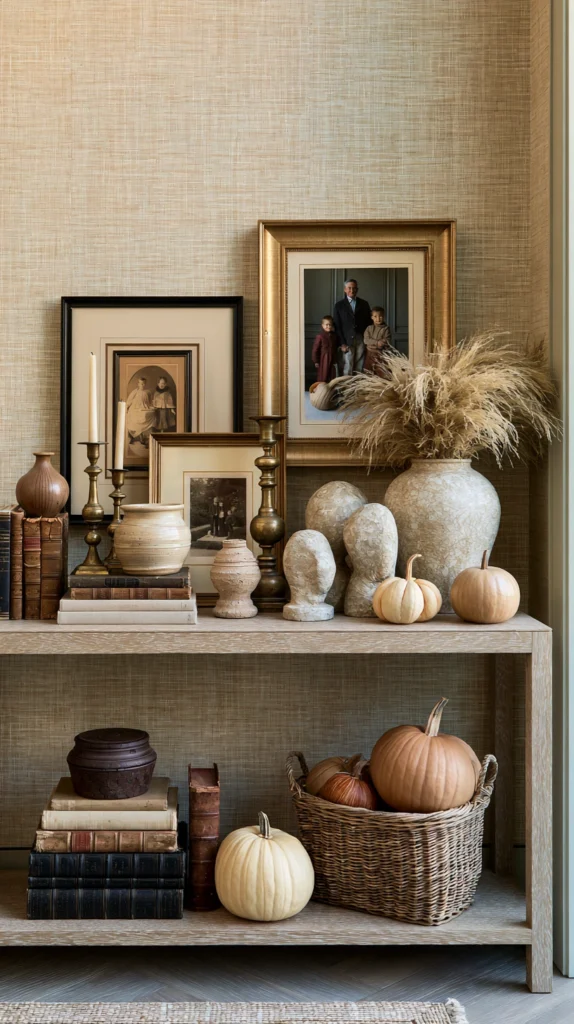
A console table assembled from meaningful personal objects with a seasonal edit — the most personal console table approach.
Why the personal story is the best console styling:
The meaningful object:
- The stone from the beach where something important happened
- The book inherited from a relative
- The small object brought back from a significant trip
- These: cannot be styled out of the home
- They: the soul of the space
The autumn edit:
The existing personal objects remain:
- The meaningful things: always on the console
- The seasonal edit: the autumn objects added around them
The seasonal additions:
- A small pumpkin beside the significant book
- A candle in a holder that has been part of every autumn for years
- One stem from the garden in the vase that was a gift
- The personal and the seasonal: together
The autumn objects specific to memory:
- The autumn walk pinecone, carried home every year
- The same small gourd purchased each October
- The copper bowl always used for the autumn display
- The ritual objects: the console table as an annual ceremony
The approach:
Start with the meaningful:
- The objects that matter: placed first
- The autumn objects: added around them
- The seasonal: in service of the personal, not the other way around
Cost breakdown:
- The personal objects: already owned
- Seasonal additions: $0–15
- Total: $0–15
13. The Scented Console (The Olfactory Decoration)
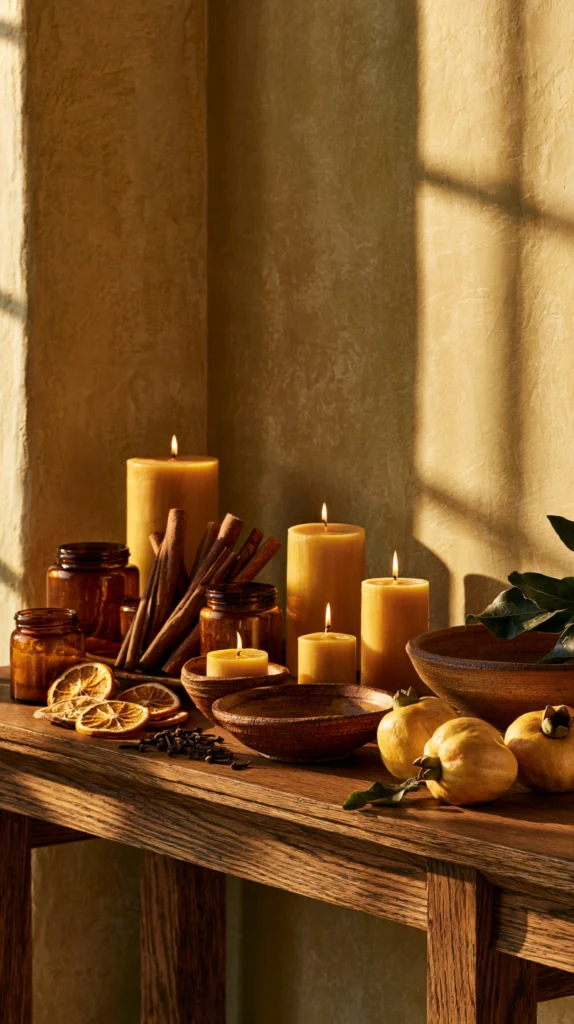
A console table organised around scent as the primary decorative element — the arrangement that affects anyone passing before they see it.
Why scent on the console:
The hallway console specifically:
- The hallway: where the house is first smelled
- The scented console: the first impression experienced before the visual registers
- The scent memory: more powerful than any visual impression
- The scented autumn hallway: among the most welcoming possible domestic spaces
The scented elements:
Natural and botanical:
Quince:
- The most powerful natural fragrance available in autumn
- Three quinces in a bowl: fill the room with the fragrance
- The quince scent: specific, warm, and irreplaceable
- Available from specialist fruit suppliers and some farmers markets
Rosemary (fresh):
- A bunch in a vase of water
- Fragrant throughout its life
- The kitchen herb: a fragrant console element
- Released when the leaves are brushed passing
Hyacinths (forced bulbs, if early enough):
- The most powerfully fragrant spring bulb
- Forced for early flowering (from the greenhouse article)
- A pot of hyacinths on the autumn console: extraordinary fragrance
Potpourri (carefully chosen):
- The worst version: the faded generic bowl of potpourri
- The good version: a handmade blend of dried autumn materials (dried orange peel, cloves, cinnamon sticks, dried rosehips, a few drops of essential oil)
- The blend: made from the same autumn materials as the rest of the styling
- Displayed in a beautiful bowl: part of the arrangement, not a separate item
Beeswax candles (scent when burning):
- The beeswax candle: fragranced when burning (naturally, from the wax)
- The honey-sweet warmth: filling the hallway when lit
- The lit candle: the evening’s scent
The olfactory console design:
Scent at every height:
- Ground level (the potpourri bowl): the scent encountered first
- Console level (the quince or rosemary): the primary scent
- Candle level (the beeswax when lit): the evening scent
- The layered scent: present throughout the passage past the console
Cost breakdown:
- Three quinces: $6–12
- Fresh rosemary from the garden: $0
- Beeswax candle: $8–15
- Dried autumn potpourri materials: $5–10
- Total: $19–37
14. The Complete Autumn Console (All Elements Integrated)
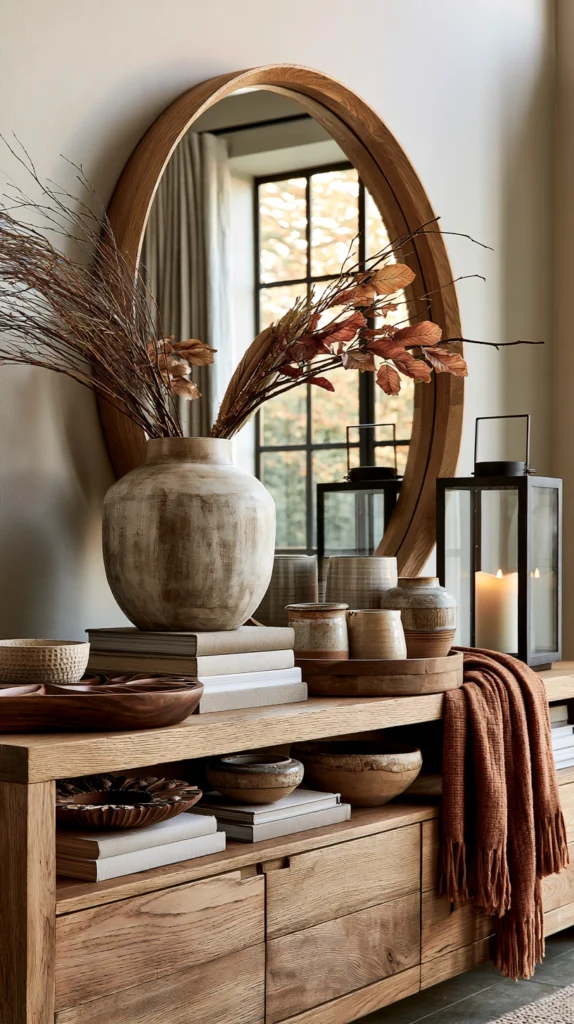
The fully considered console table with multiple elements working together — the complete seasonal statement.
What the complete autumn console includes:
The backdrop:
- A mirror (Idea #1): the visual depth
- Or: a piece of propped seasonal art (Idea #6): the personal statement
- The backdrop: the wall element that the console objects relate to
The tall element:
- A single statement vase (Idea #3) with dried botanicals
- Or: the oversized branch arrangement (Idea #10) for maximum impact
- The tall element: the back, establishing the height of the arrangement
The book stack (Idea #2):
- The structural mid-height element
- Always present, always useful
- The topper: a small gourd or pumpkin
The tray (Idea #5):
- To one side: the detailed section
- A lantern inside (Idea #8)
- A small candle
- One autumn object (a pumpkin, a gourd, a stone)
- The tray: the contained world within the larger composition
The scented element (Idea #13):
- A quince or a bowl of autumn potpourri
- The scent: the invisible layer of the arrangement
- Present regardless of the visual composition
The front layer details:
- A small pine cone
- One pressed leaf
- An acorn
- The small objects: the reward for looking closely
The composition principle:
Asymmetry:
- The tall element: off-centre (one side of the console)
- The book stack: on the other side
- The tray: between them, slightly closer to the centre
- The asymmetry: the arrangement in movement
The rule of threes:
- Three different heights (tall, medium, low)
- Three different materials (natural, ceramic, botanical)
- Three different textures (rough, smooth, soft)
- The three: the minimum for a complete arrangement
The seasonal depth:
An autumn console that has depth:
- Something at the back (the mirror or art)
- Something at the mid-point (the vase, the book stack, the tray)
- Something at the very front edge (the small detail object)
- The three-plane depth: the console arrangement that reads as complete from any angle
Cost breakdown:
- Mirror or art: $25–80
- Statement vase with botanicals: $25–50 (or $0 if from garden)
- Books: $0–15
- Tray: $20–35
- Lantern with flameless candle: $30–55
- Scented element (quince or potpourri): $10–15
- Small detail objects (gourd, pine cone, acorn): $0–8
- Total: $110–258
The fully styled console done well: guests do not comment on it specifically. It is not a focal point in the conventional sense. It is the thing that makes the room feel completely considered without anyone being able to articulate exactly why.
That invisible effect: the whole point.
The Console Table Principles
Applied to any of the 14 ideas:
The odd number:
- Three objects, or five, or seven
- Never two (a pair reads as symmetrical and static)
- Never four or six (the even number: the eye divides it)
- The odd number: the eye moves through the arrangement
The varying heights:
- At least three distinct heights in every arrangement
- The tallest: at the back
- The lowest: at the front
- The gradation: never all the same height
The negative space:
- Not every inch of the console surface covered
- The empty space: as deliberately designed as the filled space
- The console with breathing room: more restful and more elegant
- The overcrowded console: anxious
The personal object:
- Every console table: should contain one object with personal significance
- This object: the anchor that prevents the console from looking like a showroom
- The personal: what makes the arrangement belong to this household
Getting Started This Weekend
The minimum viable autumn console:
Clear the current console surface.
Remove anything that is not intentionally there (the accumulated post, the random objects that migrated there over summer).
Place three autumn objects:
- One tall element (a vase with two stems, a candlestick, the statement vase)
- One medium element (a stack of two books)
- One small element (a single gourd, a pine cone, a candle)
Add the seasonal scent:
- One stem of rosemary in a small glass of water
- Or: a beeswax candle to light this evening
Stand back: The console: already an autumn console. The three objects, the varying heights, the seasonal element.
Total time: 15 minutes. Total cost: materials from the garden and books already owned.
The rest of this list: the elaboration from this point. The foundation: the three objects and the clear surface.
The console table that was holding the keys and the post: now the room’s seasonal statement. The welcome before the welcome. The first thing seen on coming home, dressed at last for the season.