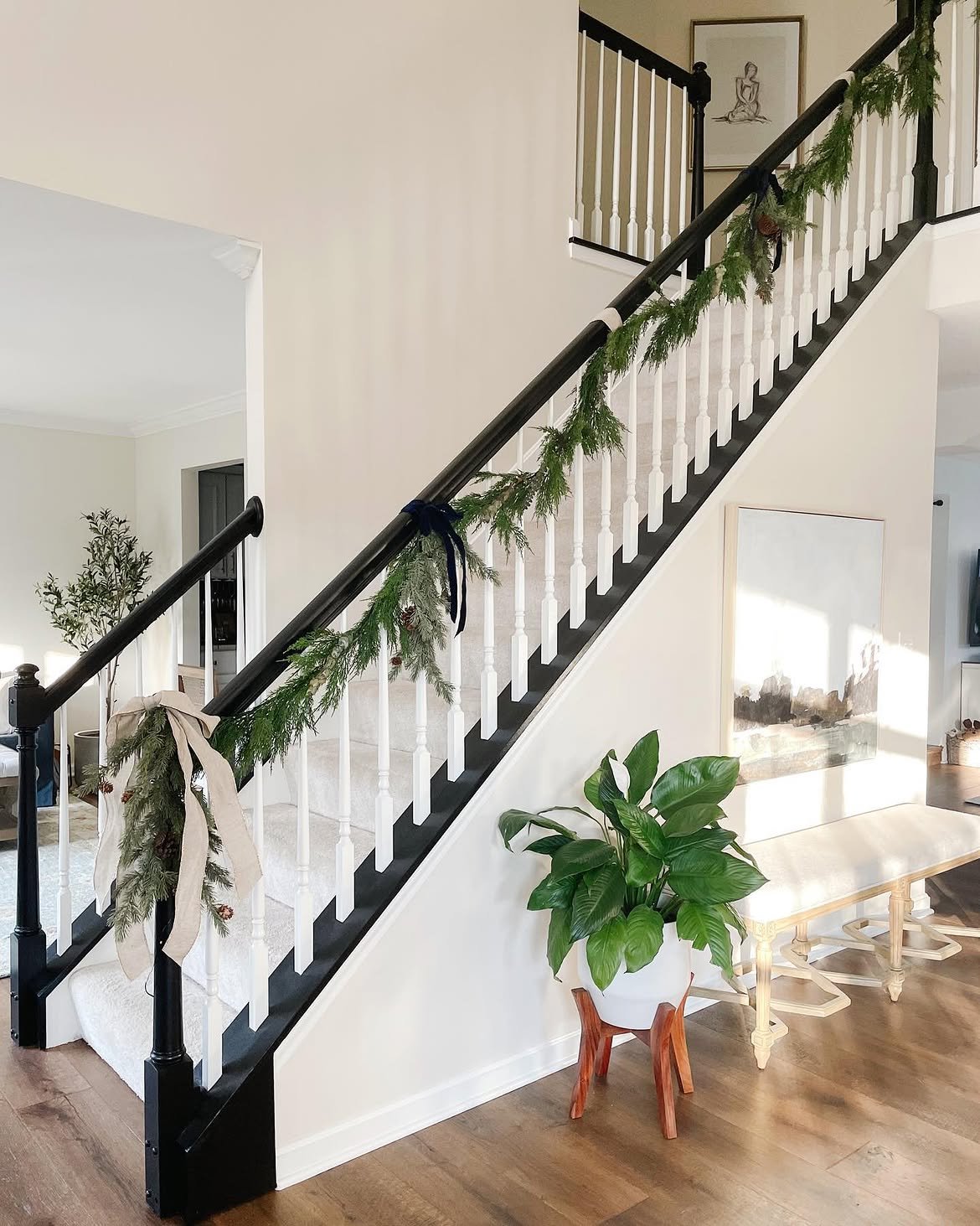
15 Fall Staircase Garland Ideas
The staircase garland is one of those decorations that looks effortless in photographs and slightly daunting in person. The photographs show it flowing perfectly down a curved banister, every element at the right interval, the warm light catching the dried grasses and copper leaves.
Then you stand at the base of your own stairs with a pile of botanical material, some wire, and no clear idea of where to start.
The gap between the photograph and the reality: smaller than it looks. The staircase garland is one of the most achievable seasonal decorations in the home, and one of the most impactful — running the height of an entire wall, visible from multiple rooms, the vertical centrepiece of the autumn interior.
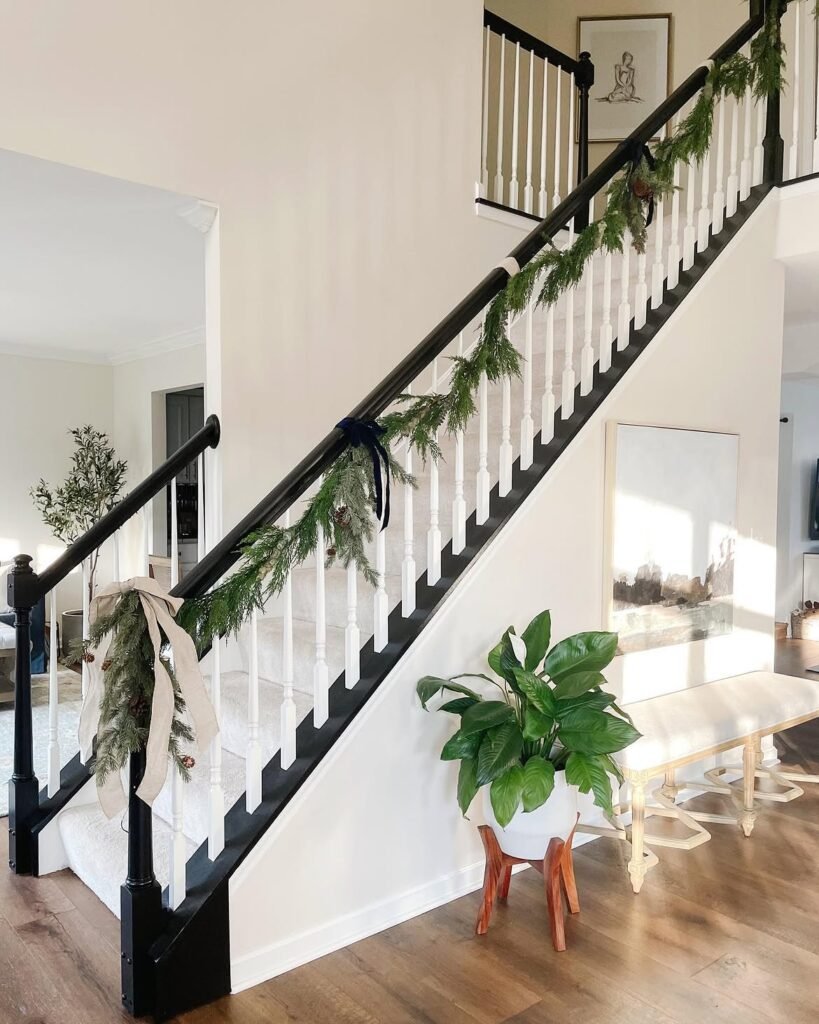
The key is understanding what the garland is doing and what it is not doing. It is not the perfectly uniform commercial garland available in a box. It is a composition that moves from the base to the top of the stairs, changing in density and texture, gathered from the garden or assembled from seasonal materials, secured in a way that keeps it in place without damaging the banister.
Here are 15 ideas — from the simplest single-material garland to the fully dressed layered installation.
What Makes a Fall Staircase Garland Work
The design principles before any material choice:
The direction:
- Garlands traditionally: either sweep up from the bottom (the natural leaf-fall direction, slightly more unusual) or cascade down from the top
- Most effective approach: the garland begins with its densest concentration at the top or at a focal point and becomes lighter and more airy toward the other end
- The visual: movement, not uniform distribution
The banister attachment:
- The garland must be secured without damaging the banister
- Not: staples, nails, or permanent adhesive
- Yes: clear command hooks (rated for weight), floral wire wrapped loosely around balusters, twist ties hidden behind the material
- The attachment: invisible when the garland is in place
The scale:
- The garland should be proportional to the staircase
- A narrow garland on a wide, grand staircase: ineffective
- An overwhelming garland on a narrow cottage staircase: busy
- The proportion: the garland’s width approximately one-fifth of the staircase’s horizontal width
The fall palette:
- As throughout this series: warm tones (copper, rust, amber, deep burgundy, warm gold, cream, forest green)
- The neutral autumn palette: nothing bright, nothing pastel, nothing cool-toned
- The palette: the single most important decision after the materials
The Attachment Methods
Before any styling, the practical:
Clear command hooks:
- Rated for the garland weight (check the label)
- Placed at 18–24 inch intervals along the banister
- The garland: draped between hooks in a gentle swag
- Removed cleanly at the end of the season
Floral wire:
- Wrapped loosely around each baluster at intervals
- The garland: wired to the banister rather than draped
- Tighter and more controlled than the draped method
- Suitable for heavier garlands
Ribbon:
- Tied around the baluster in a bow
- The bow: both the attachment and the decoration
- Works best for lighter garlands
- The ribbon colour: part of the fall palette
The test:
- Before installing the final garland: check the attachment method with a test length
- The security: more important than the aesthetics
1. The Eucalyptus and Copper Leaf Garland (The Elegant Classic)
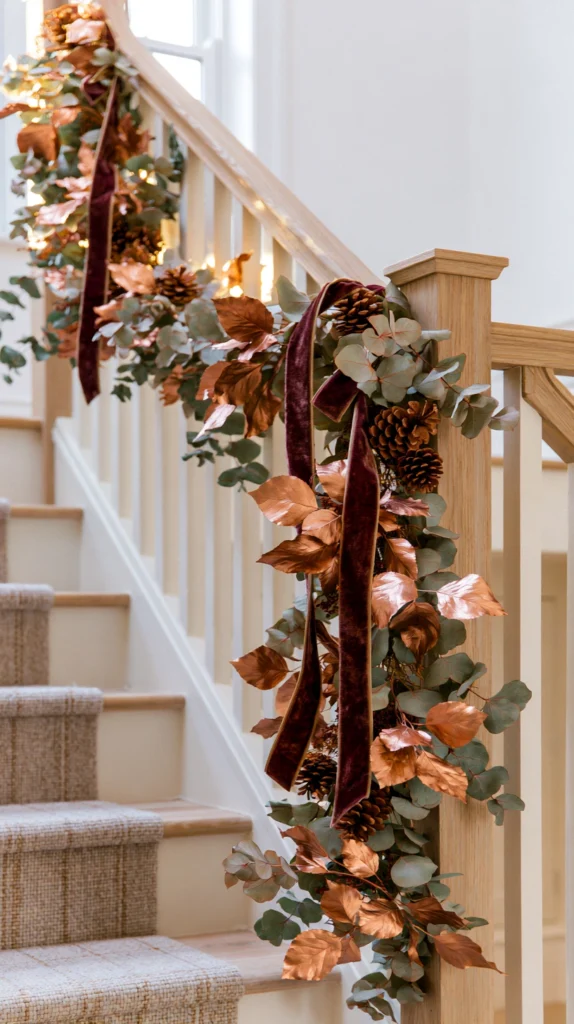
Preserved eucalyptus as the base, with copper and rust artificial or pressed leaves woven through — the most widely used and most reliably beautiful fall staircase garland.
Why eucalyptus works as a garland base:
The stem flexibility:
- Eucalyptus: naturally pliable when fresh or preserved
- Bends around curves and angles without breaking
- The staircase: often has curves and corners
- The eucalyptus: the material that handles these without stiffness
The colour:
- Preserved eucalyptus: the blue-grey-green that complements every fall palette
- The cooling green against warm copper leaves: the contrast that makes the combination work
- Not a competing colour: a backdrop for the warmer accent materials
The fragrance:
- Fresh eucalyptus: fragrant, releasing as the stems are handled
- Preserved: some fragrance remaining
- The scented garland: the quality no artificial alternative provides
The construction:
The base:
- Lengths of preserved eucalyptus (available from florists and craft stores, or dried from garden if grown)
- Secured end to end with floral wire: a continuous length
- Or: a purchased preserved eucalyptus garland as the starting point
- The length: the staircase length plus 20% (for the draping and the festooning)
The additions:
Copper and rust leaves:
- Artificial copper leaves (widely available in autumn): woven into the eucalyptus
- Or: pressed fallen leaves (as per the cleanup article) wired into the garland
- At irregular intervals: not uniform distribution
- Concentrated at the focal points (the newel post, the first landing)
The connective details:
Between the leaves:
- Dried rosehips on stems (wired in)
- Small pine cones (wired at intervals)
- A few sprigs of rosemary (the herb and the colour)
- The additional texture: making the garland a composition rather than a single material
The attachment:
- Command hooks on the banister, one at each baluster height or approximately every 24 inches
- The garland: draped between hooks
- The swag between hooks: the organic curve
The finishing:
At the newel post:
- The garland end: wrapped around the newel post
- A ribbon bow in warm burgundy or copper: the decorative knot
- A cluster of dried materials (a mini-arrangement) at the post base: the emphasis
Cost breakdown:
- Preserved eucalyptus garland (6 feet): $25–40
- Copper leaf additions: $8–15
- Pine cones and rosehips (from garden or purchased): $0–10
- Command hooks: $5
- Total: $38–70
The eucalyptus garland installed: two hours from materials to finished installation. The staircase: a different room. Every visitor going upstairs: commenting.
Garland Length Tips
Measuring:
- Measure the banister length from newel post to newel post
- Add 30% for the draping (a garland that drapes rather than runs flat needs more length)
- A 10-foot banister: needs 13 feet of garland
- This is the most common mistake: buying too little
The swagging:
- A garland fixed at both ends and at the midpoint only: sags in two sections (two swags)
- More attachment points: more swags, smaller and tighter
- Fewer attachment points: fewer swags, larger and more dramatic
- The number of swags: a design decision
2. The Dried Flower and Foliage Cascade (The Garden Brings Inside)
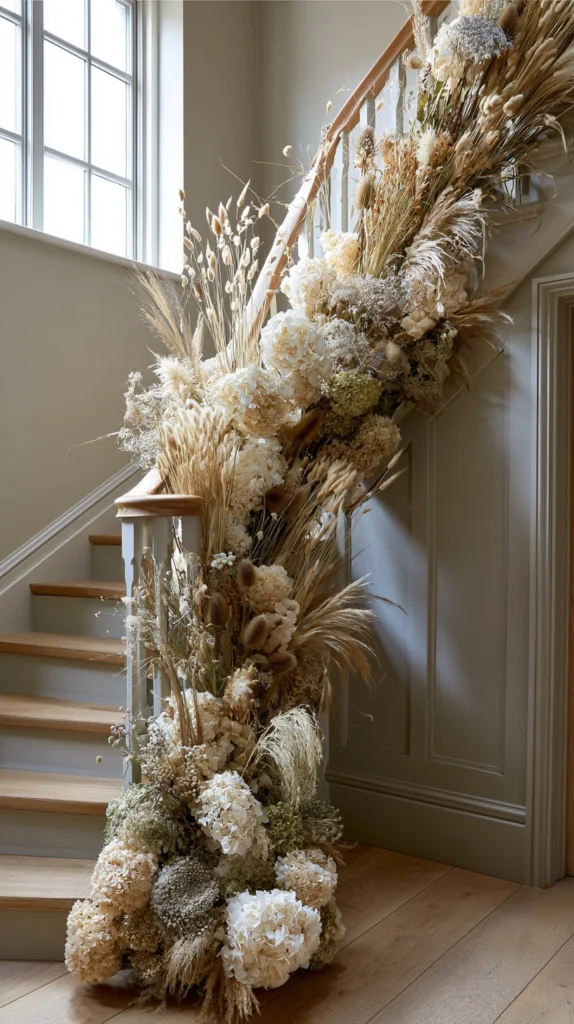
An all-dried botanical garland made from the autumn garden’s own material — the garland that is free and uniquely specific to this garden’s season.
Why the all-dried garden garland is the most authentic:
The specificity:
- The hydrangea heads from this garden
- The seed heads from the echinacea in the border
- The dried grasses from the terrace
- The honesty pods from the cutting garden
- The garland: this garden’s autumn in the house
No commercial alternative has this quality. The materials are from here, dried in October, assembled for this staircase.
The gathering:
From the garden (as covered in the cleanup article):
- Dried hydrangea heads (papery, cream to faded pink-blue)
- Ornamental grass seed plumes (miscanthus, pennisetum, stipa)
- Echinacea and rudbeckia seed heads (structural, dark)
- Honesty silver pods
- Dried fennel seed heads (feathery, aromatic)
- Rose hips on stems
The assembly:
Small bundles:
- Group 3–5 stems per bundle
- Wrap the bundle base with floral wire
- Lay the bundle against the previous bundle (covering its wire with the new bundle’s stems)
- Continue along the rope or cord: the overlapping bundle garland
- The result: a layered garland with consistent direction (all stems pointing the same way)
The base:
- A length of jute or garden twine as the spine
- The bundles: wired to this spine
- The twine: invisible once the garland is assembled
The variation:
Dense sections and airy sections:
- Not uniform density throughout
- At the focal points (the newel post, the mid-stair landing): denser clusters
- Between focal points: the garland thinner and more airy
- The variation: the natural quality
Cost breakdown:
- All garden-gathered materials: $0
- Jute twine: $3
- Floral wire: $4
- Total: $7
3. The Maple and Fall Leaf Garland (The Classic Autumn Image)
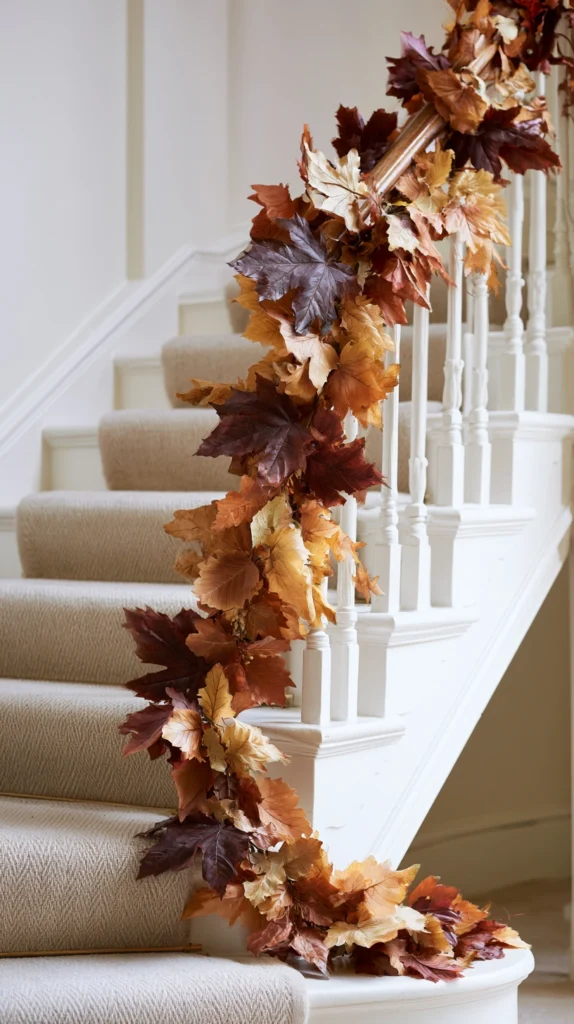
A garland made primarily of fall leaves — real pressed leaves, artificial silk leaves, or a combination — the most directly seasonal garland available.
Why leaves on a staircase are specifically autumnal:
The fall leaf:
- More than any other object: the visual symbol of autumn
- The leaf garland: the season declared without ambiguity
- November: the indoor version of what is happening outdoors
The leaf types:
Real pressed leaves:
- Large, flat, well-pressed
- Maple (the most dramatic shape), oak, liquidambar, beech
- Wired onto a garland spine through the leaf stem
- The limitation: pressed leaves are fragile and may not last the full season without crumbling
Artificial silk leaves:
- The most durable option
- Quality varies enormously (from clearly artificial to remarkably realistic)
- In the autumn palette: copper, rust, burgundy, gold
- The advantage: can be used again next year
- Purchase at the best quality available: cheap artificial leaves are immediately visible as fake
A combination:
- The silk leaf garland as the base: the structure and the durability
- A few real pressed leaves wired in: the authenticity
- The combination: the practical and the honest together
The technique for leaf garlands:
Layering:
- Leaves overlapping like scales or fish scales
- Each leaf partially covering the wire attachment of the previous
- The natural density building from the overlapping
The colour arrangement:
- Not random mixing of all colours at once
- Gradation: the deepest burgundy at one end, through rust and copper, to the palest gold at the other
- The ombré garland: more considered and more beautiful than random mixing
Cost breakdown:
- Artificial silk fall leaf garland (9 feet): $15–30
- Real pressed leaves to add: $0 (from the garden)
- Total: $15–30
4. The Pumpkin and Miniature Gourd Garland (The Harvest on the Banister)
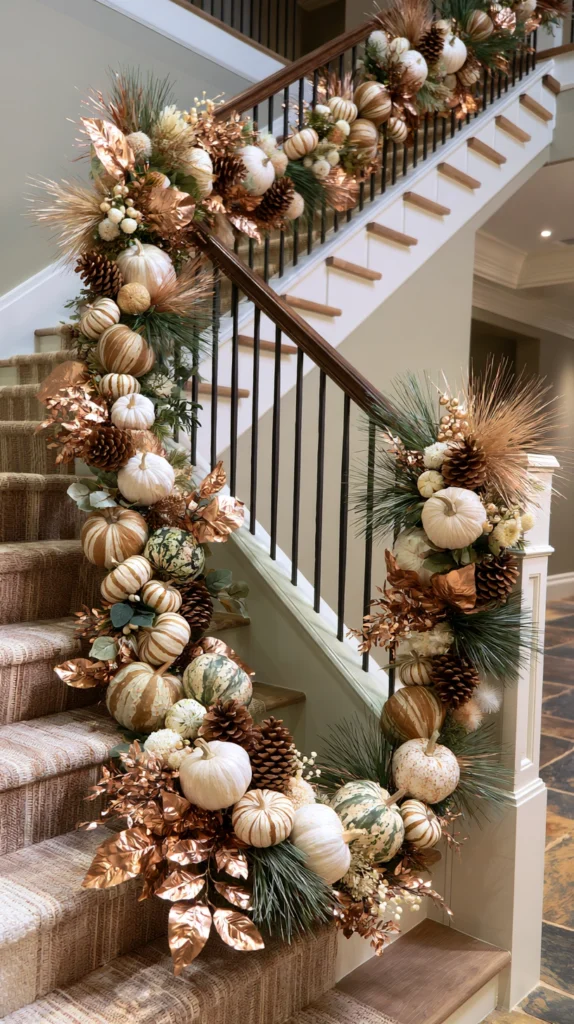
Small ornamental pumpkins and gourds integrated into a botanical garland — the harvest element brought indoors.
Why including pumpkins works on a staircase:
The weight consideration:
- Full-size pumpkins: too heavy for a staircase garland
- Miniature pumpkins and ornamental gourds: light enough
- The ‘Baby Boo’ pumpkin (white, golf ball-sized): perfect scale
- Small ornamental gourds: varied shapes, lightweight
The integration:
Nestled into the botanical base:
- The eucalyptus or dried botanical garland as the base (Ideas #1 or #2)
- The mini pumpkins and gourds placed at intervals
- The attachment: a loop of clear fishing line around the pumpkin stem, secured to the garland
- Or: wire wrapped around the stem, then wired to the garland spine
The three-dimensional quality:
Gourds extend beyond the garland plane:
- The flat garland: two-dimensional against the banister
- A gourd nestled into and extending from the garland: a third dimension
- The three-dimensional garland: richer and more interesting from every angle
The colour:
- Cream and white mini pumpkins (‘Baby Boo’, ‘White Ghost’): the most elegant
- Striped ornamental gourds: the most varied
- Deep orange small pumpkins: the most traditional
- Combine two of the three: the palette decision
The positioning:
- One cluster at the newel post (3–5 pumpkins and gourds together)
- Individual gourds at every other swag point
- Concentrated at focal points, sparse between
- The rhythm: cluster, sparse, individual, sparse, cluster
Cost breakdown:
- Six to eight mini pumpkins and gourds: $12–20
- The botanical base garland (from Idea #1 or #2): separate
- Clear fishing line or additional wire: $2
- Total: $14–22 in addition to the base garland
5. The Cinnamon and Spice Garland (The Scented Interior)
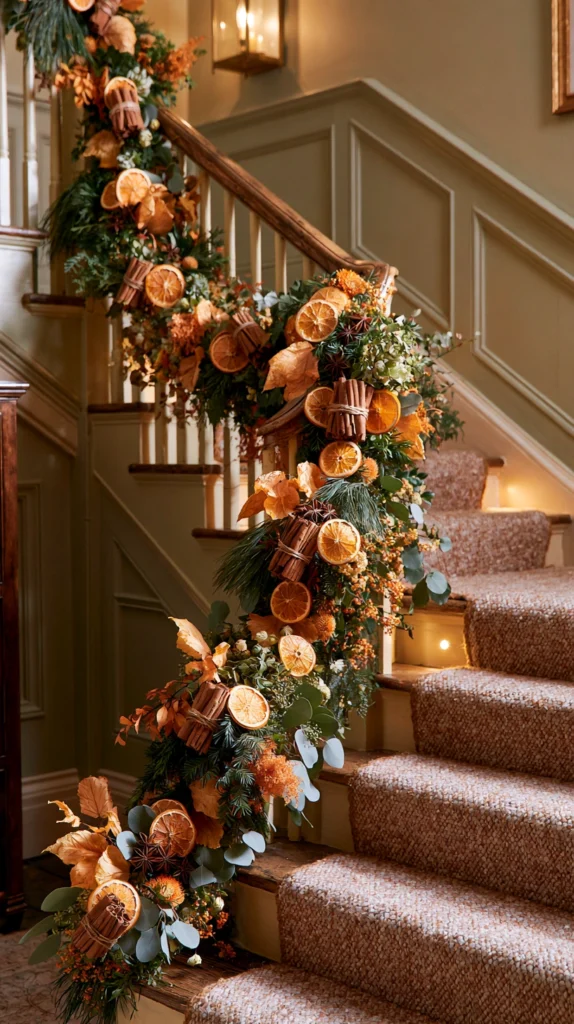
A garland with scented elements — cinnamon sticks, cloves, dried orange slices, star anise — the fall staircase decoration that fills the hall with seasonal fragrance.
Why a scented garland does something no visual decoration can:
The olfactory trigger:
- The fall spices (cinnamon, cloves, star anise): among the most powerfully memory-triggering scents
- The fragrance reaching the front door before the garland is seen: the first impression
- The scent of the house: one of the most lasting impressions for any visitor
The scented elements:
Cinnamon sticks:
- Bundle 3–4 sticks with twine
- The bundle: wired into the garland at 12-inch intervals
- The scent: released slowly over weeks
- Visual: warm brown, textural, the most recognisably autumnal spice
Dried orange slices:
- Oranges sliced 1/4 inch thick
- Dried in the oven at 200°F for 2–4 hours (until fully dry)
- Hole punched near the edge: threaded with twine for attachment
- Visual: the vivid orange-gold circle
- Scent: citrus, increasingly subtle as they dry
Star anise:
- Wired individually (the star shape: beautiful and small)
- Clustered with cinnamon bundles
- The licorice fragrance: distinctive
Cloves:
- Pressed into dried orange slices (the traditional pomander technique, simplified)
- Or: a small sachet of cloves wired into the garland
- The clove: the most powerful scented element
The botanical base:
- The scented garland: needs a non-competing botanical base
- Eucalyptus (slightly aromatic itself): complementary
- Dried botanical garland (neutral scent): does not compete
The longevity of scent:
- The dried spices: fragrant for the entire fall season
- Refresh with a drop of cinnamon essential oil on the cinnamon sticks if the scent fades
- The revived scent: immediate and strong
Cost breakdown:
- Cinnamon sticks (pack): $5
- Three oranges for drying: $2
- Star anise: $3
- Botanical base: see Idea #1 or #2
- Total: $10 for the scented additions
6. The Pine Cone and Berry Garland (The Forest and Field)
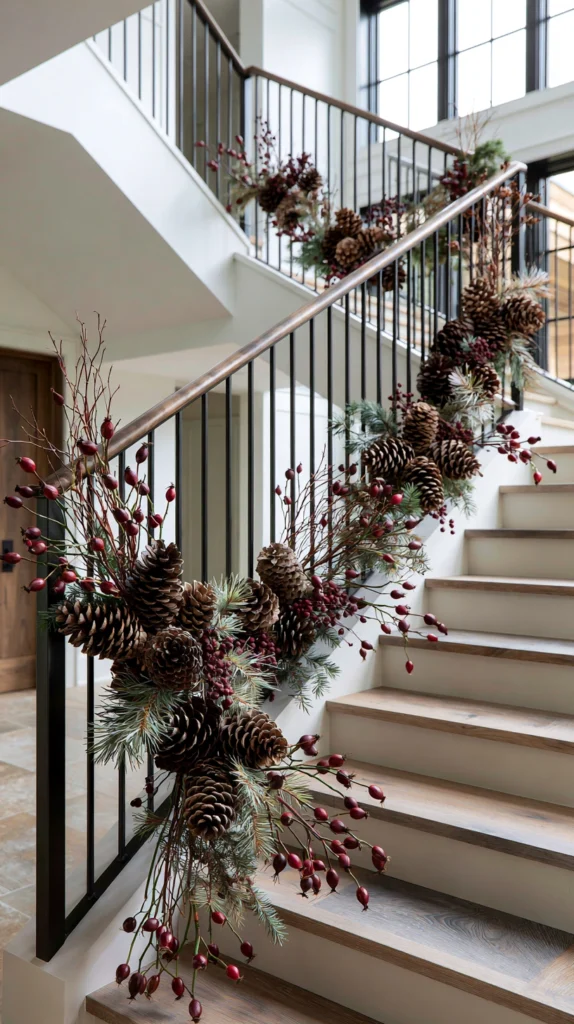
A garland of pine cones and berry-bearing branches — the most naturalistic fall garland available.
Why pine cones and berries together:
The material combination:
- Pine cones: the forest floor
- Berries (rosehips, hawthorn, holly): the hedgerow
- Together: the landscape of autumn brought inside
- The combination: specific and seasonal
The pine cone preparation:
For garland use:
- A small hole drilled in the flat base of each cone (where it was attached to the branch)
- A length of thin wire threaded through: the attachment loop
- Or: hot-glued to the garland spine (faster but less secure)
- The wire method: more durable for a month-long garland
The cone sizes:
- Large cones (spruce, pine): the structural elements at the focal points
- Small cones (larch, hemlock): filling between the large ones
- The varied size: the natural quality
The berry branches:
Rosehip branches:
- Cut from the garden (Rosa rugosa: the largest and most vivid)
- Individual stems wired into the garland
- The red: the vivid accent among the brown cones and neutral botanical
Holly (if available):
- The gloss of the holly leaf and the red berry: the most vivid combination
- Works especially well if the garland extends toward Christmas
- The autumn-to-winter transition garland
The construction:
The method:
- The pine cone loop: attached to a jute spine
- Cones at intervals (every 6–8 inches)
- Berry stems wired between cones
- Foliage (eucalyptus or evergreen sprigs) filling the gaps
Cost breakdown:
- Pine cones (gathered from garden or park walks): $0
- Rosehip branches: from the garden $0
- Jute and floral wire: $7
- Total: $7 for a garland almost entirely from foraged materials
7. The Velvet Ribbon and Botanicals Garland (The Luxe Version)
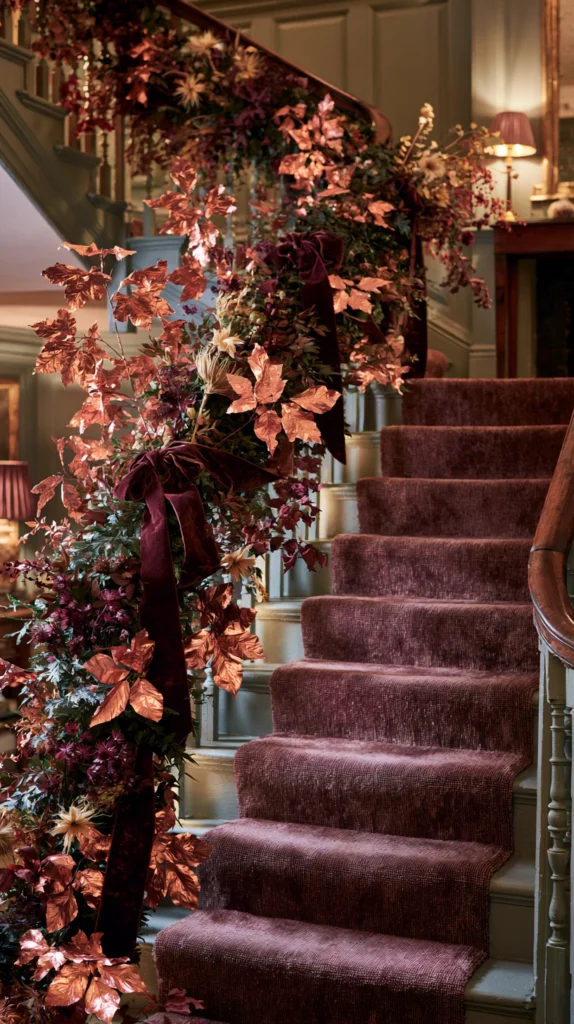
Rich velvet ribbon woven through a botanical garland — the elevated, more formal fall staircase garland.
Why velvet ribbon elevates the staircase garland:
The material:
- Velvet: the most autumn-appropriate fabric (warm, slightly heavy, reflects low light)
- The colour in velvet: deeper and richer than in any other fabric
- Deep burgundy, forest green, or warm gold velvet: the fall garland ribbon
The technique:
Woven ribbon:
- Cut the ribbon slightly shorter than the garland length
- Weave through the botanical material: under, over, under
- The ribbon: visible at intervals, hidden between botanicals
- The effect: the ribbon appearing and disappearing through the foliage
Tied ribbon:
- At each attachment point (each command hook): the ribbon tied in a bow
- The bows: the visible connection points
- The botanical garland: between bows
- The bows: coordinating the garland with other ribbon used in the fall decor
The combination:
Velvet ribbon and botanical:
- The velvet: the luxury and the colour
- The botanical: the natural and the fragrance
- The combination: the sophisticated and the organic
- The staircase: formal without being stiff
The colour:
One ribbon colour, one botanical palette:
- Deep burgundy ribbon with eucalyptus and copper leaves
- Forest green ribbon with dried flowers and cream hydrangeas
- Warm gold ribbon with pine cones and rosehips
- The ribbon: the unifying thread of the garland palette
Cost breakdown:
- Velvet ribbon (3 inches wide, 6 yards): $15–25
- The botanical base garland: see previous ideas
- Total: $15–25 in addition to the botanical base
8. The Grapevine and Leaf Garland (The Natural Structure)
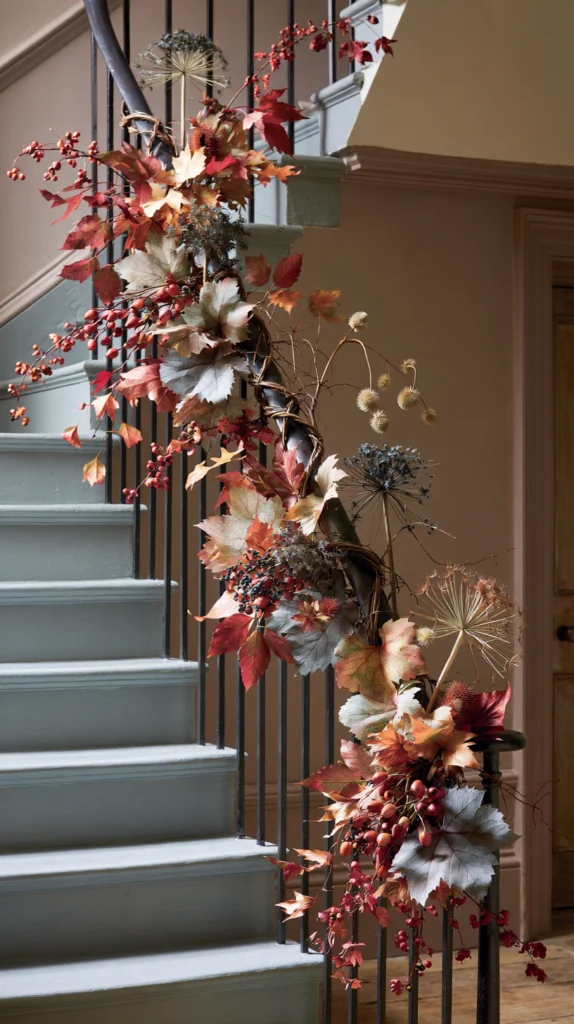
A grapevine garland base with fall leaves and berries woven through — the most structurally self-supporting garland option.
Why grapevine is the best garland base:
The structural quality:
- Grapevine: holds its own shape
- A length of grapevine twisted: maintains the twist
- Does not need as many attachment points as a softer garland
- The vine: the staircase garland’s most self-sufficient base
The sourcing:
- From a garden growing grapes or ornamental vine: the canes after the autumn pruning
- The pruned canes: long, flexible, available in quantity
- From a craft store: pre-twisted grapevine garland
- The garden source: free and specific
The autumn additions:
Into the grapevine:
- Fall leaves wired in through their stems
- Seed heads pressed into the natural gaps in the vine
- Berries tucked into the vine structure
- The grapevine: the matrix into which everything else is placed
The natural gaps:
- Grapevine garlands have natural spaces between the twisted vine
- These: the designed spaces for the additions
- The tucking method (no wiring): pushing stems into the gaps
- The gaps grip the stems naturally — no wire needed for lightweight additions
Cost breakdown:
- Grapevine from garden: $0
- Or purchased grapevine garland: $12–20
- Leaf and botanical additions: $0–15
- Total: $0–35
9. The Wheat and Grain Garland (The Harvest Abundance)
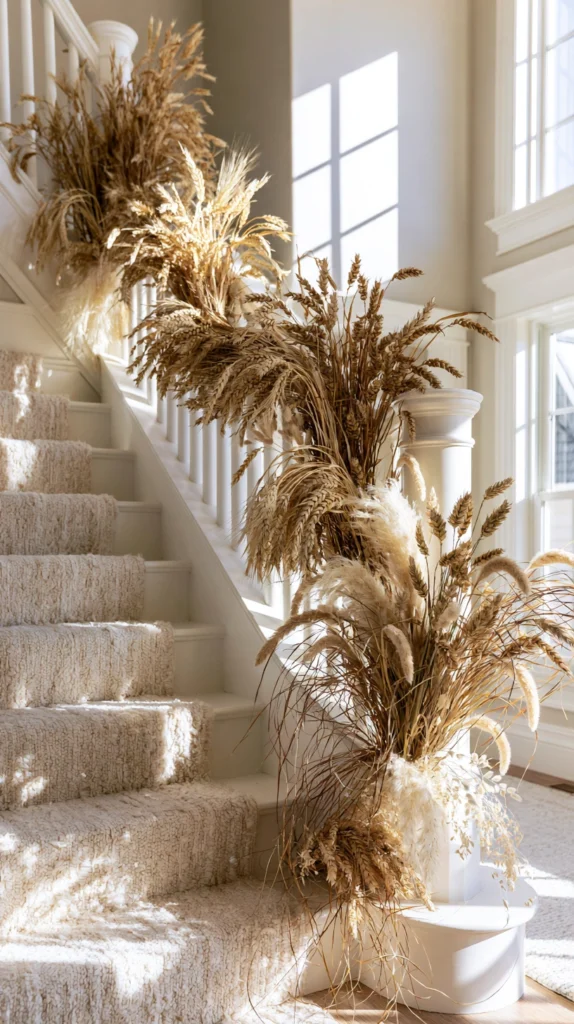
Dried wheat, barley, oat heads, and dried grasses in a golden garland — the harvest abundance brought to the staircase.
Why a grain garland is a specific and unusual choice:
The harvest reference:
- Wheat and grain: the most directly harvest-connected material
- The staircase in November: the harvest displayed at the house’s vertical axis
- The specificity: a grain garland is neither generic nor expected
The materials:
Dried wheat (triticum):
- Available from floral suppliers in bundles
- The golden colour: the harvest palette in single material
- The seed head: the most identifiable grain form
- A garland of wheat: immediately readable as harvest
Oat heads (avena):
- The nodding, pendulous seed head
- More movement than wheat (the heads hang and sway)
- Mixed with wheat: the varied grain texture
Mixed grain bundles:
- Wheat, barley, oat, and rye in one bundle
- The varied grain forms: the visual interest within the golden palette
- The bundle: tied with twine (the binding as decoration)
The construction:
The bundle garland method:
- Identical to the dried botanical garland (Idea #2)
- Small bundles of 5–7 grain stems
- The bundles overlapping in one direction
- The wired-to-spine construction
The additions:
To break the all-grain uniformity:
- Dried lavender sprigs (the blue-silver against the gold)
- Dried rose hips (the red accent)
- A length of velvet ribbon woven through (from Idea #7)
- The additions: sparingly used — the grain is the hero
The scent:
- Dried grain: faint, pleasant, straw-like
- Reminiscent of the barn and the field
- Subtle and specific
Cost breakdown:
- Dried wheat bundle: $8–12
- Mixed grain bundles: $10–18
- Total: $18–30
10. The Rosemary and Herb Garland (The Kitchen Garden Staircase)
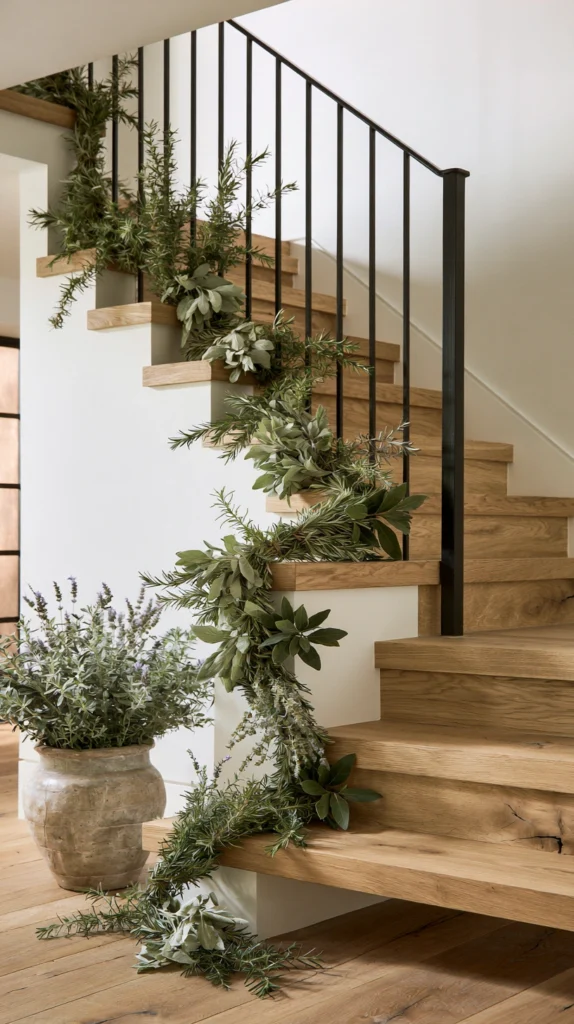
An aromatic garland made from culinary herbs — rosemary, sage, thyme, lavender — the scented garland with the most connection to the kitchen.
Why an herb garland on the staircase:
The fragrance:
- Culinary herbs: among the most evocative fragrances available
- Rosemary specifically: the fall cooking herb at its most pungent
- The garland as fragrance diffuser: releasing the herb scent when brushed by passing
The visual quality of herbs:
Rosemary:
- The structural base: upright, fine-needled, dark blue-green
- The most architectural herb
- Long stems: suitable for garland-making without any additional support
Sage:
- The large, soft grey-green leaf
- The velvet texture: unusual among herbs
- The broadest leaf in the herb garland: the contrast with rosemary’s fine needles
Lavender (dried):
- The silver-grey stem and the dried purple flower
- The most fragrant dried herb
- Adds the purple accent to the green-dominated herb palette
Bay (Laurus nobilis):
- The gloss and the formal quality
- Evergreen: holds through the full season
- The most long-lasting herb in a garland
The construction:
The herb bundle method:
- Mix 2–3 herb types per bundle
- Alternate herb bundles along the spine (all rosemary, then all sage, then all rosemary)
- Or: mixed bundles throughout
- The variation: the design decision
The functional garland:
After the season:
- The dried rosemary, sage, and bay: the cooking herbs
- The garland: harvested into the kitchen at the end of the fall season
- The decoration: finally becoming the ingredient
- The most honest possible garland use
Cost breakdown:
- Rosemary (from garden): $0
- Sage (from garden): $0
- Bay (from garden): $0
- Lavender (from garden, dried): $0
- Twine: $3
- Total: $3 for the gardener with established herb plants
11. The Copper and Black Garland (The Sophisticated Monochrome)
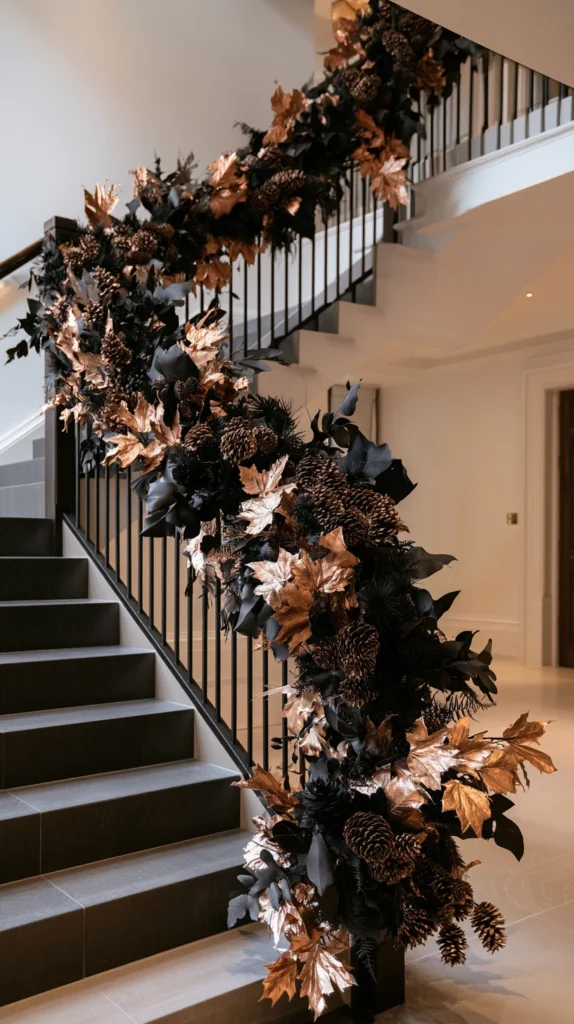
A garland in the copper-and-black colour palette — the most contemporary and most designed version of the fall staircase garland.
Why copper and black is the most sophisticated fall palette:
The colour combination:
- Black: the most contemporary neutral
- Copper: the warmest metallic
- Together: dramatic, modern, specifically autumnal without being rustic
- The combination: for a home with a more contemporary interior
The black elements:
Not literally black plants:
- Near-black dried materials (the darkest seed heads, dried black nigella)
- Deeply dark botanical (the purple-black branches)
- Dark preserved foliage (smoke bush, dark ferns)
- The near-black: the base of the dark side of the palette
The copper elements:
- Copper spray-painted pine cones (standard pine cones, sprayed)
- Copper artificial leaves
- Copper ribbon woven through
- The copper spray paint: the technique that transforms inexpensive materials
The copper spray technique:
What can be copperised:
- Pine cones: spray lightly (not uniformly) for the aged copper effect
- Small gourds: a light spray on one side (the highlight effect)
- Acorn caps: dipped in copper metallic paint
- The technique: restraint (over-spraying looks cheap, a light spray looks like patina)
The overall effect:
On a white or light-coloured banister:
- The copper and dark: dramatic against the light background
- The most striking visual contrast available for a fall garland
On a dark wood banister:
- The copper picks up the warm tones of the wood
- The dark elements: recede into the banister
- The copper: the only visible element at a distance
- The subtle version of this combination
Cost breakdown:
- Dark botanical base (eucalyptus, dark dried materials): $15–25
- Copper spray paint: $5
- Copper artificial leaves: $8–12
- Copper ribbon: $8–15
- Total: $36–57
12. The Multi-Swag Maximalist Garland (The Grand Statement)
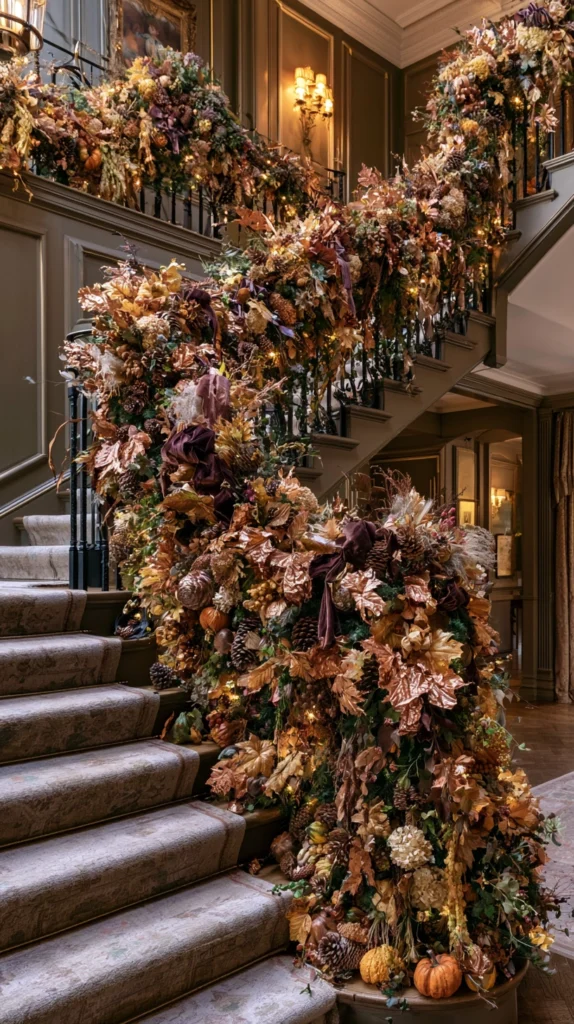
A generous, heavily draped garland with multiple deep swags and abundant botanical material — the fall staircase decoration for those who want maximum impact.
Why more is sometimes more:
The grand staircase:
- A wide, open staircase with substantial banisters
- The space: demanding of a significant gesture
- A delicate, sparse garland: lost in this space
- The maximalist garland: proportional to the grandeur
The construction of the multi-swag:
The attachment points:
- Command hooks at every baluster (more hooks than the standard approach)
- Each hook: at the same height on the banister
- The garland: draped between every hook
- The result: many small, deep swags
The density:
For the maximalist garland:
- The botanical base: much heavier than a standard garland
- The additions: at significantly closer intervals
- The total weight: distributed across more attachment points
- The test before committing: hold the full garland against the banister to check the weight
The additions:
Everything:
- The fall leaves (Idea #3)
- The pine cones (Idea #6)
- The ribbon (Idea #7)
- The mini pumpkins (Idea #4)
- The cinnamon bundles (Idea #5)
- The maximalist garland: not one idea but a combination of all
The key to making it work:
One unifying element:
- The garland can contain many different materials
- But: one material that runs throughout
- This might be the eucalyptus base, or a ribbon in a consistent colour
- Without the unifying thread: the garland becomes chaotic
The focal point:
At the newel post:
- The garland’s most abundant concentration
- Everything from the garland: also at the post
- Plus: additional material (a bow, a cluster, extra cones)
- The newel post: the exclamation point at the end of the sentence
Cost breakdown:
- Significantly more materials than the single-idea garlands
- The botanical base: $40–60
- The many additions: $40–70
- Total: $80–130
13. The Understated Minimal Garland (The Single Material Statement)
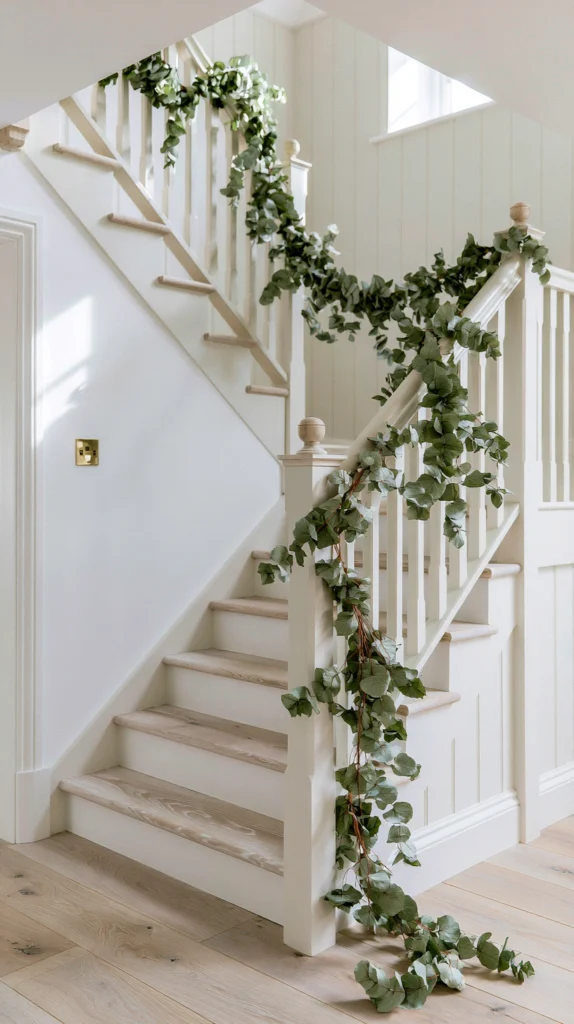
A garland made from one material only — the opposite of the maximalist, and sometimes more beautiful.
Why restraint is a design choice:
The one-material garland:
- One material: repeated the length of the staircase
- The repetition: the design
- Nothing additional: the discipline
- The result: either beautiful or boring, depending entirely on the material
The materials that work alone:
Dried eucalyptus only:
- The one material with the most inherent beauty
- Varied lengths and arrangements along the spine
- The silver-green running the full staircase
- No additions: the purity is the point
Gypsophila (baby’s breath, dried):
- White cloud dried along the banister
- The mist effect: airy, unusual, delicate
- A completely different reading from all other garlands on this list
Preserved fern:
- The deep green fern frond: the forest garland
- Dense and specific
- Suits a very green interior
Dried wheat only:
- The harvest in a single material
- The golden length from top to bottom of the staircase
- The statement: direct and unambiguous
The making of the minimal garland:
More attention to each element:
- When one material: the arrangement of that material is everything
- The varied lengths, the turned stems, the occasional pause in density
- The design work: more visible in a minimal garland than in a maximalist one
Cost breakdown:
- One material in quantity: $15–40 depending on the material
- Total: $15–40
14. The DIY Dried Citrus and Botanical Garland (The Made-at-Home Afternoon)
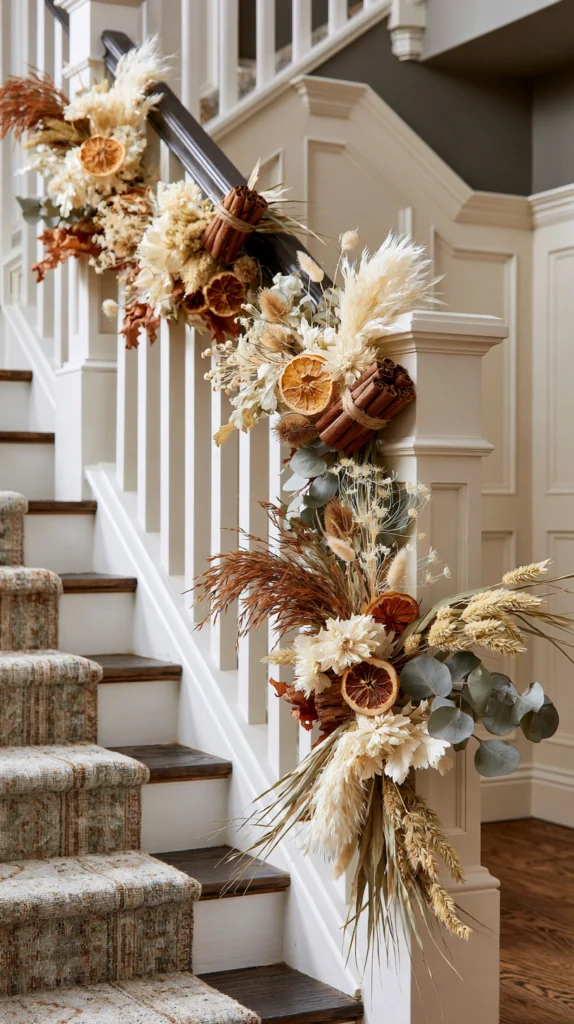
A garland made in a single afternoon using dried orange slices and simple botanical materials — the achievable DIY that looks more complex than it is.
The afternoon project:
What can be completed in one afternoon:
- The orange drying: done in advance (2–4 hours in a low oven)
- The botanical gathering: 30 minutes
- The assembly: 60–90 minutes
- The installation: 30 minutes
The orange drying (the day before):
- Slice 4–6 oranges at 1/4 inch thickness
- Lay flat on a baking rack over a baking sheet
- Oven at 200°F (95°C)
- Turn every hour: 2–4 hours total
- The slices: fully dry, the colour retained
- Cool completely before use
The assembly:
The spine:
- A 10-foot length of jute twine: the spine
- Or: a purchased simple garland as the starting point
Thread the orange slices:
- Hole punched near the edge: a bodkin or large needle with twine through
- At every 12–18 inches: an orange slice tied to the spine
- The orange: the recurring visual element throughout
Add botanical bundles between:
- Small bundles of the botanical materials available (dried grasses, eucalyptus, seed heads)
- Wired between each orange slice
- The botanical: filling the space between the citrus
Add the cinnamon:
- A bundle of cinnamon sticks beside each orange (from Idea #5)
- The orange and the cinnamon: the most classic fall fragrance combination
- Together at each point: the consistent unit along the garland
The colour:
- The orange slices: the vivid warm orange
- The cinnamon: the warm brown
- The botanical: the neutral green-grey
- The palette: warm, autumnal, deliberately combined
Cost breakdown:
- Oranges (5 for drying): $3
- Cinnamon sticks: $5
- Botanical materials (from garden): $0
- Jute twine: $3
- Total: $11
15. The Complete Fall Staircase Installation (The Fully Dressed)
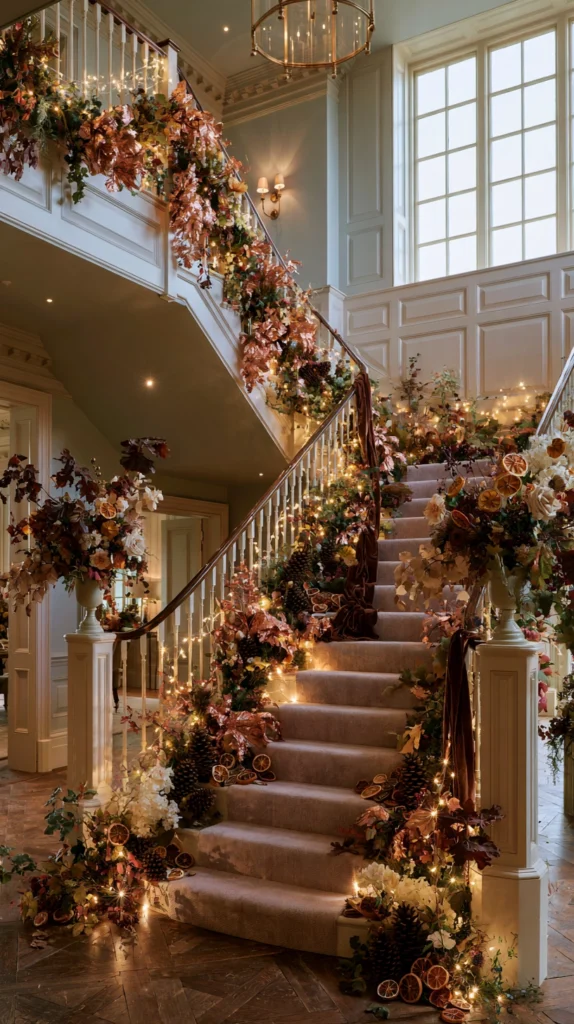
A staircase dressed with multiple elements — garland, individual decorations at focal points, lighting, and a newel post arrangement — the fall staircase as a complete seasonal installation.
What the complete installation includes:
The garland:
- The base: preserved eucalyptus and dried botanicals (Ideas #1 and #2 combined)
- The additions: copper leaves, pine cones, dried orange slices, velvet ribbon
- The full length of the banister
- The element that ties everything together
The newel post:
The base post arrangement:
- A cluster of materials at the newel post: the arrival point
- Mini pumpkins grouped at the base of the post
- A ribbon bow at the point where the garland ends or begins
- The newel post: more decorated than any other single point
The stair treads:
Additional placement on the stairs themselves:
- Small pumpkins or gourds on alternate treads (one per step, on the outside)
- Or: a single botanical element on every third step
- The stairs: decorated beyond the banister garland
The lighting:
The most-overlooked element of the staircase installation:
- Battery-operated string lights woven through the garland
- Warm white (2700K)
- Timer: set for the afternoon dark hours
- The garland at dusk: transformed by the warm light coming through the botanical material
- The lit garland: visible from below stairs, from the landing, and from any adjacent rooms
The landing:
If a landing is present:
- The garland continues to the landing
- A secondary arrangement at the landing point
- The landing: a mid-way focal point
- A simple vase of dried botanicals at the landing level
The overall composition:
Reading from the base of the stairs:
- The newel post: the most decorated element (the arrival)
- The garland: ascending the staircase
- The warm light: threading through the botanical material
- Individual details on alternate treads
- The landing: the mid-point emphasis
- The top: the garland ending at the upper newel post with a matching arrangement
The installation process:
The sequence:
- Attach all command hooks before any garland is placed
- The garland: laid out on the floor in the correct length and order
- Hang from the top hook, working down
- Adjust the swag depth at each hook before moving on
- Add the lighting (weave through the garland as the last step before adding decorative elements)
- Add the heavier decorative elements (pumpkins, pine cone clusters) while the garland is in position
- The newel post arrangement: the final step
The time:
- The assembly of the garland (not including drying time): 2–3 hours
- The installation: 45–60 minutes
- The complete installation: one afternoon
Cost breakdown:
- Botanical base garland: $30–50
- Additions (copper leaves, pine cones, orange slices, cinnamon): $20–30
- Velvet ribbon: $15–20
- String lights (battery, 10 feet): $15–20
- Mini pumpkins for treads and base: $12–18
- Command hooks: $5
- Total: $97–143
The Staircase Garland Philosophy
What the staircase garland does that no other fall decoration does:
The vertical dimension:
- Every other fall decoration in the home: horizontal (the table centrepiece, the mantelpiece display, the windowsill arrangement)
- The staircase garland: vertical
- Running from floor to ceiling: the fall decoration that uses the height of the room
- Visible from the entrance, from the living room doorway, from the landing, from upstairs looking down
- The most widely seen decoration in the house
The passage decoration:
- The staircase: the path between the floors
- The garland: dressing the passage
- Everyone who uses the stairs: passes through the decorated space
- The decoration: experienced daily, multiple times
The permission to do it imperfectly:
- The staircase garland photograph: always shows the ideal
- The actual garland: can be asymmetric, slightly uneven, the swags unequal
- The organic material: makes imperfection look intentional
- The attempt: always better than the empty banister
Getting Started This Weekend
The minimum viable fall staircase garland:
One roll of jute twine. A bundle of dried eucalyptus from the florist or garden. A packet of command hooks.
Two hours.
The jute: attached at the top and draped down the banister. The eucalyptus: tucked into the twine, stems pointed downward. One swag, generously draped.
Total cost: under $20. The staircase: transformed.
Everything else on this list: the elaboration of that beginning. The starting point: a length of jute and two hours.
The banister that was there when you moved in. The staircase nobody decorated. The vertical space the whole house walks through every day.
This weekend: dressed for the season.