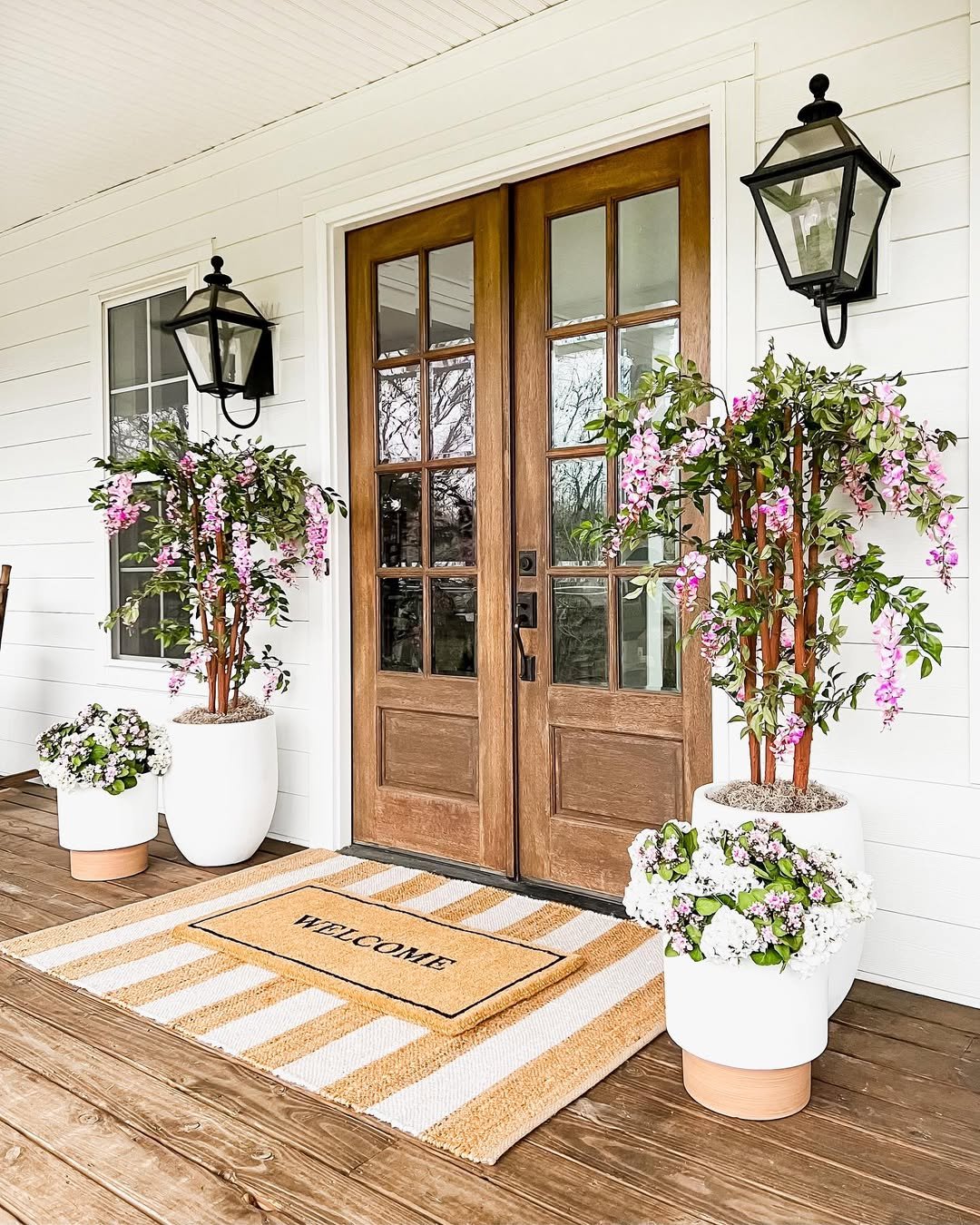
15 Faux Plants for Front Porch Decorating
A front porch sets the tone for everything behind it. It is the first thing guests notice, the last thing you see when you leave in the morning, and the detail that quietly communicates how much care has gone into a home. Fresh plants are the obvious choice for porch decorating, but they demand consistent watering, survive poorly in deep shade or extreme heat, and require replacing season after season.
Faux plants, chosen well, offer all the visual warmth of real greenery with none of the maintenance — and the best modern options are genuinely difficult to distinguish from the real thing.
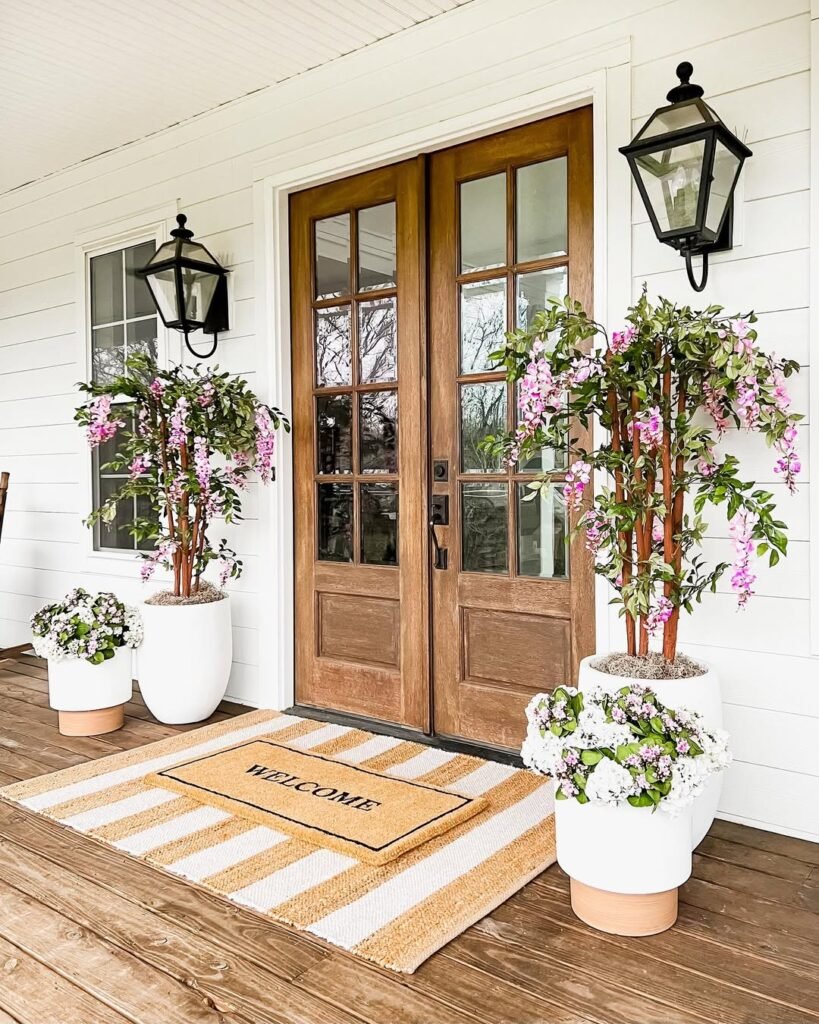
The ideas below cover every porch style, every scale, and every budget. Each one includes what to look for, what it will cost, and a practical tip for making the arrangement look as convincing and considered as possible.
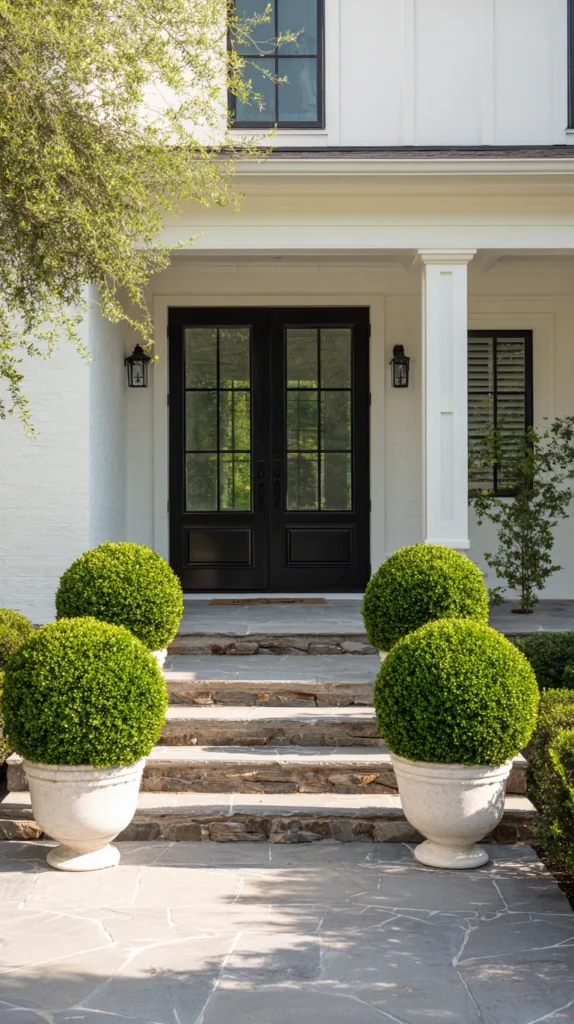
1. The Faux Boxwood Topiary Pair
Budget: $40 – $150
Two matching boxwood topiaries flanking a front door is one of the most classic and enduring porch arrangements in existence. The symmetry signals welcome, the deep green colour works against almost every exterior paint colour, and the clipped sphere or cone shape provides the kind of clean, architectural structure that living plants take years to develop. In faux form, they look perfect from the first day and stay that way indefinitely.
Look for topiaries with UV-resistant foliage — this is non-negotiable for any faux plant kept outdoors. Without UV protection, the colour fades from rich green to a washed-out yellow within a single summer. Quality faux boxwood topiaries cost $20–$75 each. Plant them in matching planters — terracotta, fibreglass stone-effect, or black metal — for a finished, coordinated look.
Styling tip: Weight the planters with sand or gravel before inserting the topiary form. An empty lightweight planter tips easily in wind, and a topiary that has blown over on your front porch looks neglected rather than decorative.
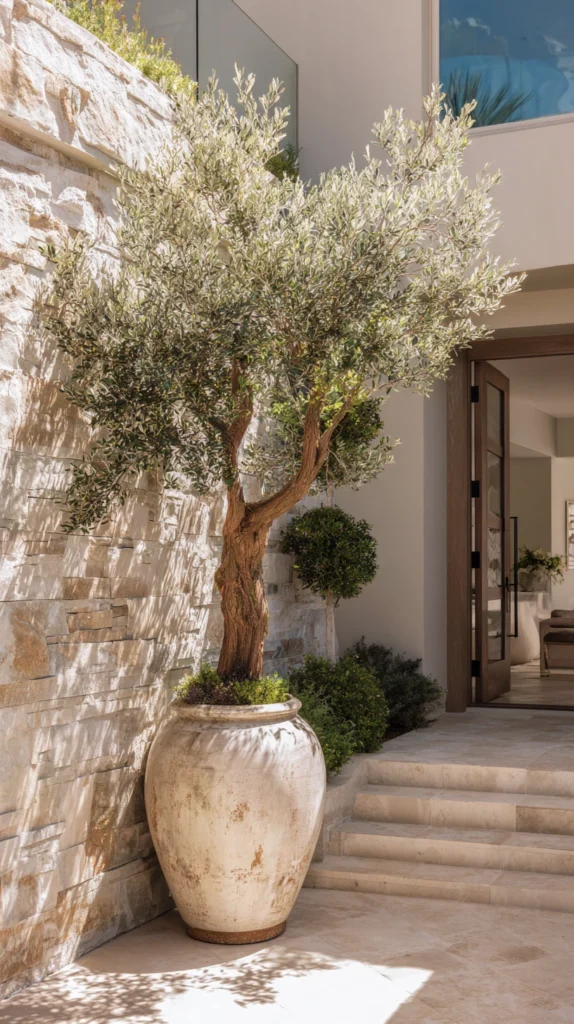
2. The Faux Olive Tree
Budget: $80 – $300
A faux olive tree in a large terracotta or cement planter is one of the most sophisticated faux plant options available for a front porch. The silvery-green foliage, gnarled trunk, and slender branching habit of a well-made faux olive read as genuinely Mediterranean and bring a calm, refined quality to any porch style — from a modern white rendered facade to a traditional stone cottage entrance.
Look for a faux olive with individually wired branches that can be shaped and adjusted rather than a fixed rigid form. The ability to angle and spread the branches means you can adjust the silhouette over time and keep the arrangement looking fresh. Trunk texture matters enormously — a convincing gnarled bark finish is what separates a quality faux olive from a cheap one.
Styling tip: Place the olive tree slightly off-centre rather than directly beside the door. A single statement tree positioned at an angle to the entrance creates a more relaxed, curated feel than two symmetrical specimens, and suits contemporary and Mediterranean porch styles particularly well.
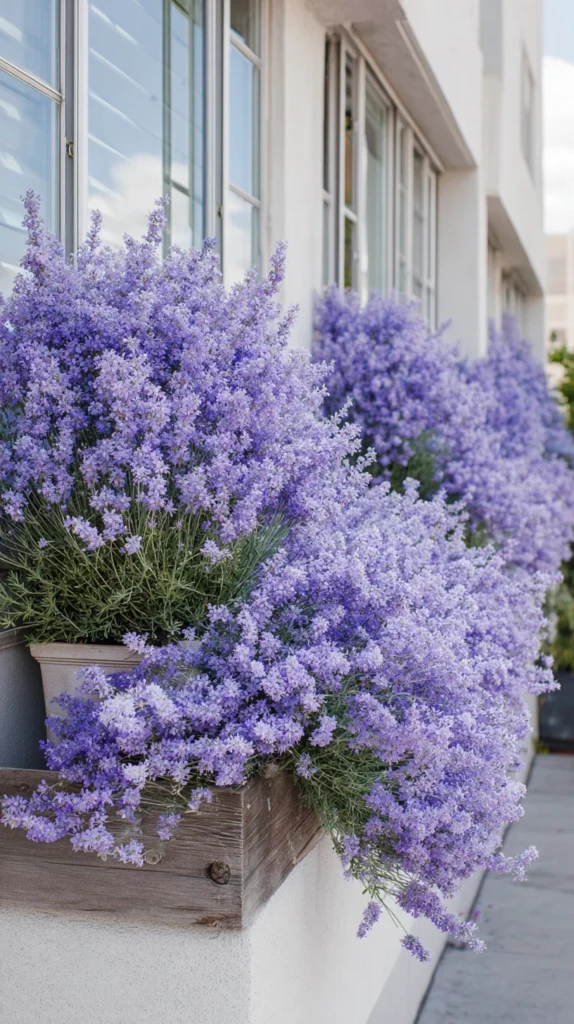
3. Faux Lavender Bundles in Window Boxes
Budget: $30 – $90
Window boxes overflowing with faux lavender bring colour, texture, and a cottage garden mood to a front porch without any of the watering, deadheading, or winter die-back that real lavender demands. The purple flower spikes against silver-grey foliage are immediately recognisable and work beautifully against brick, painted timber, and stone exteriors alike.
Look for faux lavender with fabric or silk flower heads rather than plastic ones — the soft texture of fabric petals catches light in a far more convincing way. Bundle several stems together in each window box and vary the stem heights slightly for a natural, uneven silhouette. A completely even, uniform arrangement reads as artificial regardless of the quality of the individual stems.
Styling tip: Mix faux lavender with one or two stems of faux eucalyptus or rosemary in the same window box. Breaking up a single species arrangement with complementary foliage adds visual depth and makes the overall display look planted rather than arranged.
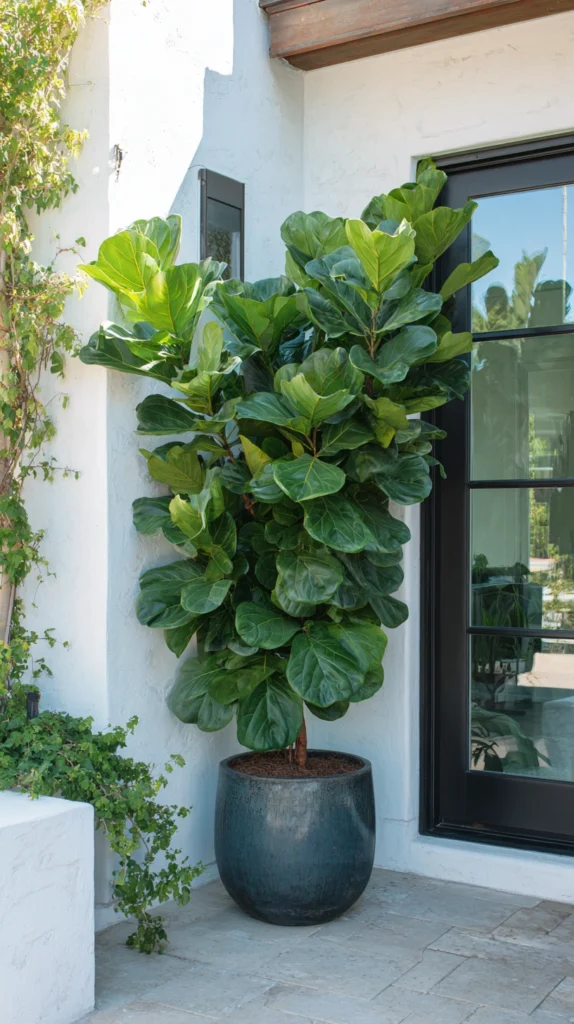
4. The Faux Fiddle Leaf Fig
Budget: $60 – $250
The fiddle leaf fig has become one of the most recognisable interior plants of the past decade, and its large, dramatic leaves translate just as powerfully to a covered front porch. A single large faux fiddle leaf fig in a statement planter beside the door creates an immediate focal point and brings the kind of bold, tropical energy that smaller arrangements struggle to achieve.
Quality matters more with large statement plants than with any other faux option — at this scale, poor leaf texture, unnatural colouring, or stiff branching is immediately obvious. Spend toward the upper end of the budget on a faux fiddle leaf fig and the investment pays for itself within the first season compared to replacing a real one.
Styling tip: A covered porch is essential for a faux fiddle leaf fig — large flat leaves collect dust and debris rapidly in an exposed position, and the cleaning commitment quickly outweighs the decorative benefit. Under a porch roof, the leaves stay clean and the arrangement looks effortless.
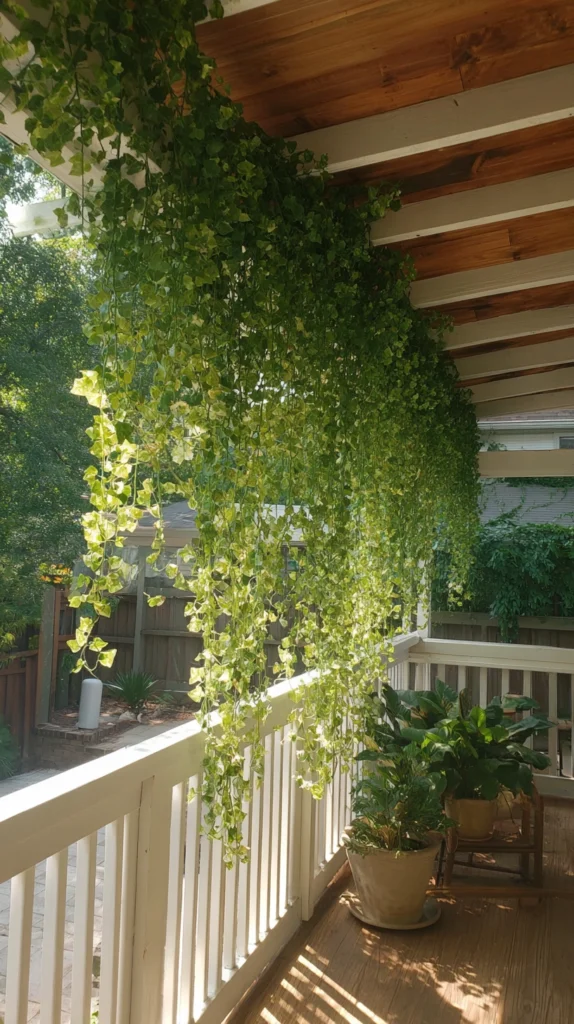
5. Faux Trailing Ivy in Hanging Baskets
Budget: $25 – $80
Hanging baskets of trailing faux ivy bring softness, movement, and a romantic cottage quality to a front porch. The cascading stems fill vertical space beautifully, frame the entrance from above, and create the layered, abundant look that makes a porch feel genuinely welcoming rather than sparsely decorated.
Look for faux ivy with varied leaf sizes along each stem — real ivy produces smaller leaves at the tips and larger ones closer to the base, and a quality faux version replicates this detail convincingly. Avoid ivy with leaves that are all identical in size and perfectly spaced, which reads as obviously artificial even from a distance.
Styling tip: Hang two baskets at slightly different heights rather than at exactly the same level. The asymmetry is barely perceptible but makes the arrangement look more naturally grown-in, and the varying drop of the trailing stems creates a more dynamic, layered effect across the porch ceiling.
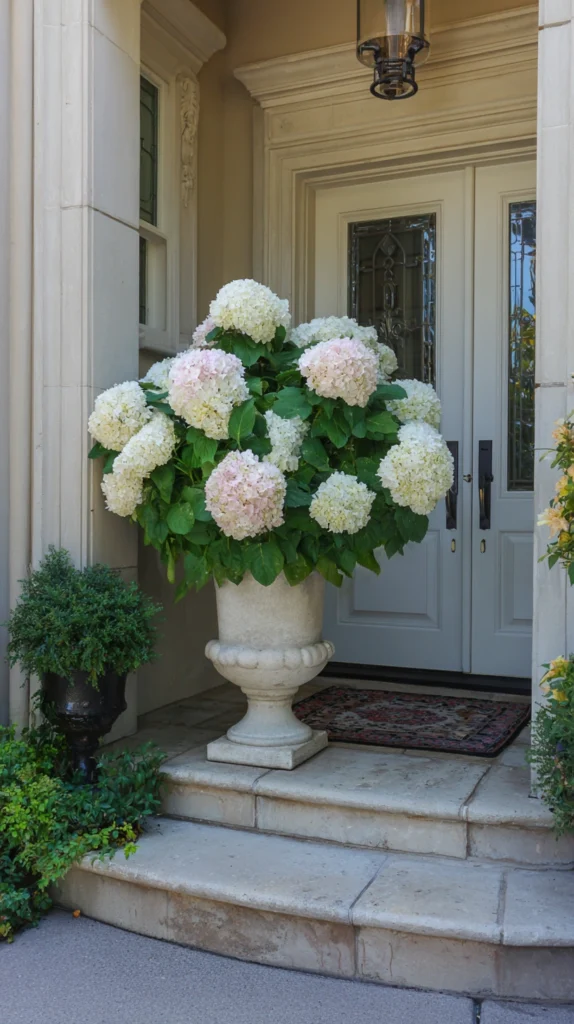
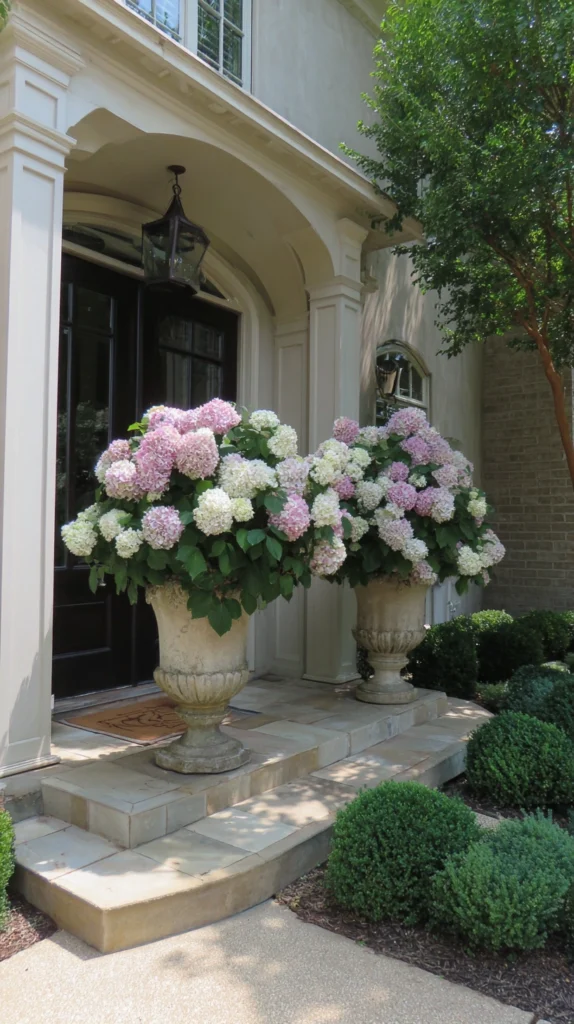
6. Faux Hydrangeas in Urn Planters
Budget: $35 – $120
Large faux hydrangea blooms — in white, dusty blue, blush pink, or sage green — arranged in classic urn planters are one of the most reliably beautiful faux plant combinations for a traditional or colonial-style porch. The full, rounded flower heads have a generous, abundant quality that immediately softens the architecture around them, and the muted colour palette works with almost every exterior colour scheme.
Fabric hydrangea stems cost $5–$15 each and look most convincing when packed densely into the planter — five to seven large heads per urn, arranged so the blooms fill the opening completely and cascade slightly over the edge. A sparse arrangement of hydrangeas, real or faux, always looks underwhelming.
Styling tip: Add faux eucalyptus or seeded grass stems among the hydrangea heads to break up the rounded uniformity of the blooms. The contrast between the full flower heads and the loose, airy filler stems makes the arrangement look like something a florist put together rather than something pulled from a box.
7. The Faux Bamboo Screen
Budget: $50 – $200
A tall arrangement of faux bamboo in a deep rectangular planter creates a living screen effect on a front porch — providing a degree of privacy, marking the boundary of the porch space, and adding dramatic vertical height without the invasive root system that makes real bamboo such a problematic garden plant. Against a contemporary exterior with clean lines and neutral colours, faux bamboo has an effortlessly sophisticated quality.
Look for faux bamboo with realistic node detailing on the canes and naturally varied stem heights. A perfectly even, identical-height bamboo arrangement looks unconvincing — real bamboo grows at different rates and the variation in cane height is part of what makes it visually interesting.
Styling tip: Use a heavy stone or fibreglass planter rather than a lightweight plastic one for a faux bamboo screen. The visual weight of a tall bamboo arrangement needs a planter that looks substantial enough to anchor it, and a flimsy pot beneath an impressive display of stems makes the whole arrangement look top-heavy and precarious.
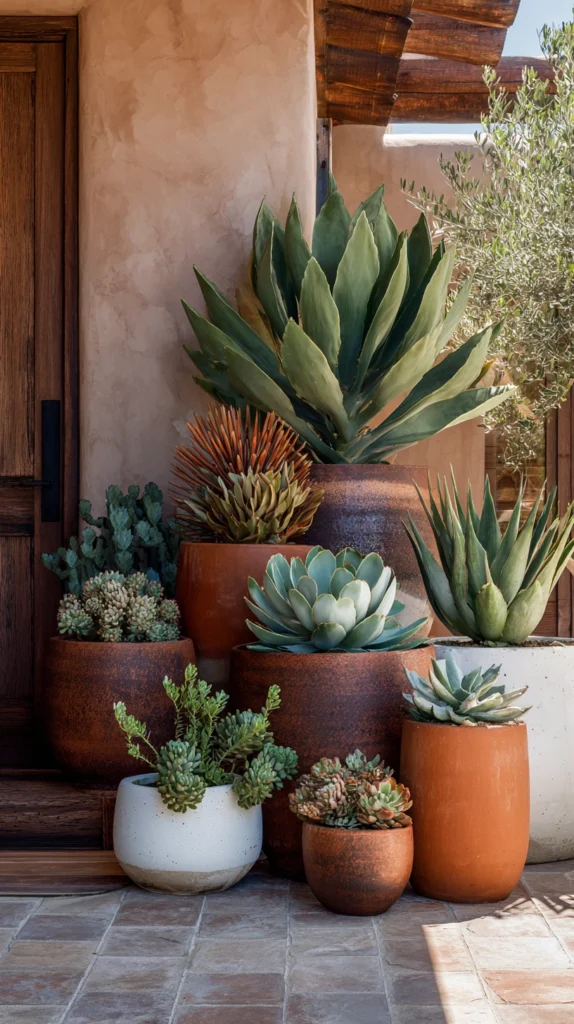
8. Faux Succulents in Grouped Terracotta Pots
Budget: $20 – $70
A collection of faux succulents — echeverias, agaves, aloes, and haworthias — arranged in a grouped cluster of terracotta pots of varying sizes creates a low-maintenance, desert-inspired porch display that suits modern, rustic, and Mediterranean-style homes equally well. Real succulents are among the easiest plants to grow but are surprisingly vulnerable to overwatering and frost — faux versions remove both risks entirely.
The quality of faux succulents varies enormously. The best versions replicate the waxy, almost architectural surface of real succulent leaves with impressive accuracy. Avoid faux succulents with an obviously plastic sheen — the surface texture is what makes or breaks the illusion at close range, and a front porch is an intimate space where visitors pass within touching distance.
Styling tip: Mix pot sizes deliberately — one large terracotta pot, two medium, and three small creates a natural-looking cluster with visual hierarchy. Arrange them at slightly varying angles rather than all facing the same direction, and place some pots partially behind others for a sense of depth.
9. Faux Grass Plumes and Ornamental Grasses
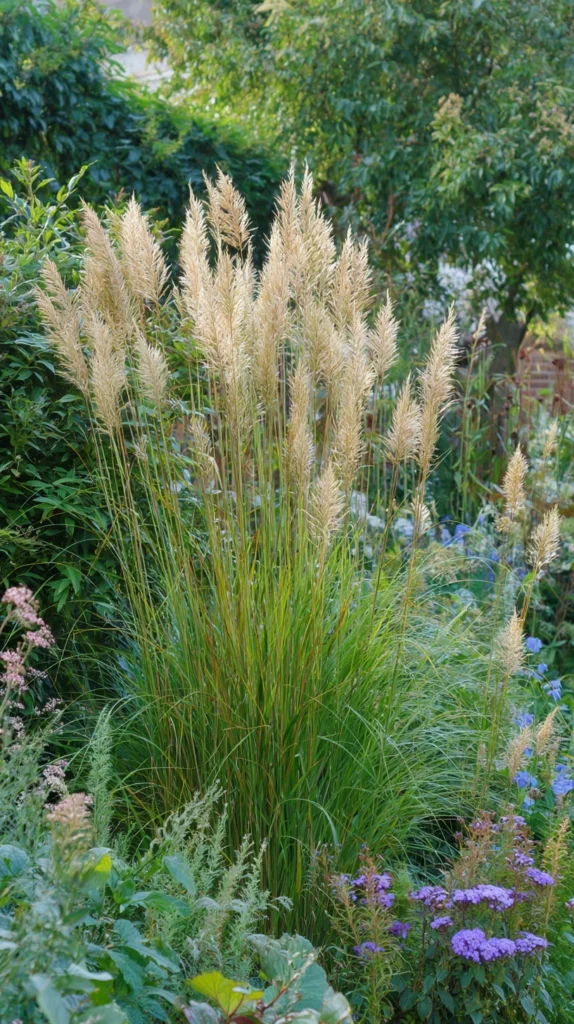
Budget: $30 – $100
Tall faux ornamental grasses — pampas grass plumes, miscanthus, or fountain grass — bring movement, texture, and a naturalistic energy to a front porch that most flowering faux plants cannot match. The loose, feathery heads and slender arching stems create a gentle sense of motion even in still air, and the neutral, earthy tones of dried grass work with every exterior colour palette.
Faux pampas grass has become particularly popular in contemporary home decorating and good quality versions are now widely available. Look for plumes with individually separated strands rather than compressed, solid heads — a quality pampas plume fans out loosely and softly, while a cheap one looks like a toilet brush.
Styling tip: Combine faux grasses with faux dried seed heads — alliums, nigella pods, or teasels — in the same large planter. The mix of textures within a neutral, dried palette creates a sophisticated, editorial arrangement that suits modern farmhouse and Scandi-inspired porch styles particularly well.
10. Faux Ferns in Hanging Planters
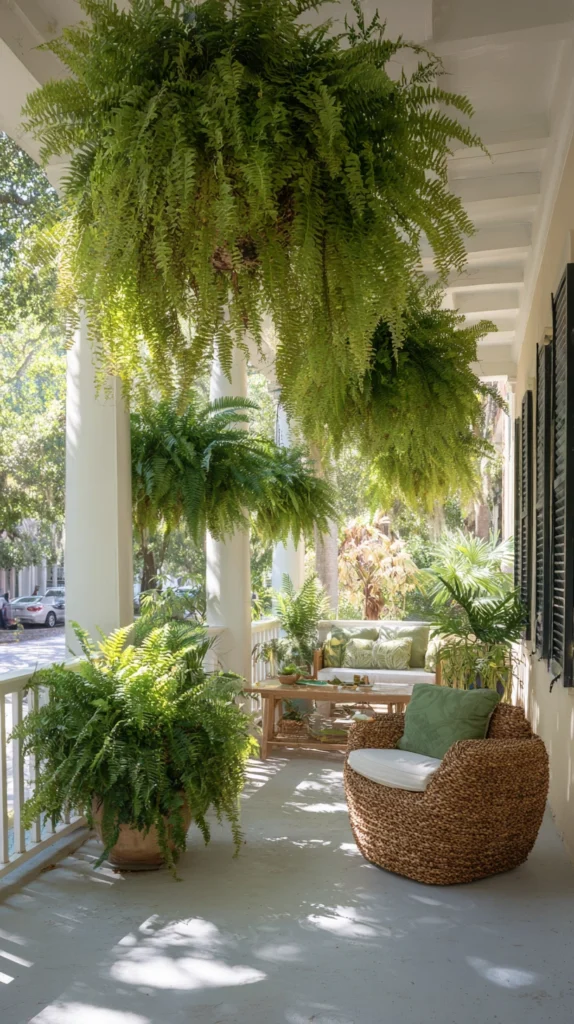
Budget: $25 – $90
Boston ferns are one of the most traditional front porch plants in existence, particularly on covered porches in warm climates. They are also notoriously demanding — they require high humidity, consistent moisture, and bright indirect light to thrive, and they drop leaves aggressively the moment conditions are not to their liking. A high-quality faux Boston fern in a wicker or rattan hanging planter gives all the lush, full, cascading beauty of the real thing with none of the drama.
Look for faux ferns with layered, arching fronds that create a full, three-dimensional silhouette rather than a flat, one-sided arrangement. The fronds should vary in length and angle, just as they would on a real fern growing in a basket. Uniform, evenly spaced fronds of identical length give the game away immediately.
Styling tip: Hang faux fern baskets where real ferns would logically thrive — in shaded, sheltered positions under the porch roof rather than in direct sun. A faux plant placed where the real version would clearly struggle reads as unconvincing regardless of its quality, while the same plant in a plausible position is accepted without question.
11. Faux Bougainvillea Climbing Display
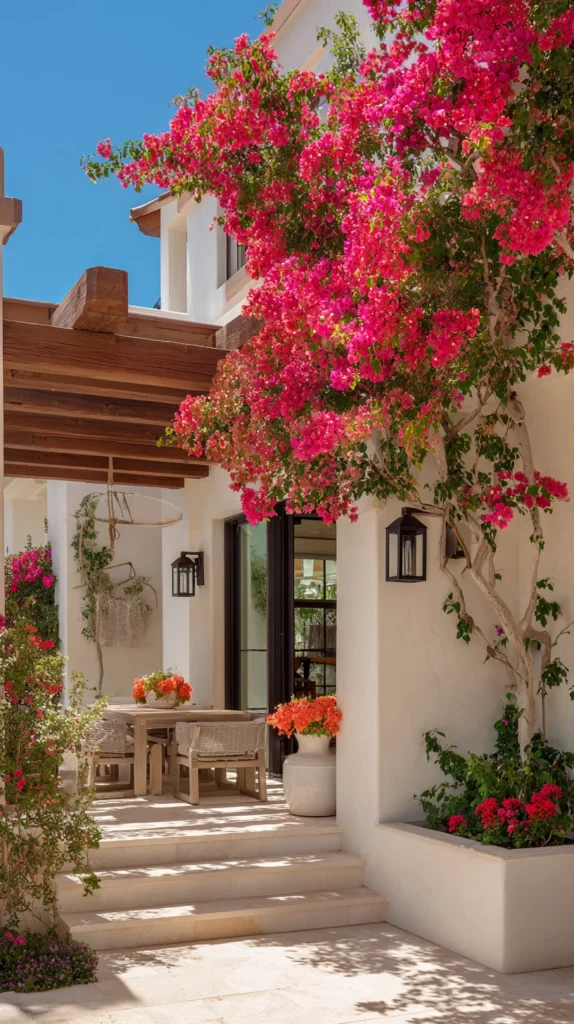
Budget: $50 – $180
Few plants signal warmth, colour, and abundant summer living as powerfully as bougainvillea, and a faux version trained up a trellis or over a porch column brings that same vivid energy without the thorns, the frost sensitivity, or the enormous pot size that a real bougainvillea requires to perform well. In deep magenta, coral orange, or bright white, a faux bougainvillea display transforms a plain porch column into something genuinely spectacular.
Look for faux bougainvillea with fabric bracts — the coloured paper-thin leaf structures that surround the tiny true flowers — rather than plastic ones. Fabric bracts have a translucency in sunlight that closely mimics the real plant, while plastic versions look flat and opaque even from a distance.
Styling tip: Weave the stems loosely around the support structure rather than tying them rigidly in place. Real climbing plants find their own route around a trellis with a natural irregularity — an arrangement that has been carefully woven in an imperfect, organic pattern reads as far more convincing than one that has been tied symmetrically at regular intervals.
12. Faux Topiaries in Animal or Geometric Forms
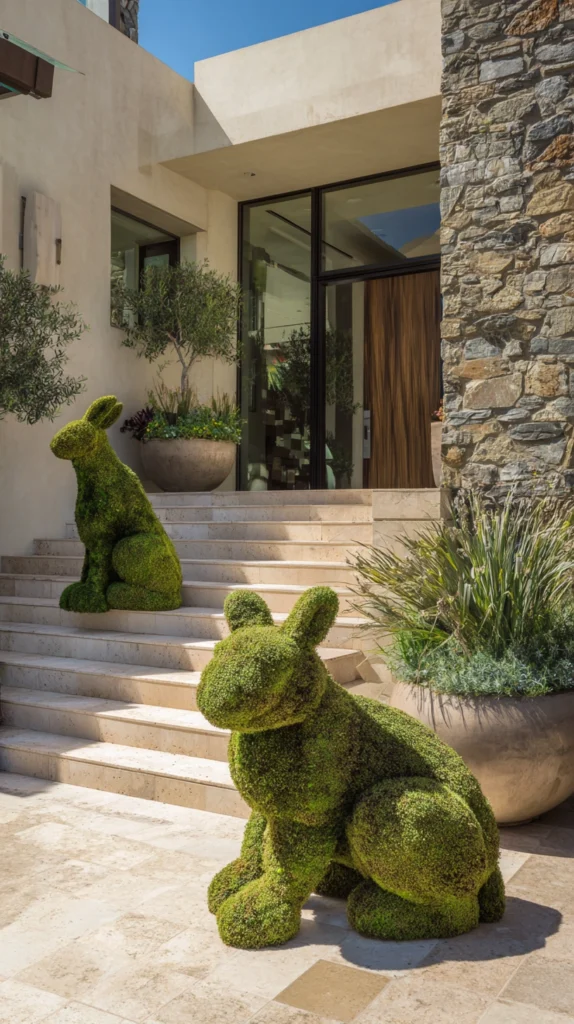
Budget: $40 – $200
Beyond the classic sphere and cone, faux topiaries are available in a wide range of sculptural forms — spiral topiaries, tiered cloud shapes, bear or bird forms, and abstract geometric frames filled with trailing moss or boxwood. These statement pieces bring personality and a degree of playfulness to a front porch that traditional plant arrangements rarely achieve, and they make a porch entrance genuinely memorable.
Spiral topiaries work well in formal, symmetrical porch arrangements. Animal forms — a topiary deer, a pair of topiary birds — suit cottage and country-style homes. Geometric moss frame topiaries in square or diamond shapes are a contemporary option that looks particularly striking against a modern, minimal exterior.
Styling tip: Commit to the statement rather than hedging it. A single bold topiary form placed with confidence reads as a deliberate design choice; the same piece placed tentatively in a corner looks as though you were not sure about it. Give a statement topiary a prominent position and an appropriately substantial planter.
13. Faux Citrus Trees in Painted Pots
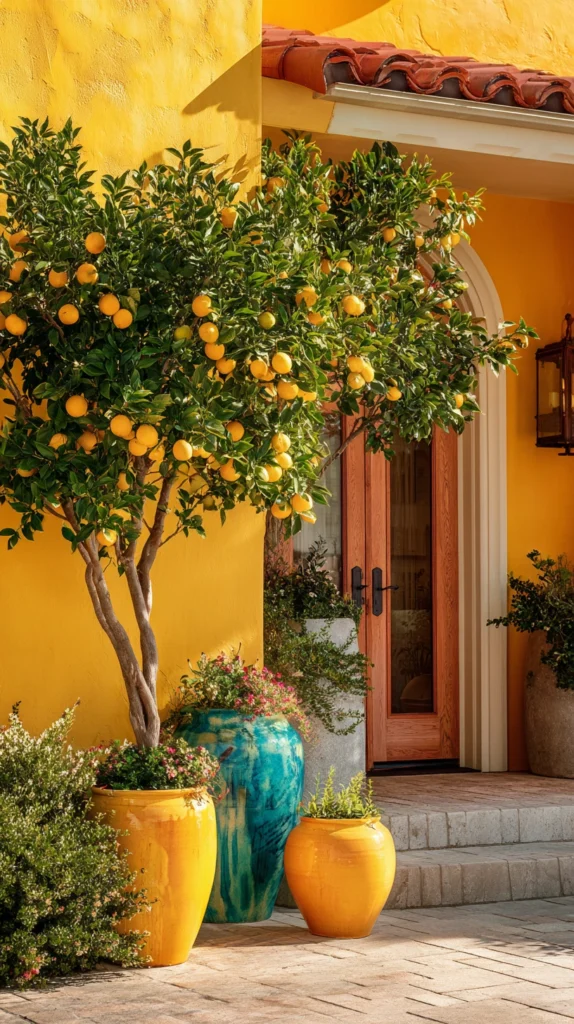
Budget: $60 – $220
A faux lemon or orange tree — complete with clusters of fruit visible among dark glossy leaves — in a brightly painted ceramic or fibreglass pot is one of the most cheerful and Mediterranean-inspired porch decoration ideas available. The combination of deep green foliage, bright fruit, and a colourful painted pot creates an instant focal point that suits farmhouse, Spanish colonial, and coastal porch styles beautifully.
Look for faux citrus trees with both fruit and blossom on the same branches — the real trees carry both simultaneously and this detail, when replicated, gives the faux version an authenticity that fruit-only arrangements lack. The painted pot matters as much as the tree — a hand-painted or distressed ceramic pot elevates the whole arrangement significantly.
Styling tip: Use a pot colour that picks up a secondary tone from your front door or exterior trim rather than matching it exactly. A terracotta pot with a painted rim in the same blue as a front door, for example, creates a connection between the decoration and the architecture that makes the porch feel considered as a whole.
14. Faux Magnolia Branches in Tall Vases
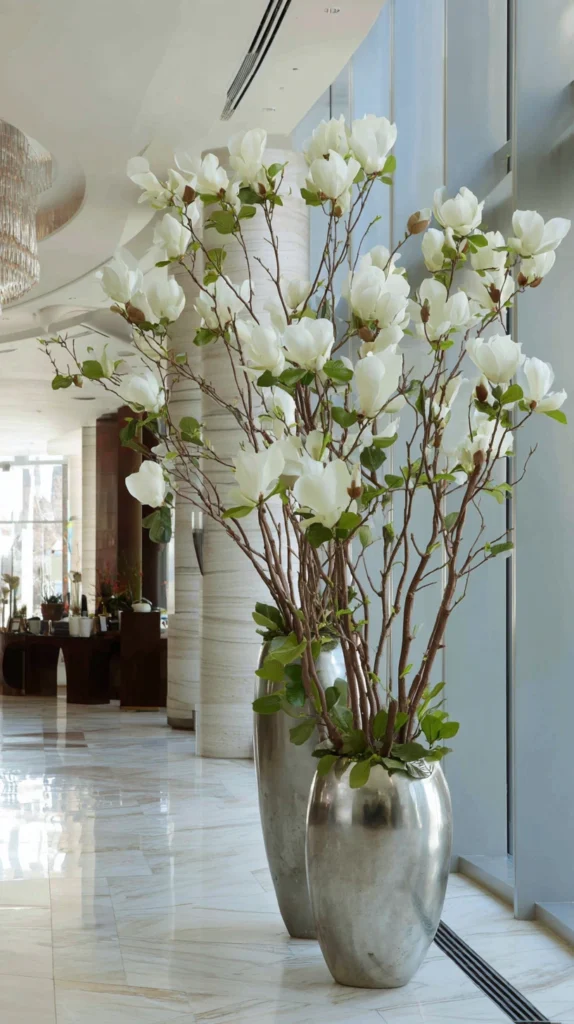
Budget: $35 – $120
Large faux magnolia branches — with their distinctive large oval leaves in deep green above and bronze-brown beneath — arranged in a pair of tall floor vases bring a dramatic, architectural quality to a front porch that smaller arrangements cannot achieve. The contrast between the bold foliage and the bare branches creates a strong graphic silhouette that looks striking against both pale and dark exterior walls.
Tall cylindrical vases in black, charcoal, aged brass, or concrete-effect finishes suit the bold character of magnolia branches far better than decorative or ornate containers. The simplicity of the vessel allows the branching structure of the plant to read clearly rather than competing with a busy pot surface.
Styling tip: Arrange the branches so they lean slightly outward from the vase rather than standing perfectly upright. A natural lean — one branch angling left, another reaching right — creates a composition that fills the space more generously and looks as though the branches grew that way rather than having been placed.
15. The Faux Seasonal Arrangement in a Planter Urn
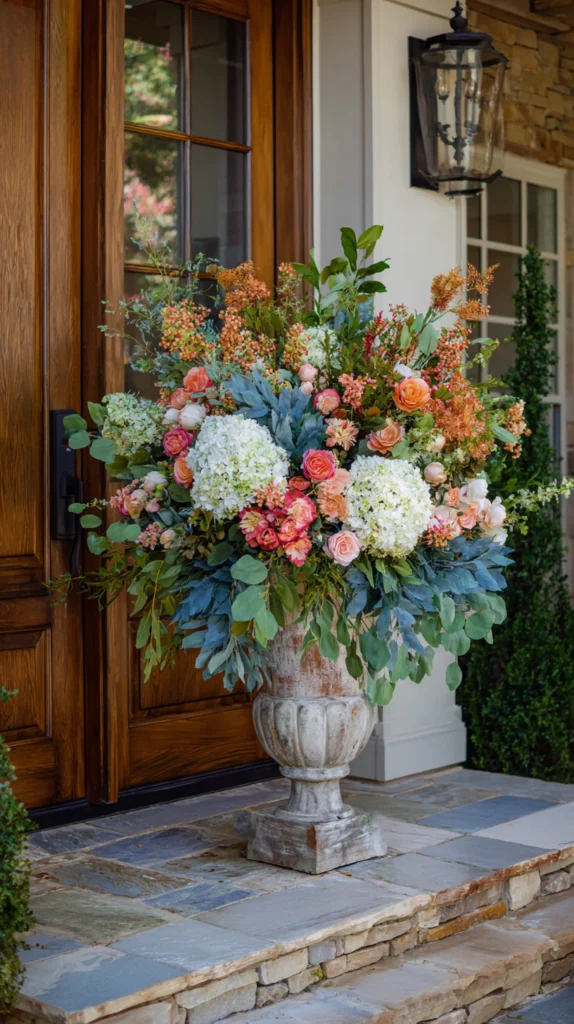
Budget: $30 – $100 per season
The most versatile faux plant approach for a front porch is a large statement urn or planter filled with a seasonal arrangement that changes four times a year — spring blooms in pastel tulips and daffodils, summer abundance in faux hydrangeas and trailing greenery, autumn richness in dried grasses and berry branches, and winter drama in frosted pine, eucalyptus, and white amaryllis. The planter stays in place all year; only the arrangement inside it changes.
This approach combines the practicality of faux plants with the seasonal rhythm that makes a front porch feel alive and cared for throughout the year. A single quality urn or planter — spent on once — costs $40–$120. Each seasonal arrangement costs $30–$80 in faux stems and branches that can be stored and reused in subsequent years.
Styling tip: Store each seasonal arrangement carefully in a labelled box at the end of its season. Faux stems and branches that are rolled loosely into a box develop permanent kinks and bends that no amount of reshaping will fully correct. Stored upright in a tall box or bin, the same stems will look fresh and convincing season after season.
The secret to a beautiful faux plant display on a front porch is the same as the secret to any good decoration — confidence, restraint, and attention to the details that matter most. Choose quality over quantity, position each arrangement where the real version would logically grow, and invest in the containers as much as the plants themselves. A front porch that looks genuinely cared for is one of the simplest and most rewarding things a home can offer, and the plants that fill it — real or otherwise — are the detail that makes it feel alive.