14 Summer Garden Lighting Ideas That Feel Magical at Night
A garden after dark is an entirely different space from the one you see by day. The boundaries dissolve, the planting becomes silhouette and shadow, and what is lit becomes the whole experience. A garden lit well at night is not simply a garden with some lights added — it is a new version of the space, one that has its own atmosphere and its own particular way of making people want to stay outside long after the temperature has dropped.
The fourteen lighting ideas below cover every budget and every garden scale — from a handful of solar stake lights placed along a path to a full wired outdoor lighting scheme with uplighters and pendant fixtures. Each one includes what it costs and a practical tip to help you get the placement and quality right before you buy.
1. String Lights Overhead
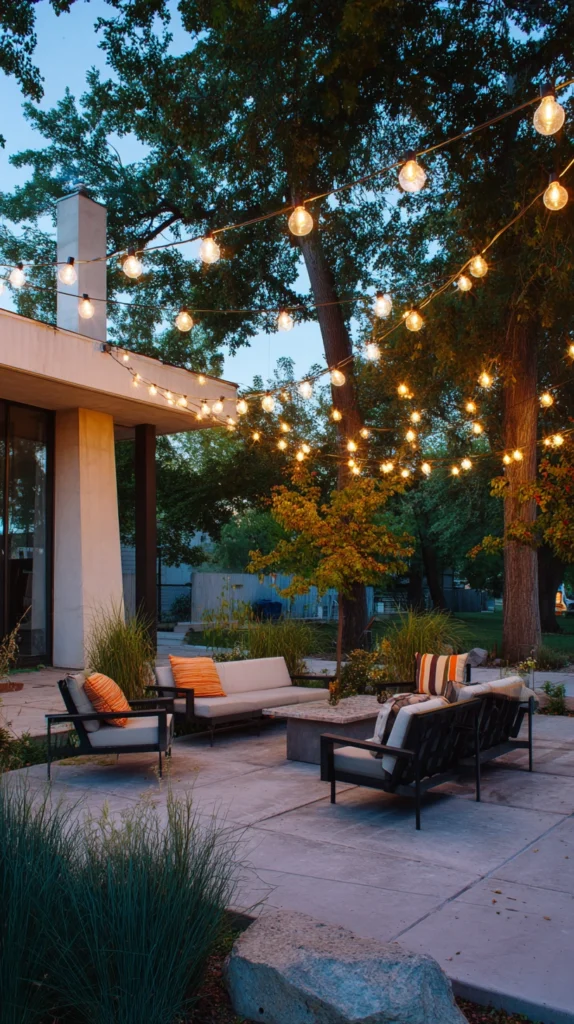
Budget: $30 – $150
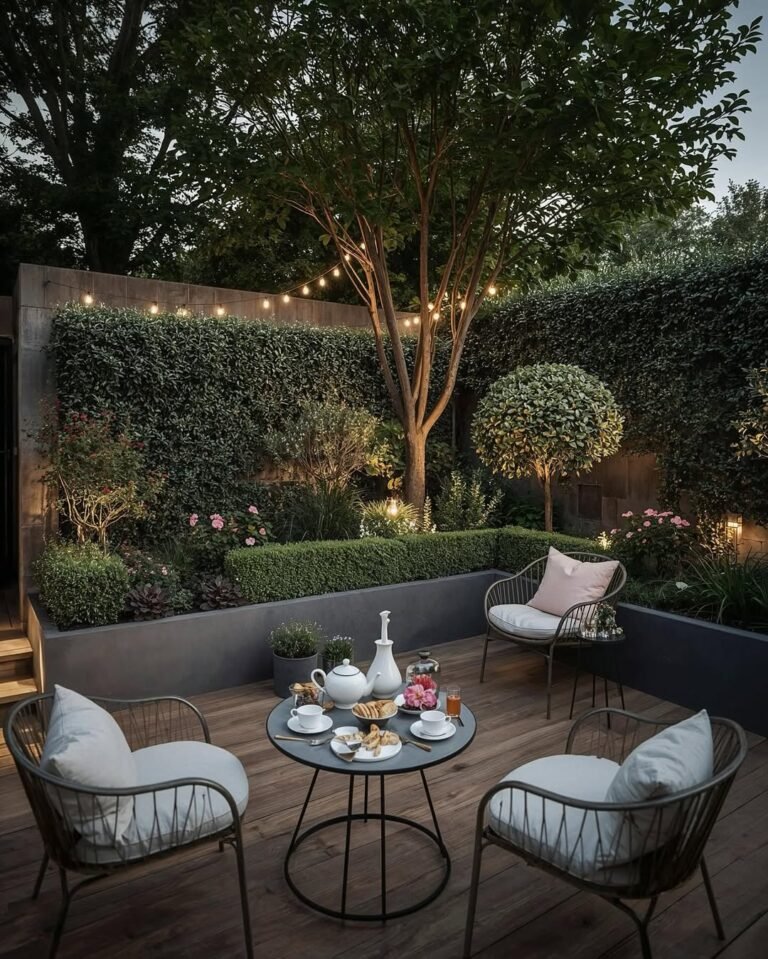
A canopy of string lights stretched above a seating or dining area is the most universally effective garden lighting idea available. The warm overhead glow at dusk transforms any outdoor space — patio, terrace, pergola, or open lawn — into somewhere that feels genuinely designed for evening use rather than simply illuminated.
Outdoor-rated string lights with warm white Edison bulbs cost $30–$80 for a 10–15 metre run. Solar-powered versions at $25–$60 require no electrical connection. Hang at 2 to 2.5 metres above head height — low enough to feel intimate and high enough to clear movement beneath. Use S14 bulb string lights rather than fairy light format for a more considered, restaurant-terrace quality that reads well even in daylight.
Lighting tip: Hang string lights between fixed points at slightly different heights rather than in perfectly level parallel lines. The slight variation in height creates a more organic, less engineered overhead canopy that looks genuinely atmospheric rather than installed. The difference between the two is immediately visible from the first evening the lights are switched on.
2. Solar Path Stake Lights
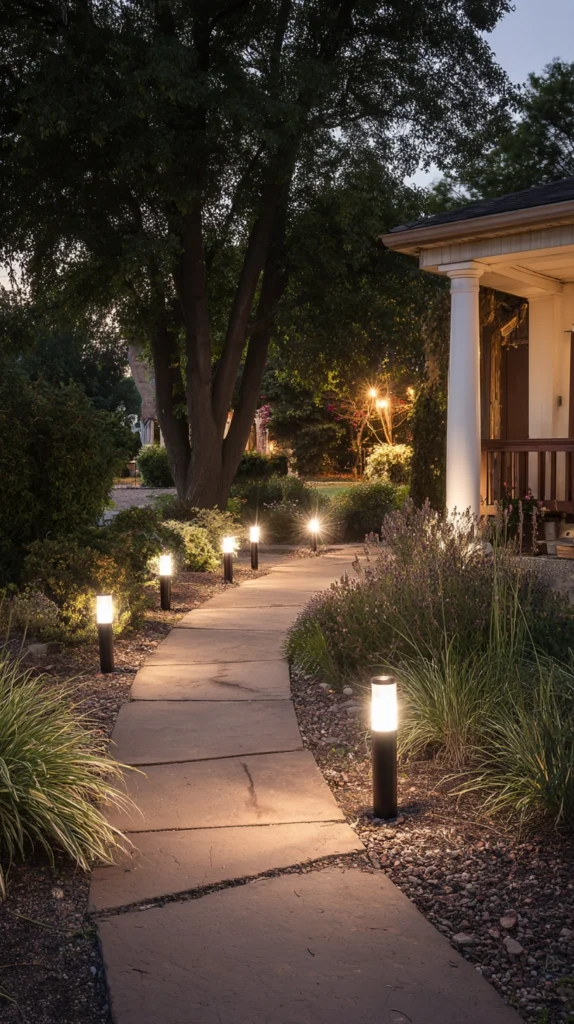
Budget: $15 – $60
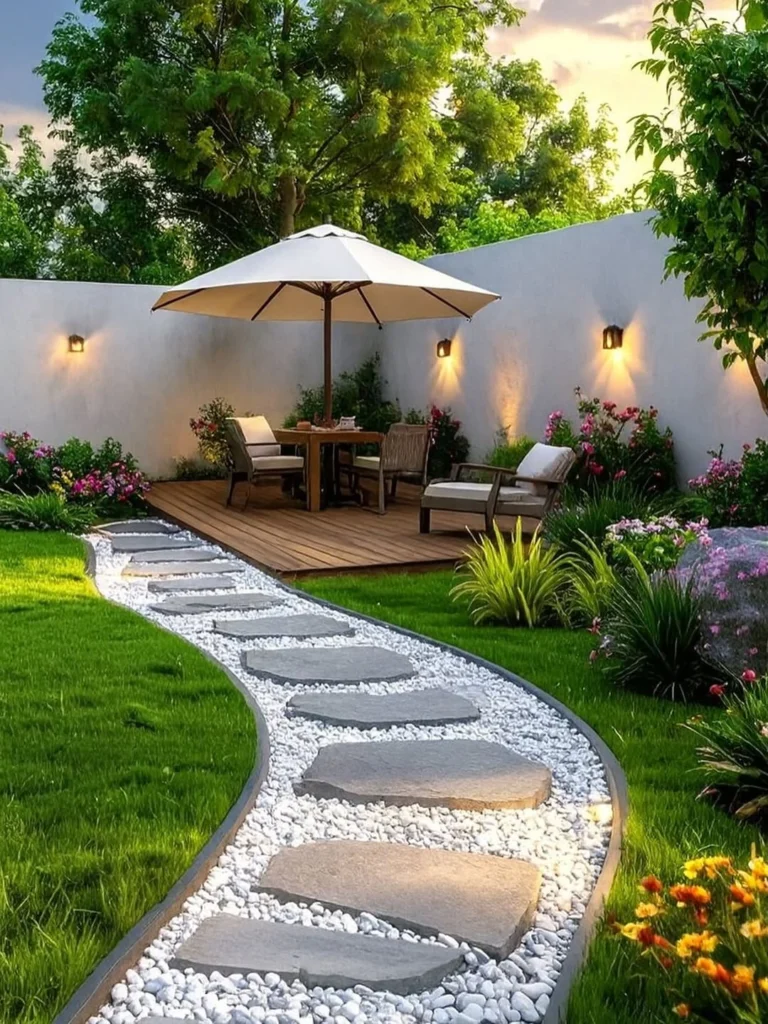
A row of solar stake lights along a garden path or lawn edge does two things simultaneously — it guides movement through the garden after dark and it defines the structure of the garden in a way that daylight, with all its competing visual information, never quite isolates as clearly.
Solar path stake lights cost $2–$8 each. A set of ten for a standard garden path runs $20–$60. Choose lights with a warm white output (2700K) rather than cool white — cool solar path lights give a garden the atmosphere of a car park rather than an evening retreat, and the colour temperature difference is the single most important purchasing decision in solar garden lighting.
Lighting tip: Position path lights alternately on each side of the path rather than paired directly opposite each other. Alternating lights create a more naturalistic rhythm along the path and cast a more even spread of light across the surface. Paired lights opposite each other produce a more formal, symmetrical effect that suits a very structured garden design but feels rigid in most informal garden settings.
3. Uplighters on Trees and Specimen Plants
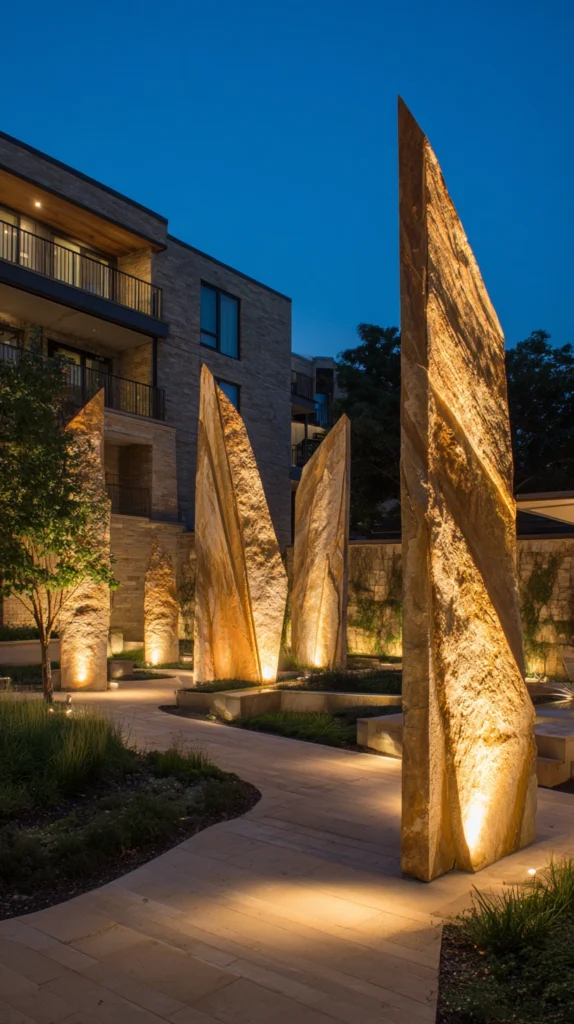
Budget: $40 – $300
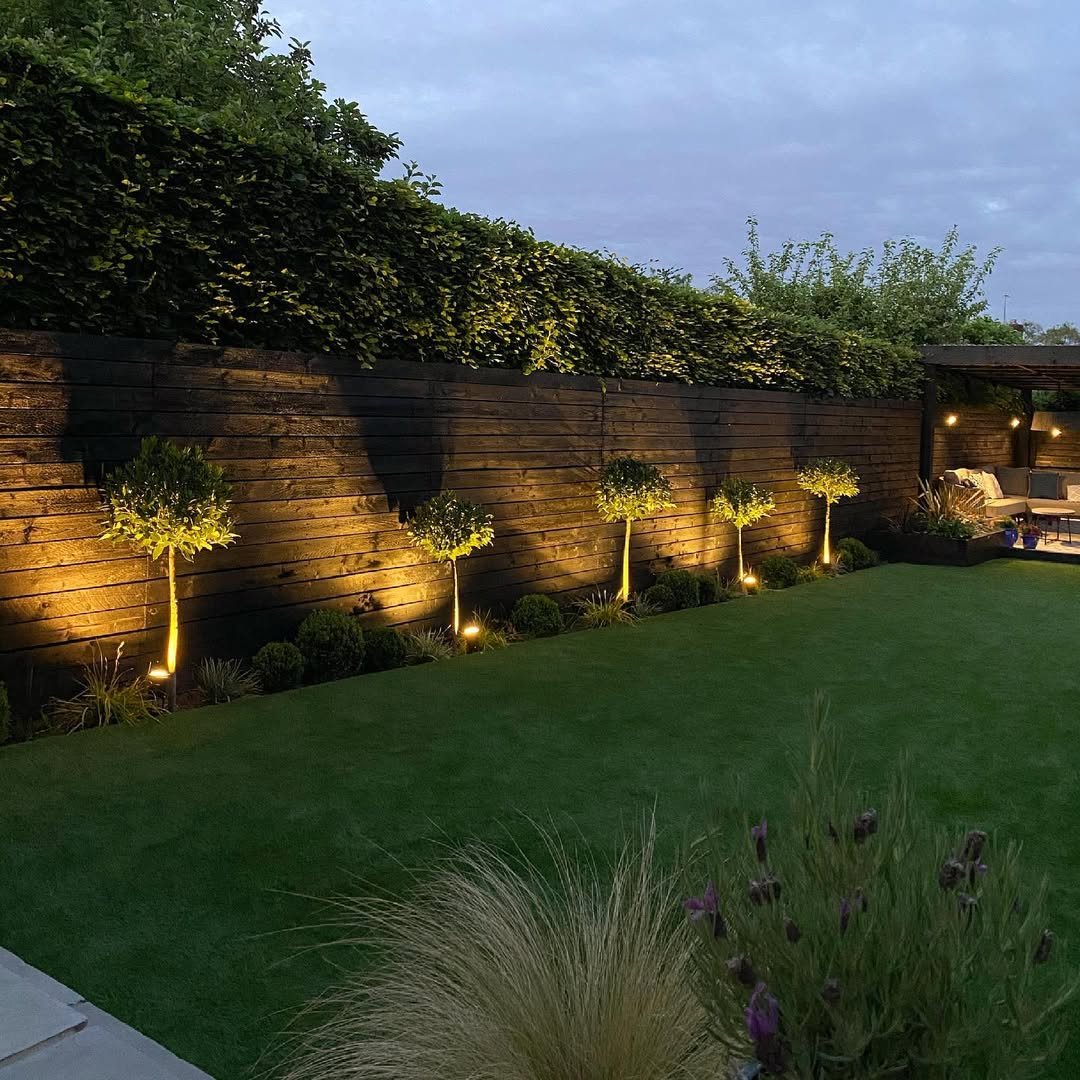
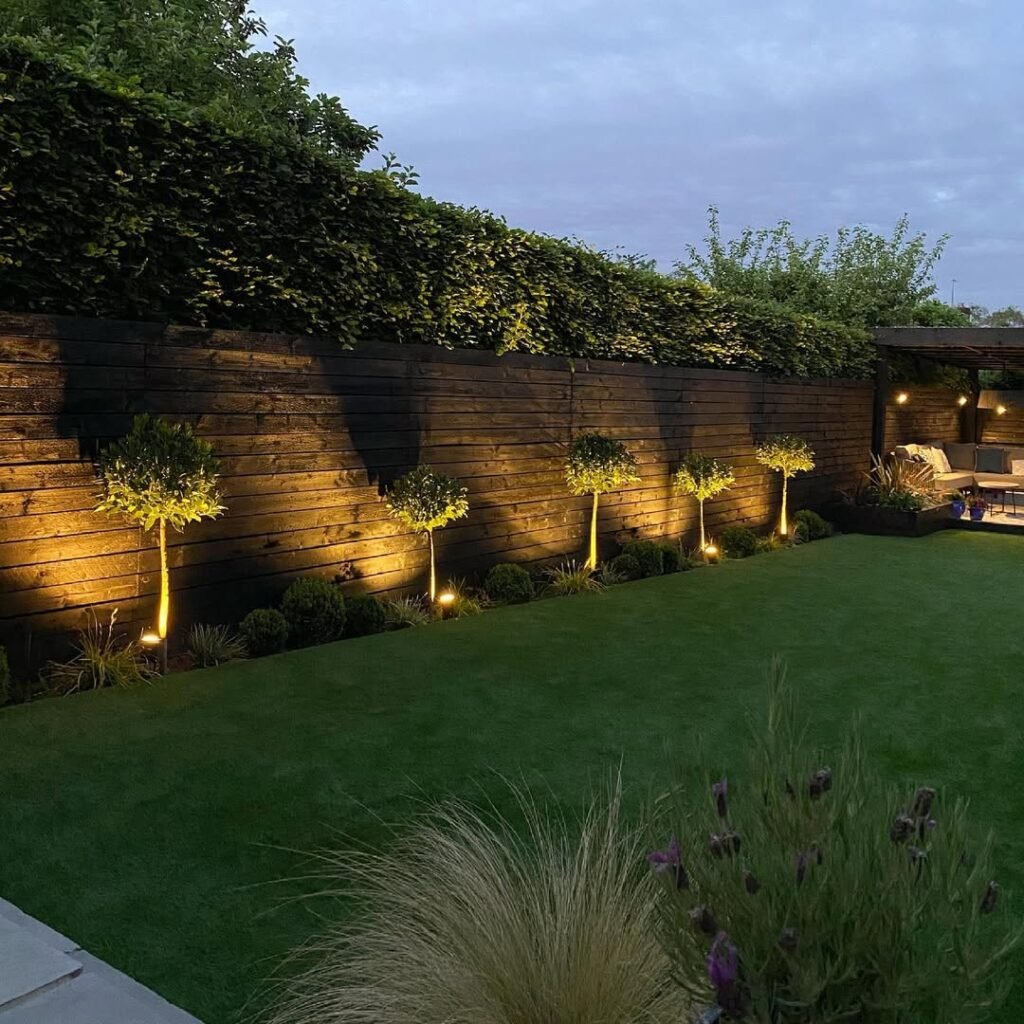
A ground-level uplighter aimed into the canopy of a garden tree or up through the stems of a large ornamental grass creates one of the most dramatic garden lighting effects available — the underlit foliage glows against the dark sky behind it in a way that makes even a modest specimen look architectural and intentional.
Solar spike uplighters cost $10–$30 each. Wired low-voltage uplighters run $20–$60 per fixture. Position the uplighter at the base of the trunk angled toward the canopy rather than aimed straight upward — a slight angle catches the undersides of the leaves more evenly and produces a fuller, warmer illumination of the whole tree than a vertically aimed light does from directly below.
Lighting tip: Uplight no more than two or three trees or large plants in a single garden. More than three uplighted specimens creates a competition for attention that reduces the dramatic impact of each individual feature. Three uplighted trees in a dark garden are spectacular. Eight are simply a garden with a lot of lights in it.
4. Lanterns Along a Path or Steps
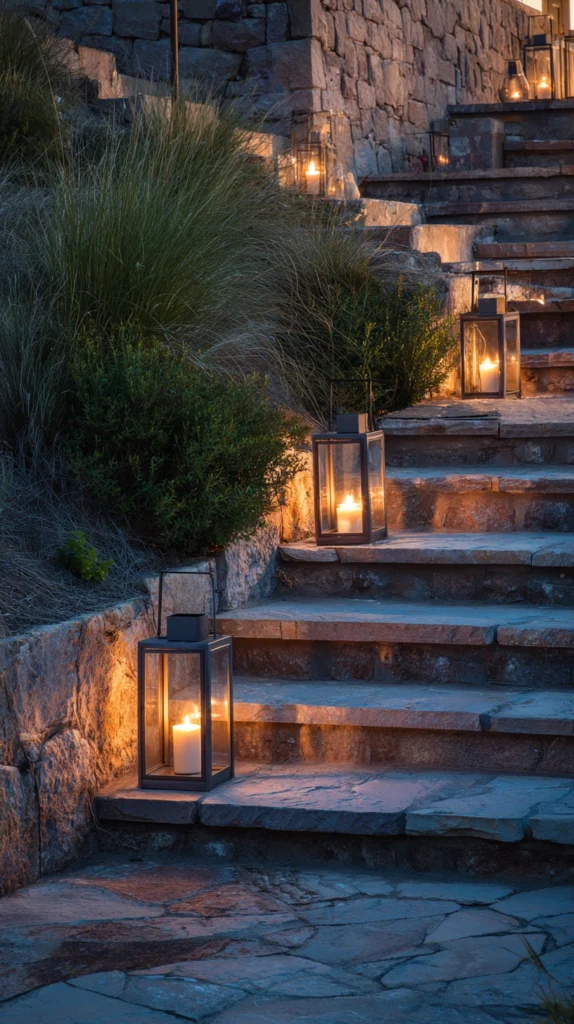
Budget: $30 – $150
A row of lanterns — Moroccan-style punched metal, simple glass hurricanes, or ceramic garden lanterns — placed along a garden path or at the edges of steps creates a warm, flickering light at ground level that is considerably more atmospheric than any fixed electric alternative at the same position.
Outdoor lanterns suitable for garden use cost $8–$30 each. A set of six along a path runs $50–$150. Battery-powered LED candles inside outdoor lanterns ($5–$15 for a set of six) eliminate the open flame risk while maintaining a realistic flicker quality that most people find indistinguishable from real candlelight at normal viewing distance.
Lighting tip: Space lanterns unevenly rather than at mathematically precise intervals. An even spacing along a path looks like a runway. An uneven spacing — slightly closer together at corners and wider on straight runs — looks like the lanterns have been placed by someone who knows the path and how it is walked, rather than measured with a tape.
5. A Fire Pit as the Central Light Source
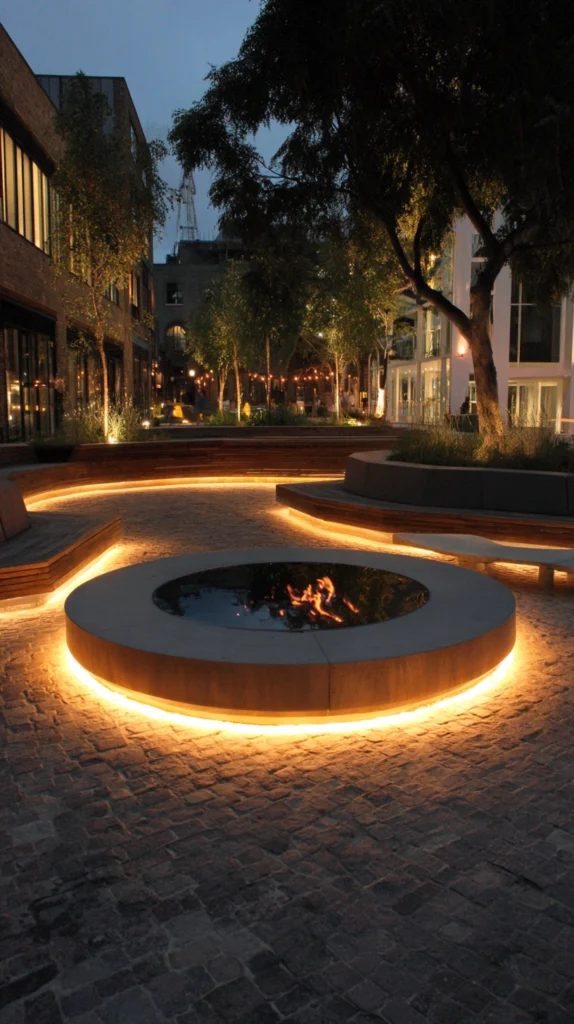
Budget: $60 – $400
Nothing in a garden produces the quality of light that an open fire does. The moving, amber flame illuminates in all directions simultaneously, casts warm shadows rather than the flat shadowless quality of artificial light, and creates a focal point around which every other outdoor activity naturally organises itself on any summer evening when it is lit.
A steel bowl fire pit costs $50–$120. A Corten steel design runs $150–$350. Position at least 3 metres from any fence or structure. The fire pit as a light source is most effective when it is the only source — turning off or dimming other garden lights when the fire is lit allows it to dominate the atmosphere completely and produces the most memorable outdoor lighting effect available in any garden.
Lighting tip: Burn hardwood rather than softwood for a cleaner, brighter, longer-lasting fire that produces less smoke. Softwood burns fast and produces sparks and smoke that disrupt the atmospheric quality of an evening fire. Seasoned hardwood logs — oak, ash, and beech — cost $5–$15 per bag and burn for two to three hours per bag with significantly better results.
6. Festoon Lights Between Posts or Trees
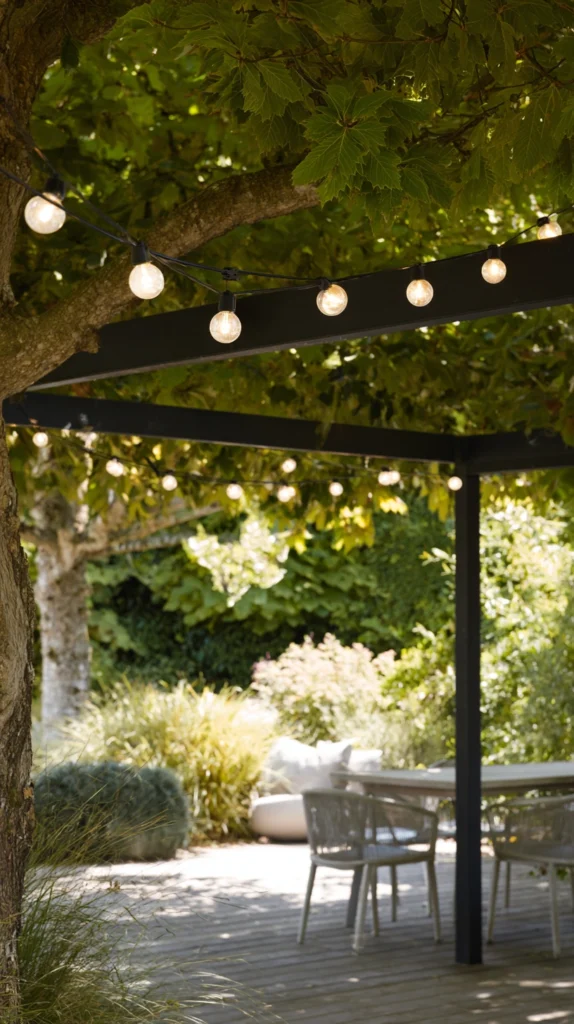
Budget: $40 – $180
Festoon lights — chunky outdoor pendant bulbs hung on a cable between two or more fixing points — create a different quality of overhead light from string lights. The individual bulbs hang at different heights on their own short cables, producing a more dimensional, less uniform canopy that suits larger garden spaces and events where string lights would look too fine and delicate.
A 10-metre festoon light run with individual pendant bulbs costs $40–$100. A longer 20-metre run runs $80–$180. Fix between timber posts driven into the ground ($15–$30 per post) or between existing garden structures at a height of 2.5–3 metres. Festoon lights are particularly effective strung across a garden party or dining area at a slight diagonal rather than in a straight line — the diagonal creates a sense of generous, relaxed abundance that a strictly parallel arrangement does not.
Lighting tip: Allow the festoon cable to dip gently between fixing points rather than pulling it taut. A slight sag in the cable is normal and deliberate — a tightly stretched festoon light cable looks strained and industrial. The gentle curve between each fixing point is what gives festoon lighting its characteristic relaxed, celebratory quality.
7. Candles in Glass Jars Along a Table
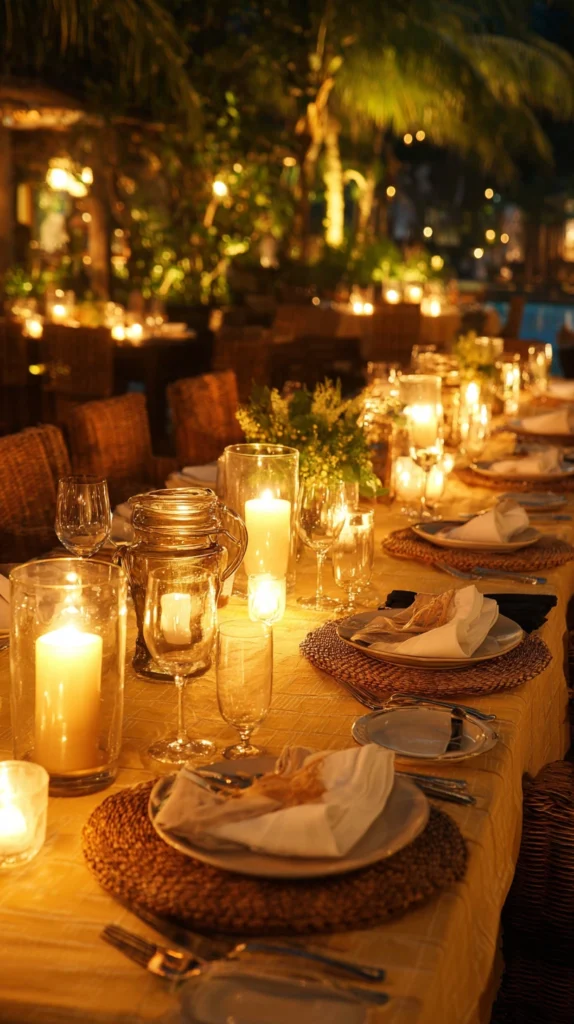
Budget: $10 – $40
Candles placed inside tall glass jam jars or hurricane glasses along the centre of an outdoor dining table create a low, warm light at table height that flatters both food and faces in a way that overhead lighting alone never achieves. The glass protects the flame from light garden breezes and turns the candle into a glowing accent object as well as a light source.
Repurposed glass jam jars cost nothing. Simple tea lights cost $3–$8 for a pack of fifty. Pillar candles in clear glass hurricanes cost $5–$15 each. Line five or seven jars down the centre of the table in an irregular arrangement rather than a straight row — the odd number and irregular spacing creates the relaxed, gathered quality that makes candlelit outdoor dining feel genuinely special rather than formally arranged.
Lighting tip: Mix candle heights along the table — some in tall jars, some in low glass holders, some as pillar candles in hurricanes — rather than using a single uniform candle type throughout. Varied heights create a layered light at the centre of the table that is more interesting and more flattering than a flat row of identical candles placed at the same height across the same surface.
8. Wall-Mounted Outdoor Lanterns
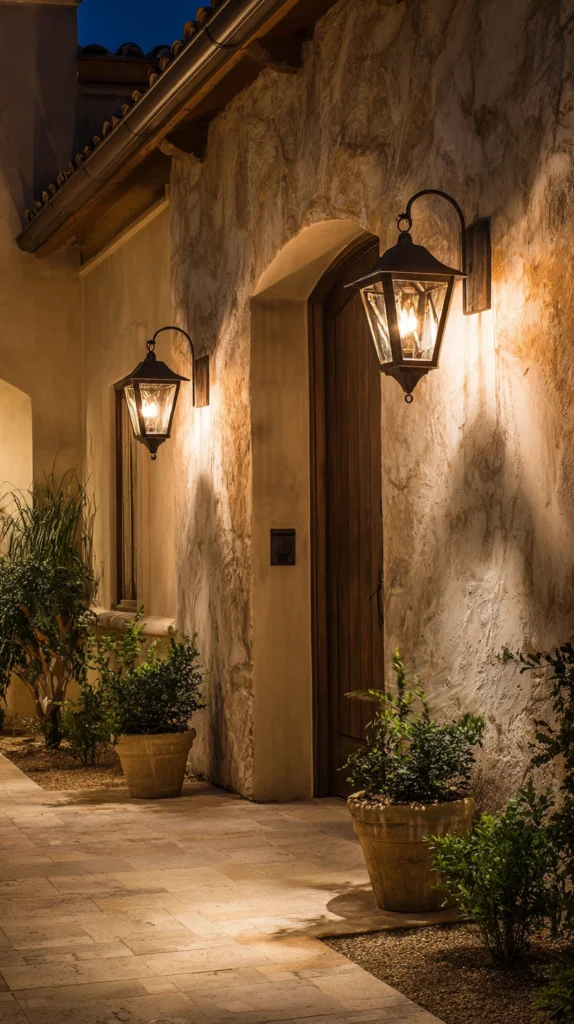
Budget: $40 – $200
A wall-mounted outdoor lantern beside a back door, at the entrance to a garden dining area, or on a garden wall provides a fixed, functional light source that also contributes to the visual character of the garden wall as a surface — particularly when the lantern is a design worth looking at in daylight as well as after dark.
Cast iron or powder-coated aluminium wall lanterns cost $40–$100. A quality lantern in a traditional or contemporary design runs $80–$200. Fit with a warm white LED bulb (2700K, 40–60W equivalent) and add a dusk-to-dawn sensor ($8–$15) that switches the light on automatically at sunset without requiring a separate switch or timer. The automatic operation means the garden is always lit at the right moment without any management required.
Lighting tip: Mount the wall lantern at eye level — approximately 1.6–1.8 metres from the ground — rather than high on the wall where most people instinctively place them. A lantern at eye level lights the face of anyone standing beneath it, illuminates the path or step immediately in front of the door, and creates a welcoming, human-scaled light that a high-mounted lantern directing its beam straight down onto the path does not.
9. Rope Lights Along a Deck Edge or Step Riser
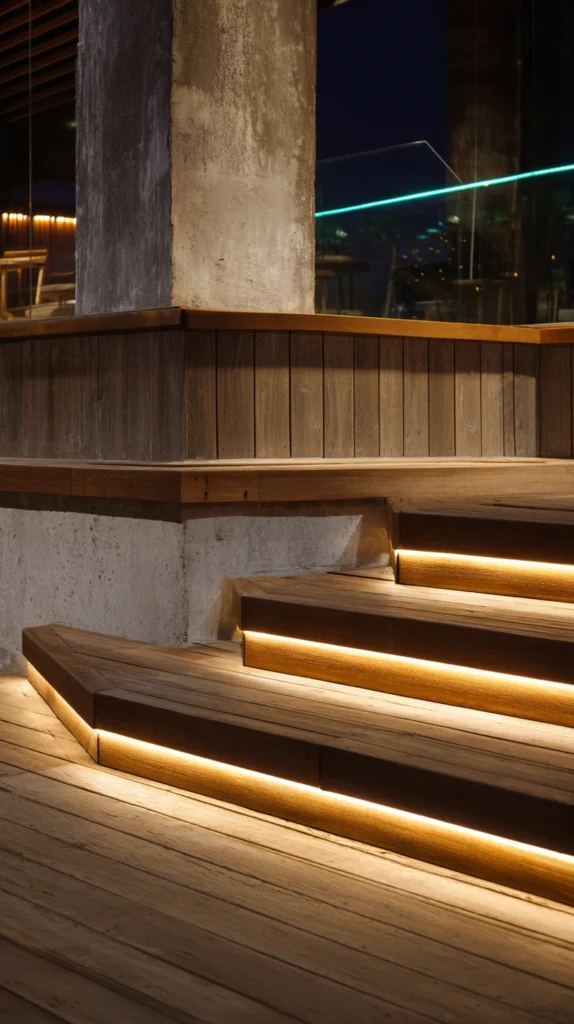
Budget: $20 – $80
Rope lights or LED strip lights fitted beneath a deck edge, along step risers, or under a raised planting bed create an indirect, ambient glow at ground level that makes the edges of outdoor structures visible after dark without introducing a direct light source into the sightline of anyone in the garden.
Outdoor LED rope lights cost $15–$40 for a 5-metre run. LED strip lights suitable for outdoor use run $20–$50 for the same length. Both require a waterproof driver and either a low-voltage power supply or a battery pack depending on installation. The light produced is subtle — supplementary rather than primary — which is exactly the right quality for step and deck edge lighting where safety and atmosphere are both considerations.
Lighting tip: Use rope lights on step risers rather than step treads. A light on the riser illuminates the edge of each step from the front, making the step depth clearly visible to anyone descending in the dark. A light on the tread shines upward into the eyes of anyone walking toward the steps and reduces visibility rather than improving it.
10. A Lit Garden Mirror
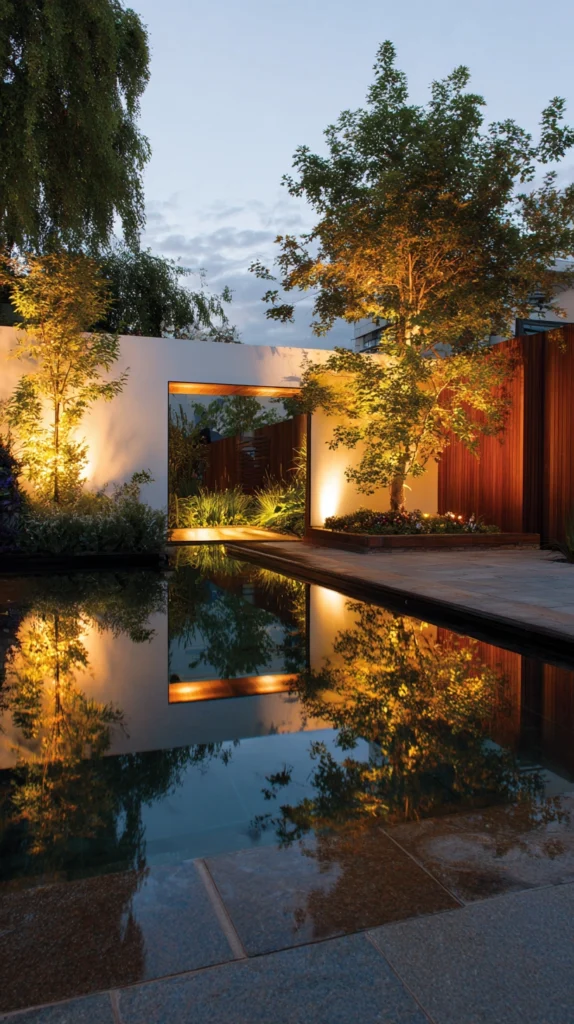
Budget: $60 – $250
An outdoor garden mirror — framed, weatherproof, and fixed to a fence or wall — doubles the apparent size of a small garden space in daylight. After dark, with a small spotlight or uplighter aimed at it from a low angle, it becomes a glowing surface that reflects the surrounding lights, candles, and fire back into the garden and creates a sense of depth in a space that might otherwise appear to end at a flat surface.
Outdoor-rated garden mirrors in circular, arched, or rectangular formats cost $60–$200 depending on size and frame material. A small 12-volt spotlight to illuminate the mirror from below costs $15–$40. Position the spotlight at the base of the mirror angled upward at approximately 30 degrees — this angle illuminates the mirror surface evenly while keeping the light source itself below the sightline of anyone sitting in the garden.
Lighting tip: Aim the light that illuminates the garden mirror toward the most visually interesting part of the garden rather than straight at the mirror’s own surface. The mirror reflects whatever the light reveals — a candle arrangement, a lit tree, a planted border — and the reflected view is always more interesting than a mirror simply reflecting the light source that illuminates it.
11. Solar-Powered Fairy Lights in Plants and Hedges
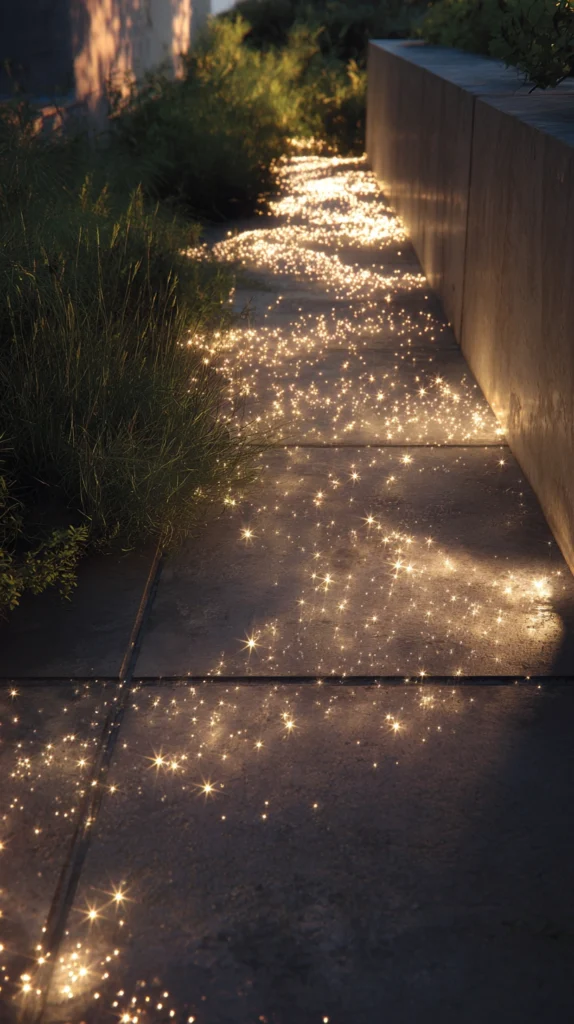
Budget: $15 – $60
Solar fairy lights woven through a hedge, trained rose, climbing plant, or dense border planting create a scattered, organic light that looks as though the planting itself is glowing rather than lit from outside — one of the most genuinely magical garden lighting effects available at the lowest cost on this list.
Solar fairy light reels of 50–100 LEDs cost $8–$20 each. Two or three reels woven through a medium-sized hedge or large climbing plant cost $15–$50 in total. Place the solar panel in a position that receives at least six hours of direct sun — the panel can be positioned separately from the lights on a longer cable in many versions, which allows the lights to be placed in a shaded hedge while the panel charges in a sunnier spot nearby.
Lighting tip: Weave the fairy light cable deep into the planting rather than running it along the surface. Lights that sit on the outside of a hedge or plant look applied. Lights woven into the interior of the planting create the illusion that the light originates within the plant itself — which is the quality that produces the most convincingly magical effect in the finished display.
12. A Lit Water Feature
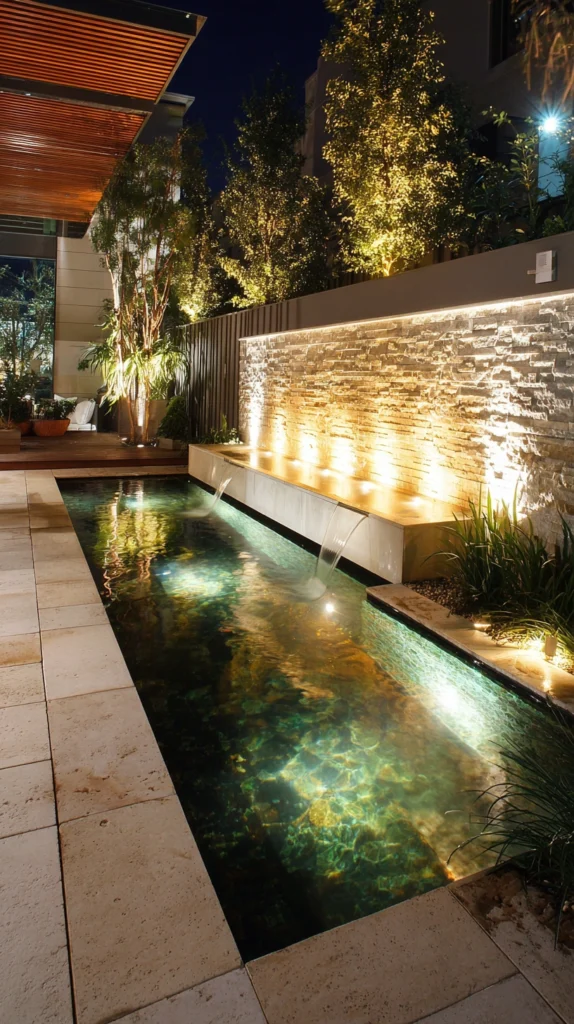
Budget: $40 – $300
A submersible LED light placed inside a garden pond, water basin, or fountain illuminates the water from below in a way that transforms the feature from a daytime focal point into a night-time one — the lit water surface glows and the ripples and movement of the water animate the light in a continuously shifting pattern that no static garden feature can replicate.
A submersible colour-changing or warm white LED pond light costs $15–$40. A solar-powered submersible fountain with integral LED lighting runs $30–$80. Use warm white underwater lights rather than colour-changing ones — a garden pond lit in alternating blue, green, and red light looks like an amusement park installation. Warm white underwater light looks like moonlight on water, which is considerably more effective as a garden lighting statement.
Lighting tip: Position a submersible light slightly to one side of the water feature rather than centrally at the bottom. A central light illuminates the water surface evenly and flatly. An off-centre light creates the rippling shadow pattern across the surrounding garden that makes an illuminated water feature genuinely atmospheric rather than merely visible after dark.
13. A Hanging Pendant Light Above the Outdoor Dining Table
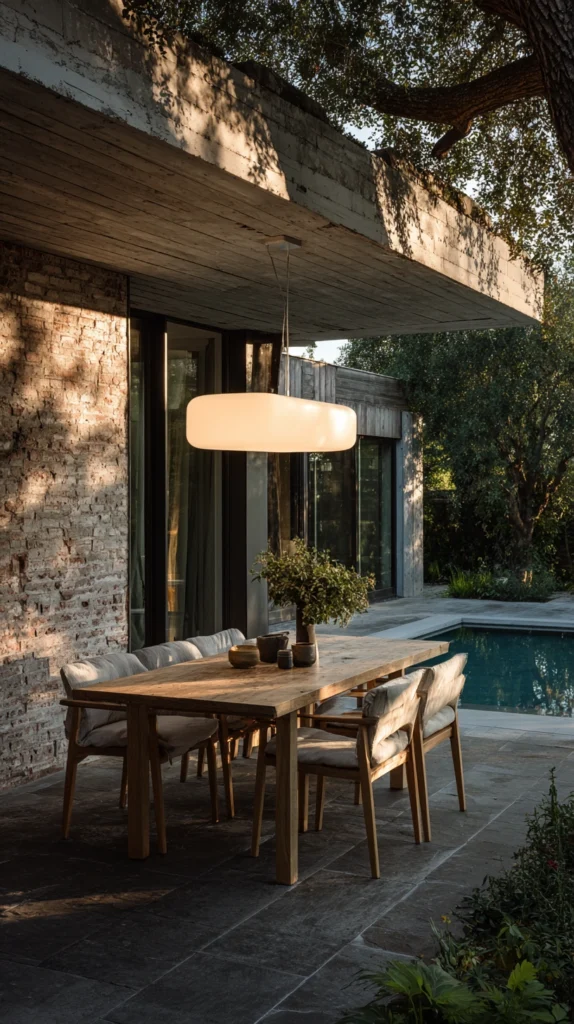
Budget: $40 – $200
A single outdoor pendant light hung directly above the centre of an outdoor dining table — from a pergola beam, a tensioned cable, or a purpose-built outdoor pendant bracket — creates the most intimate and most functional light for outdoor eating, directing its output exactly where the table is and allowing the garden beyond it to recede into atmospheric darkness.
Outdoor-rated rattan or bamboo pendant shades with weatherproof fittings cost $40–$100. A weather-resistant metal pendant in an industrial or vintage style runs $60–$150. A pendant hung at 60–75 cm above the table surface is the standard interior rule and applies equally outdoors — low enough to illuminate the table surface clearly and the faces of diners seated around it, and high enough that it does not obstruct sightlines across the table during conversation.
Lighting tip: Fit the outdoor pendant with a dimmer switch or choose a bulb compatible with a smart plug that allows brightness control. A pendant at full brightness over an outdoor dinner table is too bright for a relaxed evening — reducing to 40–60 percent of full output creates the warm, intimate light level that outdoor dining at its best always operates at.
14. Moonlighting From a Tree Canopy
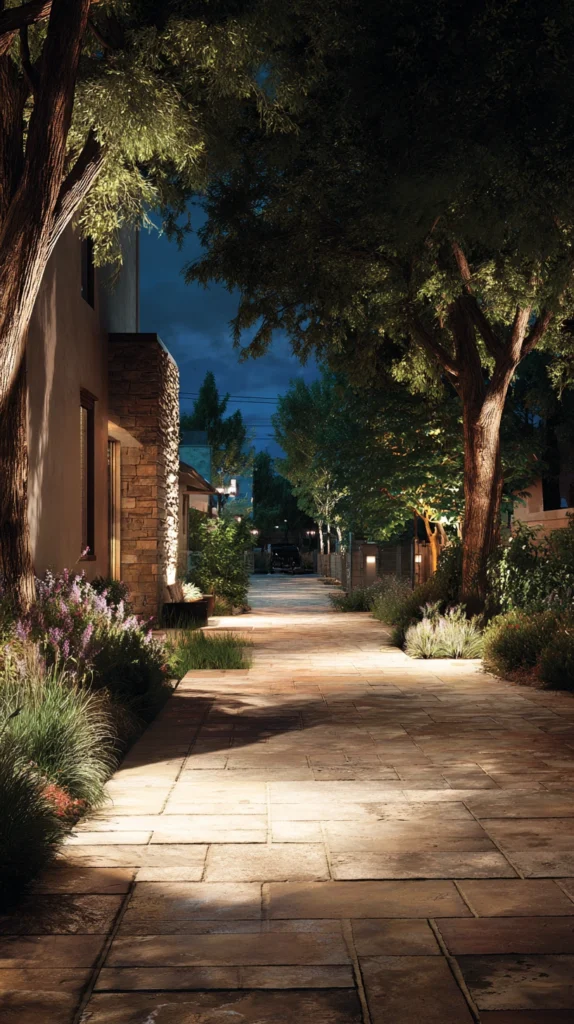
Budget: $40 – $200
Moonlighting is the technique of placing a small, cool-white or very slightly warm white spotlight high in a tree canopy and angling it downward through the branches — mimicking the effect of moonlight filtering through leaves and creating dappled, shifting shadow patterns on the ground below. It is the most naturalistic and most beautiful garden lighting technique available and one of the least commonly used by home gardeners.
A 12-volt weatherproof spotlight suitable for tree mounting costs $20–$50. A solar version with a flexible mounting bracket runs $25–$60. Mount as high in the tree as safely accessible — ideally above the main canopy — and angle downward at approximately 45 degrees through the branches. The resulting light on the ground shifts as the foliage moves in any breeze and produces a living, naturalistic light pattern that no ground-level fixture can replicate from below.
Lighting tip: Use a slightly cooler bulb for moonlighting than for other garden lighting — 3000K rather than the 2700K recommended throughout the rest of this list. Moonlight is cool and blue-white in quality and a warmer bulb from a high tree position reads as a spotlight rather than as moon. The cooler tone from elevation in the canopy creates the convincing moonlight effect that makes this the most impressive garden lighting technique available for any garden with a mature tree to work with.
Garden lighting done well is almost always more about what is not lit than what is. The most atmospheric summer gardens at night are those where darkness is treated as part of the design — where the lit surfaces and objects create focal points against genuine shadow rather than illuminating everything evenly and eliminating the mystery that makes outdoor spaces after dark so consistently compelling.
Start with the one or two ideas on this list that address the most obvious gap in how your garden works after dark — whether that is a path that is difficult to navigate, a dining area with no overhead light, or a garden that is simply dark and unused after dusk. Get those right first. Every additional layer of lighting that follows will only improve a garden that already has its foundations working properly.