14 Cozy Garden Seating Areas for Autumn Evenings
There is a particular quality to the first genuinely cold evening of autumn when you are outside and warm anyway. The air has changed. The light is different. The garden smells of damp leaves and wood smoke instead of heat and cut grass.
And the thing is: it is better than summer. Not worse. Better.
Sitting outside in July requires no effort. The evening cooperates. But sitting outside in October — warm inside the seating area while the cold air surrounds it, the fire going, the amber lights on, a blanket across the lap — that takes a little design and delivers something that summer cannot.
The cozy autumn seating area is not the summer seating area with a blanket added. It is its own thing, designed for its own conditions. The enclosure that summer seating ignores becomes essential. The warmth source that summer needed nothing from becomes the centre of the arrangement. The lighting that summer’s long evenings made secondary becomes the reason to be outside at all.
Here are 14 ways to design that thing properly.
What Makes an Autumn Seating Area Different From a Summer One
The conditions that change, and what they require:
The light:
- Summer: dark at 9pm (the evening is available before lighting is needed)
- October: dark at 6pm (the seating area must be lit from the first minute of outdoor use)
- The lighting: non-negotiable, not optional
The temperature:
- Summer: the evening often needs cooling (shade, airflow)
- Autumn: the evening needs warming (fire, heater, shelter from wind)
- The warmth source: the anchor of every autumn seating arrangement
The enclosure:
- Summer: open seating often works (the warmth keeps people outside)
- Autumn: some enclosure essential (breaks the wind, retains warmth, creates the cocoon feeling)
- Three sides enclosed: minimum for a genuinely cozy autumn setup
The materials:
- Summer: light cushions, simple furniture
- Autumn: warm-toned cushions, heavier throws, additional textiles
- The tactile warmth of the materials: part of the experience
The cozy autumn seating equation: Warmth source + enclosure + warm lighting + textiles = somewhere worth being in October
Every arrangement on this list satisfies all four.
The Seating Areas by Scale
From smallest to most elaborate — a guide to which section applies:
A single chair and a fire (the minimal): Ideas #1, #2 Two to four seats with a heat source: Ideas #3, #4, #5, #6 A full seating group with structure: Ideas #7, #8, #9, #10 The destination setup: Ideas #11, #12, #13, #14
1. The Solo Dawn and Dusk Chair (The One-Person Retreat)
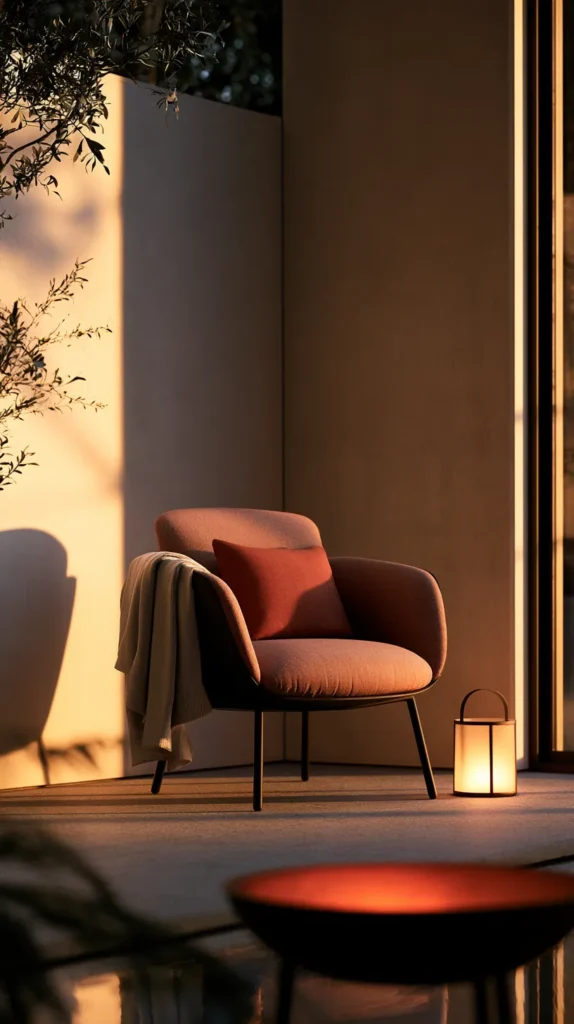
A single deep chair in the most sheltered corner of the garden, equipped for year-round solo use — the smallest possible cozy seating area, and often the most used.
Why one chair sometimes outperforms a group:
The permission to stop:
- A chair positioned for one person signals: this is for sitting, not for hosting
- The social obligation: absent
- The permission: to sit alone for 20 minutes without explanation
- The solo autumn chair: the daily retreat that a group setup cannot quite be
The requirements:
The chair itself:
- Deeply comfortable: not a dining chair or a casual perch
- Wide armrests (book and cup both)
- Deep enough to sink into rather than sit upright
- High back (protects from the wind behind)
The position:
- The most sheltered corner available (two walls or a hedge on the north and east sides minimum)
- Facing south or southwest (the low autumn sun reaches it longest)
- The sun trap corner: as discussed in previous articles, 3–5°F warmer than open garden
The kit at the chair:
What must be there without going inside:
- A thermos (already outside, always ready)
- A blanket (on the armrest, not inside the house)
- A book (in a weatherproof bag beside the chair)
- A small solar lantern (already placed, already charging)
The arrival ritual:
- Step outside, sit down, everything already there
- Zero friction: the condition that makes daily use actually happen
- Daily use: what makes a seating area worth having
The cushion:
A fixed outdoor cushion:
- Attached to the chair (not loose — loose cushions come inside and never return)
- Deep foam, outdoor fabric
- Left outside through autumn (brought in only when temperature stays below freezing)
- The fixed cushion: the chair is always comfortable, immediately
The autumn colour:
- The cushion: copper, rust, deep sage, or warm brown
- The blanket: wool or heavy cotton in matching tones
- The chair: becomes part of the autumn palette every time someone looks out from the house
Cost breakdown:
- Quality deep armchair (outdoor): $120–200
- Fixed outdoor cushion: $45
- Wool-look throw: $35
- Thermos (for outside use): $30
- Solar lantern: $18
- Total: $248–328
The solo autumn chair: used more in October than the entire summer combined. The combination of cooler air and genuine comfort and the lack of any social expectation creates something different from summer seating.
Solo Chair Tips
The visibility from the house:
- A chair visible from the kitchen window: reminds someone it is there
- Visible and inviting: used more often
- A chair in a corner not visible from any window: often forgotten
- The reminder: surprisingly powerful
The weatherproofing:
- The chair must handle light rain without damage
- Bring cushion inside only for sustained heavy rain
- Otherwise: leave everything out
- The friction of bringing things in: kills the daily habit
2. The Fire Bowl Chair Circle (The Essential Autumn Gathering)
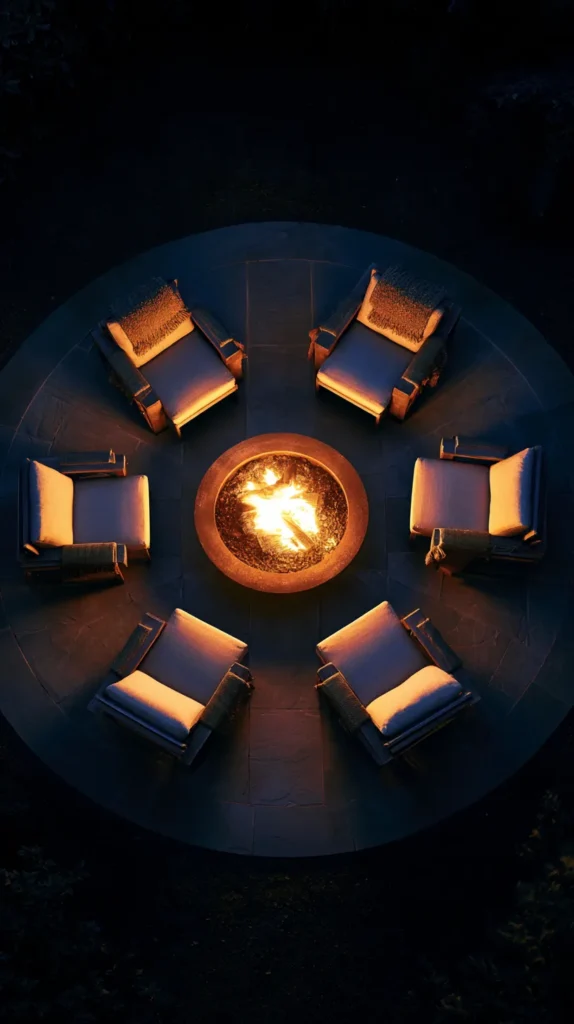
Two to four chairs arranged in a circle around a fire bowl — the configuration that keeps the most people warm with the least structure.
Why the circle is the correct arrangement:
The equality:
- No one seat is better than another
- Everyone equidistant from the fire
- Everyone equally warm
- The circle: the oldest gathering shape, still the most effective
The warmth physics:
- Fire radiates in all directions
- The circle: captures this radiation from all sides
- A row or L-shape: some seats warmer, some not
- The circle: the arrangement that serves the warmth source correctly
The fire bowl:
Selection:
Cast iron fire bowl:
- The most atmospheric
- Wood fire: the most autumnal experience (smell, sound, light quality)
- Requires wood management
- The tending: part of the ritual
Steel fire pit:
- Lighter than cast iron
- Same function
- Often more affordable
- Rusts to a warm patina over time (aesthetically correct for autumn)
Corten steel:
- The rust patina by design
- Warm orange-brown
- Modern and appropriate
- Available in various sizes
The seating:
Low and deep (always):
- The fire is at ground level
- The seating must be lower than usual to place the fire at eye level, not knee level
- Eye-level fire: the emotional experience
- Knee-level fire: the functional experience (different)
The chair height:
- Seat height: 14–16 inches (lower than standard dining/garden chairs)
- Or: standard outdoor chairs with low profile
- The low seat: the cozy signal
The chair material:
Teak (weathered to silver):
- Most elegant for a fire circle
- Weather-proof: can stay outside indefinitely
- The silver teak + warm fire light: beautiful contrast
Wicker or rattan:
- Warm-looking material
- Seasonal aesthetic
- More appropriate for a covered or semi-covered position (moisture sensitivity)
The throw (non-negotiable):
- One per chair
- On the armrest, available without standing
- The fire is not enough on its own in October
- The fire manages the ambient warmth. The throw manages the extremities.
Cost breakdown:
- Cast iron fire bowl: $80–180
- Four low outdoor chairs: $200–320
- Four throws: $80
- Total: $360–580
3. The Pergola Fire Terrace (Weather-Resistant Warmth)
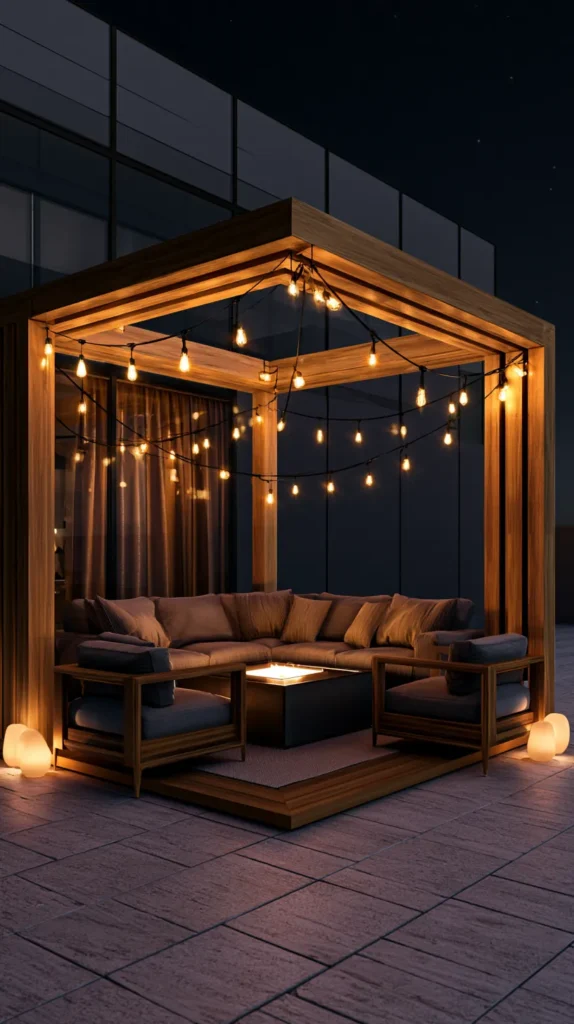
A covered pergola with an overhead heater or fire table, fully furnished for autumn sitting — the seating area that functions regardless of whether it rains.
Why a pergola changes the autumn equation:
Rain: the other enemy:
- Temperature: managed by fire and blankets
- Rain: the thing that sends everyone inside
- A covered seating area: removes rain from the calculation
- Once rain is not a reason to go inside: October evenings stay outside significantly longer
The overhead structure:
Pergola with solid roof (polycarbonate or timber):
- Rain: kept out completely
- The most weatherproof option
- Polycarbonate: lets light through (not a dark enclosed box)
- The feeling: outside, but sheltered
Pergola with shade sail:
- Water-resistant, not waterproof
- Light drizzle: handled
- Heavy rain: some gets through
- The compromise between fully open and fully covered
The heat source under cover:
Infrared overhead heater (the covered space option):
- Mounted from the pergola beam
- Heat directed downward
- Wind does not dissipate overhead-directed heat as much as ground-level radiant heat
- The covered pergola + overhead heater: the most comfortable possible combination for cold evenings
Fire table (for covered but ventilated pergolas):
- Propane or bioethanol: smokeless (essential under a covered structure)
- Wood fire under a pergola: smoke accumulates
- The propane fire table: doubles as a coffee table when unlit
- Instant on: no wood management, no waiting
The furniture:
The full outdoor living room:
- Deep sofa (weather-resistant fabric)
- Two armchairs
- Coffee table (or fire table serving this function)
- The furniture quality: matching the indoor furniture in comfort
- The indoor-outdoor boundary: dissolved
The lighting inside the pergola:
String lights along the beams:
- The ceiling of the pergola: lit from within
- Warm Edison (2700K)
- Timer: on at dusk
- The pergola at 6pm in October: the warmest-looking place in the garden
Hanging lanterns:
- From the pergola beams
- At varied heights
- The three-layer lighting principle applied vertically within the covered space
Cost breakdown:
- Pergola structure: $350–600
- Infrared heater: $150–250
- Deep outdoor sofa: $350–500
- Two armchairs: $180
- Fire table: $200–280
- String lights: $40
- Total: $1,270–1,850
4. The Sunken Fire Pit (Below Grade, Protected and Intimate)
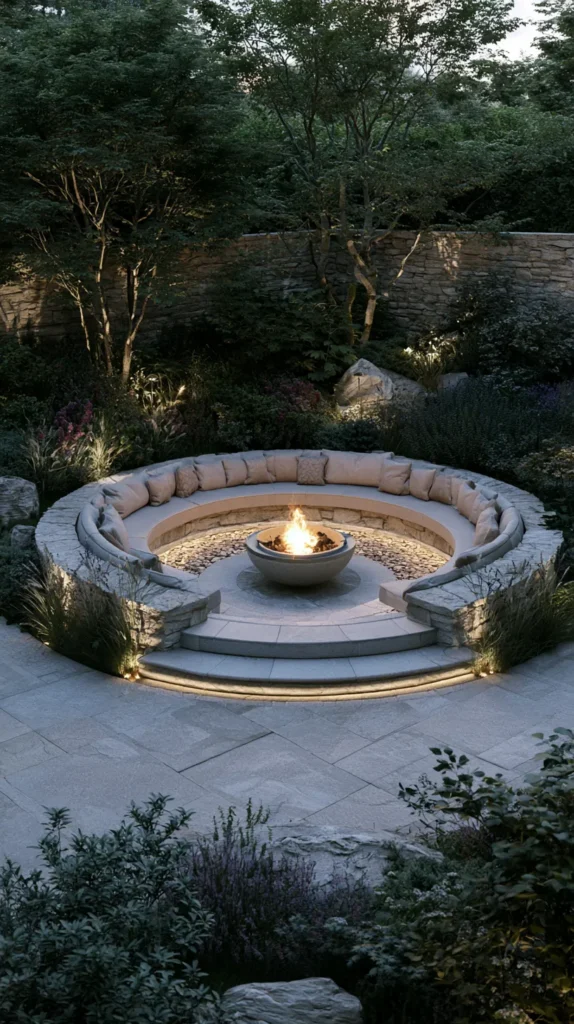
A seating area where the seats are at ground level but the fire pit is set slightly lower, or where the seats surround a depression in the garden — the arrangement that uses the earth itself as windbreak and enclosure.
Why sunken arrangements are cozy:
The wind:
- The primary comfort enemy in autumn evenings (more than temperature alone)
- At ground level: the wind is stronger
- A few inches lower: the wind passes above
- Sunken seating: uses natural physics to eliminate the wind problem
The intimate scale:
- Looking slightly upward at the garden around
- The garden: framing the seating area from above
- The contained quality: intentional enclosure without walls
- The most natural form of shelter available
The construction:
Simple version (excavated seating):
- Excavate 12–18 inches of soil from the seating area
- Level and compact
- Add gravel base (drainage)
- Seating: at the original ground level (looking slightly down into the fire area)
- Or: seating also sunken, on benches at the excavated level
The fire at the centre:
- Small fire bowl or stone-ringed fire: at the lowest point
- The fire: the visual and thermal centre
- The seating: arranged around it at slightly elevated positions
The surround:
Drystone walling:
- Low drystone walls: define the sunken area
- Seats on top of the walls (flat topped stones or timber board)
- The wall: the seating structure and the windbreak simultaneously
Raised timber edge:
- Sleepers or large timber baulks: define the edge
- The timber: warm brown, naturally insulating to sit on
- A timber board across the sleeper top: the bench
The planting around the edge:
- Low plants on the outer edge of the sunken area
- Grasses and structural planting at the lip
- The planting: softens the excavated edge and adds to the enclosure
The gravel base:
Drainage essential:
- Sunken area: accumulates rain
- 6-inch gravel base: drains through
- Landscape fabric under the gravel: prevents muddying
- The base: also warm-looking and dry underfoot
Cost breakdown:
- Excavation (DIY): $0
- Gravel base: $40–70
- Drystone or sleeper edge: $80–150
- Fire bowl: $80–150
- Seating on the wall: $0 (the wall is the seat)
- Total: $200–370
5. The Shepherd’s Hut or Garden Shed Conversion (The Autumn Room)
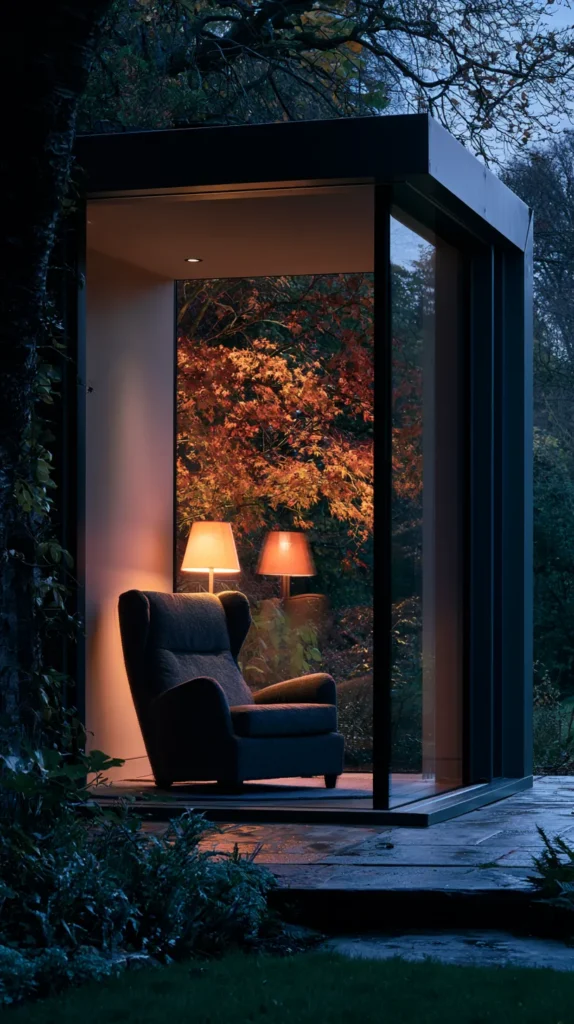
A small garden structure converted to an insulated sitting room that opens to the garden — the seating area that is definitively both inside and outside.
Why a garden room is the ultimate autumn seating area:
The door:
- The door that closes: the weather is outside
- Rain: irrelevant
- Cold: managed with minimal heating
- The garden room: the autumn outdoor space that autumn cannot close
The glass:
- Large windows or a glass-panel door: the garden visible from inside
- The warmth: inside. The view: outside.
- The best of both conditions simultaneously
- Sitting inside the garden room in October rain: experiencing the garden without being in it
The types:
Shepherd’s hut:
- Traditional corrugated tin structure on wheels
- Insulated interior (typically)
- A wood burner: the standard heating
- The most characterful autumn sitting space available
- Cost: $5,000–15,000 new. Less for vintage or secondhand.
Garden shed conversion:
- Existing shed: insulated and fitted
- Cost: $500–1,500 for the conversion
- The most affordable route to a genuine garden room
The conversion:
Insulation (most important step):
- Without insulation: cold in autumn just as the outside is cold
- Rigid foam board insulation between the wall studs
- The ceiling: insulated (heat rises — the roof loses heat fastest)
- With insulation: a small electric radiator keeps the space warm all evening
The window:
- Add a window on the garden-facing side if not present
- Or: replace the solid door with a glass-panel door
- The view: the connection to the garden even when inside
The interior:
One excellent chair:
- The best chair in the house: inside the garden room
- The incentive: the room is the best place to sit
- The room earns its use through the quality of the sitting
Warm lighting:
- One floor lamp (warm bulb)
- String lights along the roofline interior
- The garden room: always lit and warm-looking from outside
- The light through the window: the invitation
A small woodburner (for shed conversions):
- The most atmospheric heat source
- Requires flue installation through the roof
- The flickering fire through the glass door: the garden view at night
Cost breakdown:
- Shed conversion (existing shed): $500–1,500
- Insulation: $150–300
- Small electric radiator: $60
- Chair: $120–200
- Lighting: $50
- Total: $880–2,060 for a full conversion
6. The Blanket Nest (Maximum Cozy, Minimum Structure)

A deep outdoor sofa or oversized chair piled with blankets and cushions — the simplest possible cozy seating, requiring no fire and no structure beyond the furniture itself.
Why excess textiles create cosiness independently:
The nest quality:
- Blankets piled high: the signal of cozy
- Not one blanket per person: layers of blankets
- Some to sit on, some to pull over, some to lean against
- The abundance: the warmth of generosity
The nest principle:
More than enough:
- Six blankets for two people
- Twelve cushions on a three-seat sofa
- More than seems right
- The excess: the experience
The cushion architecture:
Back wall of cushions:
- Large cushions flat against the sofa back (24-inch squares)
- Smaller cushions in front of those
- Lumbar cushion across the middle
- The layered cushion wall: leans into, not sits upright against
The pull-over blankets:
- Heavy blankets folded over the sofa arm
- Available to be pulled over without standing
- Two or three for each person in the group
- The pulling-over: the signal that this is going to be a while
The shelter requirement:
The blanket nest under a pergola or covering:
- A nest without shelter from wind: the blankets blown, the cushions cold on the windward side
- A covered or sheltered position: the nest is possible
- Semi-enclosed corner (fence on two sides, pergola above): the nest works perfectly
The wind side:
- Back to the fence or wall on the prevailing wind side
- The bodies of the sitters: faces sheltered from direct wind
- The sofa positioned with this in mind
The lighting for the nest:
String lights overhead:
- The canopy of warm light
- Looking up from the reclined position: the lights above
- The nest: below the warmth of the light
Lanterns at ground level:
- Beside the sofa, not overhead
- Low warm light at sitting height
- The ground-level warm light: the cosiest possible position
Cost breakdown:
- Deep outdoor sofa: $280–450
- Outdoor cushions (8–10): $120–160
- Throws/blankets (4): $70
- Small rug under: $75
- String lights: $35
- Total: $580–790
7. The Wicker and Willow Corner (Natural Material Warmth)
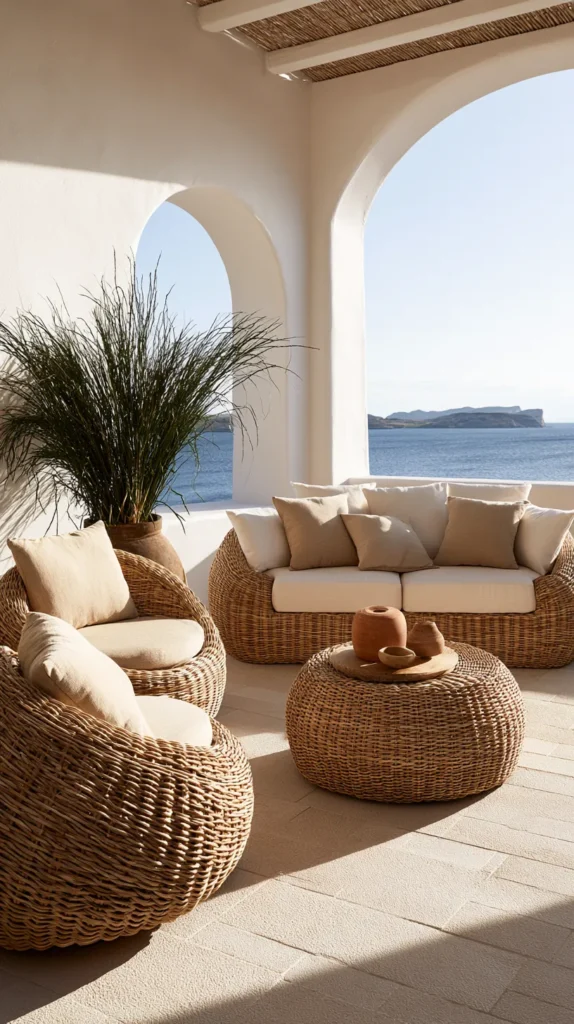
A seating area using natural wicker, rattan, or willow furniture with deep cushions — the arrangement where the materials themselves create the autumn warmth.
Why natural materials change the quality of autumn seating:
The material warmth:
- Metal furniture: cold to the touch in autumn
- Natural wicker or willow: room temperature or warmer (the natural insulation of woven organic material)
- Sitting in wicker in October: physically different from sitting in metal
- The material warmth: noticed every time
The aesthetic appropriate to the season:
Wicker furniture in summer:
- Slightly tropical, slightly resort
- Works but not specific to the season
Wicker furniture in autumn:
- Perfectly appropriate — the natural brown tones harmonise with the autumn palette
- Warm and organic: belongs to October
- Against autumn planting or a dark fence: the most visually correct material for the season
The styles:
Hanging wicker egg chair:
- The single piece of garden furniture most saved on every platform currently
- The enclosed form: creates cocoon quality around the sitter
- Hanging: slight movement, slightly detached from the ground
- With a deep cushion: genuinely comfortable for hours
Wicker sofa and chairs:
- The traditional garden conversation set in natural wicker
- Deep cushions: the critical upgrade from shallow
- The cushion depth: the whole comfort difference
- Wicker with 4-inch cushion: adequate. With 6-inch cushion: genuinely comfortable.
Willow chair (handmade or woven):
- More rustic than rattan wicker
- Entirely natural material
- More seasonal character — less “garden furniture,” more “this belongs here”
- Often found secondhand at antique markets
The positioning:
Against the warmest wall:
- The wicker corner: in the sun-trap position
- Retains heat from the day’s sun
- The natural material of the furniture + the warm wall behind: maximum afternoon warmth
With a canopy above:
- Wicker furniture is moisture-sensitive
- A pergola or shade sail overhead: significantly extends the season for wicker
- Or: storing cushions inside, leaving the frames outside
- The frames: dry quickly. The cushions: do not.
Cost breakdown:
- Wicker sofa (two-seater): $150–300
- Two wicker armchairs: $130–200
- Deep cushion set: $80–120
- Small side table: $45
- Total: $405–665
8. The Raised Decking Seating Area (A Stage for the Autumn Garden)
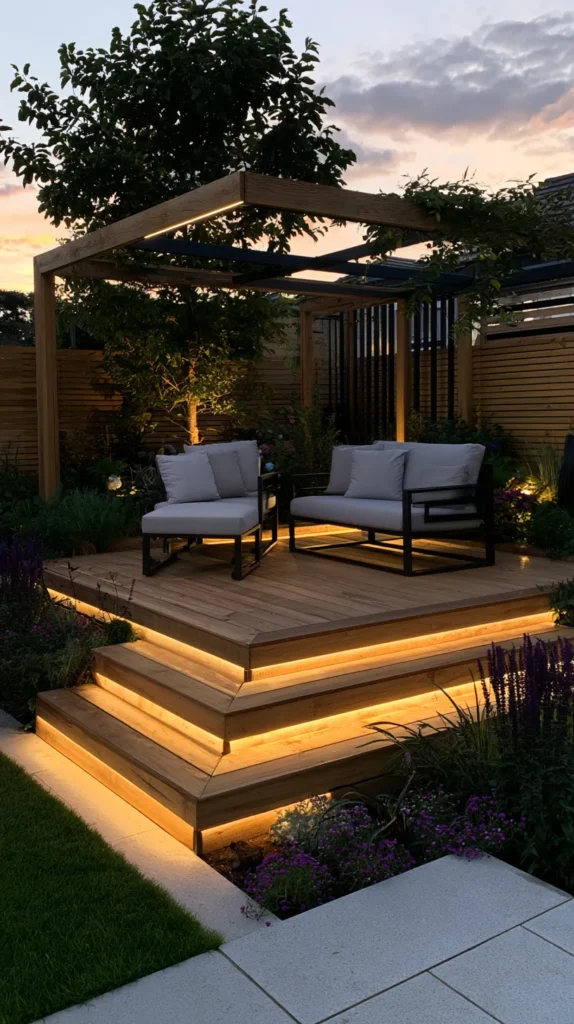
A slightly raised timber deck as the base for the autumn seating area — the structure that visually separates the seating from the garden and creates the sense of being in a room.
Why elevation changes the experience:
The stage effect:
- The seating: at a different level from the surrounding garden
- The garden: visible from slightly above
- The perspective: transformed by even 8–12 inches of elevation
- The raised area: a room with its own floor level
The enclosure from above:
- A raised deck area + pergola or shade structure above: creates a complete three-dimensional room
- Below: the deck (the floor)
- Above: the covered structure (the ceiling)
- Around: the railing or low planted border (the walls)
- The room: complete
The deck material:
Hardwood (teak or ipe):
- Weathers to silver over time
- Most durable
- The most elegant material
- Cost: high initially, but lasts indefinitely with minimal care
Composite decking:
- Low maintenance
- Consistent appearance year after year
- Available in warm wood tones
- The practical alternative to hardwood
Reclaimed timber boards:
- Already aged and weathered
- Character from the first day
- Often the most affordable
- The patina: appropriate for an autumn seating area
The railing:
Low-level railing (18–24 inches):
- Defines the deck perimeter without blocking views
- Something to lean against
- Often the detail that makes the deck feel finished
Planted border instead of railing:
- Grasses or low shrubs at the deck edge
- Soft edge rather than hard
- The garden: growing up to the deck level
- The deck: integrated into the garden rather than imposed on it
The autumn lighting on a deck:
Uplights in the deck boards:
- LEDs flush into the deck surface
- Warm amber light from below
- The deck surface illuminated from within
- The most integrated deck lighting available (requires installation during build, not retrofit)
Deck rope lights:
- Along the railing or deck edge
- Warm, low
- Simple to install and effective
Cost breakdown:
- Small hardwood deck (10×12 feet): $800–1,500
- Pergola above: $350–600
- Furniture: $300–500
- Lighting: $80–150
- Total: $1,530–2,750
9. The Enclosed Hedge Room (The Living Walls Version)
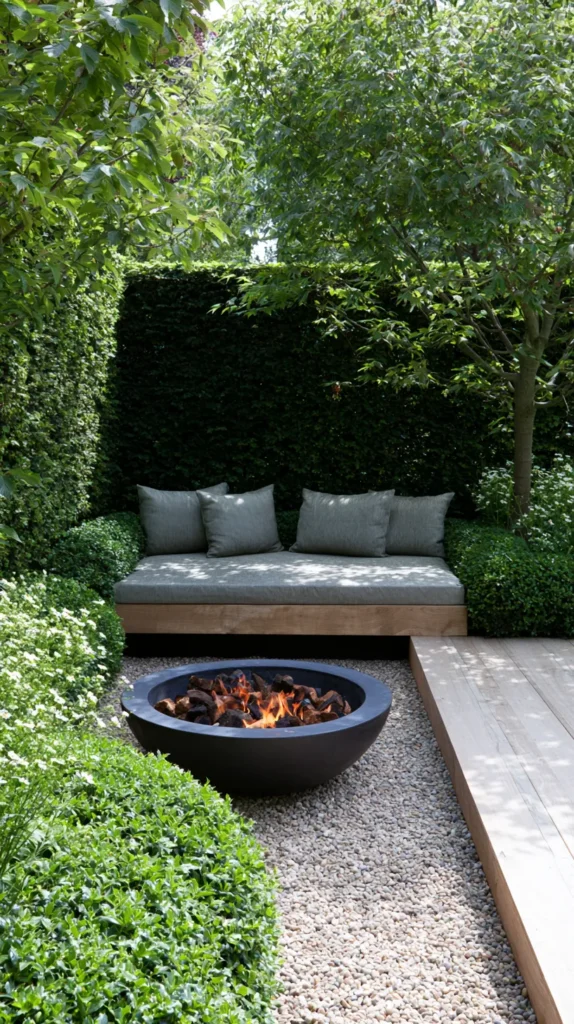
A seating area enclosed on three or four sides by hedging or dense planting — the garden room that grows into place over time.
Why a hedge enclosure is the most transformative autumn seating structure:
The sound:
- A tall hedge on three sides: reduces wind noise significantly
- The acoustic enclosure: a quieter, calmer space
- Even traffic sounds: reduced by 50% or more by dense hedging
- The seating area inside: a different acoustic world from a few feet outside
The warmth retention:
- The hedge: blocks wind from multiple directions
- The microclimate inside a hedge enclosure: 5–8°F warmer than open garden on a calm night
- More significantly: 10–15°F warmer on a windy night
- The hedge walls: the most effective windbreak available
The growth timeline:
Year one:
- Hedging planted
- Little enclosure effect
- The season: planting year
Year three:
- Significant height (4–5 feet, depending on species)
- Beginning to feel enclosed
- The enclosure quality: present but developing
Year five:
- Full height (6+ feet)
- The enclosed room: complete
- The investment: fully paid
The species:
Yew (most beautiful, slowest):
- The finest hedging plant
- Dense, clippable to perfect flatness
- Takes 5 years to the first real enclosure
- Worth every year of waiting
Hornbeam (fastest to enclosure):
- Faster than yew
- Keeps its dead leaves through winter (privacy and sound protection year-round)
- Can be shaped to create an entrance arch
- The fastest route to the full enclosed hedge room
Beech:
- Similar to hornbeam in copper-leaf retention through winter
- The dead leaf: the most beautiful winter hedge colour
- Clips well
- More widely available than hornbeam
Instant alternative (bamboo):
- Clumping bamboo in root barriers
- Significant height within one season
- Year one: 6+ feet
- The instant screen: not as beautiful as yew but immediate effect
- Combined with slower hedging: the bamboo provides the enclosure while the hedge grows
Inside the enclosed room:
The simplest furnishing:
- One or two benches (stone or wooden)
- A small water feature (the sound within the enclosure: remarkable)
- Minimal planting inside (let the hedge walls be the planting)
- The restraint: the room is the design. The furniture: serves it.
Cost breakdown:
- Hornbeam hedge (15 plants for three-sided enclosure): $120
- Simple stone bench (one): $80
- Small water feature: $90
- Total: $290 to plant, growing into its value over 3–5 years
10. The Copper and Dark Palette Seating Area (The Designed Aesthetic)
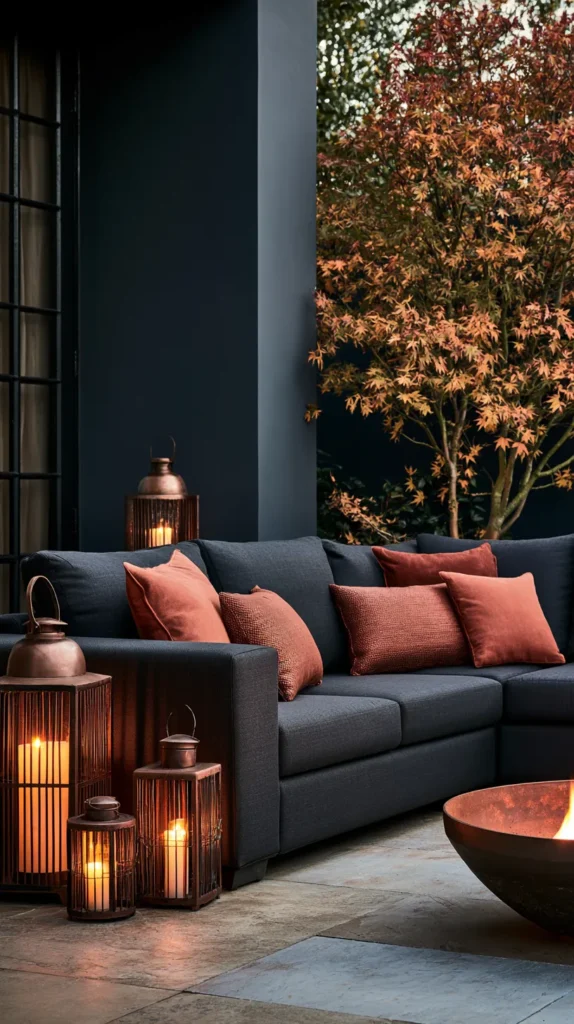
A seating area styled specifically in the autumn palette — dark furniture, copper and rust accessories, warm amber lighting — the arrangement designed around the season’s visual character.
Why a colour-designed seating area feels more intentional:
The seasonal palette:
- Summer seating: often light, airy, pale tones
- Autumn seating: the palette shifts to match the season
- Not decoration but design — the colours of the seating area in conversation with the colours of the season
- The visitor: feels the match without being able to name it
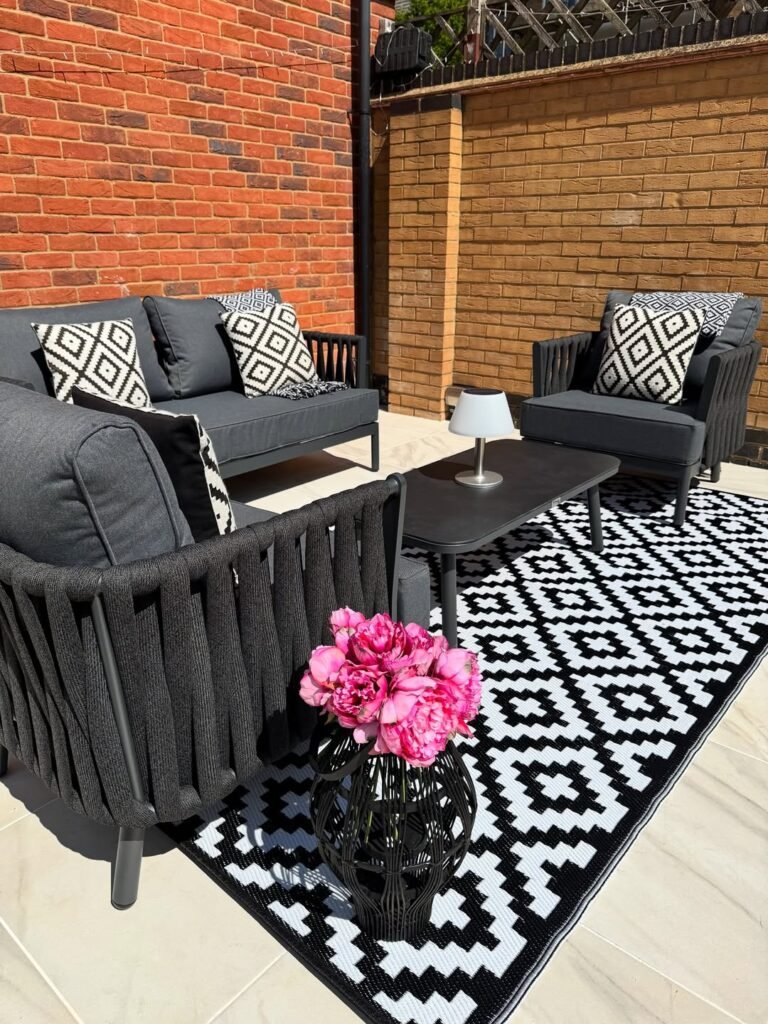
The palette:
The dark furniture foundation:
- Dark charcoal or near-black furniture (powder-coated aluminium, painted steel, or dark-stained timber)
- The dark base: against which the autumn palette reads
- Dark furniture + autumn lighting: the warmth of the light is amplified by the dark surface
The copper and rust cushions:
- Two primary copper or burnt orange cushions
- One or two in deep rust
- An accent in warm burgundy or plum
- The cushion palette: October in a handful of textiles
The warm metal accessories:
Copper lanterns:
- The material: appropriate for the season
- Warm copper-amber glow inside
- The metal: matching the cushion colour
- The lanterns and the cushions: speaking the same material language
Rusted steel or corten elements:
- A corten steel fire bowl (ages to warm rust)
- Or: a corten steel planter nearby
- The warm rust: the season’s most distinctive material colour
The botanical additions:
Dried grasses in a dark pot:
- A tall grass (stipa, pampas, or miscanthus) in a dark glazed pot
- Beside the seating
- The feathery plumes at eye level when seated
- Moving in autumn wind: the aliveness
Copper-toned autumn plants:
- Heuchera in copper or bronze tones
- In a terracotta pot beside the seating
- The plant colour: matching the cushions
The lighting:
Only warm amber sources:
- 2200K–2700K throughout
- The cool white source: ruins the palette (the warm copper and rust read differently under cool light)
- Warm light: amplifies the copper and rust tones
- The palette: complete only with the correct lighting temperature
Cost breakdown:
- Dark outdoor furniture set (2-seater + 2 chairs): $350–550
- Copper and rust cushions: $90
- Copper lanterns (3): $65
- Dried grass in dark pot: $45
- Corten steel fire bowl: $180
- Warm string lights: $35
- Total: $765–965
11. The Outdoor Cinema Seating Area (Autumn Evening Entertainment)
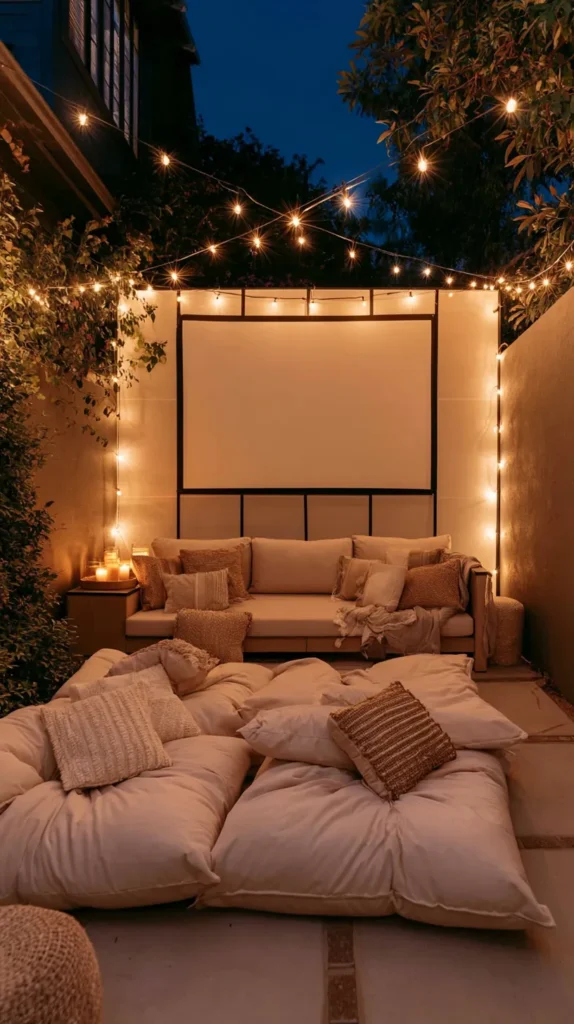
A seating area designed around a projector and screen for autumn outdoor film nights — the setup that creates a specific and memorable autumn gathering.
Why outdoor cinema is better in autumn than summer:
The darkness:
- Summer outdoor cinema: must wait until 9pm or later for darkness
- Autumn outdoor cinema: begins at 6pm
- More time available, earlier in the evening
- The film: started before anyone is tired
The blankets:
- The outdoor cinema requires everyone to be warm
- The autumn brings blankets as a natural element
- The blanket + cinema + warm drink: the combination specific to this season
The setup:
The projector:
- 3000+ lumens for outdoor use in partial darkness
- Earlier autumn evenings: some ambient light still present at the start
- Higher lumens: the advantage
- The screen visible: from the start of the film rather than the halfway point
The screen:
- A pale section of fence (painted matte white)
- Or: a retractable or inflatable screen
- Or: a pale canvas sail
- The screen size: as large as the space allows
The seating for cinema:
Layered seating:
- Back row: the standard outdoor seating (sofa, chairs)
- Front row: cushioned floor seating (outdoor floor poufs, large cushions, a folded blanket)
- The layer: children in front, adults behind
- Or: all adult, all floor level — reclining on large cushions under the sky
The floor layer:
- Giant outdoor floor cushions (30×40 inches)
- A large picnic blanket as the base
- Additional throw blankets
- The nest quality: the floor cinema is the cosiest version
The warm drink station:
- Beside the seating (not requiring a trip inside during the film)
- Thermos of mulled cider, hot chocolate, or warm spiced apple juice
- Self-service throughout the film
- The warm drink in hand while watching outdoors in October: the specific pleasure of autumn cinema
The lighting:
Before and after the film:
- Warm string lights for the gathering and the post-film conversation
- Turned off for the film itself (darkness required)
- The transition: lights off signals the film beginning
- Lights on after: signals the film over, the evening continuing
Cost breakdown:
- Portable projector: $200
- Inflatable screen: $80
- Outdoor floor cushions (4): $80
- Additional blankets: $50
- Warm drink station: $35
- Total: $445
12. The Pergola Dining Area for Autumn Evenings (Al Fresco Extended)
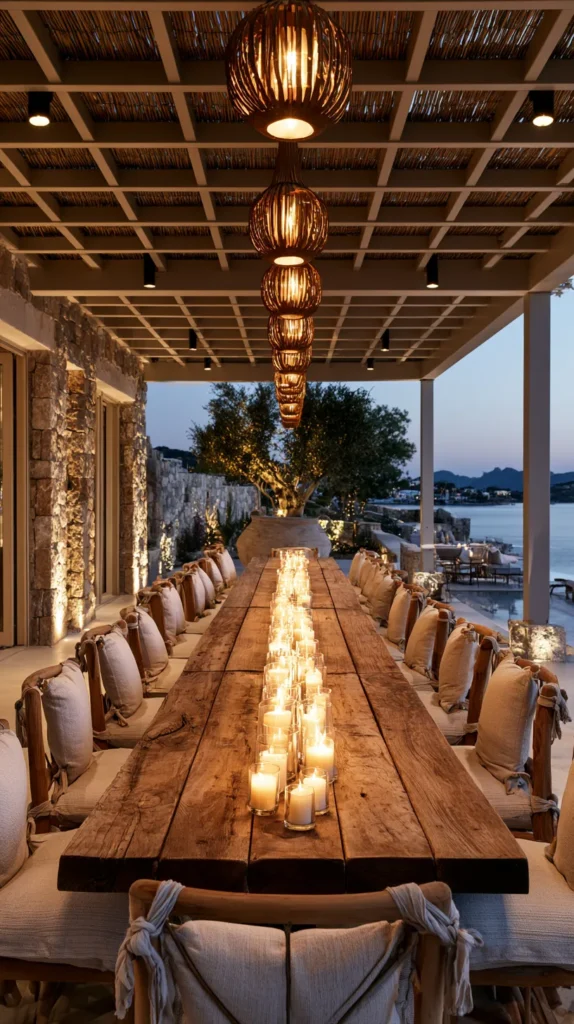
A covered pergola dining area, fully equipped for outdoor meals into late autumn — the setup that makes a meal outside in October not just possible but specifically pleasant.
Why outdoor dining in autumn is worth designing for:
The experience:
- October dinner outside by firelight and candles
- Cool air, warm food, the smell of autumn
- Something specifically autumn that no other month provides
- The design: enabling the experience
The covered dining:
A pergola over the table:
- Rain: managed
- Wind: reduced
- The table: available regardless of autumn weather
The table itself:
Long and generous:
- A long table: seats more, creates a convivial feeling
- 6-foot minimum for the full autumn dining experience
- Stone or thick timber top: retains warmth throughout the meal
The table setting for autumn:
The centrepiece:
- Five pillar candles at varied heights
- Dried seed heads and botanicals around the base
- Hurricane glasses over the candles (the wind problem)
- The table: lit and beautiful before guests arrive
A runner of natural materials:
- Dried eucalyptus laid along the centre
- Small pumpkins or gourds at intervals
- Pine cones, acorns, or autumn leaves as scatter
- The table surface: the season expressed in objects
The chairs:
Cushioned for duration:
- A long autumn dinner: two to three hours at the table
- Uncushioned chairs: uncomfortable after 45 minutes
- A thin tie-on cushion for each chair: the simple comfort solution
- The cushion: already on the chair before guests arrive
The overhead lighting:
A pendant above the table:
- Outdoor-rated pendant
- 30 inches above the table surface (restaurant standard)
- Warm bulb (2200K)
- The pendant: making the table feel like a destination
The heat:
The table-level heat:
- The overhead heater (as in Idea #3) directed down toward the table
- Or: a small fire bowl beside the table
- Or: the fire table replacing the coffee table (combining heat and dining surface)
- The heat: present throughout the meal, not just before
Cost breakdown:
- Long outdoor table: $220–350
- Six cushioned chairs: $300–450
- Overhead pendant: $55
- Centrepiece materials: $20
- Table candles and hurricanes: $35
- Overhead heater: $150
- Total: $780–1,060
13. The Fire Pit and Star-Gazing Area (The Night Garden)
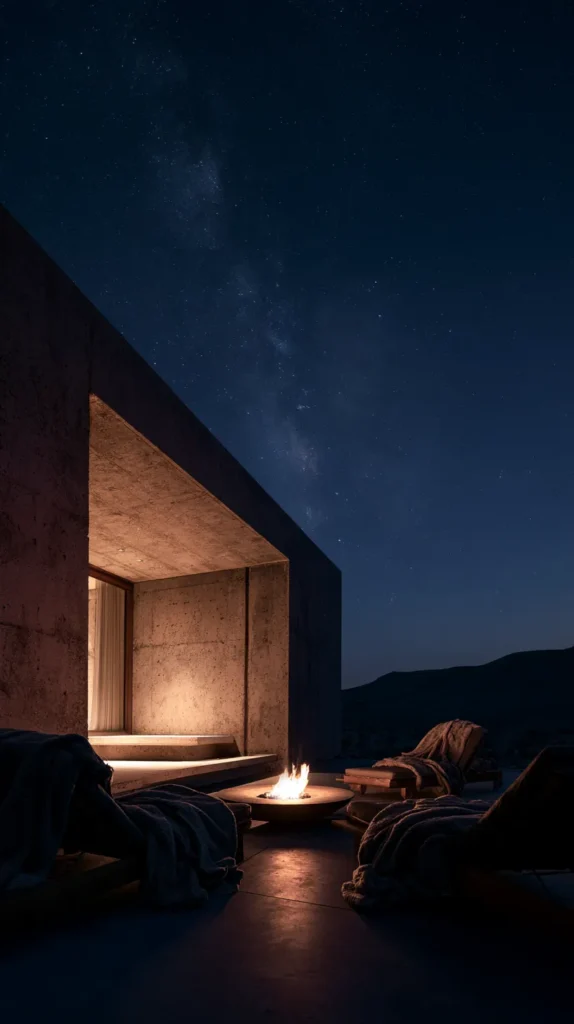
A fire pit with reclining chairs or a flat daybed, positioned for both warmth and sky viewing — the seating area designed for the evening that extends into the night.
Why autumn is the best stargazing season:
The sky conditions:
- Autumn nights: often the clearest of the year (summer haze gone, winter cloud not yet arrived)
- The Milky Way: visible in autumn evenings in the northern hemisphere
- Meteor showers: the Perseids (August) and Leonids (November) flank the autumn months
- The sky: specifically worth looking at in this season
The reclining requirement:
Looking up:
- To see the sky properly: the body must be horizontal or close to it
- A standard garden chair: requires craning the neck
- A fully reclining sun lounger in autumn: the correct piece of furniture for this purpose
- Or: a fixed daybed in the most open part of the garden
The fire and the sky together:
The fire:
- Beside the reclining position (not above it)
- Warmth radiating toward the reclining body
- The fire: at the same level as the ground-level seating
- The view: upward toward the stars. The warmth: from the side.
The darkness required:
- Stars: require no artificial light interference
- The lighting for this setup: the fire only (for the stargazing phase)
- The string lights and lanterns: for the gathering phase (before lying down)
- Switched off when the stargazing begins
The blanket situation:
Heavier than any other setting:
- Lying down: the body cools faster than when sitting upright
- Two or three blankets per person (not one)
- The ground-level position: closer to the cold ground
- A ground-level mat or rug: insulation between body and cold earth
The Perseid and Leonid windows:
- Perseid meteor shower: peak around August 12th (just into the autumn season in many gardens)
- Leonid meteor shower: November 17th
- Both: worth designing the star-gazing setup specifically for
- The setup: used for the peak nights and for any clear autumn night
Cost breakdown:
- Two reclining loungers: $140–240
- Fire pit: $80–150
- Three heavy blankets: $60
- Ground-level mat: $45
- Total: $325–495
14. The Complete Autumn Evening Outdoor Room (All Elements Combined)
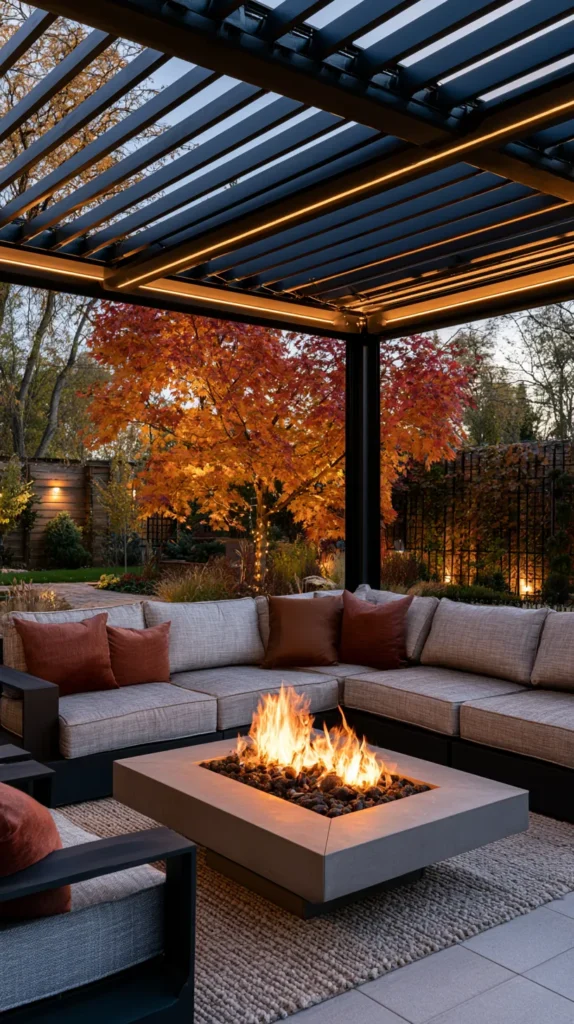
The fully realised autumn seating area — every element of warmth, enclosure, lighting, and textiles working together — the arrangement that makes October the best month to be outside.
What the complete autumn outdoor room contains:
The warmth layer:
- A fire: the primary heat source and gathering anchor (Idea #2’s fire bowl, or Idea #3’s fire table)
- An overhead heater: the secondary heat source for when the fire dies or for the table area
- Blankets: one per person, stored in the space (not inside the house)
- The three-source warmth: fire, heater, textiles. All three required for genuine October comfort.
The enclosure:
- Three sides enclosed (fence, hedge, or pergola walls on three sides)
- One side open: the view, the access, the feeling of being in the garden rather than separated from it
- Overhead: covered or partially covered
- The enclosed outdoor room: the condition for warmth to accumulate rather than disperse
The lighting:
- String lights overhead (the ceiling light of the outdoor room)
- Lanterns at eye level and ground level (the multiple warm source requirement)
- The fire: the primary light source for the centre of the arrangement
- All warm amber (2700K): the non-negotiable temperature requirement
- All on timers: the garden always ready at dusk
The seating:
- Deep and low (the extended-stay signal)
- Varied (one sofa, two armchairs, one bench or window seat)
- All facing the fire (the arrangement designed around the warmth source)
- Cushions and throws in autumn palette
The sensory layers:
Scent:
- Wood smoke (if wood fire)
- Fragrant autumn plant nearby (lavender still going, sarcococca beginning in October)
- Hot drink at hand (the steam, the spice)
- The scent: the sensory element that makes the memory
Sound:
- The fire cracking
- Wind in the remaining leaves
- The water feature if still running
- The quiet: the quality most people say they notice first
Touch:
- The warmth of the blanket
- The deep cushion
- The warm mug in the hand
- The tactile experience: not an afterthought
The occasion this setup creates:
The evening that does not end until midnight:
- Nobody suggests going inside
- Someone refills the drinks without discussion
- A second person gets up to add wood
- The conversation slows but continues
- At some point: the stars are noticed
The occasion is not planned. It is designed for. The design creates the conditions. The conditions create the occasion. The occasion creates the memory.
Cost breakdown for the complete setup:
- Fire feature: $150–280
- Overhead heater: $150–250
- Seating (sofa + 2 chairs): $450–700
- Autumn cushions and throws (full set): $180
- String lights + lanterns + timer: $120
- Blanket storage (deck box): $90
- Table and accessories: $80
- Fragrant plant beside: $20
- Total: $1,240–1,720
Phased approach over two or three seasons:
Season one ($350–450):
- Fire bowl, four low chairs, four throws
- The foundation: warmth and the circle
- Everything else: builds from this
Season two ($300–400):
- String lights on timer
- Autumn cushion refresh
- Three additional lanterns
- The atmosphere: added to the functional base
Season three ($600–900):
- Pergola or partial enclosure
- Overhead heater
- Deep sofa replacing two chairs
- The complete outdoor room: built in stages
What Every Autumn Seating Area Needs
The irreducible minimum:
The warmth source (non-negotiable):
- No autumn seating area functions without a heat source
- The cheapest effective option: a chiminea ($60–80) with wood
- Without warmth: everyone goes inside by 7pm regardless of everything else
The lighting (non-negotiable):
- Dark by 6pm: the garden invisible without lighting
- The cheapest effective option: three lanterns with flameless candles ($35) plus one string light strand ($25)
- Without lighting: the garden does not exist in the evening
The enclosure (high importance):
- Wind is colder than cold
- The cheapest effective option: two chairs against the corner of an existing fence or wall
- Without enclosure: the warmth dissipates; with: it accumulates
The textiles (high importance):
- The physical experience of warmth
- The cheapest effective option: two quality throws stored outside ($30–40)
- Without: people leave earlier; with: they stay later
The minimum viable autumn outdoor seating area:
- One corner of an existing fence
- Two low chairs positioned in the corner
- A chiminea in front
- Two stored throws on the armrests
- Three lanterns at varied heights
- Cost: under $200. Result: outdoor evenings in October.
Getting Started This Weekend
The two-hour autumn setup:
Assess the existing furniture:
- Where is it? Push it into a sheltered corner (the most protected position in the garden)
- Is it low? Lower chairs are cosier around a fire
- Is it deep? Move the deepest, most comfortable chairs to this position
Add warmth:
- If a fire pit exists: clean it, stock it with dry wood
- If not: a chiminea from a garden centre ($60–80) is today’s purchase
Add textiles:
- Two throws from inside: the autumn starting point
- Moved outside, placed on the armrests
- The discipline: they stay outside unless it rains hard
Add light:
- Three lanterns from wherever they currently are in the house or garden
- Grouped at varied heights beside the seating
- Flameless LED if available: set the timer
The garden this evening: a genuinely cozy autumn outdoor space assembled from what was already there, in an afternoon.
The additions over time: the deeper cushions, the fire bowl, the string lights, the pergola — each one improving what already works.
But tonight: the corner, the fire, the blanket, the lanterns.
That is the whole thing. Everything else is the elaboration of that beginning.