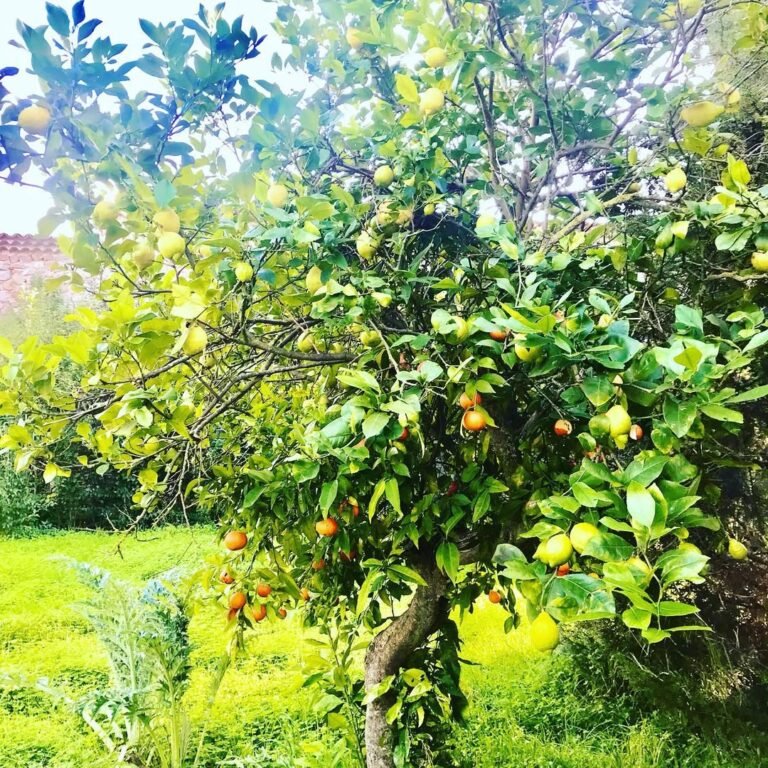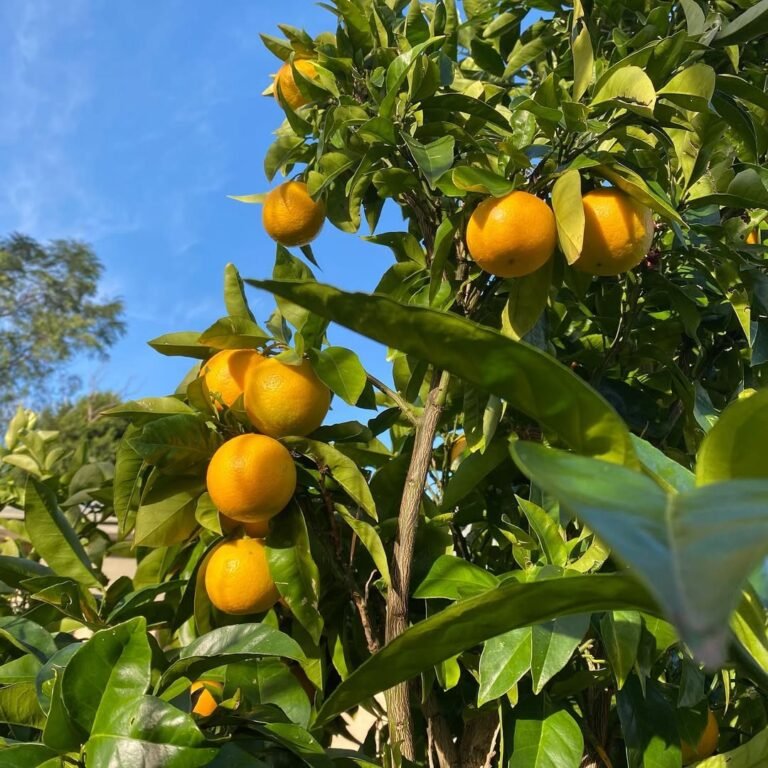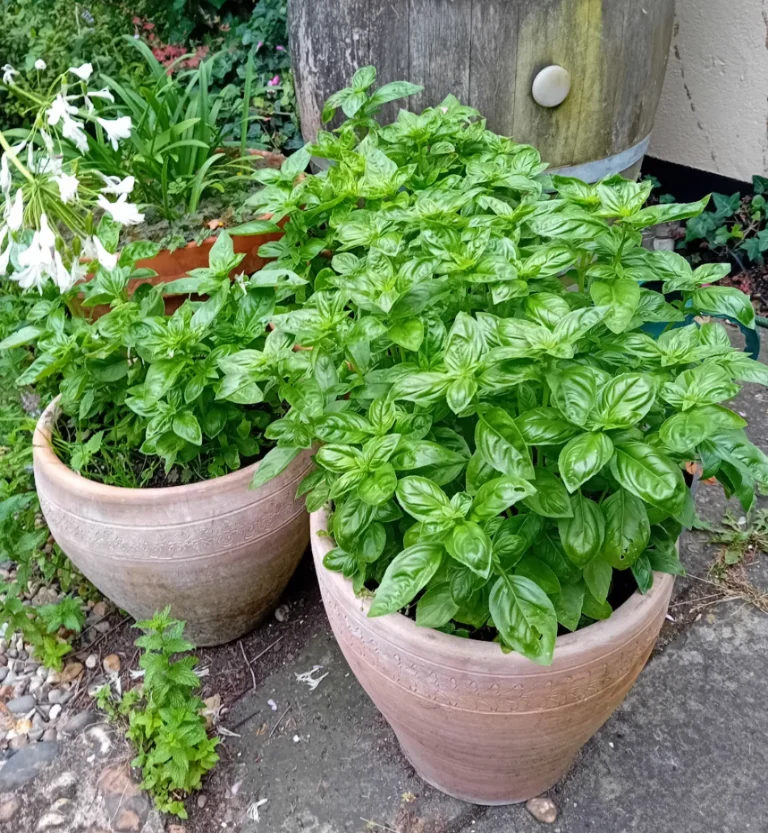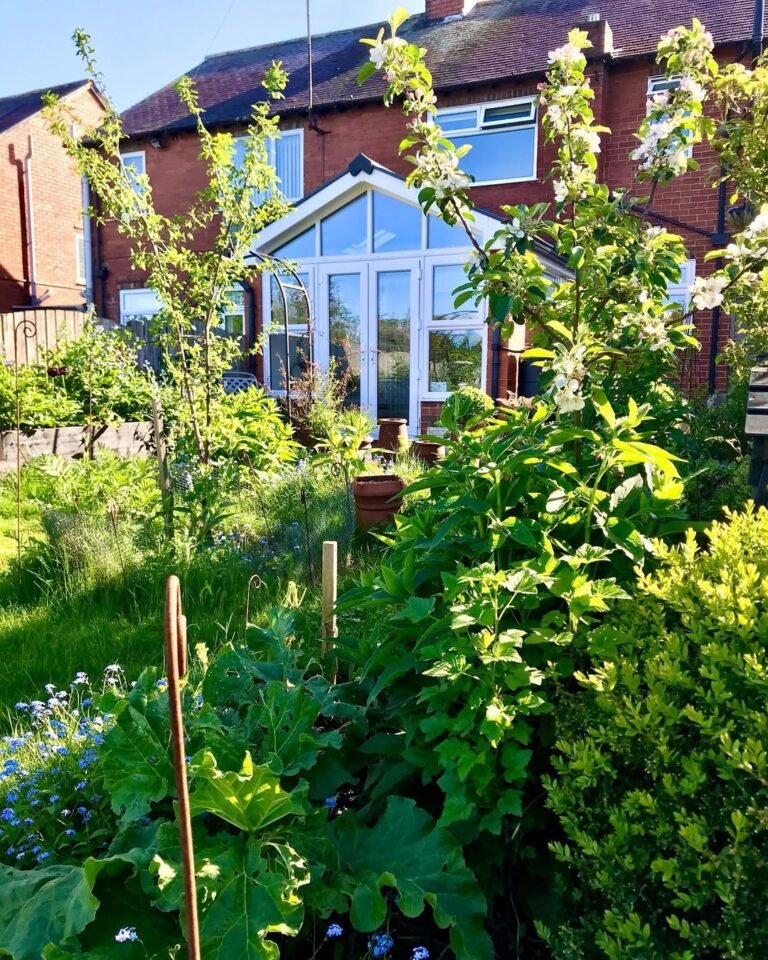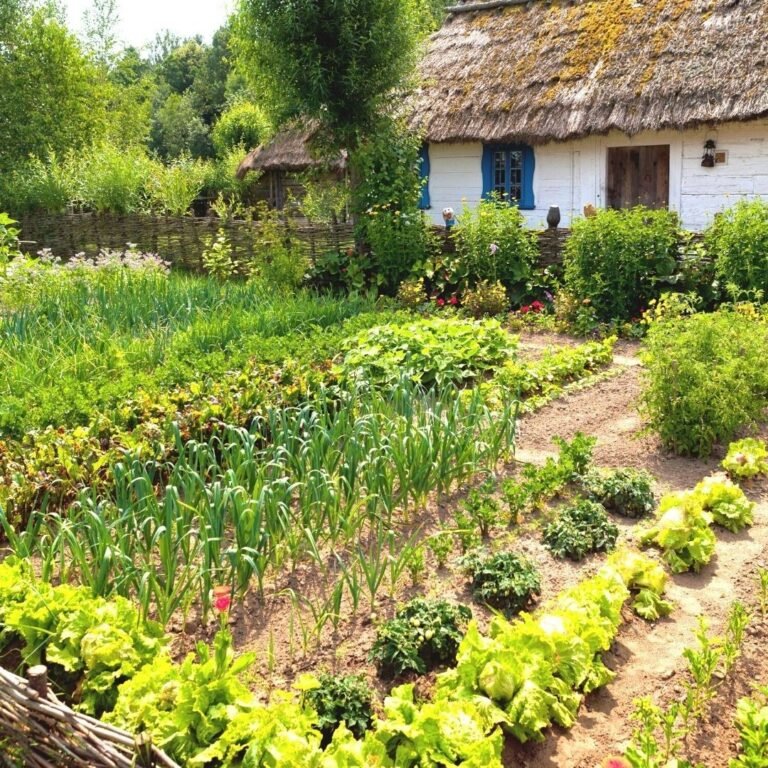
14 Beautiful Front Yard Edible Landscaping Ideas for Year-Round Color
The front yard is the garden that does not get to be practical. Or so the convention goes.
The backyard: the place to grow food. The front yard: the place to look respectable. One flower bed. One lawn. Possibly a shrub or two. The front yard as public performance — designed for the neighbour walking past and the estate agent taking photographs, not for the person who lives there.
This convention costs most homeowners half their available growing space and produces no benefit that a well-designed edible front yard cannot provide. The front yard that looks beautiful and produces food: more beautiful than the front yard that looks beautiful and produces only appearance.
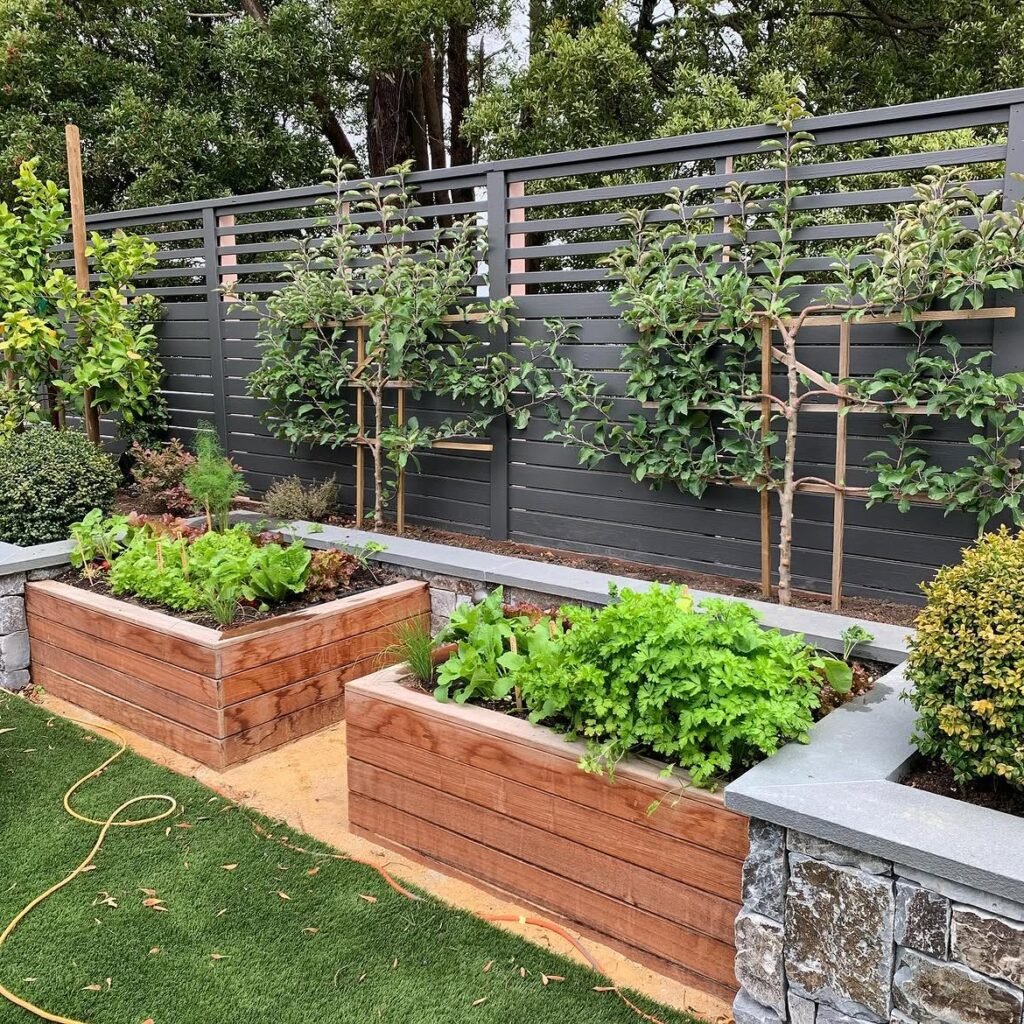
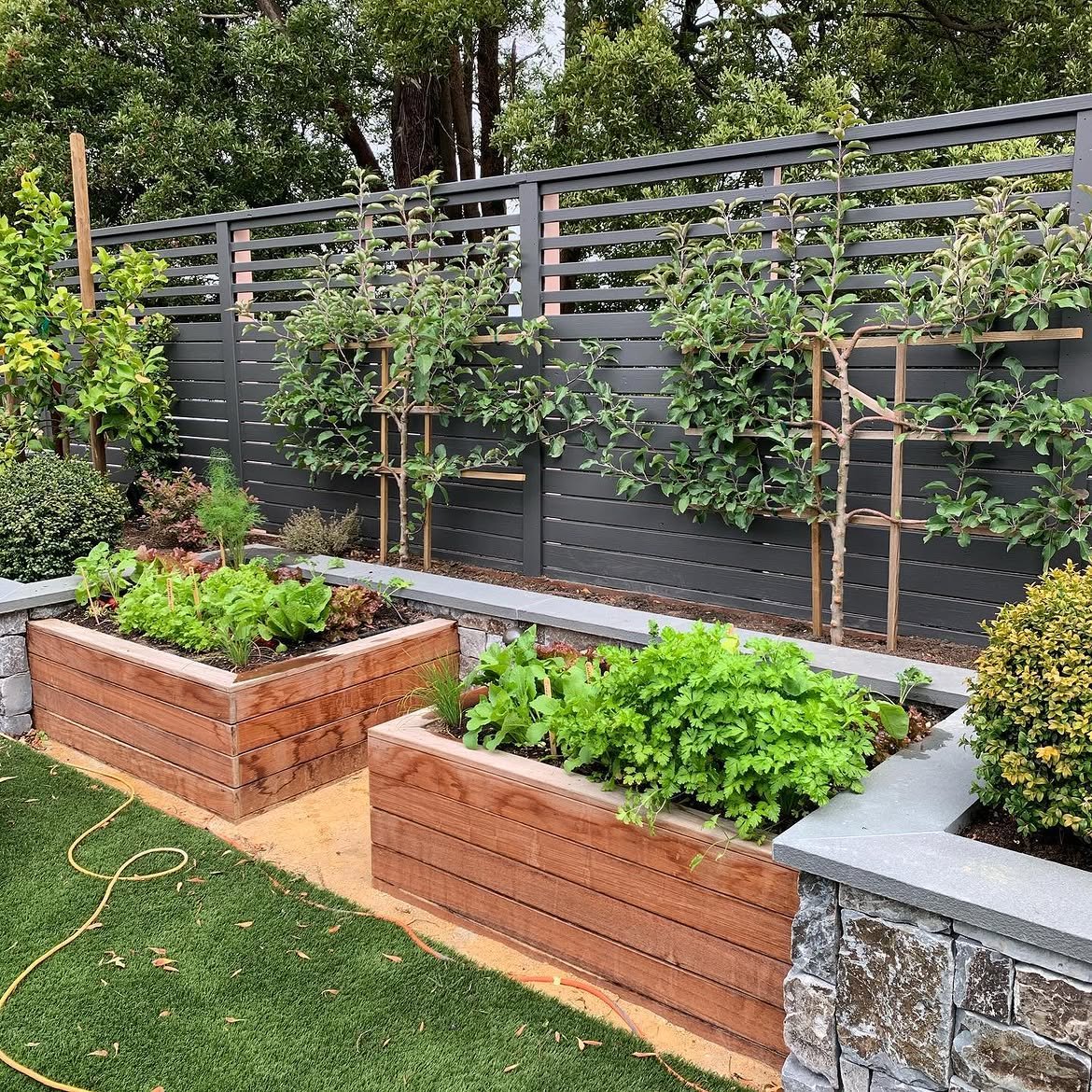
The kale that turns purple in autumn is more beautiful than a standard ornamental shrub. The espaliered apple against the front fence: more beautiful than a plain fence. The herb border beside the path: more fragrant and more visually interesting than a standard border.
Here are 14 ways to make the front yard do both things: look extraordinary and feed the household.
Why the Front Yard Edible Landscape Works
The design argument:
Most ornamental plants:
- Attractive for a few weeks (flowering period)
- Visually quiet for most of the year
- Producing nothing edible
- Requiring as much maintenance as anything productive
Most edible plants:
- Also attractive for part of the year (blossom, fruit, interesting foliage)
- Also quiet for part of the year
- Producing food
- Requiring comparable maintenance
The logic:
- The front yard will be maintained regardless
- It will be planted regardless
- The only question: are those plants also productive?
- The productive landscape: all the visual quality, additional function
The community consideration:
The front yard is visible:
- Neighbours see it
- Passers-by see it
- The HOA (where applicable) observes it
- The edible front yard: must be well-maintained to communicate intention rather than neglect
The designed edible landscape:
- More beautiful than random vegetable planting
- Indistinguishable from ornamental landscaping when well-designed
- The design: the answer to any community concern
The principle:
- Replace ornamental plants with equally beautiful edible plants
- Not: add vegetable beds to an ornamental front yard
- The substitution: the design method
The Design Principles
Before any plant selection:
Structure first:
- The edible front yard needs the same bones as any well-designed landscape
- Path defined: clear and generous
- Focal point established: the entrance, the tree, the feature border
- Height variation: from ground cover to the tallest plant
- The bones: permanent, structural, regardless of what is planted
Year-round interest:
- The front yard: seen in every season
- Each plant: evaluated for multiple seasons
- The apple tree: blossom (spring), fruit (summer/autumn), structure (winter)
- The kale: colour (autumn/winter), flower (spring), food (autumn/winter)
- Every plant earning its place in multiple seasons
One colour palette:
- The front yard: one coherent palette
- Not: red vegetables beside yellow marigolds beside blue salvia
- A chosen palette: the discipline that makes the landscape look designed
1. The Espaliered Fruit Tree Fence (The Beautiful Productive Boundary)
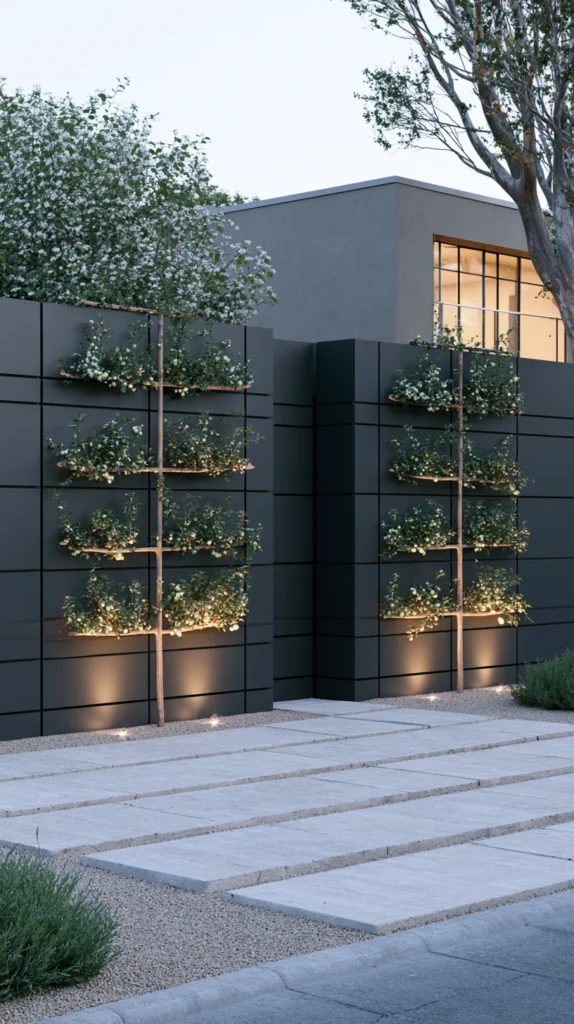
A fruit tree trained flat against the front fence or wall — the most beautiful and most space-efficient edible plant for the front yard.
Why espalier is specifically suited to the front yard:
The space:
- Front yards: often narrow
- Espalier: takes one foot of depth
- A standard trained tree: 15–20 feet wide
- An espalier: 10 feet wide and one foot deep
- The same productivity: a fraction of the footprint
The beauty:
- The trained structure: visible in winter (the bare arms against the fence)
- The blossom: dramatic and symmetrical
- The fruit: displayed as if placed (not hidden in foliage)
- The architectural quality: the most designed-looking of all fruit tree forms
The forms:
The horizontal espalier (most common):
- Two to four tiers of horizontal arms
- The tiers: at regular intervals (12–18 inches apart)
- Each arm: trained along a horizontal wire
- The form: architectural, precise, unmistakably intentional
The fan:
- Arms fanning outward from a low central point
- Against a fence or wall: beautiful
- Particularly suitable for stone fruit (peach, plum, cherry)
- More forgiving of slight irregularity than the horizontal
The tree selection:
Best for espalier:
- Apple (the standard — any variety)
- Pear (particularly beautiful: ‘Doyenne du Comice’, ‘Conference’)
- Quince
- Cherry (fan-trained)
- Peach and nectarine (fan-trained against a warm, south-facing wall)
The training:
Year one:
- Plant the maiden tree (a single unbranched stem, or one with two laterals)
- Tie the laterals to the first wire
- Cut the central stem to just above the second wire
- The foundation of the future tiers: established
Subsequent years:
- Each new tier: trained over 1–2 years
- The final form: achieved in 3–5 years
- The mature espalier: requires one annual pruning session (summer)
The front yard impact:
A 10-foot section of espaliered apple:
- The bare fence: beautiful architecture
- The March blossom: the most beautiful moment of the front garden year
- The summer: leafed-out green against the fence
- September: apples visible along the arms
- The October bare arms after harvest: winter architecture
Cost breakdown:
- Maiden apple tree: $20–35
- Fencing wire and vine eyes (for the training wires): $15–25
- Total: $35–60
The espaliered apple on the front fence: visitors stop to look. The tree the passing conversation starter.
Espalier Tips
The wall versus the fence:
- A brick wall: the most beautiful backdrop (and the warmth stores to benefit the tree)
- A fence: workable with wire supports added
- The warmth of a south-facing wall: makes it possible to grow fruit that would otherwise be marginal in the climate
The patience required:
- Year one and two: the tree looks sparse and intentional-but-unformed
- Year three: the shape clear
- Year five: the mature espalier
- The patience: the investment in the architectural beauty that takes years to achieve
2. The Herb Border (The Scented Front Path)
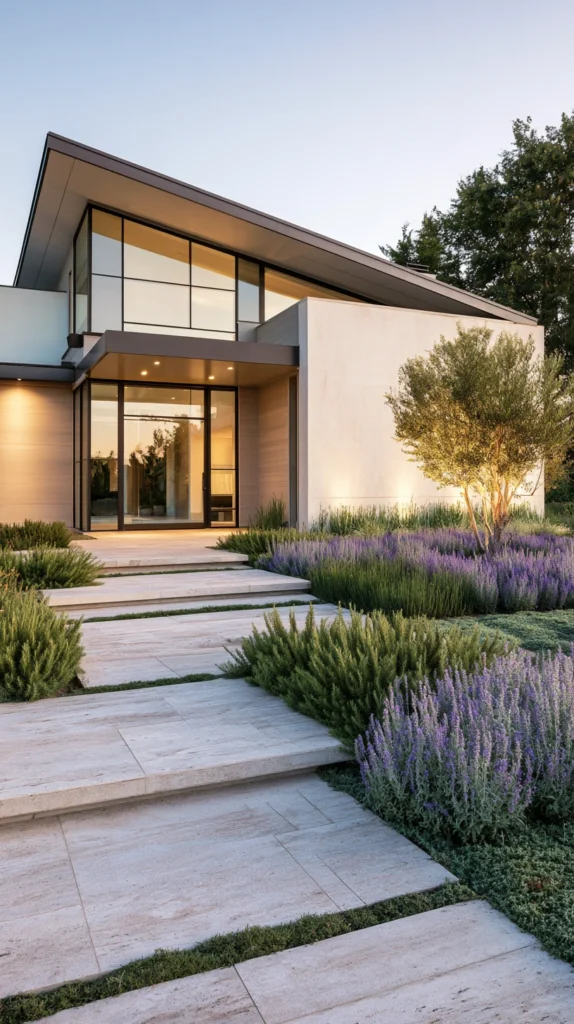
A mixed herb border alongside the front path — the planting that makes the walk to the front door fragrant and edible.
Why herbs are ideal for the front border:
The year-round structure:
- Rosemary: evergreen, structural, blue-flowered in spring
- Lavender: silver-grey structure, purple flowers, the summer front border
- Sage: grey-green leaves, purple-blue flowers, architectural
- Thyme: the ground cover, fragrant underfoot
- The herbs: structure and interest in every month
The front border characteristics:
The visual quality of a herb border:
- Silver and grey foliage: the most sophisticated colour in any border
- Purple and blue flowers (lavender, rosemary, sage): harmonious and calming
- The herb border palette: the most reliably beautiful low-maintenance front border
The fragrance:
- The walk to the front door: through the scent of rosemary and lavender
- Brushed by the plants: the scent released
- The lavender in July: the most fragrant front garden available
- The fragrance: the quality no ornamental substitute provides
The border design:
From front to back:
- Front: creeping thyme (the path edge, ground cover, fragrant underfoot)
- Middle: lavender (the signature of the border, mid-height, structural)
- Back: rosemary and sage (the tall structural elements, the winter evergreens)
- The height graduation: the border reads correctly from the street
The seasonal structure:
Winter:
- Rosemary: evergreen, still structural
- Sage: semi-evergreen (loses some leaves in hard frosts, returns)
- The border: not bare in winter
Spring:
- Rosemary flowering (blue)
- The new growth on all herbs: fresh silver-green
Summer:
- Lavender in flower: the peak moment
- The bees: constant and visible
- The front border: the most-seen part of the garden, at its most beautiful
Autumn:
- Lavender cut back: tidy and structured
- The herbs intensifying in flavour (the autumn essential oil concentration)
- The harvest: the herbs at their most useful in the kitchen
Cost breakdown:
- Lavender (5 plants): $35–45
- Rosemary (2): $16
- Sage (2): $14
- Creeping thyme (5 plants): $20
- Total: $85–95
3. The Kale and Brassica Statement Border (The Ornamental Vegetable)
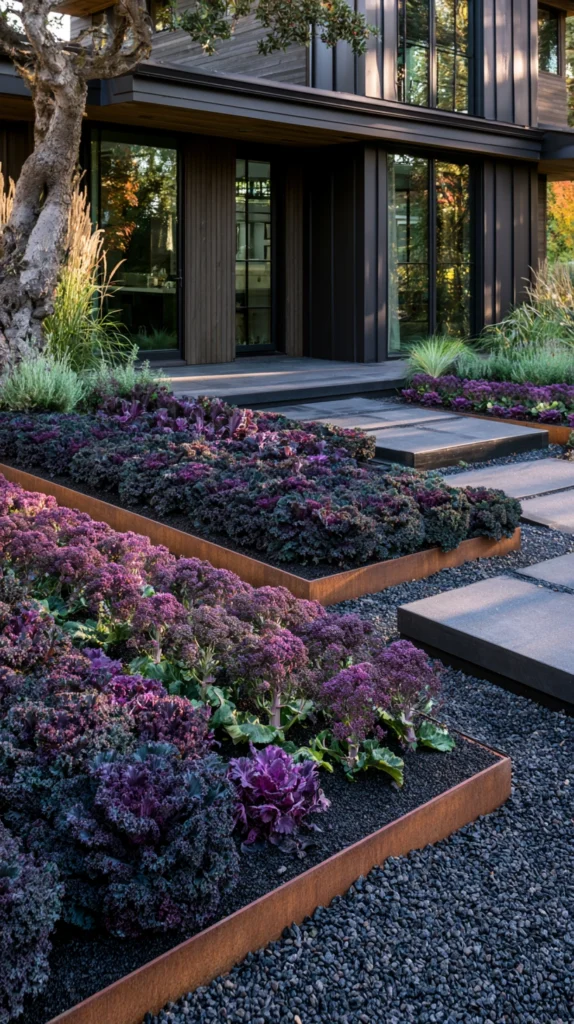
Ornamental kale, purple sprouting broccoli, and Tuscan black kale planted as design elements — the vegetables that are more beautiful than most ornamental plants.
Why brassicas belong in the ornamental front yard:
The visual case:
- Ornamental kale: the deep purple-red rosette is extraordinary in its own right
- Tuscan black kale (cavolo nero): the most architecturally striking leaf available
- Purple sprouting broccoli: the purple stems against the blue-green leaf — genuinely beautiful
- These: more visually interesting than most ornamental plants
The autumn front yard specifically:
October through February:
- The brassicas: at their visual peak
- The autumn and winter: when most front yards are bare and grey
- The kale border: the front yard that looks extraordinary in November
- The colour intensifying with each frost: the plant that gets better as the season gets harder
The specific plants:
Tuscan black kale (Cavolo Nero):
- Upright, tall (3–4 feet)
- Dark blue-green strappy leaves
- The most architectural kitchen vegetable
- In a border: reads as a dramatic foliage plant
- The food: the most useful autumn and winter kitchen green
Red Russian kale:
- Grey-green leaves with purple stems
- Flat, lobed leaves
- Different form from cavolo nero (more open)
- The purple stem: the visual detail that elevates it
Ornamental kale:
- The deep purple-red rosette
- Strictly ornamental (too bitter to eat)
- Planted beside edible kales: the design element
Purple sprouting broccoli:
- A larger plant (3 feet)
- The purple stems: the most specific colour in a kale border
- The broccoli side shoots: harvested through February and March
- The spring flower: yellow (when the plant bolts)
The border design:
The mixed kale border:
- Three varieties alternating: cavolo nero (tall, upright), red Russian (mid, open), ornamental kale (low, rosette)
- Height variation within one family of plants
- The colour: deep blue-green, grey-purple, deep magenta
- The palette: rich, warm, and specifically autumnal
Cost breakdown:
- Cavolo nero plants (3): $9
- Red Russian kale (3): $9
- Ornamental kale (4): $12
- Purple sprouting broccoli (2): $8
- Total: $38
The kale border in November: the most commented-on element of the front garden. Nobody guesses that the most beautiful plants are dinner.
4. The Fruit Tree as the Street Tree (The Productive Focal Point)
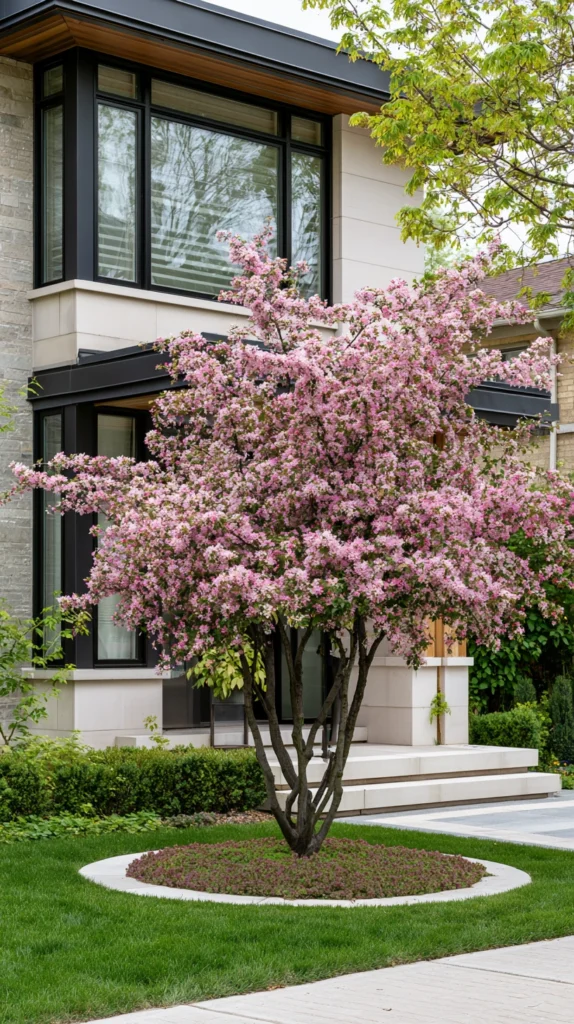
A fruit tree planted as the focal point of the front yard — the tree that is both the ornamental centrepiece and the harvest.
Why a fruit tree outperforms an ornamental tree:
The comparison:
- An ornamental cherry: beautiful for 2 weeks in March
- A fruit tree: blossom (spring), leaf (summer), fruit (late summer/autumn), structure (winter)
- Four distinct moments of interest versus one
- And: the fruit tree also produces food
The specific trees:
For small front yards (under 20 feet wide):
Crab apple (‘John Downie’ or ‘Gorgeous’):
- 12–15 feet at maturity on standard rootstock
- The spring blossom: abundant and fragrant
- The fruit: small red apples (beautiful on the tree, excellent for jelly)
- Hardy and reliable
- The most beautiful small fruit tree available
Quince (Cydonia oblonga):
- 10–15 feet
- The gnarled form: increasingly beautiful with age
- Pink-white blossom (May)
- Yellow aromatic fruit (October)
- The most characterful small front yard tree
Medlar (Mespilus germanica):
- 10–15 feet
- Extraordinary autumn colour
- White blossom (May)
- The fruit: bletting — the old-fashioned fruit that requires cold to ripen
- The most unusual and most garden-worthy small tree
Mulberry (Morus nigra):
- Eventually large (but very slow — decades to reach full size)
- The most luscious fruit
- Extraordinary gnarled form with age
- Chosen for a permanent front yard planting: the tree for generations
The planting:
In a grass circle (the tree pit):
- Cut a 3-foot diameter circle in the lawn
- Plant the tree in the centre
- Mulch the circle (3 inches, not touching the trunk)
- The grass: grows up to the mulch circle edge
- The tree: its own space within the lawn
Or: in a planted circle:
- The tree circle planted with ground cover (thyme, strawberry, wild garlic)
- The guild planting (as from the food forest article): below the tree
- The tree: within a designed planting, not in a grass circle
Cost breakdown:
- Crab apple or quince tree (standard): $35–55
- Guild or ground cover planting: $15–25
- Total: $50–80
5. The Edible Hedge (The Boundary That Produces)
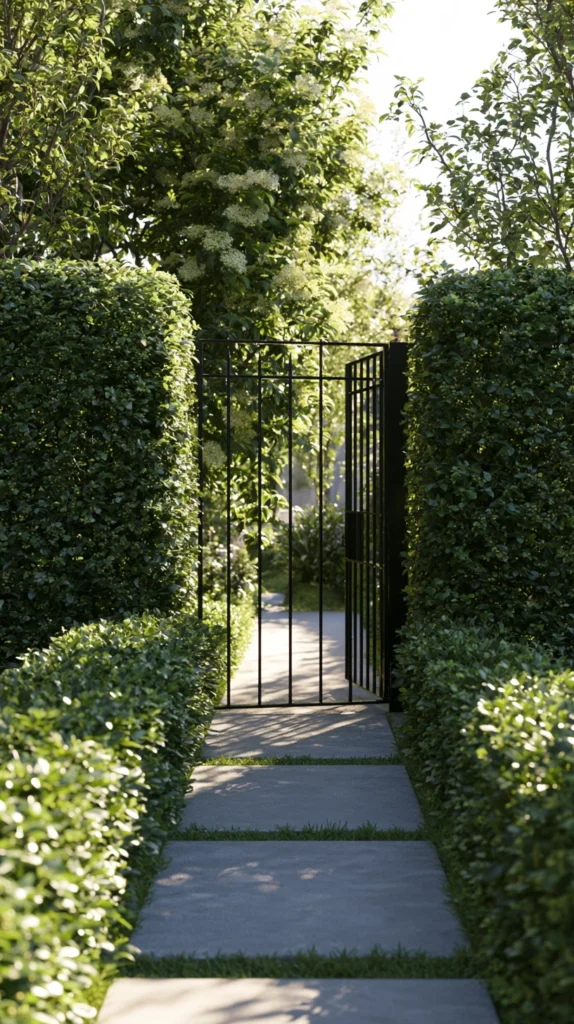
A mixed hedge using productive fruiting shrubs — the boundary that is also the harvest.
Why a productive hedge outperforms an ornamental one:
The hedge as a harvest:
- A standard privet or laurel hedge: dense, green, impenetrable, producing nothing
- A productive mixed hedge: equally dense, equally impenetrable, producing fruit from June to November
- The same maintenance effort: the productive hedge returns food
The plants:
The traditional mixed hedge species:
Hawthorn (Crataegus monogyna):
- The native hedging species
- Thorny: the best wildlife hedge and the most animal-proof
- The haws (berries): technically edible (the haw ketchup is real) and excellent wildlife food
- Hardy and fast-growing
Blackthorn (Prunus spinosa):
- The sloe: the foraging prize
- Sloe gin, sloe vodka, sloe jelly
- Dense and thorny: excellent boundary
- White blossom in March (before the leaves): one of the most beautiful spring moments
Elder (Sambucus nigra):
- The most productive hedging plant
- Elderflower (June): the cordial, the champagne, the fritters
- Elderberries (September): the syrup, the wine
- Grows rapidly, not thorny
- Left unpruned: large. Hard-pruned: contained.
Guelder rose (Viburnum opulus):
- The native viburnum
- White flowers (May)
- Red berries (autumn)
- The berries: technically edible when very ripe and cooked (not for fresh eating)
- Extraordinary autumn colour
The designed mixed hedge:
Not a monoculture:
- Four or five species mixed
- Hawthorn (the foundation: 40% of the hedge)
- Blackthorn (20%)
- Elder (20%)
- Guelder rose or other native shrub (20%)
- The mix: both productive and beautiful, supporting wildlife
Cost breakdown:
- Mixed native bare-root hedge plants (per metre): $5–8 per plant
- For a 10-metre front boundary: $50–80
- Total: $50–80
6. The Strawberry Border Edge (The Low-Line Edible Edging)
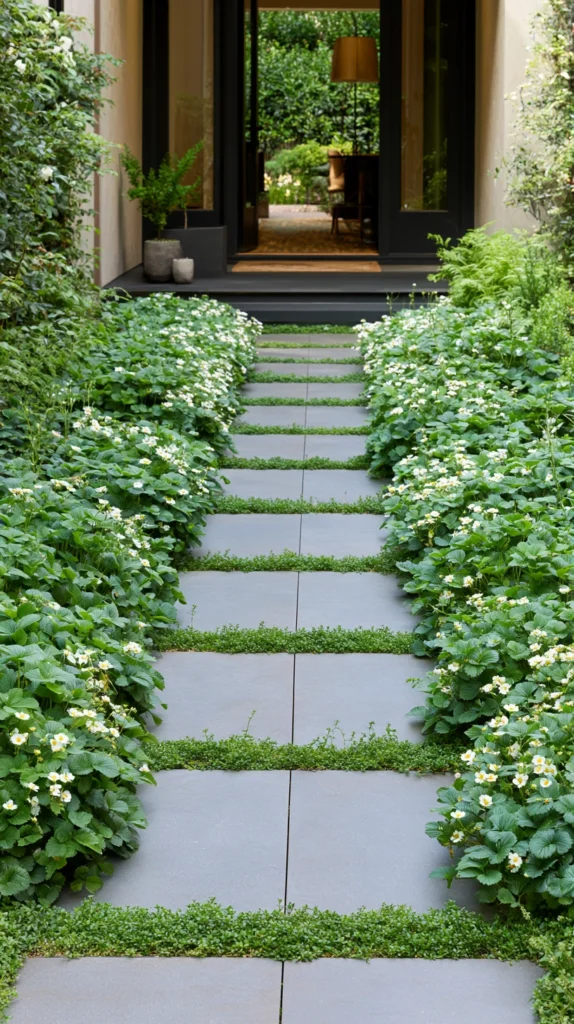
Alpine or day-neutral strawberries as the edging to borders and paths — the edible ground cover that replaces standard edging plants.
Why strawberries work as edging plants:
The ornamental quality:
- The strawberry plant: low, rounded, glossy-leaved
- The white flowers: spring and summer
- The red fruit: summer and into autumn
- The runners: trailing naturally along the path edge
- Visually: indistinguishable from ornamental edging at a glance
The alpine strawberry specifically:
For a front yard edge:
- Smaller fruit than standard strawberries
- Flowers and fruits continuously from June to October (not just one flush)
- No runners (the neat edge is maintained without management)
- More shade-tolerant than standard strawberries
- Varieties: ‘Baron Solemacher’, ‘Alexandria’, ‘Yellow Wonder’
- The front yard edge: a strawberry you can pick while walking to the door
The standard strawberry:
- Larger fruit
- One main flush (June) with some repeat
- Produces runners (the edge management challenge — but runners are also new plants)
- The runners: redirected as desired or potted up for new plantings
The placement:
The path edge:
- Strawberries planted 12 inches apart along the path edge
- Within reach from the path (the hand picking without bending far)
- The fragrance of ripe strawberries beside the front path: the summer front garden’s defining quality
Combining with herbs:
- Thyme at the path edge (Idea #2)
- Strawberries between the thyme
- The two plants: complementary in form and in the kitchen
Cost breakdown:
- Alpine strawberry plants (12, for 12 feet of edging): $18–24
- Or runners (free if any strawberry plants already in the garden): $0
- Total: $0–24
7. The Edible Climbing Plant Front Fence (The Productive Screen)
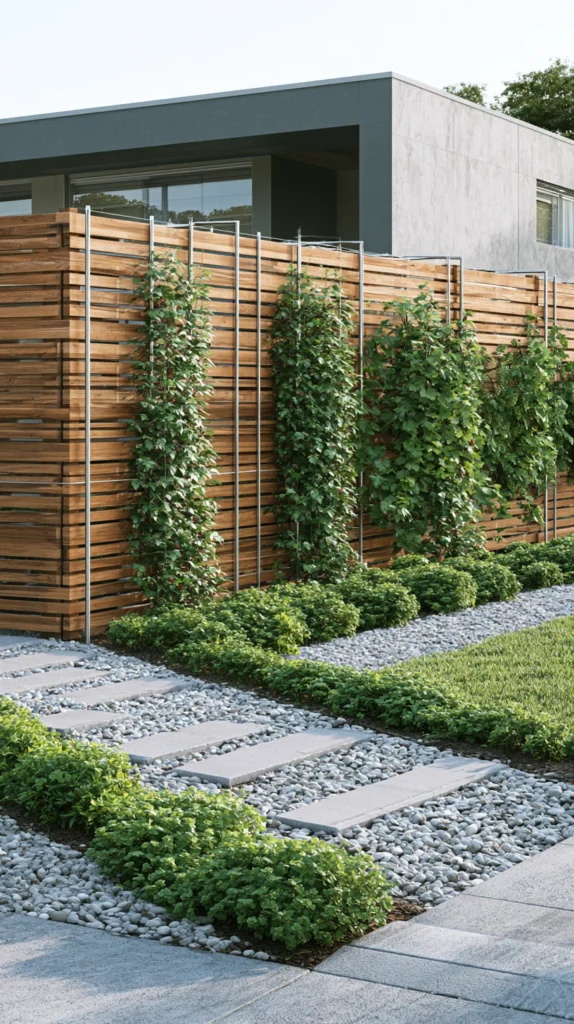
Climbing edible plants trained along the front fence — the productive screen that replaces a plain fence with a food-producing surface.
Why climbing edibles belong on the front fence:
The fence use:
- A standard fence: a boundary. Nothing more.
- A fence with climbing plants: a boundary that is also a garden and a food source.
- The same fence: doing three things.
The climbing edibles:
The productive:
Thornless blackberry:
- The most productive edible climber
- The thorns: absent (the critical detail for a front yard — passers-by)
- Varieties: ‘Loch Ness’, ‘Loch Tay’, ‘Reuben’
- August–September: abundant fruit
- The trained form: beautiful against a fence
Climbing beans (annual):
- Installed in May, removed in October
- The most abundant summer vegetable
- Runner beans: the ornamental version — vivid orange-red flowers, vigorous
- ‘Painted Lady’ runner bean: the heritage variety with bicolour pink-and-white flowers
- Beautiful and productive through summer
Kiwi vine (Actinidia arguta — hardy kiwi):
- Completely hardy (unlike standard kiwi)
- The mini kiwi fruit: intensely flavoured
- Vigorous: covers a fence in 3–4 years
- Male and female plants required (one male: five females)
- The ornamental quality: large, bold leaves, vine structure
Grape (Vitis):
- The most classically ornamental climbing food plant
- Suited to a warm, south-facing fence
- ‘Brant’: the most reliable outdoor variety in cool climates
- The autumn colour: extraordinary (burgundy-red)
- The fruit: eating grapes (in a warm summer) or wine grapes
The winter-interesting climber:
Rosa rugosa trained as a climber:
- Not a true climber but trainable
- The flowers: fragrant and abundant (summer)
- The hips: the largest and most beautiful rosehip available (autumn)
- The hips: the hip syrup, hip tea
- Evergreen in mild winters
Cost breakdown:
- Thornless blackberry: $15–20
- Climbing rose or grape: $15–25
- Training wire and vine eyes: $10–15
- Total: $40–60
8. The Four-Season Edible Front Border (Year-Round Colour)
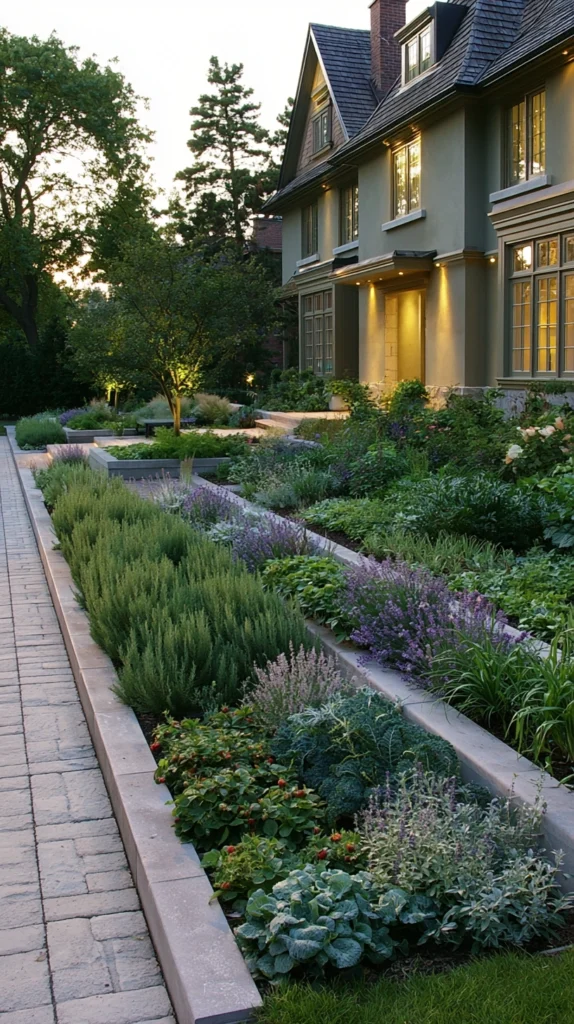
A designed border with edible plants specifically selected to give colour in every month — the front border that never looks bare.
The month-by-month edible border:
The principle:
- At any given time: at least one plant in the border is at its visual peak
- The planning: which plant is that in each month?
- The selection: around that requirement
The planning:
January–February:
- Rosemary (evergreen structure, possibly in early flower)
- Kale (the deep purple-blue of cavolo nero in frost)
- Winter heather (at the border edge)
- The border: not bare
March–April:
- The fruit tree blossom (if included as a border plant or backdrop)
- Rosemary in full flower (the blue-violet covering the bush)
- Chives (the first emerging green)
- The border: coming alive
May–June:
- The herb border flowering: lavender just starting
- Strawberry flowers (white, abundant)
- Nasturtiums beginning to flower
- Borage (the star-shaped blue flowers)
- The border: at full spring abundance
July:
- Lavender: the peak moment
- Runner bean flowers (if included)
- The first edible fruit on the strawberries
- The summer harvest beginning
August:
- Lavender fading but still beautiful
- The fruit tree fruit developing
- Thornless blackberry ripening
- The harvest season
September–October:
- The kale deepening in colour
- The fruit tree fruit at peak
- The ornamental kale rosettes intensifying
- Rosa rugosa hips in deep red
November–December:
- The structural plants: rosemary, sage
- The kale in deep blue-green and purple
- The deciduous fruit tree structure revealed
- The border: interesting in its winter austerity
The specific plants for the four-season edible border:
The permanent framework:
- Rosemary (2): the structure
- Lavender (3): the summer statement
- Sage (1): the silver anchor
- Rosa rugosa (1, at the back): the climbing element or large shrub
The seasonal fill:
- Kale (3): planted September, last until April
- Strawberries (6): at the border edge
- Nasturtiums (self-seeding from year two): summer colour
- Chives (small clumps between): the spring accent
Cost breakdown:
- Framework plants: $70–90
- Seasonal plants: $25–40
- Total: $95–130
9. The Front Door Flanking Edibles (The First Impression)
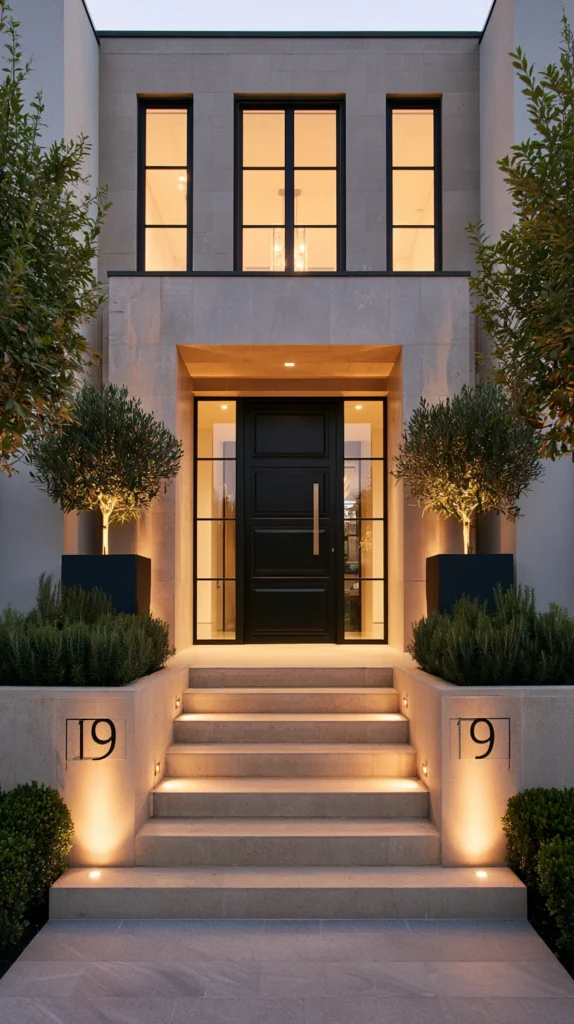
Productive plants flanking the front door — the welcome that is also the harvest.
Why the door flanking position is the most important edible planting in the front yard:
The high-visibility position:
- The flanking planting: what every visitor sees when arriving
- What every household member sees every time they leave and return
- The most-noticed plants in the front yard
- The most important to get right
The containers:
Matching containers at the door:
- Two identical pots, one each side
- The symmetry: the formal welcome
- The matching: the designed quality
- The edible plant in each: the function
What to plant:
Bay standard (Laurus nobilis):
- The most classic front door plant
- Clipped into a ball or cone
- Evergreen: present all year
- The leaves: the cooking ingredient
- The topiary form: architectural and beautiful
Rosemary standard:
- Rosemary trained as a standard
- More casual than bay
- The fragrance: released when brushed
- The spring flower: the blue that covers the trained form
Olive tree (in mild climates):
- The architectural small tree
- Silver foliage: year-round
- The Mediterranean association: immediately warm
- The olives (where climate allows): the harvest
Standard blueberry:
- Underused as a front door plant
- The spring flower: small white bells
- The summer fruit: directly accessible from the front door
- The autumn colour: extraordinary red and orange
The seasonal understorey:
In the container beneath the standard:
- Summer: trailing herb (thyme, oregano) or nasturtium
- Autumn: ornamental kale or heather
- Winter: cyclamen hederifolium or ivy
- Spring: herbs re-established
- The container: always interesting, season by season
Cost breakdown:
- Two bay standards (matched pots): $70–120 (pots and plants)
- Or rosemary standards: $50–90
- Seasonal understorey planting (per season): $15–25
- Total: $65–145 depending on the plant choice
10. The Lawn Replacement Food Garden (The Edible Front Yard)
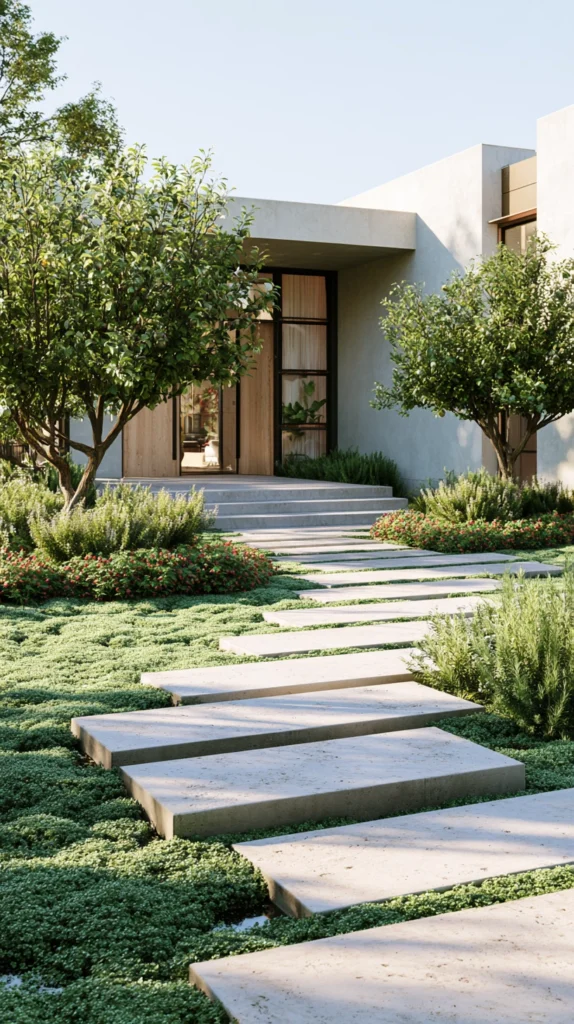
Replacing all or part of the front lawn with low-maintenance edible ground cover and productive planting — the most transformative edible front yard decision.
Why the front lawn is the front yard’s most wasteful element:
The lawn:
- High maintenance (weekly mowing, fertilising, aerating, overseeding)
- Zero food production
- High water consumption in summer
- Using the most valuable part of the front yard for the least productive use
The edible alternative:
Ground cover level:
- Creeping thyme (fragrant, edible, beautiful in flower)
- Alpine strawberries (edible, productive, low-growing)
- Clover (the nitrogen-fixer, technically edible, beautiful when flowering)
- The lawn-replacement ground cover: walkable (in the case of thyme), fragrant, productive
The mixed planting:
A no-lawn front yard:
- A defined path (maintained, functional)
- Ground cover planting on both sides of the path
- One or two feature plants (the espalier apple, the ornamental tree)
- Herb border beside the path
- The whole front yard: planned, designed, and entirely productive
The transition:
Sheet mulch method:
- Cardboard over the entire lawn area (kills the grass)
- Compost over the cardboard
- Planting through the compost
- No digging
- No rotovating
- The lawn: gone without the major effort
The community presentation:
The well-maintained edible front yard:
- Clearly designed (not neglected)
- Clean paths
- Structured borders
- The edible plants: chosen for beauty, not just productivity
- The no-lawn front yard: more beautiful and more interesting than the lawn it replaced
The transition period:
Year one:
- The new planting: sparse-looking
- The gaps: mulched (dark bark mulch — tidy)
- The front yard: clearly in transition
- Year two: the gaps filling
Year two:
- The ground cover establishing
- The plants growing together
- The front yard: beginning to look complete
Cost breakdown:
- Sheet mulch materials (cardboard: free, compost): $80–120
- Ground cover plants: $50–80
- Path material (if upgrading): $100–200
- Total: $230–400
11. The Rhubarb and Globe Artichoke Statement (The Bold Architectural Edibles)
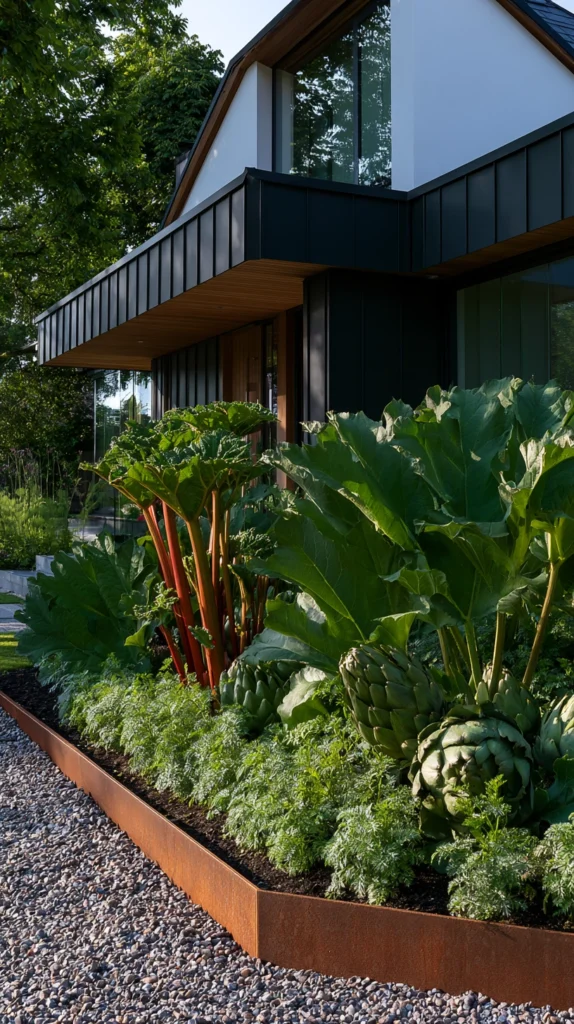
Globe artichokes and rhubarb used as architectural statement plants — the bold, large-leaved edibles that function as ornamental sculptural plants.
Why architectural edibles work in the front yard:
The visual scale:
- Globe artichoke: 4–5 feet wide, 4–5 feet tall
- The silvery-grey deeply cut leaves: more dramatic than most ornamental plants
- The thistle-like flower head: extraordinary
- The silver-green: the most sophisticated colour in any border
The rhubarb:
- The large, bold, tropical-looking leaves
- Red stems (on some varieties): vivid
- ‘Champagne’: the red-stemmed variety
- ‘Victoria’: the reliable all-red variety
- The rhubarb crown: striking even before the leaves emerge (the deep red forcing)
The front yard position:
As specimen plants:
- One globe artichoke: the corner of a border
- One rhubarb crown: the back of the border
- Both: used for their bold form, not massed
- The specimen: the focal point
Combined with fine-textured plants:
- The artichoke’s bold silver beside lavender’s fine silver-grey
- The rhubarb’s large red leaf beside the fine texture of herbs
- The contrast: the artichoke and rhubarb are more dramatic for having fine-textured neighbours
The seasonal performance:
Artichoke through the year:
- Spring: the new growth — dramatic and silvery
- May–June: the flower heads developing (harvest before they open)
- Summer: the bold leaf mass
- Winter: die back — some evergreen in mild climates
Rhubarb through the year:
- February: the first red forcing heads — extraordinary
- April–May: the full leaf — tropical and bold
- Summer: the leaf maintained
- October: dies back — the crown visible
Cost breakdown:
- Globe artichoke (2 plants): $18–25
- Rhubarb crown (2 varieties): $16–25
- Total: $34–50
12. The Fruit Hedge (The Formal Fruiting Boundary)
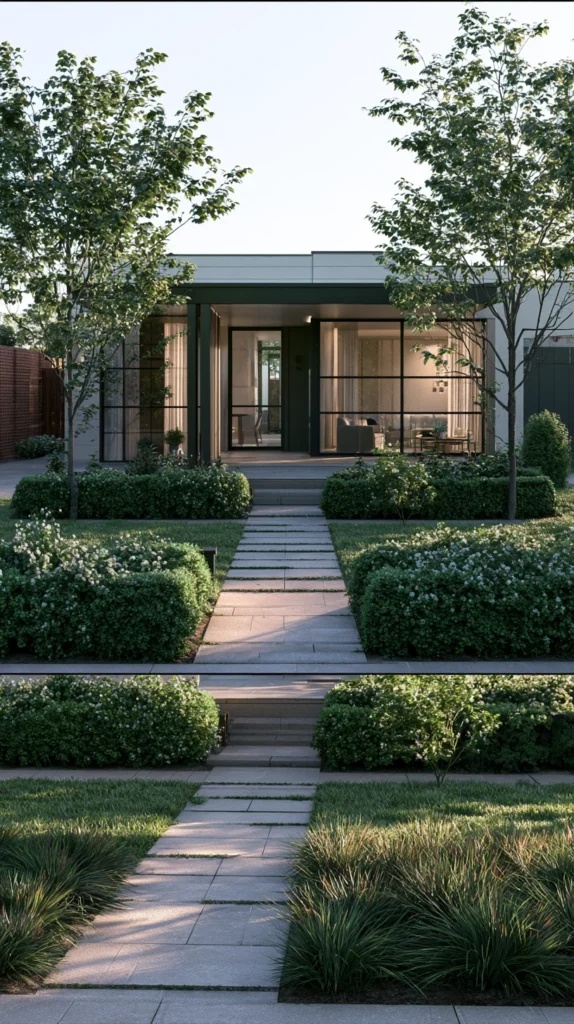
A formal hedge clipped from fruiting plants — the boundary that is both the formal front garden structure and the fruit supply.
Why fruiting hedges work in a formal front yard:
The formal front garden:
- Many front gardens: require a formal appearance
- The clipped hedge: the standard formal boundary
- The fruiting hedge: clipped to the same formal appearance, producing fruit
The plants:
Gooseberry hedge:
- Gooseberry: clips well (unlike most fruit)
- Trained as a formal hedge: clean lines, formal appearance
- Fruit: hanging from the formal clipped form (the visual joke)
- Varieties: ‘Invicta’ (most productive), ‘Hinnonmäki Red’ (most beautiful)
- Hardy, reliable, low-maintenance
Redcurrant hedge:
- The most formal-looking fruiting hedge
- The red berries: on a clipped formal hedge — beautiful in July
- Clips well and maintains a clear form
- ‘Rovada’: the most productive redcurrant variety
Blackcurrant (less formal but productive):
- Does not clip to a tight form (too vigorous)
- Works as an informal hedge or a large boundary planting
- The most productive soft fruit plant available
The mixed berry hedge:
- Alternating plants: gooseberry, redcurrant, whitecurrant
- The variety: different fruit at different times
- The form: unified by clipping to the same height and width
- The mix: the variety within the formal structure
The height:
- 3–4 feet: the standard formal front hedge height
- Maintained with one annual clip (after fruiting)
- The fruiting hedge: maintained exactly as a standard ornamental hedge
Cost breakdown:
- Gooseberry and redcurrant bushes (6, for a 6-foot hedge): $55–75
- Total: $55–75
13. The Edible Cottage Front Garden (The Romantic Productive Garden)
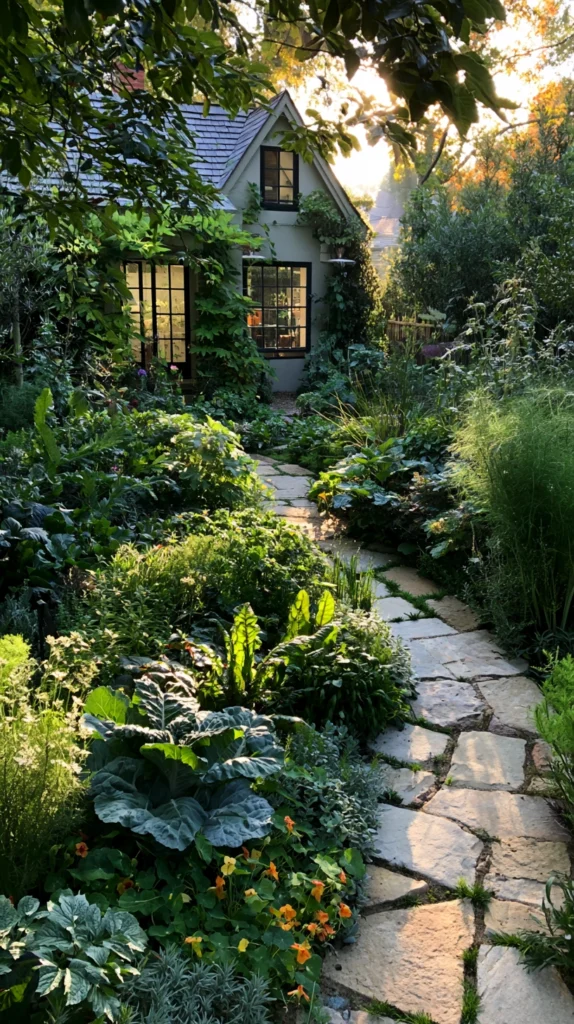
A cottage-style front garden replacing all ornamental plants with their edible equivalents — the most beautiful edible landscape possible.
Why the cottage garden translates so well to the edible front yard:
The cottage garden tradition:
- Historically: edible and ornamental together
- The cottage garden: beans beside sweet peas, vegetables beside flowers
- The separation of ornamental and productive: a 20th century suburban invention
- The edible cottage front garden: returning to the original intention
The edible cottage equivalents:
Instead of: climbing ornamental clematis
- Use: climbing nasturtium (the same generous spread, the same colour abundance, edible flowers)
Instead of: ornamental purple allium
- Use: chives (the same globe flower, the same purple, the same effect, smaller scale)
Instead of: ornamental foxgloves
- Use: edible foxgloves? No — foxgloves are toxic. But:
- Use: tall edible herbs (angelica, dill, lovage) for the same vertical dramatic quality
Instead of: sweet peas (ornamental)
- Use: sweet peas (they are edible — the flowers, not the seeds)
- Or: climbing beans (the functional equivalent with the same upright vigour)
Instead of: standard ornamental roses
- Use: Rosa rugosa (the edible rose: hips, petals, and it is more beautiful than most ornamentals)
Instead of: standard flowering shrubs
- Use: elder, quince, hazel, crab apple (each with blossom, fruit, and comparable beauty)
The cottage edible front garden design:
The path:
- A generous, slightly winding path (cobbles or flat stone)
- Thyme and alpine strawberry at the edges
- The fragrant walk to the door
The borders:
- Deep, densely planted (cottage style: full)
- Kale and chard in the structural positions
- Rosemary and sage as the permanent framework
- Nasturtiums and borage self-seeding through everything
- The bean wigwam: the vertical feature
- The ornamental cabbages: the rosette detail
- The dill: the tall airy accent
The front of the border:
- Chives (the globe flowers)
- Alpine strawberry
- Creeping thyme
- The low edible edging
Cost breakdown:
- Framework plants (rosemary, sage, Rosa rugosa): $55–75
- Seasonal fill (seeds: nasturtium, borage, dill): $8
- Kale and chard plants: $12
- Strawberries: $12
- Total: $87–107
14. The Complete Four-Season Edible Front Yard (All Elements Together)
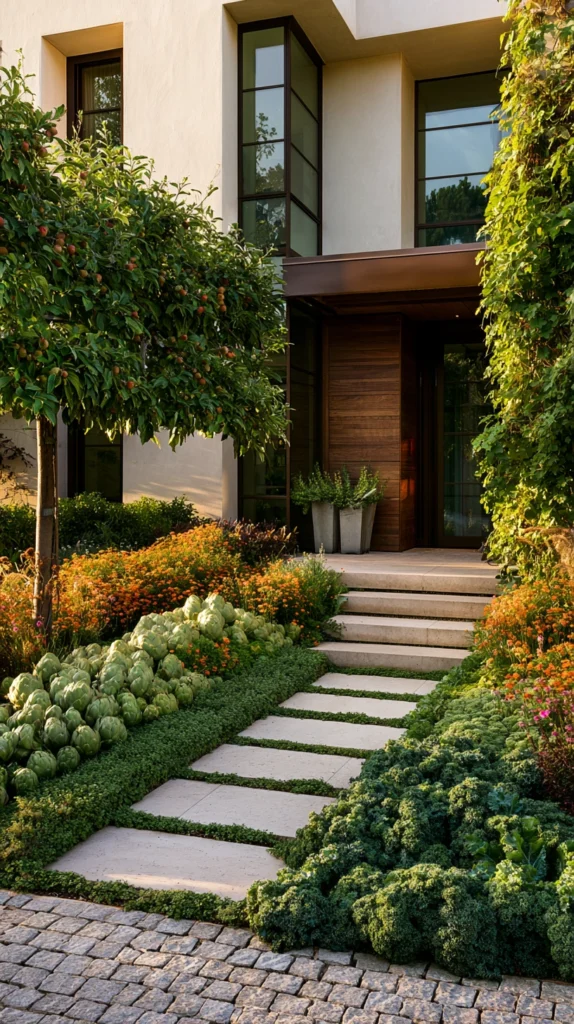
The front yard designed with all 13 ideas working together — the complete edible landscape that is the most beautiful front garden on the street.
What the complete edible front yard looks like:
The arrival:
- The front path: creeping thyme and alpine strawberries at the edge
- The herb border along both sides of the path
- The fragrance: rosemary brushed, lavender wafting
- The first impression: a front garden that smells extraordinary
The boundary:
- The espaliered apple or pear against the fence (Idea #1)
- The mixed productive hedge on one side (Idea #5)
- The climbing productive plants on the fence sections in between (Idea #7)
- The boundary: every surface productive
The centre:
- The fruit tree or crab apple as the focal point (Idea #4)
- The ground below it: guild-planted with wild garlic, strawberry, chives
- The structure: the tree that earns its place in every season
The borders:
- The four-season edible border on both sides (Idea #8)
- Globe artichoke and rhubarb as the architectural statements (Idea #11)
- The edible cottage style planting filling in between (Idea #13)
- The borders: always in colour, always interesting
The door:
- Two matched bay standards in quality containers (Idea #9)
- The autumn understorey: ornamental kale
- The summer understorey: thyme and nasturtium
- The door: flanked by something permanent, something seasonal
The year-round calendar:
January: Cavolo nero in deep blue-green, rosemary and sage evergreen, bay standards February: First rhubarb forcing, rosemary beginning to flower March: Rosemary in full blue flower, chives emerging April: Wild garlic carpet under the tree, fruit tree blossom May: The front yard in full spring blossom (the espalier, the hedge plants, the herbs) June: Lavender beginning, strawberries in flower and fruit, elderflower July: Lavender at peak, herbs at peak, fruit developing on the espalier August: The blackberry harvest, the kale beginning to darken September: The espalier apples ready, the kale deepening purple October: The rosehips, the kale in deep purple, the autumn colour November: The kale extraordinary against a frost, the espalier arms bare and architectural December: The winter structure of the espalier, the evergreen herbs, the bay standards
No month without visual interest. No month without harvest available.
The cost of the complete edible front yard:
All ideas implemented:
- Espalier (Idea #1): $35–60
- Herb border (Idea #2): $85–95
- Kale border (Idea #3): $38
- Fruit tree (Idea #4): $50–80
- Mixed hedge (Idea #5): $50–80
- Strawberry edging (Idea #6): $20–24
- Climbing plants (Idea #7): $40–60
- Four-season border (Idea #8): $95–130
- Door flanking (Idea #9): $65–145
- Architectural edibles (Idea #11): $34–50
- Total for a complete implementation: $512–762
Phased over two to three years:
- Year one: the framework plants (espalier, trees, hedge, herb border): $220–315
- Year two: the borders and climbers: $180–240
- Year three: the details (door planting, strawberry edges, architectural edibles): $120–220
- Total phased: $520–775
Annual maintenance compared to a standard ornamental front yard:
- Similar (the edible front yard: pruning, clipping, mulching)
- Some additional tasks (fruit harvest, herb cutting)
- But no additional cost for the food produced
- The front yard investment: producing food, not just appearance
The Principle
The edible front yard is not the front yard with vegetables in it.
It is the front yard where the decision was made to choose productive plants whenever a choice between equally beautiful ornamental and productive options existed.
At every decision point:
- Hedge: native fruiting rather than privet
- Tree: fruit tree rather than ornamental cherry
- Border plant: herb rather than standard perennial
- Climber: blackberry rather than clematis (or as well as)
- Ground cover: strawberry rather than ajuga
Each substitution: the same visual quality, additional function. None requiring a compromise. None looking like a vegetable garden rather than a designed front landscape.
The complete edible front yard is not a different kind of front yard. It is a better version of the same thing.
The same street-facing garden. The same annual maintenance. More beautiful in more seasons (because the productive plants are selected for four-season interest, not just one). And twelve months of harvest from what is otherwise one of the most underused spaces most homeowners have.
The convention that front yards are not for food: worth questioning this weekend.