14 Modern Garden Design Ideas for a Clean Aesthetic
There is a particular kind of calm that a well-designed modern garden creates. It is not the stillness of emptiness — it is the stillness of intention. Every line is considered, every material chosen for both its visual quality and its practical honesty, and every plant earns its place through form and texture rather than simply through colour. The modern garden does not try to do everything. It does a few things with complete conviction, and the result is a space that feels genuinely restful in a way that more complex gardens rarely achieve.
The clean aesthetic is not about minimalism for its own sake. It is about clarity — knowing what the garden is for, understanding what suits the architecture it sits beside, and having the discipline to stop adding things before the design becomes cluttered. The ideas below cover every scale and every budget, each one offering a different interpretation of what modern garden design can look like when it is done with confidence and care.
1. The Poured Concrete Patio
Budget: $200 – $1,500
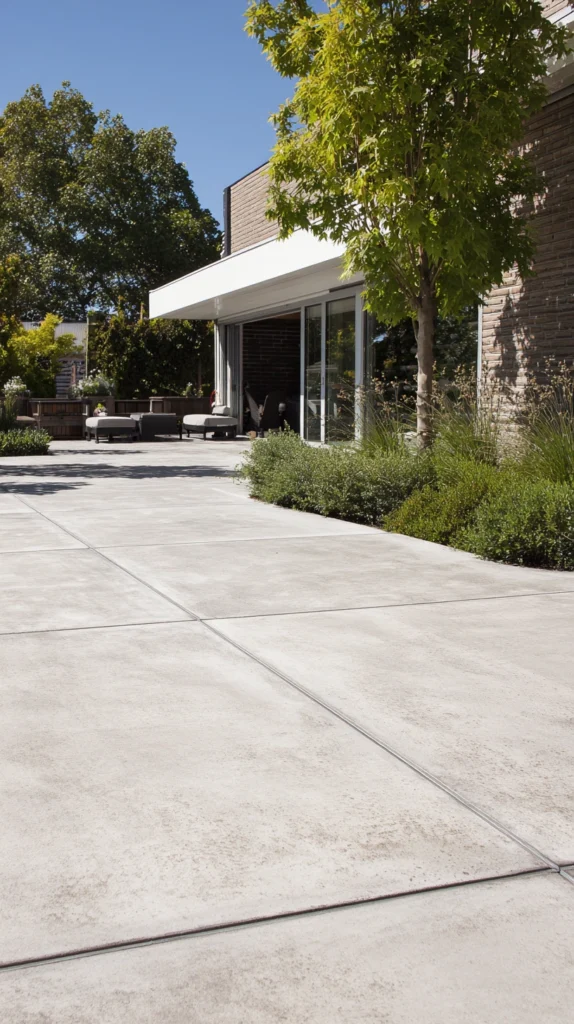
Poured concrete is the foundational material of modern garden design — honest, durable, endlessly versatile, and more beautiful than its utilitarian reputation suggests. A large-format concrete patio, brushed or polished to a smooth finish and edged with a clean steel or stone border, provides the kind of uninterrupted horizontal plane that modern garden design depends on. It does not compete with the planting, the furniture, or the architecture — it simply provides a calm, consistent surface that makes everything placed on it look considered.
Board-formed concrete — poured against timber shuttering that leaves a linear grain impression in the surface — adds texture and warmth to what might otherwise feel like a cold material. Exposed aggregate finishes introduce visual interest at ground level without disrupting the overall clarity of the surface. Both finishes cost marginally more than plain poured concrete but produce a result with significantly more character.
Garden tip: Incorporate drainage channels into the concrete patio design at the planning stage rather than adding them afterward. A slim stainless steel or resin-bonded gravel drain channel running across the surface handles rainfall without directing water toward the house foundations, and a flush-fitted drain is significantly more visually refined than a surface-level grate added after the pour.
2. The Clipped Hedge Architecture
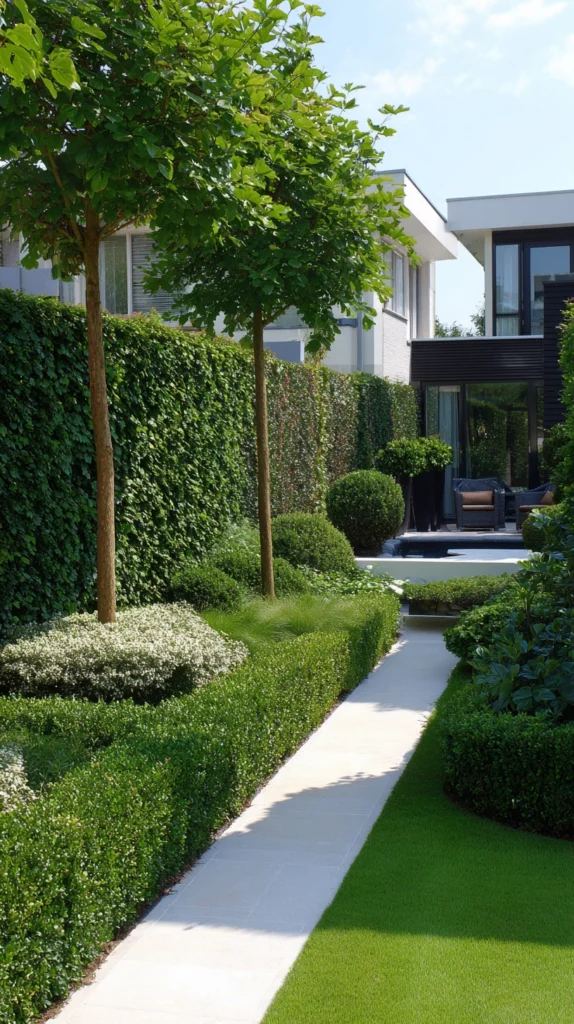
Budget: $80 – $600
In a modern garden, clipped hedges serve as living architecture — walls, screens, and enclosures that define space with the same authority as stone or timber but with the additional quality of seasonal change and biological richness. Box, yew, hornbeam, and beech clipped into precise geometric forms — cubes, rectangles, long runs of flat-topped hedge — create the structural bones of a modern garden and give it a sense of considered design that planting alone rarely achieves.
A single large cube of clipped yew costs $60–$200 depending on size and supplier. A run of hornbeam hedge planted from bare-root whips costs $2–$5 per plant and reaches a useful screening height of 1.5 metres within four to five years. The maintenance commitment — a single precise clip per year for yew, two clips for box and hornbeam — is modest for the architectural return the plants provide.
Garden tip: Use a taut string line and a long spirit level every time you clip a formal hedge rather than trusting your eye alone. A hedge that is even 2–3 centimetres out of level reads as noticeably uneven from a distance and undermines the precise, controlled quality that makes clipped hedging so effective in a modern garden. The string line takes two minutes to set up and produces a consistently level result that freehand clipping never achieves.
3. The Minimalist Water Feature
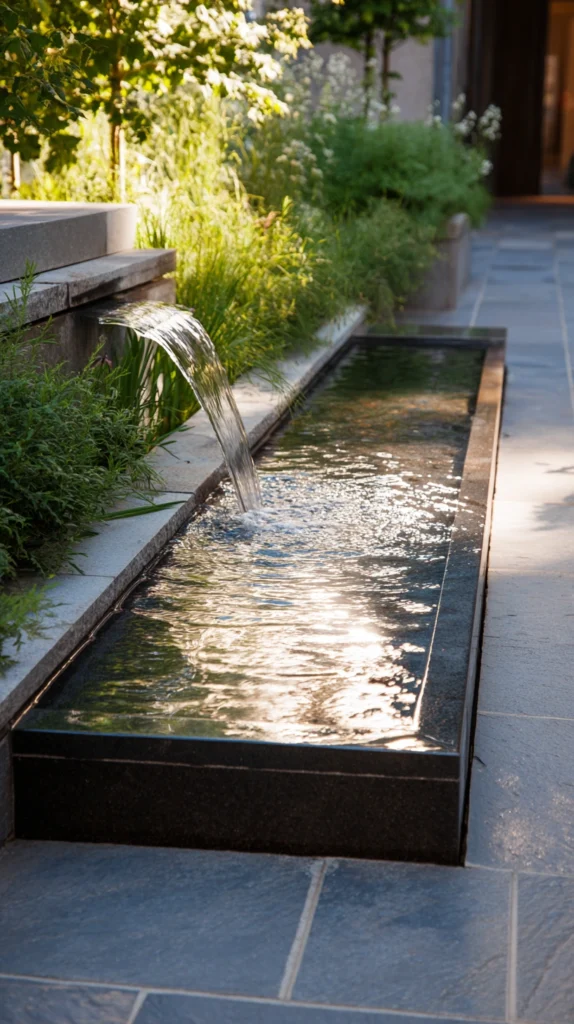
Budget: $150 – $2,000
Water in a modern garden is at its most powerful when it is at its most restrained. A long, narrow rill running flush with the patio surface, a rectangular reflecting pool with still dark water and no planting, a single blade of water falling from a wall-mounted spout into a stone trough below — these are water features that use simplicity as their primary design quality. The reflection, the sound, and the movement of water are what the feature is for, and every element of its construction serves those qualities without distraction.
A wall-mounted blade water feature in corten steel or brushed stainless costs $200–$600 including pump and basin. A flush-fitted rectangular rill in concrete or black-painted steel costs $300–$1,200 depending on length. Both require a submersible pump, a reservoir, and a return pipe — the engineering is straightforward and the maintenance minimal once installed correctly.
Garden tip: Use a black liner or black paint on the interior of any modern water feature rather than the standard blue or grey. A dark interior creates the deep, mirror-like reflective surface that makes modern water features so visually compelling — pale interiors create a lighter, shallower-looking body of water that loses the reflective quality entirely.
4. The Single Species Planting Drift
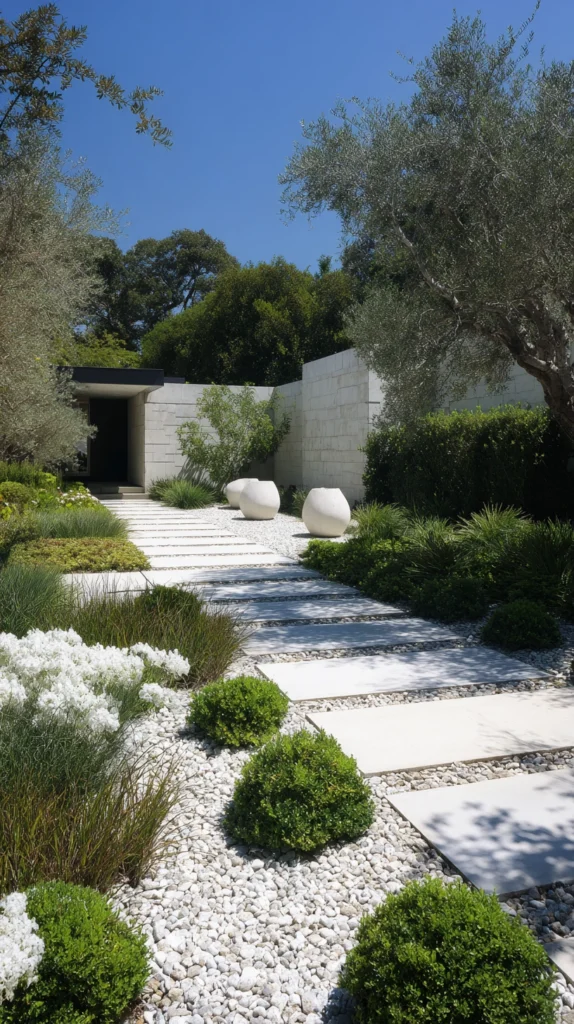
Budget: $40 – $200
One of the most powerful techniques in modern garden planting design is the single-species drift — a generous, uninterrupted sweep of one plant variety repeated across a bed or border in sufficient quantity to create a bold, graphic statement. Ornamental grasses, agapanthus, salvias, verbena bonariensis, or alliums planted in drifts of twenty, thirty, or fifty of the same variety create a visual impact that scattered individual plants of many different species could never achieve.
The single species drift works because it treats the garden border as a graphic design exercise rather than a botanical collection. The eye reads the repeated form as a pattern, the colour reads as a coherent block rather than a scattered mixture, and the overall composition has the kind of visual confidence that only comes from commitment to a limited palette of plants used generously.
Garden tip: Choose one plant for its winter presence as well as its summer performance when planning a single species drift. Pennisetum, miscanthus, and stipa grasses hold their form and their dried seed heads through autumn and winter, giving the modern garden a structural presence through the coldest months that flowering perennials cannot provide once they have died back.
5. The Corten Steel Raised Bed
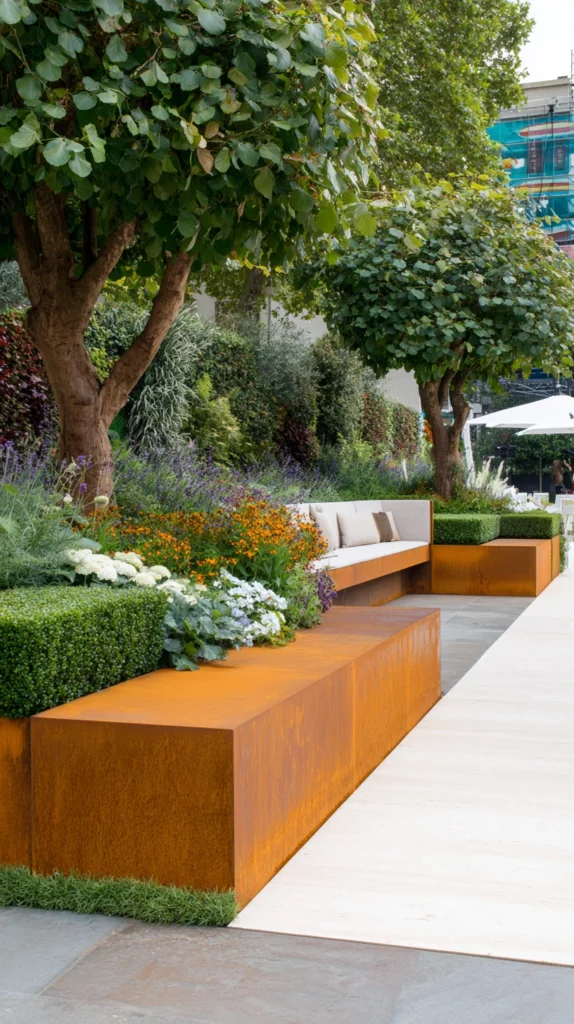
Budget: $150 – $800
Corten steel — the self-rusting weathering steel whose warm amber-brown patina deepens and stabilises over time — is one of the defining materials of contemporary garden design. Used as raised bed edging, as retaining walls, as screen panels, or as freestanding planters, it brings a warm industrial character to a modern garden that complements both stone paving and lush planting with equal ease. The colour of aged corten — a rich, layered rust that shifts between amber, copper, and deep brown depending on the light — is genuinely beautiful and entirely unlike any painted or powder-coated alternative.
Corten raised bed kits in standard rectangular sizes cost $150–$400. Custom fabricated corten planters and screens cost more but can be made to any dimension. The steel requires no painting, no sealing, and no maintenance — the patina is the surface, and it improves with every season of weathering.
Garden tip: Allow corten steel to weather fully before planting into raised beds or positioning them on pale stone paving. Fresh corten weeps rust-coloured water for the first several weeks of weathering and will permanently stain pale limestone, sandstone, or concrete surfaces beneath it. Weather the steel on gravel or on a sacrificial surface for four to six weeks until the rust stabilises before moving it to its final position.
6. The Gravel and Ornamental Grass Garden
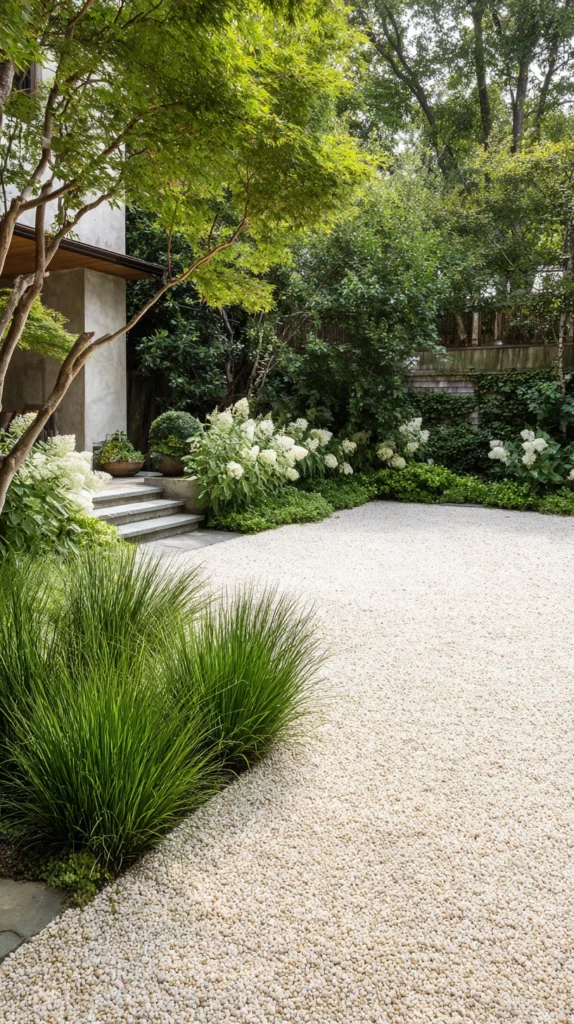
Budget: $80 – $400
Pale gravel as a ground surface with ornamental grasses planted through it in loose, naturalistic groupings creates a modern garden that manages to be simultaneously graphic and organic — the clean gravel plane providing the clarity, the grasses providing the movement and softness. This combination suits contemporary architecture particularly well and requires almost no maintenance once the grasses are established and the gravel is deep enough to suppress weeds effectively.
Stipa tenuissima, pennisetum, molinia, and festuca are among the most beautiful grasses for this treatment — all relatively compact, all producing fine-textured foliage and seed heads that move in the lightest breeze, and all tolerant of the free-draining conditions that a gravel garden provides. Plant in irregular groupings of three to five of the same variety rather than evenly spaced individual plants.
Garden tip: Lay gravel at a minimum depth of 7 centimetres over a permeable membrane for effective weed suppression. A shallower gravel layer allows light to reach weed seeds through the membrane and produces a maintenance problem that undermines the clean aesthetic the garden depends on. Seven centimetres feels generous when laying it — it is the minimum that actually works.
7. The Timber Deck With Integrated Seating
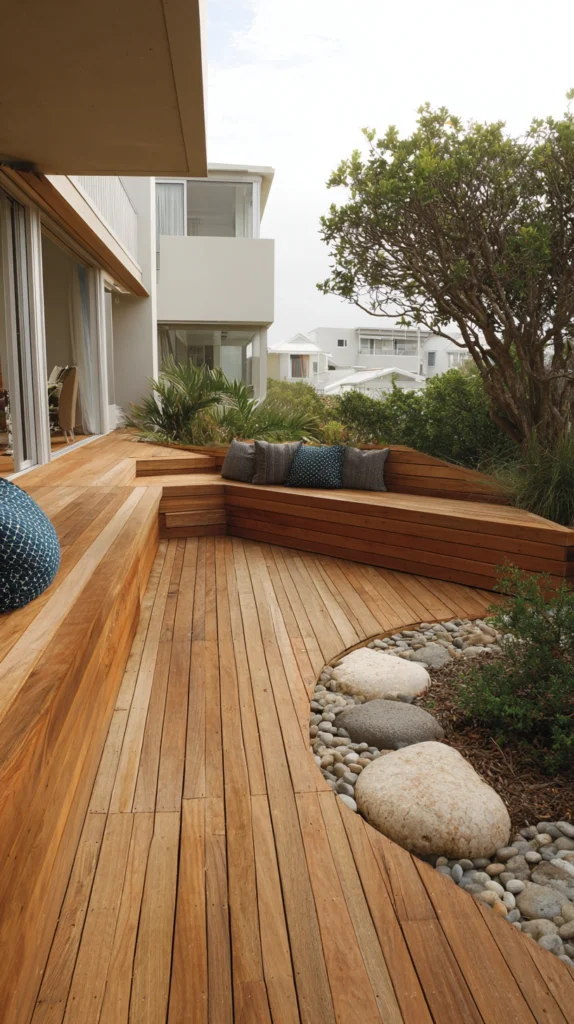
Budget: $300 – $2,500
A hardwood deck with built-in bench seating — either a continuous perimeter bench along one or two edges, or a freestanding bench integrated into a central deck structure — removes the visual clutter of moveable furniture and gives the outdoor space a finished, architectural quality that loose chairs and tables rarely achieve. The deck and the seating read as a single designed element rather than a surface with furniture placed on it, and the simplicity of the arrangement suits the modern garden perfectly.
Hardwood decking in ipe, teak, iroko, or thermally modified timber costs $40–$100 per square metre. Integrated bench seating adds $50–$150 per linear metre to the overall cost. Specify the same timber species for both the deck surface and the bench tops — a consistent material throughout the structure gives it a resolved, considered quality that mixed materials undermine.
Garden tip: Run the decking boards in a single consistent direction across the entire deck surface rather than introducing herringbone patterns or directional changes. A single board direction reinforces the clean, linear quality of modern design and makes the deck feel larger and more unified. Pattern changes in the boarding draw the eye to the surface rather than across it and reduce the sense of space.
8. The Outdoor Room With Defined Zones
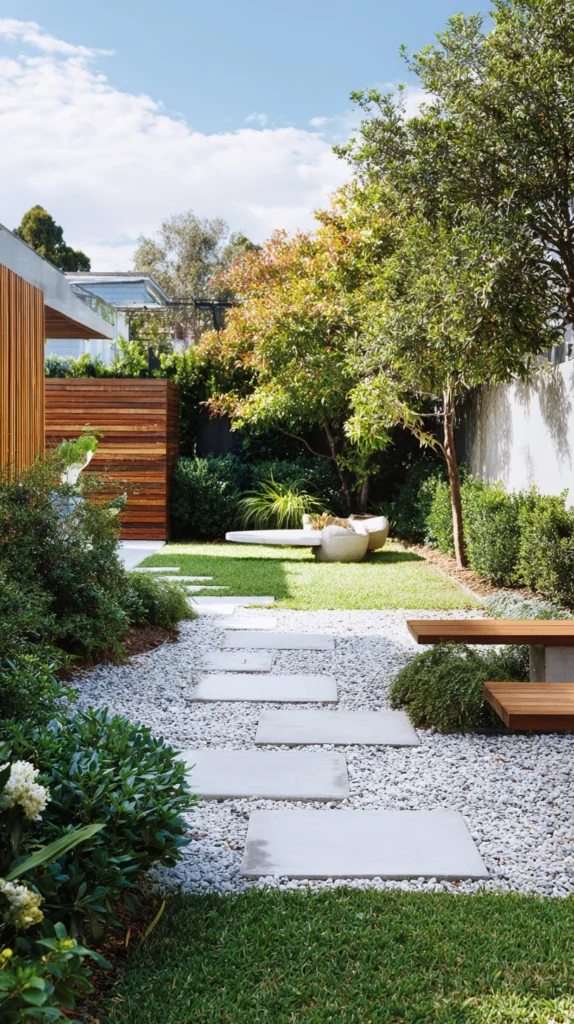
Budget: $400 – $3,000
The modern garden works best when it is conceived as a series of distinct outdoor rooms — a dining zone, a relaxing zone, a planting zone, a circulation zone — each clearly defined by changes in surface material, level, or planting, and each with a specific purpose that determines its scale, its orientation, and its relationship to the house. The discipline of zoning prevents the modern garden from becoming a single undifferentiated space and gives it the spatial complexity of a well-designed interior.
Define zones through material changes — poured concrete for dining, timber decking for relaxing, gravel for planting areas — rather than through furniture or decoration. Material transitions at ground level are the most permanent and most visually resolved way to distinguish between areas of a modern garden, and they work equally well with or without furniture in place.
Garden tip: Keep the number of different surface materials in a modern garden to a maximum of three. More than three materials in a single garden creates visual fragmentation and undermines the coherence that the clean aesthetic depends on. Two materials used confidently — concrete and gravel, timber and stone — always looks more considered than four or five materials used sparingly across the same space.
9. The Pleached Tree Screen
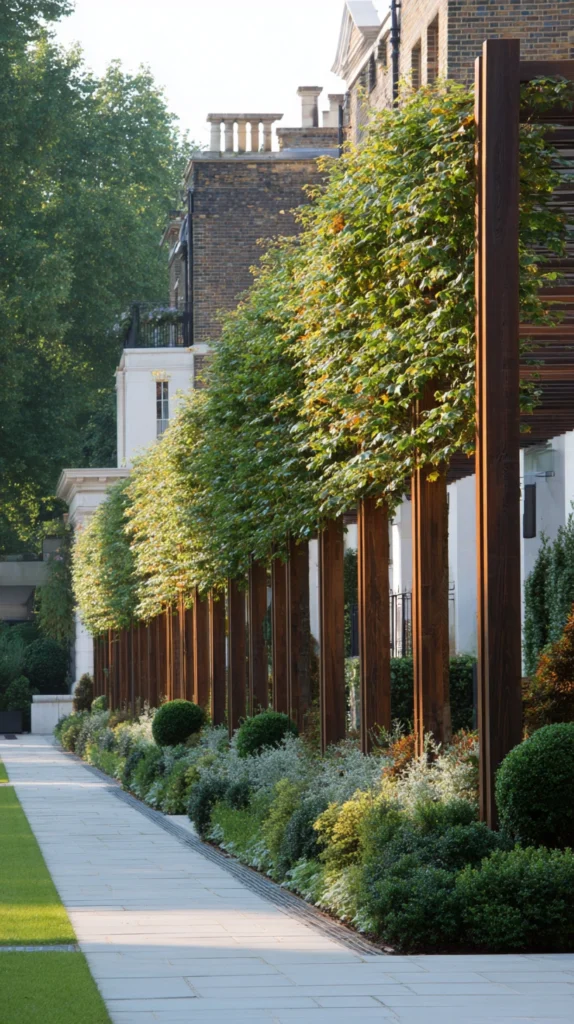
Budget: $200 – $1,500
Pleached trees — standard trees whose lateral branches are trained horizontally on a framework to create a raised, elevated screen of foliage on clear stems — are one of the most sophisticated planting techniques available in modern garden design. A row of pleached hornbeam, lime, or photinia creates privacy and enclosure at head height and above while leaving the lower level of the garden visually open, producing the effect of a floating green wall above a clear, unobstructed ground plane.
Pleached hornbeam trees in 10-litre containers with a basic framework cost $40–$80 each. Instant pleached trees on a pre-built framework, 1.8–2.5 metres tall, cost $150–$400 each. Plant in a row at 1–1.5 metre centres for a continuous screen effect. The trees require an annual clip in late summer to maintain the flat, even canopy that makes pleaching so effective as a design element.
Garden tip: Install the supporting post and wire framework before planting the trees rather than after. Driving posts into the ground beside established pleached trees risks root damage, and trying to tension horizontal wires around a planted row without a proper framework produces an uneven, unstable structure. A properly installed framework takes a morning to build and makes the subsequent training of the trees straightforward.
10. The Black and White Planting Palette
Budget: $50 – $250
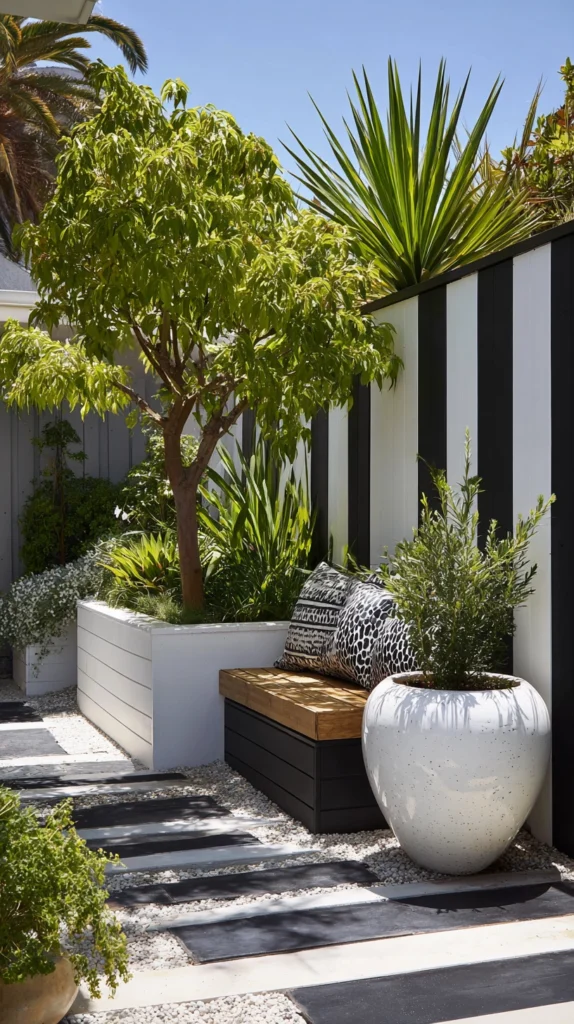
A planting palette restricted to near-black and white flowering and foliage plants — white agapanthus, black mondo grass, white cosmos, **dark-leaved aeoniums, white Japanese anemones, and silver artemisia — creates a modern garden border with a graphic, almost monochromatic quality that suits contemporary architecture and clean-lined design better than any multicoloured planting scheme. The restraint of the palette forces the eye to focus on form, texture, and composition rather than colour variety.
The near-black of Ophiopogon planiscapus ‘Nigrescens’ (black mondo grass) beside the pure white of agapanthus or white hydrangea is one of the most striking and most modern planting combinations available — the contrast is as graphic as a design decision can be in a planted border, and it looks extraordinary in both daylight and evening light.
Garden tip: Introduce one metallic or silver-leaved plant into a black and white palette as a bridging element between the two tones. Stachys byzantina, artemisia, or silver-leaved astelia provide a mid-tone that prevents the black and white contrast from feeling harsh and adds a luminous quality to the border in evening and overcast light.
11. The Walled Courtyard Garden
Budget: $500 – $5,000
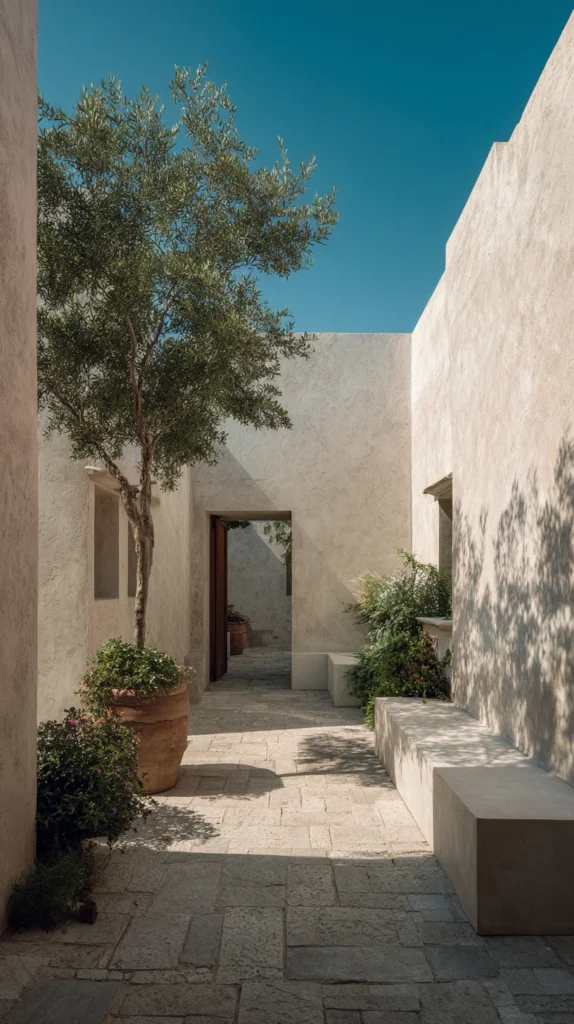
An enclosed courtyard with high walls on all four sides — rendered in a single consistent finish and colour, with a simple geometric planting scheme, a flush-fitted water feature, and a single large specimen tree as the vertical focal point — is the purest expression of modern garden design principles available in a domestic setting. The enclosure creates a controlled environment in which every element is visible from every other element, and the design must work as a complete composition rather than as a collection of individual features.
Render the courtyard walls in a single colour that relates to the interior finishes of the house — warm white, pale grey, charcoal, or deep olive all work beautifully as courtyard wall colours and create a visual connection between the indoor and outdoor spaces that open gardens cannot achieve. A large specimen olive, fig, or multi-stem birch in the centre or at one corner provides the scale and seasonal presence the courtyard needs.
Garden tip: Ensure every element in a walled courtyard is perfectly finished — there is nowhere to hide an imperfect render joint, an uneven paving line, or a poorly detailed drainage channel in an enclosed space where every surface is visible from every seat. The standard of finish that a courtyard demands is higher than any open garden because the enclosure makes every detail inescapable.
12. The Linear Formal Pool
Budget: $400 – $3,000
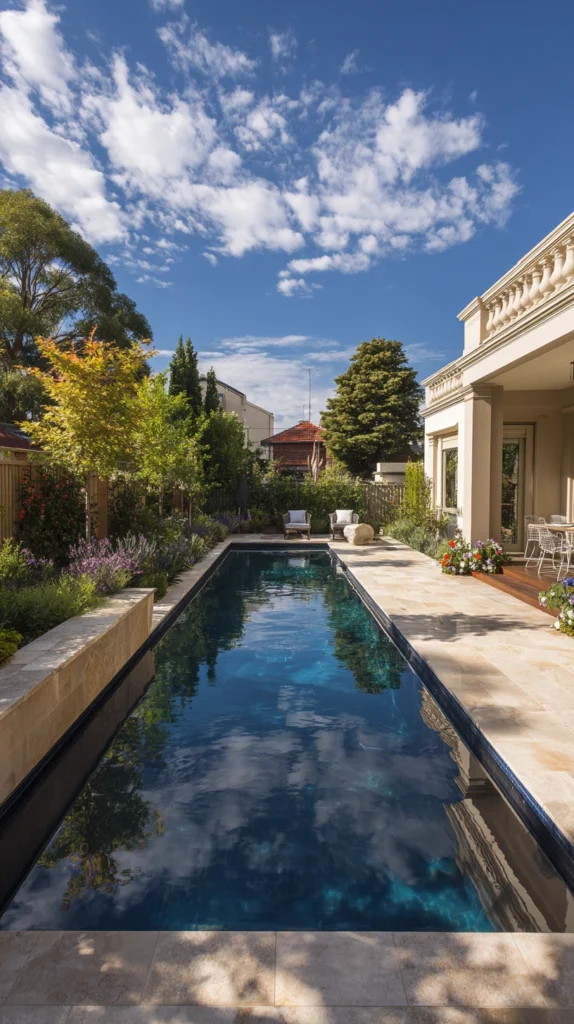
A long, narrow rectangular pool — flush with or slightly raised above the surrounding paving, with clean geometric edges and still, dark water — is the defining water feature of the modern formal garden. It reflects the sky, the surrounding planting, and the architecture of the house in its surface, doubling the visual depth of the space without adding a single additional planted element. It creates sound only when a thin blade of water breaks the surface at one end, and even that is restrained and precise.
Construct the pool in reinforced concrete with a black waterproof render finish on all interior surfaces. Edge it in the same material as the surrounding paving — limestone, granite, or concrete — for a continuous, flush transition between pool and patio that reads as a single designed surface. Plant the pool edges sparingly if at all — one variety of aquatic plant in one corner, or no planting whatsoever, both suit the modern aesthetic equally well.
Garden tip: Install underwater LED lighting in a modern formal pool from the outset rather than retrofitting it later. Flush-mounted underwater lights at the ends of the pool, angled to illuminate the water length rather than pointing upward, create a subtly luminous effect after dark that transforms the garden’s evening character. Retro-fitting underwater lights into a completed pool requires draining and breaking the render — a significant disruption that is entirely avoidable with early planning.
13. The Green Roof Garden Structure
Budget: $500 – $3,000
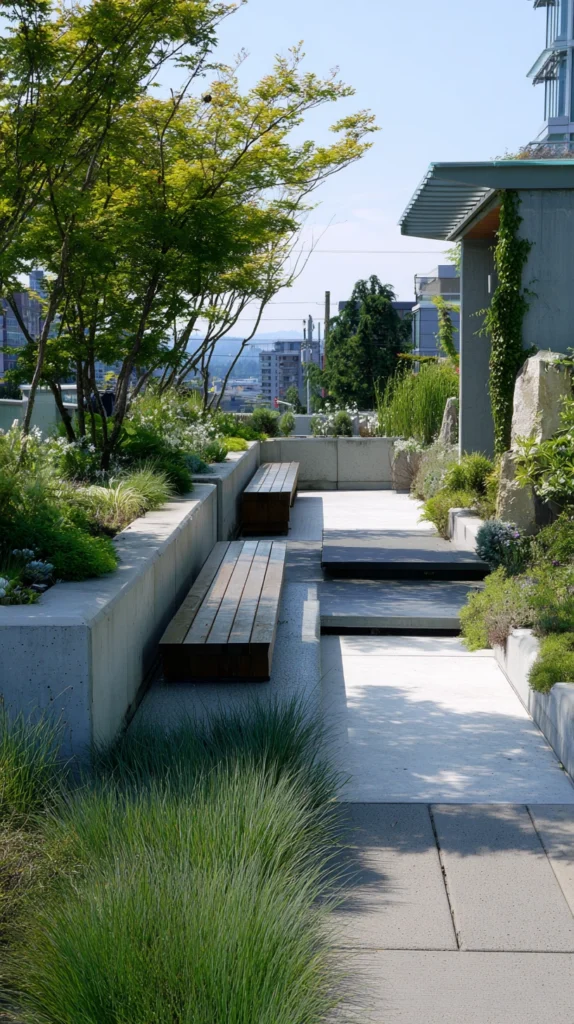
A garden structure — a pergola, a seating shelter, a garden room — with a living green roof planted in sedum, wildflower mix, or low ornamental grass brings a modern ecological sensibility to the garden while simultaneously providing an extraordinary visual feature when viewed from an upper-storey window or an elevated terrace. The green roof manages rainwater, insulates the structure beneath, provides wildlife habitat, and looks beautiful from every angle in every season.
A flat or very gently pitched roof structure needs a waterproof membrane, a drainage layer, a growing substrate, and the plant material itself — a combined system cost of $20–$40 per square metre in materials. The structural frame must be engineered to carry the additional weight of a saturated green roof — approximately 80–120 kilograms per square metre — which typically means consulting a structural engineer or specifying a proprietary green roof kit designed for the load.
Garden tip: Choose a sedum mat system over loose-laid substrate and plug plants for a green roof on a garden structure. Sedum mats are pre-grown, weed-free, immediately established in appearance from day one, and significantly easier to install on a roof surface than building up the substrate and plant layers individually. They cost slightly more per square metre but save several hours of installation labour and produce an instantly finished result.
14. The Night Garden With Architectural Lighting
Budget: $200 – $2,000
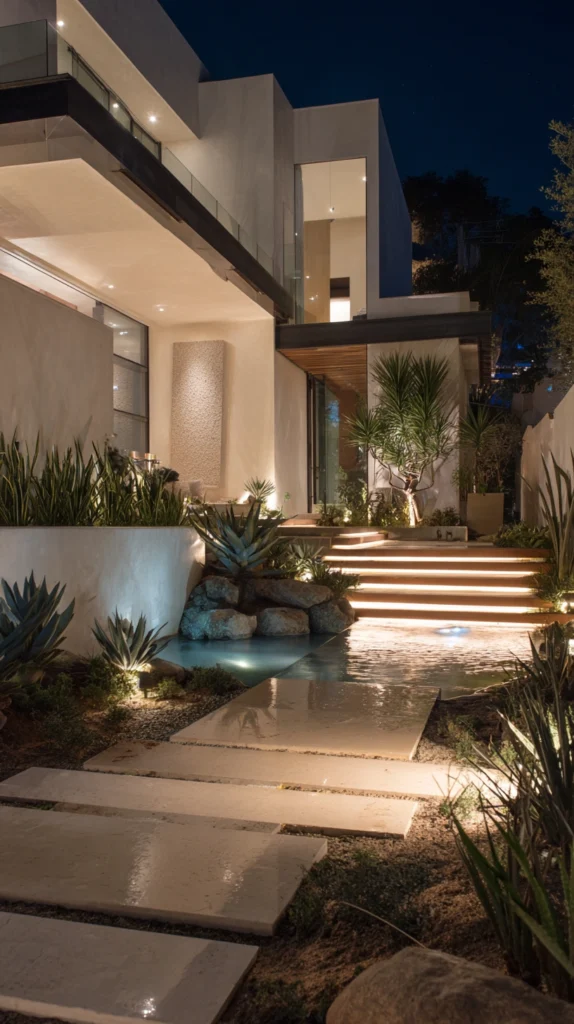
A modern garden designed to be as beautiful after dark as it is in daylight requires a lighting scheme that is planned from the outset rather than added as an afterthought. Uplighting a specimen tree or a clipped hedge wall, grazing light across a textured render surface, illuminating a water feature from below, and marking the edges of paths and level changes with flush ground-level light — these are lighting techniques that reveal the garden’s architectural qualities after dark in a way that general overhead lighting never can.
Low-voltage LED systems run from a transformer and can be controlled by a timer or smart home system. Brass or stainless steel fixture housings weather well in an outdoor environment and suit the material palette of a modern garden. Specify warm white bulbs at 2700K colour temperature throughout — cooler temperatures create a clinical, commercial quality that is entirely at odds with the warmth a well-designed garden should generate in the evening.
Garden tip: Light the garden from low positions angled upward or across surfaces rather than from high positions angled downward. Downlighting from height creates flat, even illumination with no shadow — competent but characterless. Low-level uplighting and grazing light creates depth, shadow, and drama that makes the garden feel genuinely three-dimensional after dark and reveals the texture and form of every surface it touches.
The modern garden rewards the designer who understands that restraint is not a limitation but a skill. Choosing three materials instead of six, one plant species instead of ten, one strong focal point instead of several competing ones — these are decisions that require more confidence and more clarity of vision than adding more. Make those decisions with conviction, execute them with precision, and the result is a garden that feels exactly like what it is — a space that knows what it wants to be and is entirely comfortable being it.