14 Mums and Ornamental Grass Garden Combos for Fall
Planted chrysanthemums and grasses side by side three autumns in a row before noticing that some combinations worked and some did not. Same plants, different results.
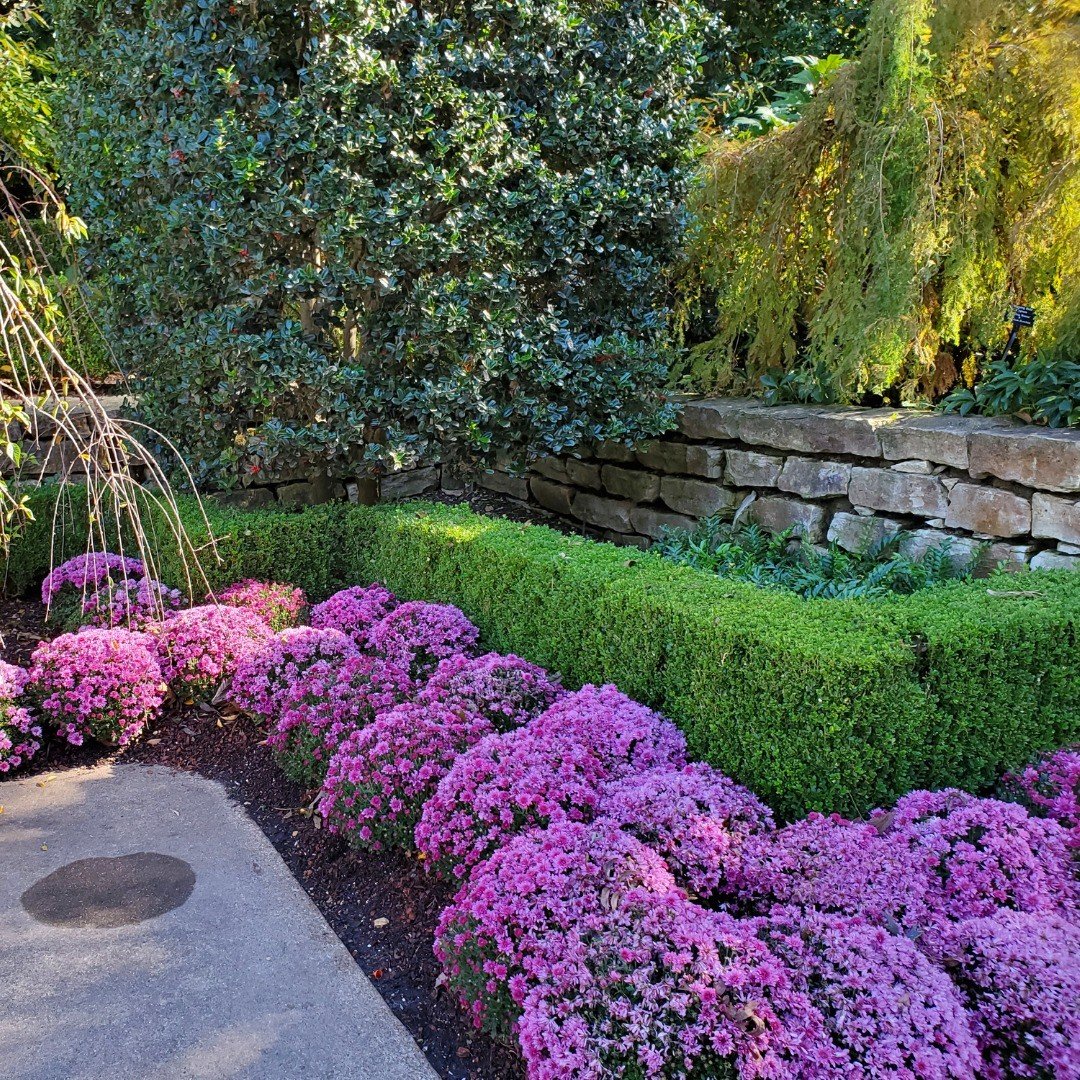
The purple mum beside the stipa: extraordinary — the deep colour against the pale feathery grass, both catching October light differently, the contrast between the still flower and the constantly moving grass.
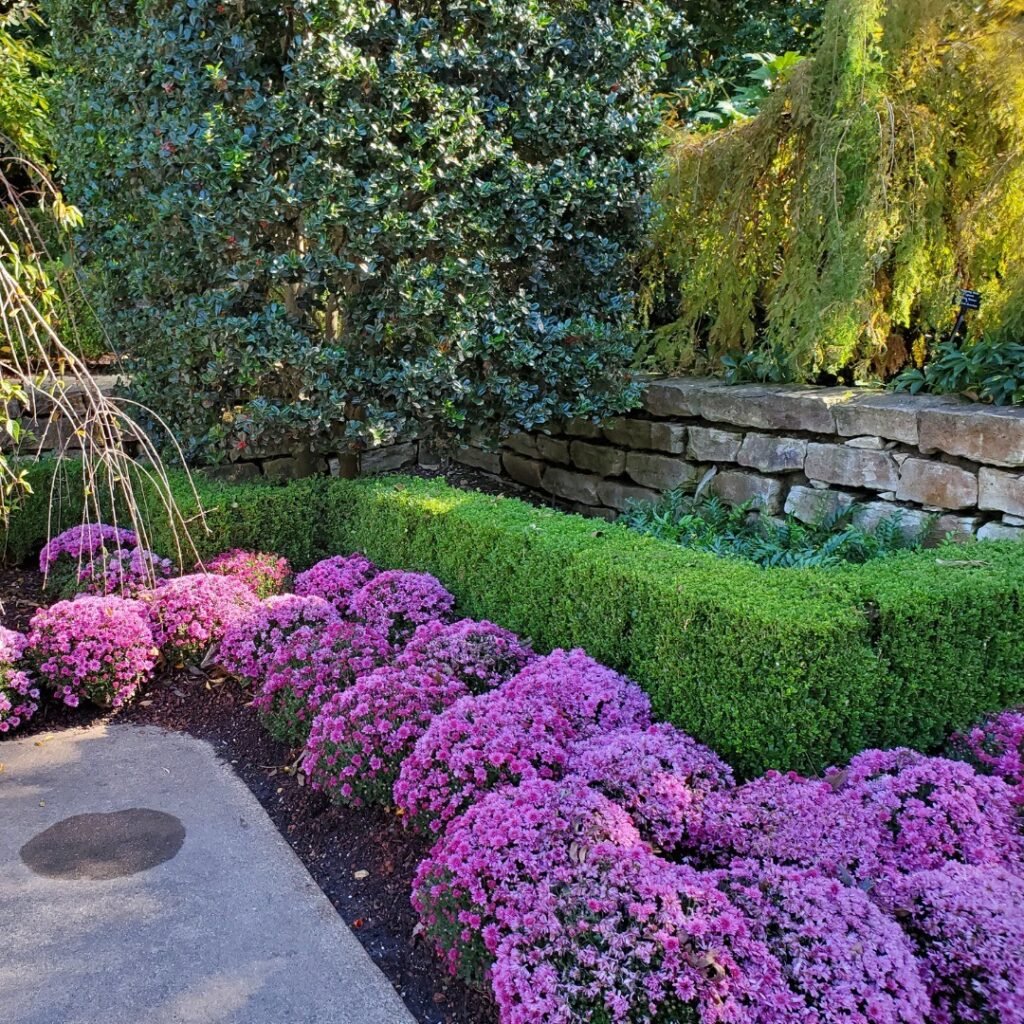
The same purple mum beside the miscanthus: flat. The colours too similar. The scale wrong. Neither plant able to be itself properly because the other plant was competing at the same frequency.
The combination is where the design is. Both plants individually: beautiful in autumn. Together correctly: extraordinary. Together incorrectly: both diminished.
Here are 14 combinations that work — with the reasoning behind why each one works.
Why Mums and Grasses Are the Perfect Autumn Pairing
The complementary nature of the two plants:
What mums bring:
- Colour (the whole warm palette from white through yellow, orange, copper, rust, burgundy, and deep purple)
- Rounded, compact form
- Dense texture (many small petals)
- A relatively static quality (mums do not move much in wind)
- A moment (mums have a peak flowering window, approximately 4–8 weeks)
What ornamental grasses bring:
- Movement (even the slightest breeze moves a grass)
- Transparency (grasses are see-through — the light behind them is part of their beauty)
- Season-long structure (grasses are interesting from spring through winter)
- Fine texture (the extreme of fine — individual leaf blades and seed filaments)
- Warm neutral colours (the gold, amber, and tan of autumn grass)
Why they need each other:
- Mums without grasses: the colour is there, the movement and transparency are absent
- Grasses without mums: the structure and movement are there, the colour is absent
- Together: the full autumn garden expression
The contrast principles:
Form contrast:
- The rounded cushion of the mum against the arching, upright, or weeping form of the grass
- The dome against the fountain: the pairing that the eye reads as complete
Texture contrast:
- The dense, closely-petalled mum against the single-bladed grass
- The maximum texture contrast available in the autumn garden
- The contrast: makes both textures more visible
Movement contrast:
- The mum: still (or nearly so)
- The grass: always moving
- The still and the moving: the most dynamic relationship in the garden
Scale contrast:
- The grass often taller than the mum (the grass: the vertical, the mum: the horizontal)
- Or: the mum and grass at the same height but different forms
- Scale relationship: one of the four design decisions for each combination
The Mum Palette
The colour families available:
White and cream:
- The purest version — works with any grass
- Most elegant combination partner
- Suits grasses with winter interest (the white mum fades as winter settles in, leaving the grass alone)
Yellow and gold:
- The harvest colour
- Pairs naturally with gold-toned grasses (the monochromatic approach)
- More impact against darker grasses (the contrast approach)
Orange and copper:
- The most distinctly autumnal
- The colour that most directly references autumn leaves
- Against silver grasses: the most striking
Rust and terracotta:
- Deeper and warmer than orange
- Sits in the same family as the warm-toned grasses (sympathetic palette)
- The most relaxed combination: warm tones together
Deep burgundy and wine:
- The darkest available
- High contrast against pale grasses
- The most sophisticated combination
- Particularly beautiful in the low angle of October afternoon light
Deep purple:
- The strongest contrast against pale gold grasses
- The combination that most often stops people
- The reason for this article’s opening paragraph
The Grass Palette and Form
The grass forms:
Fountain/arching (pennisetum, stipa):
- Falls outward from the crown
- The fountain: the grass’s most graceful form
- Seed plumes arch and hang
- The movement: maximum at the tips
Upright/vertical (calamagrostis, panicum):
- Grows strongly vertical
- The exclamation mark in the planting
- The structure: most visible in winter
Weeping/cascading (hakonechloa, carex):
- Falls to one side or downward
- The softest grass movement
- Like water over a stone
Tall/structural (miscanthus, cortaderia):
- The architectural grass
- The tall background element
- The seed plumes: dramatic and enormous
The grass colours:
Silver-blonde:
- Stipa tenuissima (the palest, the most fine)
- Catches backlight like nothing else
- Glows in October afternoon light
Green-gold:
- Most grasses in summer
- By October: transitioning to amber
Amber and red-amber:
- Pennisetum alopecuroides in autumn
- The warm transition colour
- The russet-gold
Blue-green:
- Helictotrichon sempervirens (blue oat grass)
- The cool grass in a warm season
- The contrast within the grass choice itself
Deep red-bronze:
- Panicum ‘Shenandoah’ (the most dramatic autumn grass)
- Red-bronze foliage
- The grass that acts as a dark foliage plant
1. Deep Purple Mum and Stipa Tenuissima (The Classic Contrast)
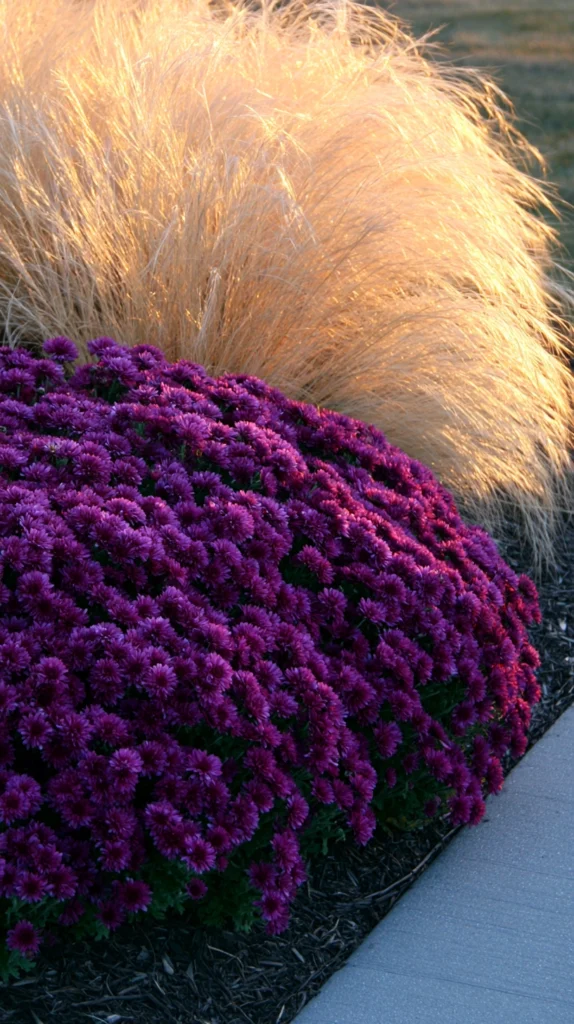
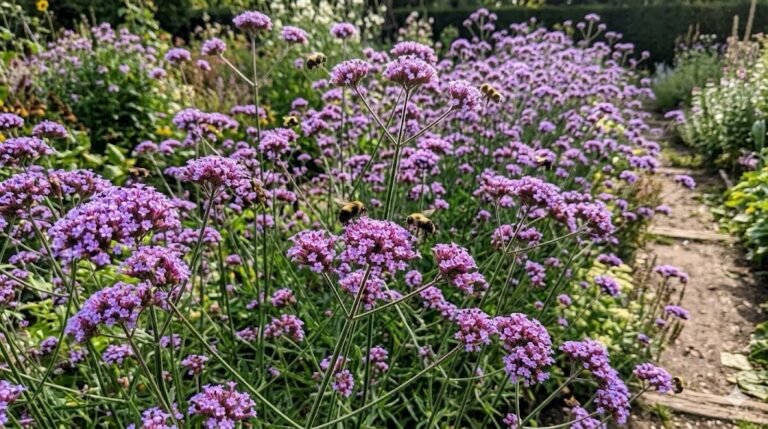
Deep purple chrysanthemum beside Mexican feather grass (Stipa tenuissima) — the combination that started this article and the one that most consistently draws the stopped reaction.
Why this combination works:
The colour contrast:
- Deep purple (mum): the heaviest, deepest colour in the autumn palette
- Pale blonde (stipa): the lightest, most transparent colour available in any plant
- Maximum colour contrast within the warm palette
- The purple reads deeper because the blonde is beside it
- The blonde reads more luminous because the purple is beside it
The form contrast:
- The cushion mum: dense, rounded, static
- Stipa tenuissima: a fountain of fine hair-like blades, in constant movement
- The still dome against the moving fountain: the visual tension
The texture contrast:
- The mum: many small petals, maximum texture density
- Stipa: the minimum texture — individual grass blades almost invisible at distance
- The contrast: maximum possible
The light quality:
- In afternoon October sun, with the light behind:
- The stipa: glows — backlit, it turns to spun gold
- The purple mum: absorbs the light, becoming deeper and richer
- The two plants: responding to the same light in opposite ways
- The response: the combination at its most beautiful
The scale:
- Mum: 18–24 inches typically
- Stipa: 24–30 inches (slightly taller)
- The grass: just above the mum level
- The grass visible above and beside the mum: not behind it
Cost breakdown:
- Purple cushion mum: $8–12
- Stipa tenuissima (medium): $12–18
- Total: $20–30
In the border: plant three mums and three stipa in alternating groups. Not one of each: groups of each. The groups: the combination works at scale.
Combination Scale Tips
For every combination on this list:
- In a container: one mum, one grass
- In a border: three of each, minimum
- In a significant planting: five of each, in drifts
- The same colour contrast works at any scale
- The drift: what makes it a garden composition rather than a specimen planting
2. Copper Mum and Karl Foerster Grass (The Warm Partnership)
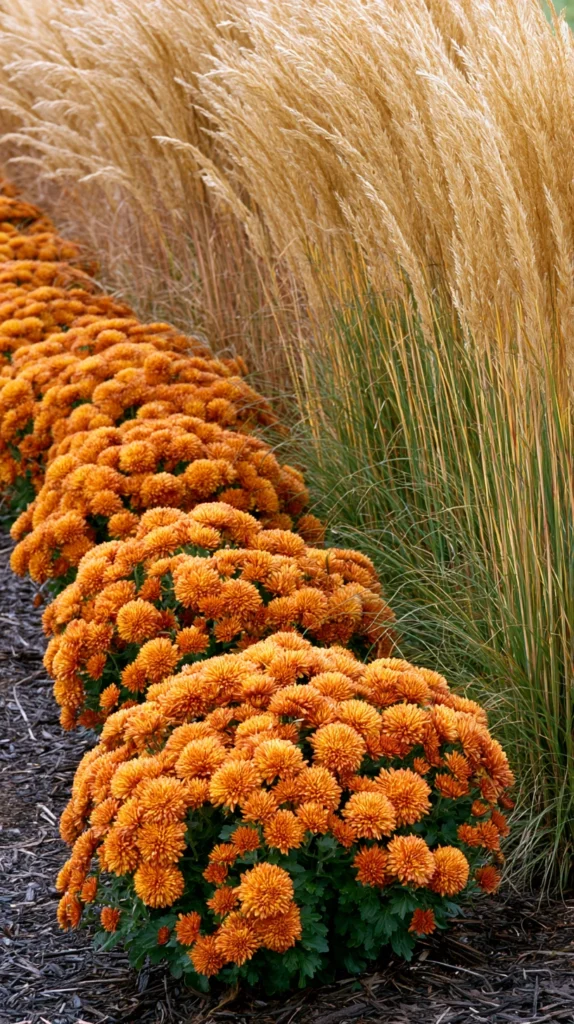
Copper or amber chrysanthemum with Calamagrostis x acutiflora ‘Karl Foerster’ — the combination where the warm tones work together rather than contrasting.
Why sympathetic palettes work:
The warm partnership:
- Copper mum: the warm orange-amber of autumn
- Karl Foerster in autumn: the amber-gold of its seed plumes
- Both warm, both golden, both autumnal
- The palette: harmonious rather than contrasting
When harmony is better than contrast:
- Contrast: makes each element more vivid
- Harmony: creates a mood rather than a statement
- The mood: a warm autumn afternoon, the whole colour temperature raised
- For a seating area or somewhere the feeling is the point: harmony often better
The Karl Foerster specifically:
The grass:
- Upright structure (vertical, architectural)
- Feathery seed plumes in autumn
- Amber-gold autumn colour
- Reliable and widely available
- Holds its structure through winter (the seed heads standing even in snow)
The relationship:
- The Karl Foerster: twice the height of the mum
- The mum: the flowering crown at the base of the grass
- The grass: the vertical behind the horizontal mum
- The combination: a complete plant composition in two plants
The repetition:
- In a border: mum and Karl Foerster alternating at regular intervals
- The Karl Foerster: the regular vertical punctuation
- The mum: the colour mass between the verticals
- The rhythm: the entire border
Cost breakdown:
- Copper mum: $8–12
- Calamagrostis ‘Karl Foerster’: $14–20
- Total: $22–32
3. White Mum and Miscanthus ‘Gracillimus’ (The Elegant Simplicity)
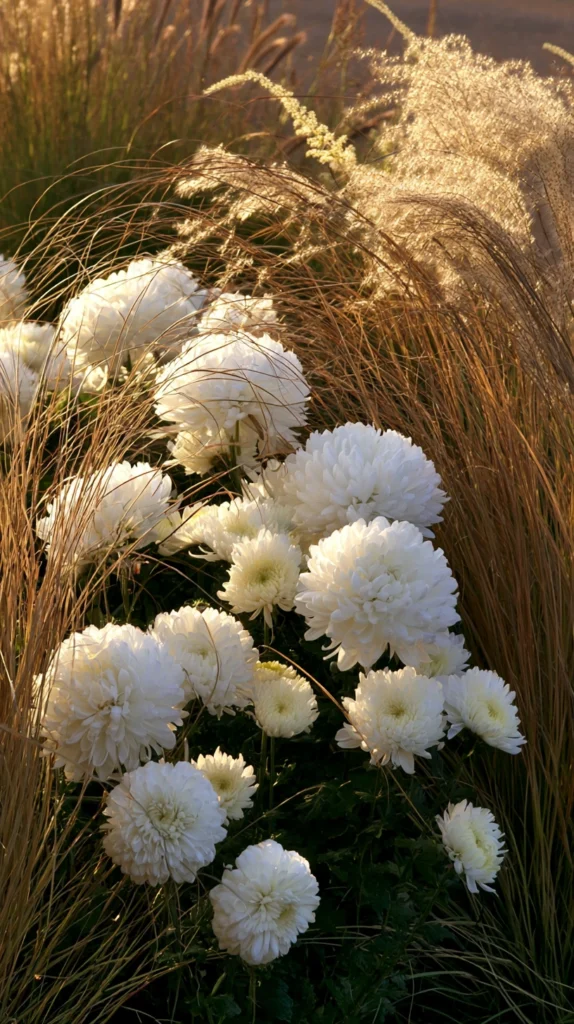
White chrysanthemum with the fine-leaved Miscanthus sinensis ‘Gracillimus’ — the most restrained combination, and sometimes the most refined.
Why white mums require special consideration:
The white in autumn:
- White: not a typical autumn colour
- But: white glows in October light in a way that coloured flowers do not
- The white mum in afternoon autumn sun: luminous
- The contrast with the warm tone of everything else in the garden: the reason for its beauty
Gracillimus specifically:
The grass:
- The finest-leaved miscanthus
- Graceful and arching
- Copper-bronze autumn colour
- The seed plumes: small, airy
- More delicate in character than other miscanthus varieties
The pairing:
- White mum: the clean focal point
- Gracillimus: the warm copper movement surrounding it
- The white surrounded by warm bronze: the contrast that works
The scale:
- Gracillimus: 4–5 feet in full growth
- The mum: 18–24 inches
- The size difference: the mum appearing small and jewel-like beside the large graceful grass
The simplicity principle:
Two plants, two materials:
- No additional plants needed
- The combination: complete in itself
- The restraint: the sophistication
- A border of this combination, repeated: extraordinary
Cost breakdown:
- White cushion mum: $8–12
- Miscanthus ‘Gracillimus’: $18–25
- Total: $26–37
4. Rusty Red Mum and Panicum ‘Shenandoah’ (The Autumn Fire)
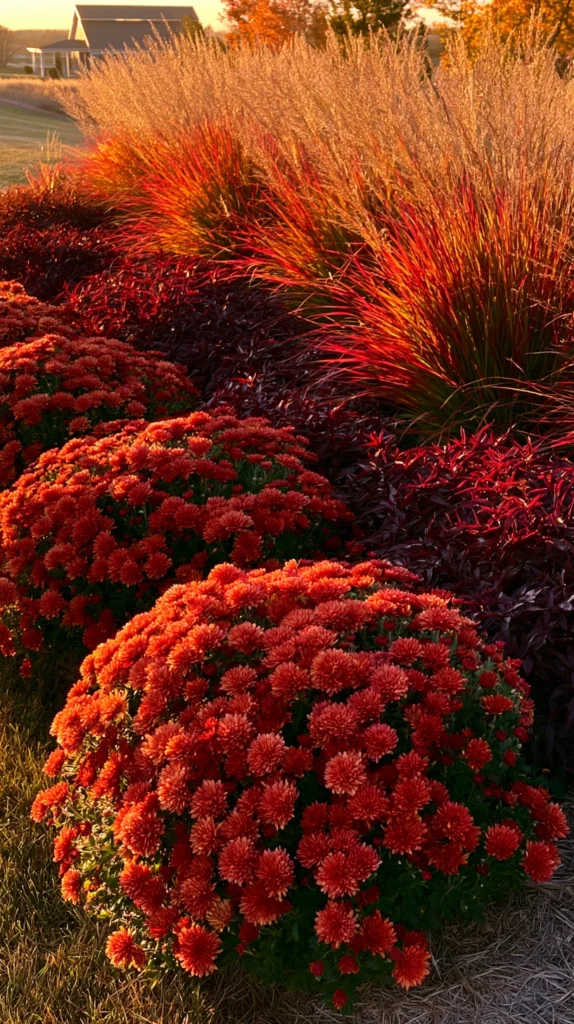
Rust-red chrysanthemum with Panicum virgatum ‘Shenandoah’ — two plants that both turn red in autumn, creating a layered intensity.
Why monochromatic autumn red works:
The layers of red:
- The mum: the warm rust-red of the flower
- Panicum ‘Shenandoah’: the red-burgundy of the foliage by October
- Two reds: not identical (the flower red versus the foliage red)
- The variation within the colour: what makes monochromatic interesting
‘Shenandoah’ specifically:
The grass:
- Blue-green in summer (the contrast with most warm-season grasses)
- By September–October: increasingly red-bronze
- The most dramatic autumn colour change of any commonly grown grass
- The September transformation: the moment to plan around
The combination moment:
- September: ‘Shenandoah’ beginning to turn, mums beginning to open
- October: the full red of both simultaneously
- The combined effect: the border appears to be on fire
- The viewing distance: this combination works from 20 feet as well as from 5
The height:
- ‘Shenandoah’: 3 feet with upright, slightly vase-like form
- Mum: 18–24 inches
- The grass: slightly taller, the mum forward
- The layering: the mum in front, the grass rising behind
The addition of ‘Shenandoah’ seed heads:
- After the grass has flowered: delicate seed heads in early autumn
- They catch the light before the foliage turns fully red
- The transparent seed head against the blue-green foliage: September
- The seed head against the red foliage: October
- Two different combinations from the same plant through the season
Cost breakdown:
- Rust-red mum: $8–12
- Panicum ‘Shenandoah’: $14–20
- Total: $22–32
5. Deep Burgundy Mum and Blonde Pennisetum (The Jewel and the Setting)
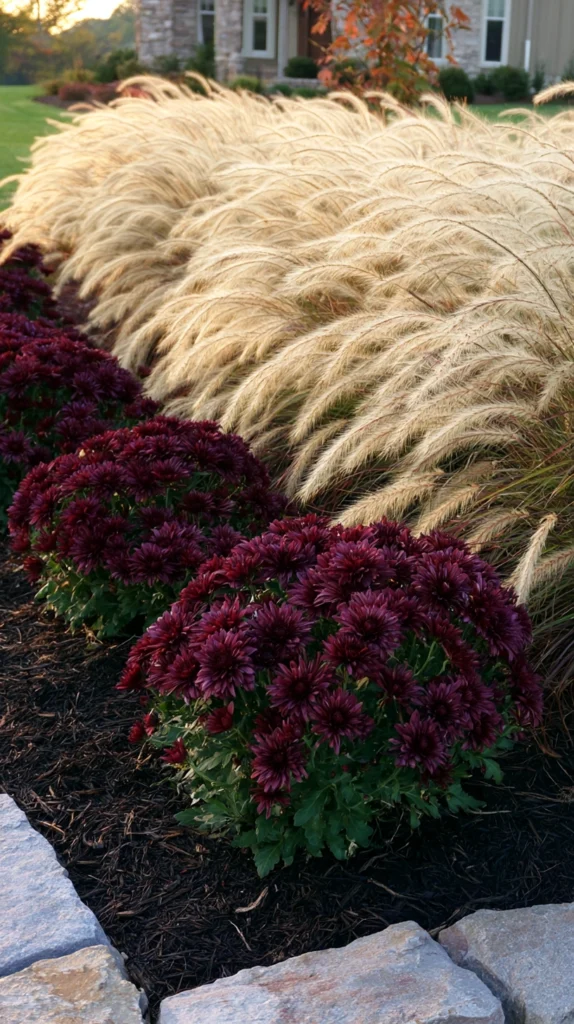
Deep burgundy chrysanthemum with blonde pennisetum (Pennisetum alopecuroides) — the dark jewel set in the warm gold of its companion.
Why this combination photographs consistently:
The jewel effect:
- The deep burgundy mum: the darkest, richest colour in the autumn palette
- The blonde pennisetum: the warmest, most luminous
- Together: the dark stone in its warm setting
- The metaphor is literal: the mum set into the surrounding grass is jewel-like
Pennisetum alopecuroides specifically:
The grass:
- The classic fountain grass
- Arching, flowing form
- Purple-black seed heads in late summer, transitioning to buff-gold
- By October: the full blonde-gold of the mature seed plumes
- One of the most graceful autumn grasses
The colour at peak:
- Burgundy mum: peak at the same time the pennisetum seed plumes are fully golden
- The timing of the combination: approximately late September–October
- The coincidence of peak: the combination designed to be exactly this
The container version:
This combination in a large pot:
- One deep burgundy mum
- One pennisetum in the same large container
- Or: two containers side by side, one each
- The container version: immediate effect, no bed preparation
The pairing in a border:
- Groups of three burgundy mums with groups of three pennisetum
- Alternating along the border front
- The rhythm: dark, light, dark, light
- The rhythm: the border’s visual beat
Cost breakdown:
- Burgundy mum: $8–12
- Pennisetum alopecuroides: $12–18
- Total: $20–30
6. Yellow Mum and Blue Oat Grass (The Cool Contrast)
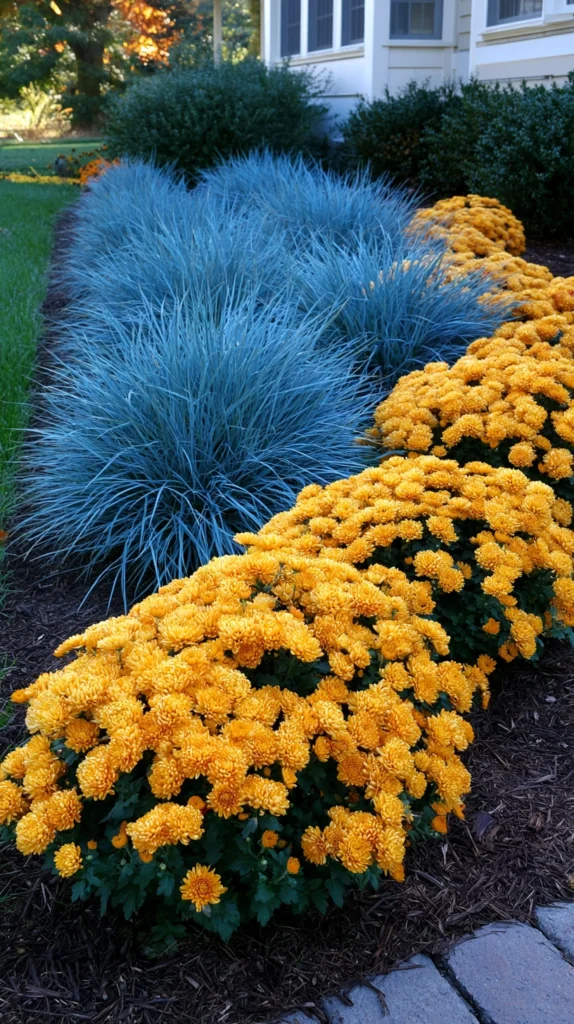
Clear yellow chrysanthemum with Helictotrichon sempervirens (blue oat grass) — the combination that uses the cool blue-grey of the grass as a foil for the warm yellow flower.
Why cool-warm contrast works:
The temperature opposition:
- Yellow: warm (associated with sun, heat, summer)
- Blue-grey oat grass: cool (associated with silver, stone, winter sky)
- The temperature opposition: the same as complementary colours on the colour wheel
- The contrast: more vivid than adjacent colours
Helictotrichon sempervirens specifically:
The grass:
- Evergreen (year-round silver-blue)
- Stiffly upright blades
- Not a typical soft grass: firmer, more architectural
- Blue oat seed heads on tall stems above the clump: summer through autumn
- The blue-grey: constant, reliable, regardless of season
Why the combination is year-round:
- The mum: present for 4–8 weeks of autumn
- The Helictotrichon: present all year
- The combination: at its best in autumn (mum present), but the grass contributes interest in every month
- The investment: the grass earns its place beyond the autumn combination
The yellow mum palette:
Clear gold yellow:
- The most direct complement to the blue-grey
- The contrast: maximum
- Not the pale primrose yellow: the warm gold
Copper yellow:
- Slightly warmer and more orange-tinted
- The combination: slightly warmer in mood
- The contrast: slightly softer
Cost breakdown:
- Yellow/gold mum: $8–12
- Helictotrichon sempervirens: $14–20
- Total: $22–32
7. Orange Mum and Hakonechloa ‘Aureola’ (The Japanese Partnership)
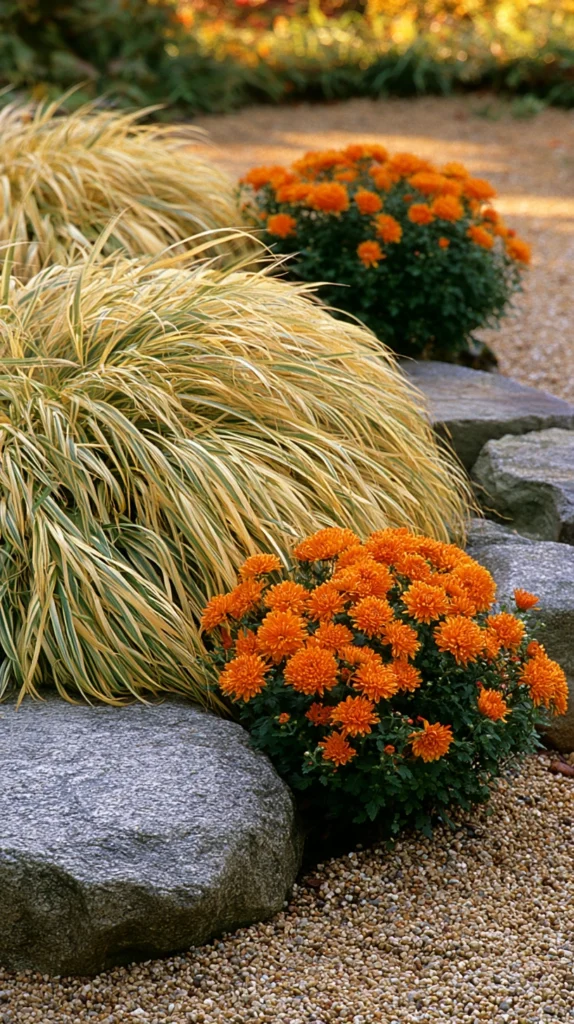
Orange chrysanthemum with Hakonechloa macra ‘Aureola’ (Japanese forest grass) — the combination where the warmth of the grass and the flower create a rich, layered warmth.
Why ‘Aureola’ is the most beautiful grass for container combinations:
The grass:
- The gold-striped Japanese forest grass
- Cascading form (falls to one side like water running over a stone)
- Yellow-gold variegated blades with green stripes
- Brilliant autumn colour: the gold intensifies to orange-bronze
- More beautiful in autumn than in summer
The movement quality:
- Hakonechloa: the most graceful movement of any grass
- In any air movement: the whole plant sways in one direction
- The movement is not random: it flows like hair
- The flowing movement beside the still mum: the contrast
The shade tolerance:
An important practical consideration:
- Hakonechloa: tolerates partial shade (unlike most ornamental grasses)
- Orange mums: also tolerate partial shade (not preferred, but possible)
- This combination: suitable for a partially shaded position
- Useful for a north-facing corner or dappled shade under a tree
The warm layering:
- Orange mum and gold hakonechloa: both warm, both autumn
- The difference: the mum is orange, the grass is gold
- The variation within warmth: the combination
- The mood: autumn afternoon warmth, the most specific possible seasonal mood
Cost breakdown:
- Orange mum: $8–12
- Hakonechloa ‘Aureola’: $15–22
- Total: $23–34
8. Lavender Mum and Silver Pampas (The Unexpected Softness)
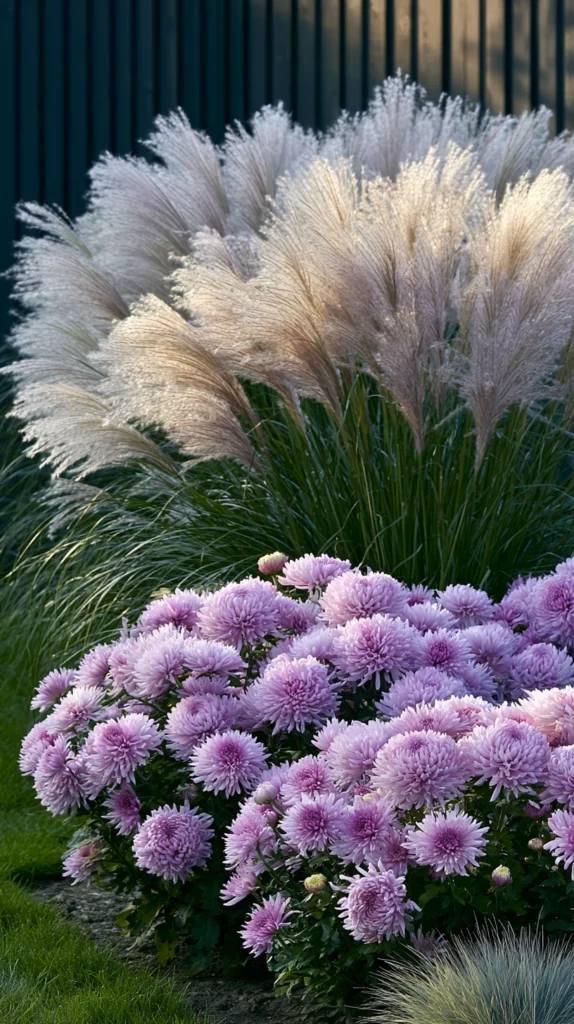
Lavender or pale pink chrysanthemum with Cortaderia selloana (pampas grass, dwarf variety) — the combination that goes soft and romantic in a season that mostly goes warm and rustic.
Why a soft palette works in autumn:
The alternative to warm:
- All other combinations on this list: the warm palette
- The lavender and silver: the palette the season can also support
- The cool morning light in October: sometimes softer and more lavender-toned
- The garden: matching the mood of a specific time of day rather than the season’s peak
Pampas grass considerations:
The dwarf variety (essential):
- Standard pampas grass: 8–12 feet (too large for most garden combinations)
- Dwarf varieties (‘Pumila’, ‘Tiny Pampa’): 3–4 feet
- The dwarf: used as a planting companion rather than a solo statement
- The full-scale version: for a specimen position, not a combination
The silver plume:
- Cortaderia plumes: the most dramatic seed structure in any grass
- Silver-white: the palest of all grass plumes
- In October light: luminous
- Against the lavender mum: the softest possible autumn contrast
The mood:
- Not the fire and drama of the hot colour combinations
- The mist and softness of a cool autumn morning
- The combination: for a garden that is a retreat rather than a statement
The pairing in a container:
- One lavender mum in a white or pale pot
- One dwarf pampas in the same or adjacent pot
- The pale combination: requires a dark background (dark fence) to read properly
- On a pale wall: the combination loses its definition
Cost breakdown:
- Lavender/pale pink mum: $8–12
- Dwarf pampas grass: $18–28
- Total: $26–40
9. Red and Gold Mum with Molinia (The Late Season Transparency)
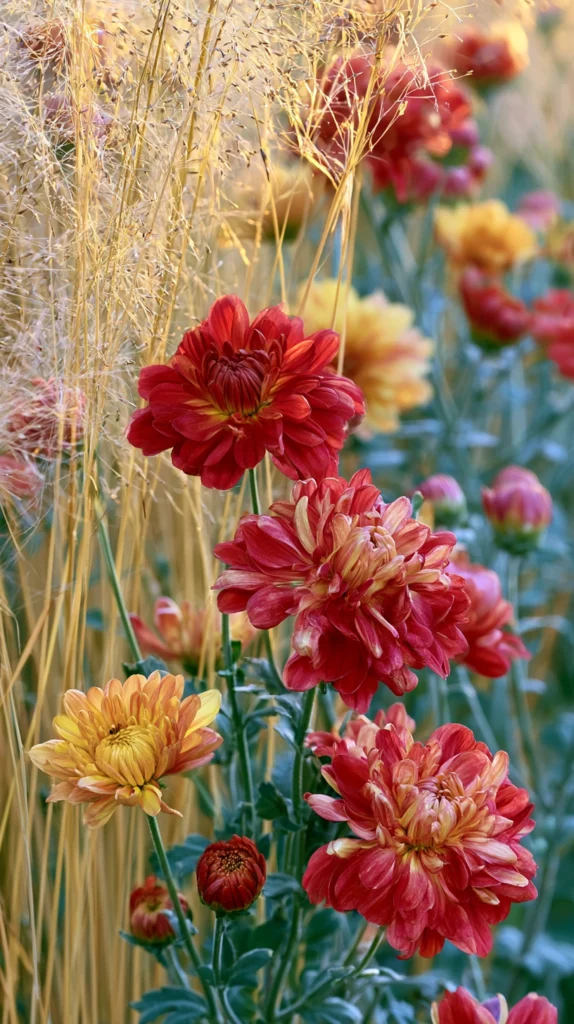
Red and gold chrysanthemums with Molinia caerulea (purple moor grass) — the combination that uses transparency as a design element.
Why Molinia is the most underused autumn grass:
The transparency quality:
- Molinia: the most transparent of all grasses
- The stems: hair-thin
- The seed heads: tiny, almost invisible individually
- The effect: a gauze-like screen
- Looking through molinia: the plants behind are visible but softened
The transparency as a design element:
- The mum behind a screen of molinia: seen through a gauze
- The gauze: softens the mum’s solid form
- The combination: the mum dimly present behind the grass
- The discovery: walking around to see the mum from a different angle and the gauze effect changed
Molinia’s autumn colour:
- Pale straw to amber in autumn
- The stems: becoming more golden
- The upright form: columns of transparent amber
- The backlit stems: the most beautiful interpretation of autumn light
The combination:
- Red mum (solid, opaque, strong colour): behind the molinia
- Gold mum (warm, advancing): in front of the molinia
- The two mums at different distances from the molinia: different levels of filtering
- A border with this layering: three-dimensional
Cost breakdown:
- Two mum varieties (red and gold): $16–24
- Molinia caerulea: $14–20
- Total: $30–44
10. Bronze Mum and Carex ‘Evergold’ (The Winter-Extending Combo)
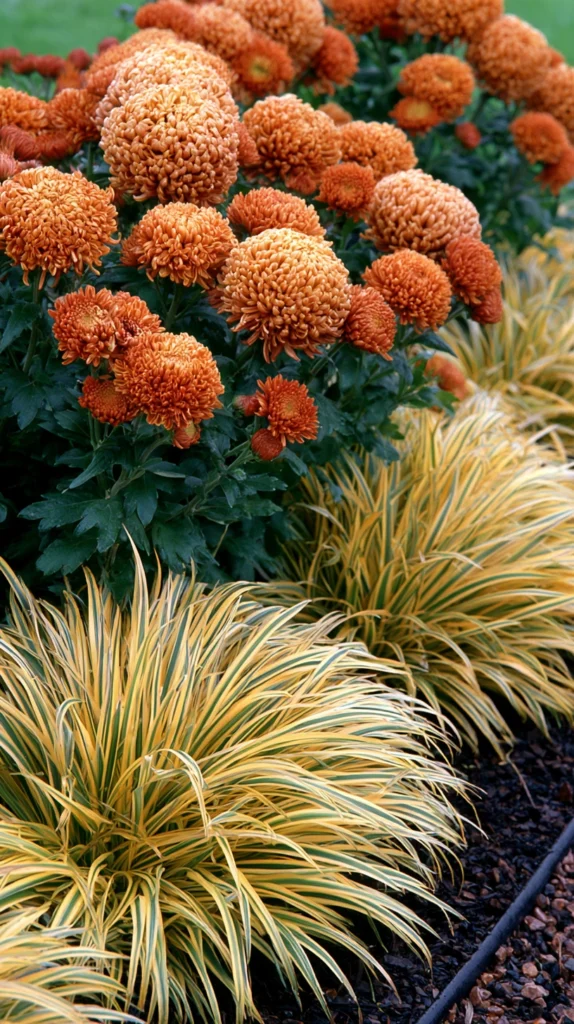
Bronze or copper chrysanthemum with Carex oshimensis ‘Evergold’ — the combination designed for the garden beyond autumn, carrying interest into winter.
Why the winter-extending approach matters:
The mum’s limitation:
- Mums: peak for 4–8 weeks
- After peak: the plant declines
- Without an evergreen partner: the combination is over
- With an evergreen grass: the combination continues into winter
‘Evergold’ specifically:
The sedge (not technically a grass, but used as one):
- Evergreen: year-round interest
- Bright yellow-gold variegation: visible in winter
- Low, arching, dense
- One of the most garden-useful foliage plants available
The winter combination:
- Mum finishes: the ‘Evergold’ remains
- The bronze-gold of the ‘Evergold’: a lower-key echo of the finished mum
- Winter: the mum replaced by winter containers or other plants
- The ‘Evergold’: the continuation of the partnership after the partner has changed
The all-year contribution:
January through March:
- ‘Evergold’: brightening the winter border
- The contrast of its gold with dark soil and grey sky
- The low maintenance: nothing needs to be done until spring
The bronze mum specifically:
- A bronze (brown-copper) mum: the warmest available
- Beside ‘Evergold’: the warmest possible pairing
- The brown-copper of the mum harmonises with the gold of the grass
Cost breakdown:
- Bronze mum: $8–12
- Carex ‘Evergold’: $10–15
- Total: $18–27 — the most affordable combination on this list
11. White Mum and Pennisetum ‘Rubrum’ (The Dramatic Opposite)
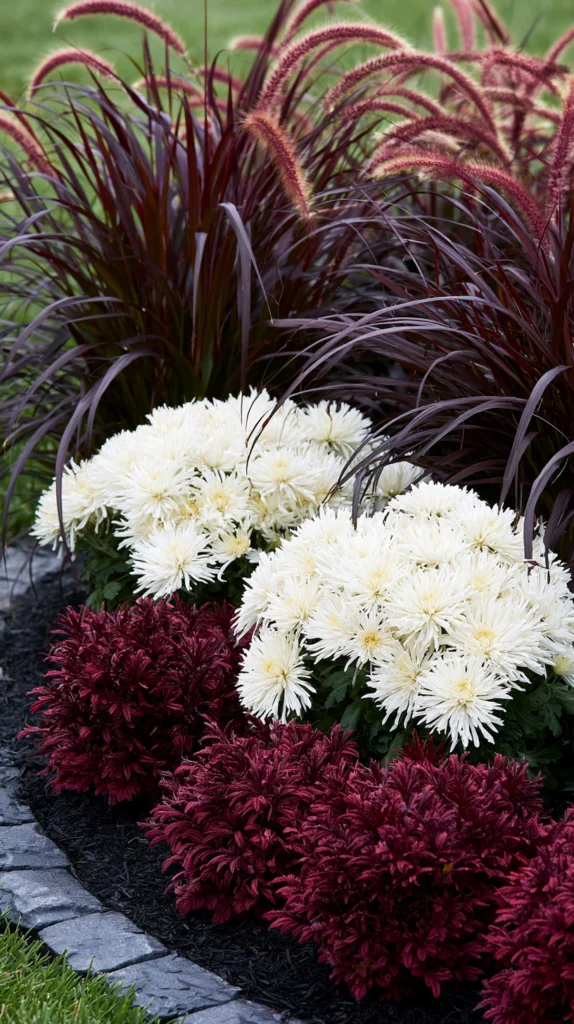
White chrysanthemum with Pennisetum setaceum ‘Rubrum’ (Purple fountain grass) — the most dramatic contrast on this list: pure white against deep burgundy-purple.
Why this is the highest-contrast combination:
The colour extremes:
- White: the absence of colour, the brightest
- Deep burgundy-purple foliage: the darkest available in a grass
- The maximum contrast in the autumn garden
- The white mum: appears to glow against the dark grass
‘Rubrum’ specifically:
The grass:
- Burgundy-purple leaves (the entire plant)
- Arching, fountain form
- Purple-brown seed heads in late summer
- The darkest ornamental grass widely available
- Note: not fully hardy in zones below 7/8 — treat as an annual in colder climates, or overwinter inside
The combination:
- The white of the mum: a light source in the dark planting
- The purple-black of the grass: the darkest possible backdrop
- The forms: rounded white dome against arching dark fountain
- Everything contrasting: colour, form, texture
In a container:
- This combination particularly suited to container display
- One ‘Rubrum’ and one white mum in a large pot
- The pot colour: dark (black, charcoal, deep blue) to continue the drama
- Against a pale wall: the contrast maximised
Cost breakdown:
- White mum: $8–12
- Pennisetum ‘Rubrum’: $14–20
- Total: $22–32
12. Multi-Colour Mum and Switchgrass Mix (The Prairie Border)

A mix of warm-coloured chrysanthemums with Panicum virgatum varieties — the planting that references the American prairie and creates a naturalistic autumn border.
Why the prairie approach works:
The naturalistic style:
- Not specimen planting: distributed groups
- Not one of each: masses of each
- The mums: drifts rather than individuals
- The grasses: repeated structural elements throughout
The switchgrass varieties:
Panicum virgatum as a genus:
- The native American prairie grass
- Multiple autumn-interest varieties
- ‘Northwind’: tall (5 feet), upright, blue-green with good autumn colour
- ‘Shenandoah’: medium (3 feet), the red-autumn variety (see Idea #4)
- ‘Dallas Blues’: the blue-grey leaved variety for a cooler palette
- ‘Prairie Fire’: red autumn colour, shorter
The multi-colour mum approach:
Rather than one mum colour:
- Gold and copper mums together (same colour family, different tones)
- Or: rust and yellow together
- The variation within a limited palette: the naturalistic quality
- Not random colours: related colours in drifts
The prairie border structure:
From front to back:
- Front: low mums (18 inches), compact cushion form
- Middle: medium grasses (2–3 feet)
- Back: tall switchgrass (4–5 feet)
- The layering: front to back, low to tall
- The prairie: always layered in this way
The season-long quality of panicum:
- Spring: blue-green foliage
- Summer: seed heads developing
- Autumn: the full colour change
- Winter: seed heads standing (wildlife food and structural interest)
- The mum: occupies the autumn slot in a planting that is interesting year-round
Cost breakdown:
- Three warm-colour mums (mixed): $24–36
- Two panicum (one ‘Northwind’, one ‘Shenandoah’): $28–40
- Total: $52–76
13. Crimson Mum and Silver ‘Morning Light’ Miscanthus (The Autumn Zenith)
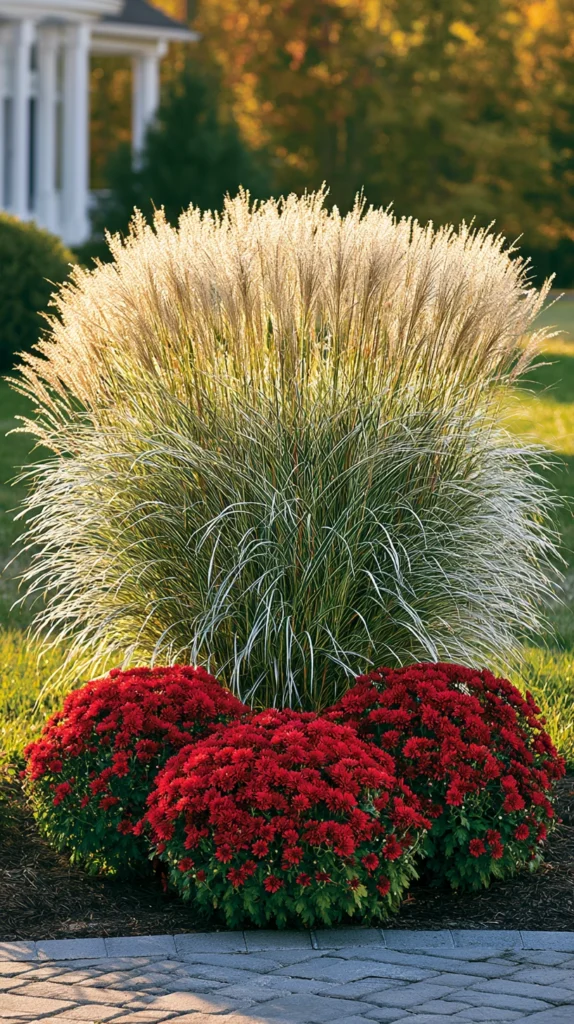
Crimson chrysanthemum with Miscanthus sinensis ‘Morning Light’ — the combination that captures the specific quality of October at its absolute peak.
Why ‘Morning Light’ is the finest grass for this combination:
The grass:
- The most refined miscanthus variety
- Each blade finely silver-edged (the white edge: the “morning light” reference)
- The overall appearance: silver-grey rather than green
- The plumes: pink-silver in late summer, transitioning to warm tan
- The scale: 4–5 feet (significant)
The silver quality in October light:
- Morning light in October: golden and diffuse
- ‘Morning Light’ in October morning light: catches each blade individually
- The grass: not silver as a block but silver as countless individual glints
- The effect: the grass appears to be lit from within
The crimson mum:
- Deep red-crimson: the deepest available in the mum palette
- Against silver: the most striking contrast (the complementary warmth-cool)
- In October afternoon light: the crimson deepens as the silver glows
- The two plants: intensifying each other through the quality of the light
The scale relationship:
- ‘Morning Light’: 4–5 feet
- Crimson mum: 18–24 inches
- The grass: nearly twice the height of the mum
- The mum: appearing as the crown of colour at the base of the towering silver grass
- The composition: complete and balanced despite the size difference
The placement:
- A single ‘Morning Light’ miscanthus with three crimson mums around its base
- In a significant position: at the end of a border, at the corner of a bed
- The specimen planting rather than the repeated border
- This combination: too strong to repeat — best used as a focal point
Cost breakdown:
- Crimson mum: $8–12
- Miscanthus ‘Morning Light’: $20–30
- Total: $28–42
14. The Complete Autumn Border (All Combinations Working Together)
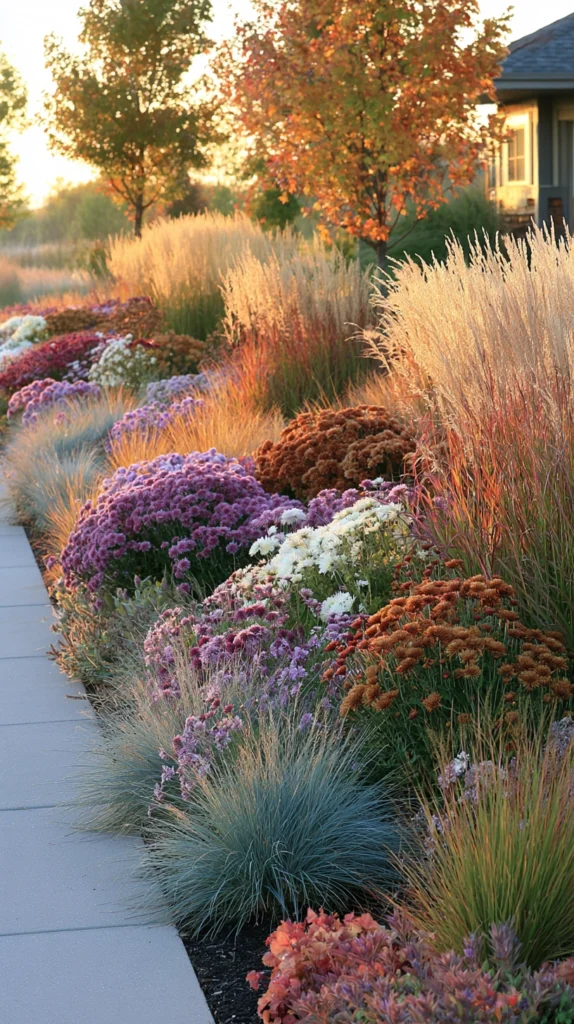
A border designed using multiple mum and grass combinations simultaneously — the autumn display that uses the scale of a planting bed to show the combinations in relationship.
How multiple combinations coexist:
The connecting thread:
- Not all 13 combinations used simultaneously (chaos)
- A selection of three or four, sharing a colour thread
- The warm palette (combinations 1–9): share enough warmth to coexist
- Or: a more restrained palette (white, gold, and silver only)
- The selection: the design decision
The border structure:
The grass framework (permanent):
- The grasses: planted first
- The border’s structure: established by the grasses
- The mums: added in September
- The grasses: there all year. The mums: the autumn component.
The grass spacing:
- A medium grass (2–3 feet): every 3–4 feet along the border
- The grasses: the regular punctuation
- Between the grasses: the space for mum planting
The mum placement:
In drifts between the grasses:
- Three mums of one colour between each pair of grasses
- Repeated rhythm: mums — grass — mums — grass
- The alternation: the border’s heartbeat
The height profile:
From front to back:
- Front row: compact cushion mums (18 inches)
- Middle: medium-height grasses and upright mums
- Back: tall grasses as the backdrop
- The height: ascending from front to back
Example full border (20 feet):
- Back: 4 Karl Foerster grass (tall, upright, amber in autumn)
- Middle: 6 copper mums (in drifts between the following grasses)
- Middle grasses: 3 pennisetum alopecuroides (medium, fountain form, golden)
- Front: 6 more mums in a deeper rust or burgundy
- Front edge: 3 Carex ‘Evergold’ (low, bright, year-round)
The colour reading from a distance:
- Warm amber and copper: dominant
- Darker burgundy at the front: grounding
- The tall Karl Foerster: the amber vertical behind everything
- The border: readable as a composition from 20 feet
The maintenance:
The grasses: once a year
- Cut to 6 inches in February
- The only grass maintenance required
- Remove the dead leaves if they bother, or leave them as winter habitat
The mums: seasonal
- Plant in September
- Allow to flower through October
- Cut back after flowering
- Or: pot up and overwinter inside for replanting next year
The year-round contribution:
- The grasses: interesting in every month
- Winter: the Karl Foerster standing in snow, the ‘Evergold’ bright
- Spring: the grasses emerging and fresh
- Summer: the grasses at their architectural best
- Autumn: the mums arrive, the grasses at their colour peak — the full combination
Cost breakdown for a 20-foot border:
- 4 Karl Foerster: $56–80
- 3 Pennisetum alopecuroides: $36–54
- 3 Carex ‘Evergold’: $30–45
- 12 chrysanthemums (mixed copper and rust): $96–144
- Total: $218–323
The Principles Behind Every Combination
Applied to every pairing on this list:
The contrast principle (used in most):
- The mum and grass should contrast in at least two of: colour, form, texture, movement
- Two contrasts: a combination
- Three contrasts: a great combination
- Four contrasts: exceptional (the purple mum / stipa: all four contrasting)
The scale principle:
- The grass slightly taller than the mum: the standard successful proportion
- The grass and mum at the same height: works if the forms are very different
- The mum taller than the grass: rarely works (the grass loses its structural role)
The number principle:
- In a container: one and one
- In a border: three mums to one grass, or three grass to three mums
- The drift size: the minimum for the combination to read at border scale
The timing principle:
- Check the flowering period of the specific mum variety
- Match it to the peak period of the grass (typically September–October for most)
- The combination that peaks simultaneously: the combination that works
- The early mum with the late grass: the peak moments missed each other
Getting Started This Weekend
The immediate combination under $35:
Purple mum + stipa tenuissima (Combination #1):
- The most reliable starting point
- The most consistently photographed
- Available at any garden centre in September
In two containers side by side:
- One mum, one grass, one dark pot each
- Place where visible from the main seating area or front entrance
- The combination: immediate impact from the first placement
In the border:
- Plant the grass now (wherever there is space)
- The mum: available from September at any garden centre
- Plant them together when both are available
The most important single decision:
The distance between the two plants.
In a container: they share the pot — the distance is zero. In a border: plant them close (12–18 inches between the crown of the grass and the edge of the mum).
The combination only reads as a combination when the plants are close enough for the viewer to take both in simultaneously. At 3 feet apart: two separate plants. At 18 inches: a combination.
This weekend’s action: buy one mum, buy one stipa. Place them together. The rest of this list: the elaboration of that one pairing.