15 Backyard Glow-Up Ideas That Instantly Add Charm
Spent three years walking past my backyard without stopping. Functional. Forgettable. Nobody’s first choice for anything.
Grass existed. Fence existed. A patio slab existed. Nothing connected to anything else. Nothing invited anyone anywhere.
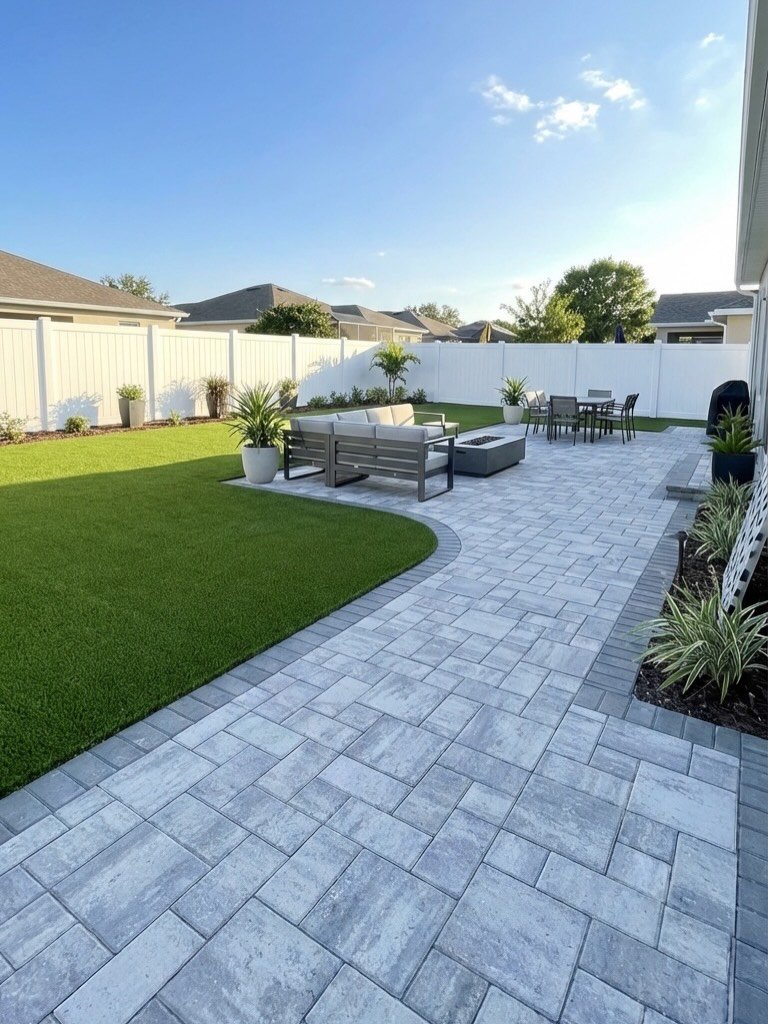
Then started treating charm as a design goal the same way function is. Not an accident. Not something that shows up when enough money gets spent. A deliberate outcome with specific ingredients.
Now people drift outside without being asked. Conversations happen out there that would never happen inside. The backyard is doing work that the interior of the house cannot.
Here are 15 ideas that add that quality directly and immediately.
What Charm Actually Is
Not a feeling that happens by accident:
What most people think:
- Charm is subjective
- Cannot be designed deliberately
- Requires expensive materials
- Shows up when budget allows
What it actually is:
- Specific combination of elements
- Reproducible with intention
- Budget-independent
- Available this weekend
The ingredients of charm:
Warmth:
- Warm light (never cool)
- Warm materials (wood, stone, wicker)
- Warm colors (terracotta, cream, amber)
- Temperature of a space is felt before seen
Imperfection:
- Nothing too perfect reads cold
- Slightly weathered = lived-in = charming
- Moss on stone signals time
- New and pristine signals showroom
Scale contrast:
- Large next to small
- Tall next to low
- Rough next to soft
- Contrast creates visual interest
Something living:
- Plants always
- Water if possible
- Birds as side effect
- Life signals life
One surprise:
- Something unexpected in every charming space
- The thing people comment on first
- Not expensive — just unexpected
- Earned attention not purchased
What kills charm instantly:
- Clutter without intention
- Dead or neglected plants
- Mismatched materials fighting each other
- Bright cool lighting after dark
- Plastic furniture in natural settings
- Symmetry so perfect it looks corporate
Why Backyards Lose Charm Over Time
The accumulation problem:
Year one:
- One table, four chairs, looking good
- One planter, thriving
- Clean and intentional
Year three:
- Extra chairs added (don’t match)
- Dead planter never replaced
- Random items migrated outside
- Original intention diluted
The fix is subtraction first:
- Remove before adding
- Identify what does not belong
- Restore original intention
- Then add from this list
Charm is maintained by editing not adding.
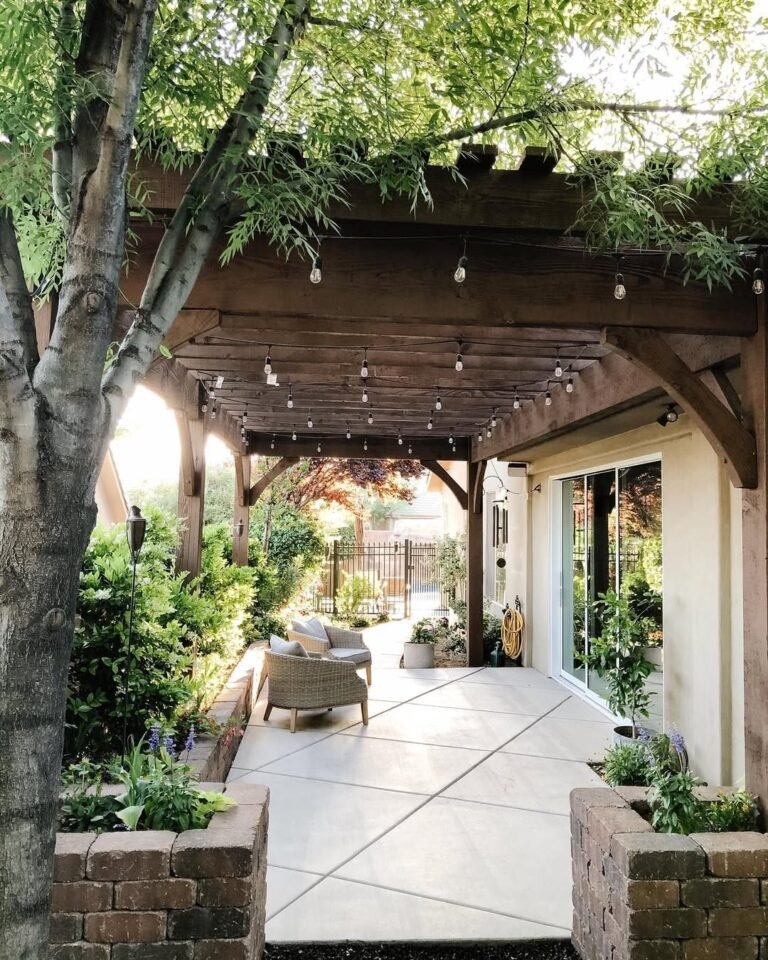
1. Warm String Lights Overhead (The Charm Multiplier)

Overhead warm lighting transforms every hour after 5pm — the single highest-return charm investment.
Why this is always first:
The daylight problem:
- Backyard exists fully in daylight
- After dark it disappears
- Half the day lost to no lighting
- Worst backyards look identical after dark
String lights solve this completely:
- Backyard exists at night
- Better than daytime for many setups
- Extends use by four to six hours daily
- Every other charm element amplified by good light
Getting it right:
Bulb temperature is everything:
- 2200K: amber, campfire warm, most charming
- 2700K: warm white, classic, reliable
- 3000K: starts to feel clinical
- Anything above 3000K: kills charm immediately
Bulb style:
- Vintage Edison: visible filament, beautiful up close
- Globe bulb: round, generous glow
- Standard warm: fine from a distance
- Edison is worth the small extra cost
Coverage that charms:
Full canopy (best):
- Grid of lights covering entire seating area
- 12 inches between parallel runs
- No dark patches underneath
- Complete overhead room created
Perimeter with drops:
- Lights run along edges
- Every 8 feet a light drops to center height
- Dramatic and directional
- Easier to install than full grid
Posts vs existing structures:
New posts (most control):
- 4×4 cedar posts set in ground
- Exact placement you choose
- Most professional result
- $12 per post, worth it
Existing structures:
- Fence posts (spacing may not be ideal)
- Pergola beams (best case scenario)
- Trees (natural, beautiful, no drilling)
- House eaves (close to structure only)
The automation that makes it work:
Timer switch:
- Set on at dusk, off at midnight
- Never manually switched
- Always on when needed
- Backyard ready without effort
Smart plug (upgrade):
- App-controlled
- Sunrise/sunset automation
- Never think about it again
- $15 and worth every cent
What changes after installation:
Behavioral shift:
- People drift outside after dinner (they did not before)
- Conversations last longer
- Nobody suggests going inside first
- The backyard earns its keep
Cost breakdown:
- String lights (50 feet): $28
- Four cedar posts: $48
- Concrete for posts: $20
- Timer switch: $12
- Total: $108
My overhead lights: Installed on a Thursday. By Saturday the backyard had more social hours than the living room. Nothing else changed.
String Light Tips
The sag problem:
- Loose lights look sloppy
- Turnbuckles on each line ($3 each)
- Taut lines = professional
- Ten seconds per line to tension
When bulbs blow:
- Buy one replacement string now
- Store in garage
- Burned-out bulbs in a line read neglected
- Replace same week always
2. A Painted Fence (Instant Backdrop)
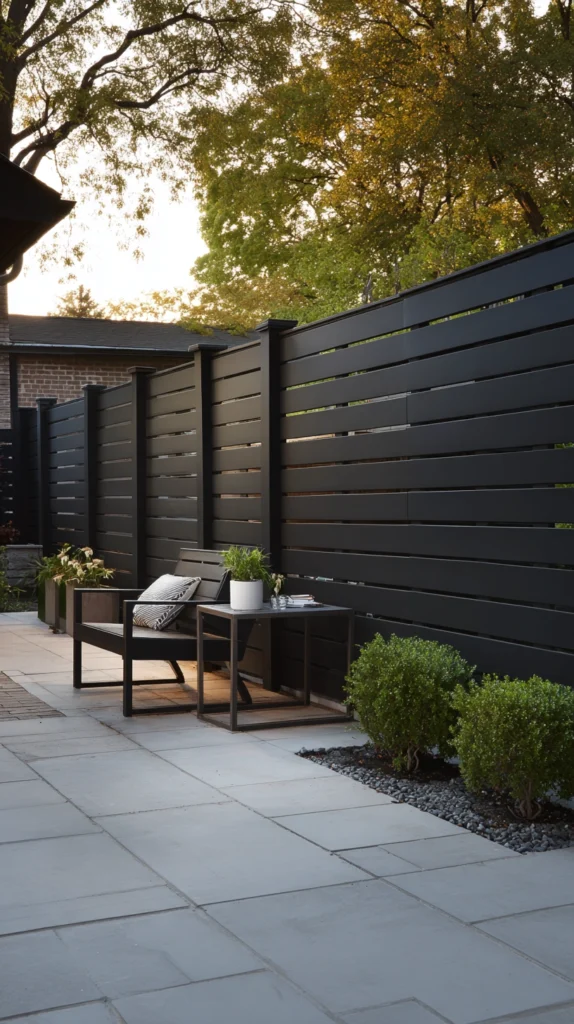
Dark-painted fence as design element — the backdrop that makes everything in front of it look intentional.
Why fences are the most overlooked charm surface:
What an unpainted fence does:
- Blends into nothing
- Browns and grays with age
- Recedes without intention
- Plants in front look unanchored
What a dark-painted fence does:
- Creates a wall (outdoor room)
- Makes plants pop in front of it
- Signals that someone cares
- Photographs dramatically better
The color choice:
Charcoal or near-black (most charming):
- Backdrops everything beautifully
- Plants look more vivid against it
- Photographs with depth
- Works in every garden style
Deep forest green:
- Disappears into garden
- Most natural choice
- Particularly good with lush planting
- Classic cottage garden backdrop
Warm charcoal-brown:
- Softer than pure black
- Natural and earthy
- Works with wood tones nearby
- Less stark than pure charcoal
Never:
- Bright white (reflects too much, shows every mark)
- Natural bare wood (ages poorly, looks unfinished)
- Multiple colors on one fence (chaotic)
- Colors that fight the garden palette
The product that works:
Solid color exterior stain (not paint):
- Penetrates wood (does not peel like paint)
- Lasts 5–8 years before touch-up
- Breathes with wood movement
- $35–50 per gallon (covers 150 sq ft)
Paint vs stain:
- Paint sits on surface (peels eventually)
- Stain absorbs into wood (weathers gracefully)
- Always stain for fences
- Paint is the common mistake
The prep work:
Clean first:
- Pressure wash or scrub with deck cleaner
- Remove mold and mildew (bleach solution)
- Allow to dry completely (48 hours minimum)
- Dry wood absorbs stain properly, wet wood rejects it
The painting day:
Best conditions:
- Overcast day (not direct sun)
- Above 50°F (stain needs warmth to set)
- No rain forecast 48 hours
- 10am start (dew dried off)
Application:
- Brush for rails and details
- Roller for broad flat sections
- Work section by section
- Two coats (second coat next morning)
Before planting anything new:
- Stain the fence first
- Then plant in front
- Sequence matters
- Replanting after staining = wasted effort
Cost breakdown:
- Solid color exterior stain (3 gallons): $120
- Brushes and rollers: $20
- Pressure washer rental: $40
- Total: $180
My dark fence: Made a $30 plant in front of it look like a $200 plant. Backdrop is doing the work.
3. A Gravel Seating Area (Defined Ground)
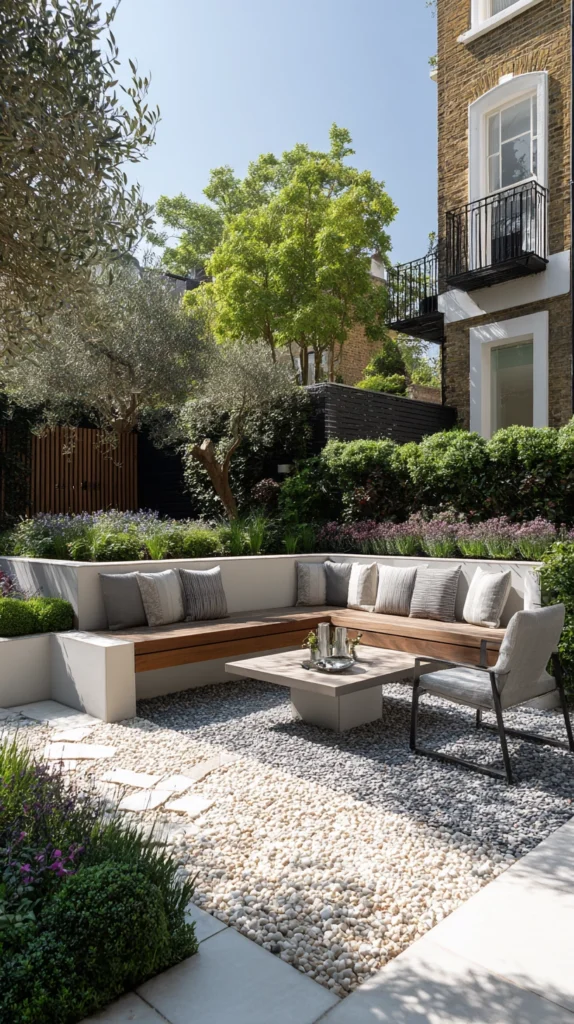
Defined gravel zone — turns scattered furniture into an intentional outdoor room.
Why definition creates charm:
Furniture on lawn (no definition):
- Furniture looks placed randomly
- No sense of arrival
- Edges unclear
- Always slightly wrong
Furniture in defined zone:
- Arrival point established
- Clear boundary between zones
- Everything looks placed deliberately
- Room has been created
The gravel advantage:
vs. Concrete:
- Concrete: $3,000–8,000 installed
- Gravel: $200–350 installed
- Appearance difference: small from 15 feet
- Gravel drains better, repairs easily, costs 10× less
vs. No treatment:
- Lawn under furniture: muddy, patchy, damaged
- Gravel: dry, defined, charming
- No comparison on charm level
- Gravel wins immediately
Choosing the gravel:
Pea gravel:
- Round and smooth
- Comfortable underfoot
- Moves slightly when walked on
- Natural and classic
Decomposed granite:
- Compacts firm
- Most stable underfoot
- Clean and modern
- Desert and Mediterranean aesthetic
Crushed limestone:
- Warm cream color
- Compacts reasonably
- Brightest underfoot
- Cottage garden feel
The right color:
- Warm tones (cream, tan, buff) add charm
- Cold gray gravel can look industrial
- Match to fence color family
- Warm with warm always
The installation:
Shape options:
Rectangle (simplest):
- Clean edges easy to cut
- Steel edging follows straight line
- Most formal option
- Works in modern gardens
Circle:
- Fire pit center naturally
- Softer and more charming
- Mark with string and stake
- Steel edging bends to curve
Organic shape:
- Free-form edge following natural lines
- Most charming option
- Hardest to edge cleanly
- Worth the effort
The edging (critical):
- Cor-ten steel (rusts warm brown — most charming)
- Black steel (clean and modern)
- Without edging: gravel migrates everywhere
- Edging is not optional
Depth:
- 3 inches minimum
- 4 inches in high-traffic areas
- Less than 3 inches disappears into ground
- Landscape fabric underneath (weed suppression)
Cost breakdown:
- Gravel (3 tons): $150
- Steel edging: $60
- Landscape fabric: $25
- Delivery: $50
- Total: $285
My gravel area: Furniture stopped looking stranded. Space stopped looking unfinished. Charm arrived with the defined edge.
4. A DIY Fire Pit (Evening Anchor)
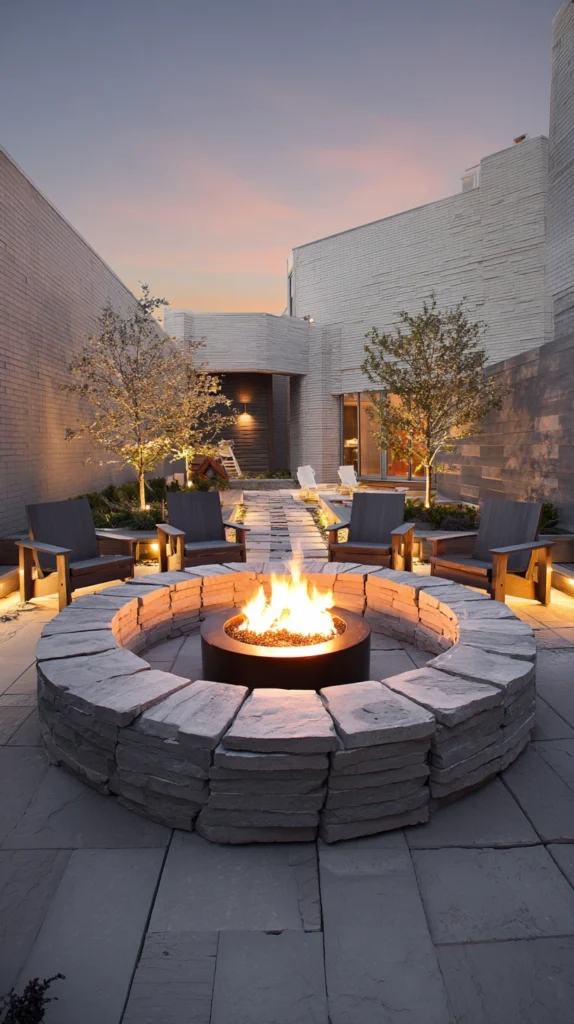
Simple fire pit as backyard focal point — the element that changes how evenings work.
What a fire pit actually does:
The behavioral effect:
- People face inward (toward fire)
- Conversations deepen naturally
- Phones go away without asking
- Evenings extend by hours
The charm it adds:
- Light and movement (flickering)
- Sound (crackling)
- Warmth (physical and emotional)
- Ancient and irreplaceable atmosphere
The simple block fire pit:
Materials:
- Retaining wall blocks or fire pit blocks
- 28–36 blocks depending on diameter
- No mortar required (dry stack)
- Fire bricks for interior (optional)
Diameter:
- 36 inches interior (standard)
- 42 inches for larger gatherings
- Measure with string before buying blocks
- Too small: not enough flame. Too large: awkward.
Block options:
Standard retaining wall block:
- $1.50–2.50 each
- Rectangle shape
- Stacks in circle
- $42–70 for full pit
Curved fire pit block:
- Pre-curved for circle (easier)
- $3–4 each
- Purpose-built appearance
- $84–112 for full pit
Natural stone:
- Most charming option
- Fieldstone from construction sites (free)
- Irregular and beautiful
- Requires more skill to stack level
The seating circle:
Why the circle matters as much as the pit:
- Pit alone looks incomplete
- Defined seating circle = complete feature
- Gravel circle extends from pit edge
- Seating at even intervals around it
Gravel circle:
- 8-foot radius from pit center
- Same gravel as main seating area ideally
- Steel edging as circle perimeter
- Transforms pit into destination
Seating:
- Matching chairs (four minimum)
- Or log rounds as seats (free and charming)
- Or stone bench sections
- All at same height (comfortable conversation)
Log round seats:
- Cut sections of fallen tree
- 18 inches tall, 14 inches diameter
- Free if you have access to logs
- Most charming fire pit seating available
Cost breakdown:
- Fire pit blocks: $90
- Gravel circle: $80
- Seating chairs (4): $160
- Total: $330
My fire pit: October became the best outdoor month instead of the last one. Backyard charm peaks in autumn now.
Fire Pit Tips
Position from structures:
- 10 feet minimum from fence or house
- Check local codes (some require more)
- Downwind from seating when possible
- Smoke follows warmth (people lean toward fire)
The wood storage charm:
- Stacked wood beside pit = visual charm even unlit
- Log store or simple stack
- Signals use and preparation
- Part of the aesthetic year-round
5. Climbing Plants on Fences and Walls (Living Architecture)

Trained climbing plants — the element that makes backyards look established and cared for.
Why climbing plants add charm faster than anything planted in ground:
Vertical coverage is instant backdrop:
- Ground plants fill slowly outward
- Climbing plants fill quickly upward
- Coverage where eyes look (fence height)
- Three years of climbing beats ten years of border planting
The charm of vertical green:
- Softens hard structures (fences, walls, sheds)
- Makes space feel enclosed and protected
- Flowers at eye level (not ground level)
- Wind movement visible from inside
Choosing the climber:
For fragrance (most charming):
- Jasmine (summer, intoxicating)
- Honeysuckle (spring to summer, classic)
- Climbing rose (repeat-flowering varieties)
- Rosa ‘Gertrude Jekyll’ (pink, strong scent)
For speed (results in year one):
- Clematis (flowers in first season)
- Nasturtium (annual, covers quickly)
- Honeysuckle (fastest perennial)
- Climbing hydrangea (slow first, fast after)
For drama (show-stopping):
- Wisteria (takes patience, rewards enormously)
- Climbing rose (classic and irreplaceable)
- Clematis ‘Nelly Moser’ (large pink flowers)
- Passion flower (exotic, fast)
Training the plant:
Trellis attached to fence:
- 1-inch gap between trellis and fence
- Air circulation prevents mildew
- Trellis screwed to fence through spacers
- Plant at base (6 inches from fence)
Wire system:
- Horizontal wires every 12 inches
- Vine eyes screwed into fence
- Wire threaded through vine eyes
- Cleaner look than trellis
Guiding the growth:
- Tie new growth loosely every few weeks
- Guide horizontal not just vertical (more coverage)
- Pinch leading shoot to encourage branching
- More branches = more coverage = more flowers
Around doorways and arches:
The arch trick:
- Metal arch over gate or path entrance
- Climbing rose or jasmine trained over
- Two seasons to cover
- Most charming backyard feature possible
Cost breakdown:
- Trellis panels (3): $45
- Climbing plants (3): $55
- Wire and vine eyes: $15
- Metal arch: $45
- Total: $160
My climbing jasmine: Covered 12 feet of fence in two seasons. Neighbors stop at the gate in June to smell it. That is the definition of charm.
6. Weathered Terracotta Pots (Aged Material Charm)

Terracotta pots aged or naturally weathered — the material that adds patina and warmth instantly.
Why terracotta is irreplaceable for charm:
The material qualities:
- Warm orange-red tone (naturally charming)
- Ages beautifully (unlike plastic which degrades)
- Moss grows on it (signals establishment)
- Breathes (better for plants and better looking)
Aged vs new:
New terracotta:
- Bright orange (vivid, too new-looking)
- Charms over time as it weathers
- Speed the aging process (method below)
Weathered terracotta:
- White salt marks (efflorescing)
- Moss patches (green and gray)
- Chips and marks (history)
- Most charming version
Aging new pots quickly:
Yogurt method:
- Plain yogurt brushed onto pot
- Promotes moss and algae growth
- Keep moist for two weeks
- Moss appears within 4–6 weeks
Diluted paint method:
- White latex paint diluted 50/50 with water
- Brush over surface unevenly
- Wipe back partially (leave some)
- Instant aged terracotta look
The grouping:
Odd numbers always:
- Three together (minimum)
- Five for larger setups
- Seven for full corner
- Even numbers feel corporate
Height variation (critical):
- Tall, medium, short in every group
- Never all same height
- Stack smaller ones on bricks or stones
- Varied height = natural arrangement
What to plant:
For charm (not just growth):
- Herbs spilling over edges (rosemary, thyme)
- Geraniums (classic cottage, long-season)
- Lavender (silver foliage, purple spike)
- Succulents in short wide pots
The arrangement on steps:
- One pot per step edge
- Alternating sides (left, right, left)
- Trailing plants spill toward viewer
- Most photographed charm detail
Cost breakdown:
- Terracotta pots (5 varied sizes): $55
- Aging materials (yogurt or diluted paint): $5
- Plants: $40
- Total: $100
Highest charm-per-dollar ratio on this list. Five aged terracotta pots with the right plants beats $500 of modern plastic any day.
7. A Garden Gate (Arrival and Enclosure)
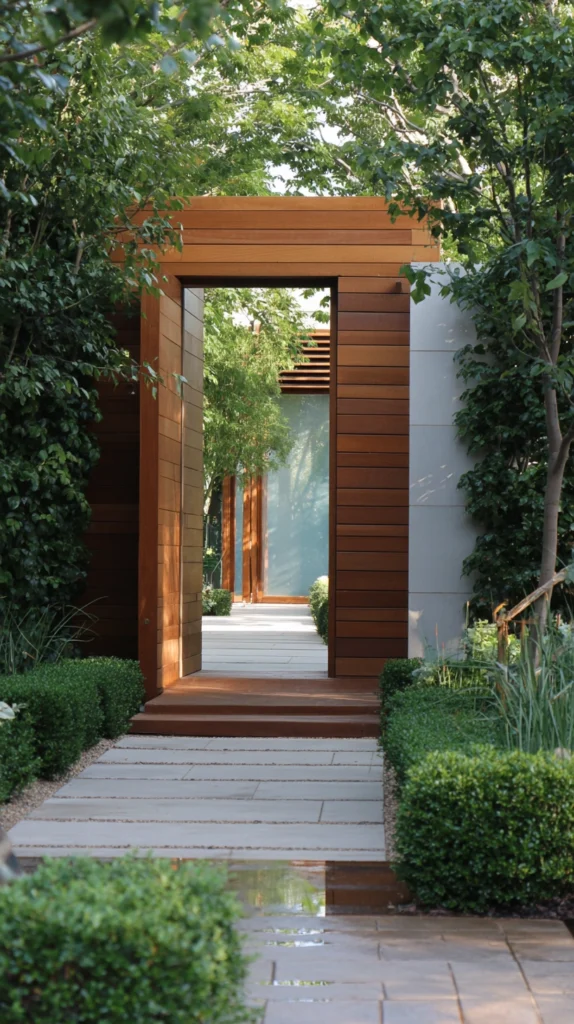
Decorative garden gate — the charm element that creates an entrance where none existed.
Why gates charm so effectively:
The arrival experience:
- Walking through a gate is entering somewhere
- Transition from outside world to private space
- Signals that beyond it is different
- Creates anticipation even in familiar spaces
The enclosure signal:
- Gate implies boundary
- Boundary implies protection
- Protected space feels safer
- Safer feels more relaxing
Where to add a gate:
Between front yard and back:
- Most common and most impactful
- Arrival into backyard formalized
- Even open always, presence matters
Between patio and garden:
- Separates zones
- Journey from sitting to planting
- Destination created within a destination
At garden path entrance:
- Arch with gate (most charming)
- Path leading somewhere
- Framed entry point
- Classic cottage garden element
Gate styles that charm:
Picket gate (cottage):
- Pointed tops
- Painted white or black
- Climbing rose over arch above
- Timeless and widely loved
Wooden slatted gate (modern):
- Horizontal boards
- Natural wood or dark stained
- Wider gaps (lets light through)
- Contemporary without being cold
Metal scroll gate (traditional):
- Wrought iron style
- See-through (plants visible beyond)
- Formal and permanent
- Antique versions at salvage yards
The arch that goes with it:
Metal arch:
- Paired with gate always
- Climbing plant trained over (jasmine, rose)
- Frames the entry completely
- $45–90 at garden centers
Planted gate sides:
- Tall plants either side of gate
- Frames the entry point
- Creates portal aesthetic
- Two matching plants (symmetry acceptable here)
Cost breakdown:
- Wooden garden gate: $80
- Metal arch: $55
- Climbing plant (2): $40
- Installation hardware: $15
- Total: $190
My garden gate: Divided nothing from nothing originally. Now divides patio from garden. Both feel more special for having a boundary between them.
8. An Outdoor Rug Under Everything (Warmth From the Ground)
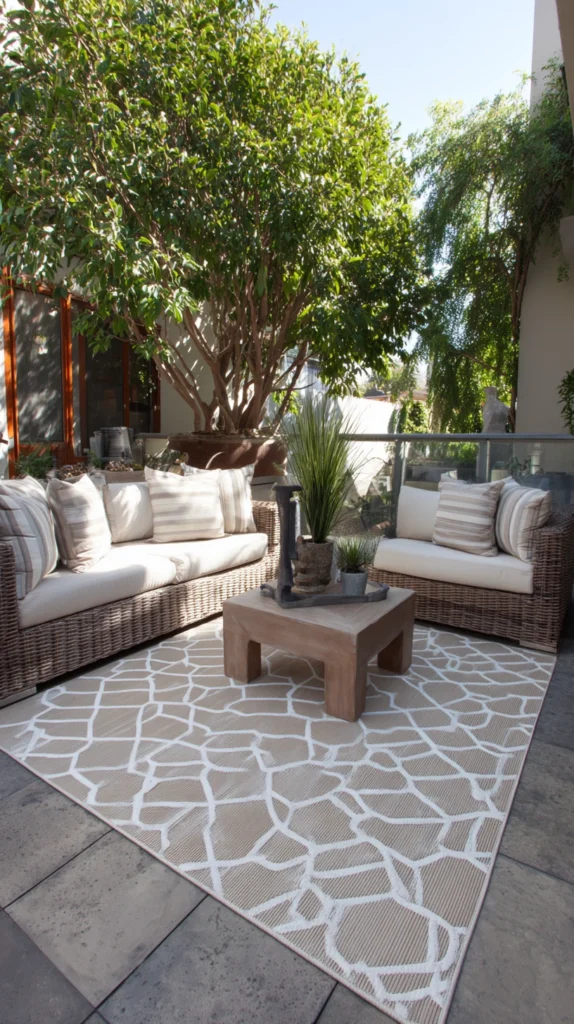
Properly sized outdoor rug — the foundation that makes outdoor rooms feel like rooms.
The floor truth:
What concrete or bare ground communicates:
- This is a utility space
- Comfort secondary to function
- Nobody planned this with care
- Temporary arrangement
What an outdoor rug communicates:
- This is a room
- Comfort was considered
- Someone made decisions here
- This is permanent and intentional
The size mistake:
Too small (most common error):
- Rug looks like it wandered in
- Furniture appears unrelated to rug
- Worse than no rug in many cases
- The most common outdoor rug mistake made
Right size:
- All furniture legs on the rug
- Or front legs only (minimum)
- Extends 12 inches beyond furniture on all sides
- Bigger than feels right is usually right
For a standard patio setup:
- Four-chair dining: 8×10 minimum
- Seating area: 9×12 preferred
- Small bistro: 5×7 minimum
- Go up a size whenever uncertain
Material selection:
Polypropylene (best for outdoors):
- UV-resistant (won’t fade in sun)
- Water-resistant (dries fast)
- Washable (hose it down)
- Soft underfoot (better than it sounds for synthetic)
Natural fiber (jute, sisal):
- Beautiful texture and color
- Not fully weatherproof
- Covered areas only
- Brings natural charm that synthetic cannot match
Color and pattern:
Neutral base (most flexible):
- Warm cream, warm gray, terracotta
- Everything placed on it works
- Pattern in cushions and plants instead
- Safe and effective
Pattern anchor:
- One bold rug and everything else simpler
- Geometric or botanical pattern
- Commits the space to a style
- More decisive and more charming
The layered rug:
- Larger neutral underneath
- Smaller patterned runner on top
- Slight offset (intentional)
- Designer detail that costs almost nothing extra
Cost breakdown:
- Large outdoor rug (8×10): $85
- Smaller layered rug: $40
- Non-slip pad: $20
- Total: $145
The single change that makes the most other things work better. Start here before buying anything else.
9. Garden Lighting Beyond String Lights (Layered Glow)

Multiple light sources at different heights — the lighting that makes backyards feel resort-level after dark.
Why one light source is never enough:
Single source (overhead only):
- Flat and institutional
- No depth or dimension
- Every surface equally lit
- No mood created
Multiple sources (layered):
- Depth and shadow created
- Eye travels through space
- Warmth comes from everywhere
- Mood without effort
The three layers:
High (overhead — string lights or pergola light):
- Already covered in Idea #1
- The ambient foundation
- Sets the overall warmth
- Everything else layers below this
Mid (surface level — lanterns and table lights):
- Lanterns on every flat surface
- Table lanterns, step lanterns, shelf lanterns
- Warm amber sources at eye level when seated
- Multiple sources create visual rhythm
Low (ground level — path lights and uplights):
- Solar stake lights along paths
- LED uplights at base of trees or plants
- Lowest and most subtle layer
- Completes the depth from above
The uplight trick:
Spotlights aimed upward:
- At base of tree or large plant
- Aimed upward through branches
- Shadow patterns on fence behind
- Completely different space at night
Product:
- Solar spotlight with stake: $10–15 each
- Or low-voltage wired (brighter): $20–30 each
- Two or three per feature plant
- Angle slightly off-center (more dramatic)
Lantern placement:
Every flat surface gets a lantern:
- Dining table center
- Side tables
- Steps
- Retaining walls
- Window sills
All same finish (critical):
- Matte black (most versatile)
- Or brass (warmer, more charming)
- Never mixed finishes in same space
- Consistency = intention = charm
Flameless vs real candle:
Real candle:
- Most charming option
- Flicker is natural and beautiful
- Requires lighting before guests arrive
- Worth it for dinner gatherings
Flameless LED (timer):
- Comes on at dusk automatically
- Never forgotten
- Realistic flicker on quality versions
- Daily use answer
Cost breakdown:
- Lanterns with flameless candles (5): $75
- Solar uplights for trees (3): $35
- Solar path stake lights (6): $45
- Total: $155
My layered lighting: Guest asked who did the lighting design. Nobody — just understood the principle and applied it.
10. A Water Feature (Sound and Movement)

Any moving water element — the addition that engages senses string lights cannot reach.
What water does that nothing else does:
Sound:
- Masks traffic and neighbor noise
- Provides constant gentle background
- Psychologically calming (proven)
- Sets apart the backyard from the street world
Movement:
- Only living element that moves constantly
- Eye drawn to it repeatedly
- Reflective surface (light on water)
- Dynamic not static
Wildlife:
- Birds come to drink and bathe
- Dragonflies appear (urban miracle)
- Butterflies visit
- Backyard becomes ecosystem
Options by scale:
Small (balcony or tight corner):
- Tabletop recirculating fountain: $35–60
- Glazed bowl with small pump: $50–80
- Solar floating fountain: $25–40
- Minimal footprint, real effect
Medium (patio feature):
- Large ceramic urn fountain: $100–180
- Stacked stone fountain: $80–150 (DIY)
- Wall-mounted spout into basin: $120–200
- Focal point scale
Large (garden feature):
- Stock tank pond: $400–600
- In-ground pond with liner: $300–800
- Raised stone pond: $400–700
- Destination within the garden
The DIY stacked stone fountain:
Materials:
- Three to five large flat stones
- Waterproof basin (buried)
- Submersible pump ($20)
- Flexible tube (pump to top stone)
- Small stones to hide basin edge
Process:
- Bury basin flush with ground
- Stack stones above (drill hole through center stones for tube)
- Water pumps up through stack
- Trickles down over stone faces
- Recirculates
The sound calibration:
Too loud = aggressive:
- High pump output
- Long drop height
- Sounds like pressure washer
- Stressful not calming
Right level = gentle:
- Low pump output
- Short drop (4–8 inches)
- Heard from 6 feet away
- Noticed not announced
Cost breakdown:
- Stacked stone fountain DIY: $80
- Submersible pump: $20
- Basin: $25
- Plants around feature: $35
- Total: $160
My water feature: Realized three months after installation that I had stopped hearing traffic. Water replaced it so gradually the transition was invisible.
11. A Potting Bench (Productive Charm)

Dedicated potting station as garden feature — the working element that adds charm through purpose.
Why potting benches charm:
The signal they send:
- Someone gardens here seriously
- Purposeful space not accidental
- Tools have a home
- Work happens here with intention
The aesthetic:
- Aged wood (weathered naturally)
- Tools hanging (organized chaos)
- Pots stacked (abundance)
- Soil and growth implied
Building vs buying:
DIY from salvaged lumber:
- Old door as work surface
- Two sawhorses underneath
- Shelf below (reclaimed boards)
- Total: $0–40 depending on salvage
Purchased potting bench:
- Cedar or teak option ($80–150)
- Hooks and shelves included
- Assembly required but straightforward
- Looks designed from day one
The staging:
What goes on it:
- Three to five terracotta pots (stacked, varied sizes)
- Small trowel and hand fork (hanging)
- Watering can (decorative and functional)
- One planted pot (something growing)
- Trug or basket for tools
What goes below:
- Bag of compost (fold top down)
- Extra pots (organized not scattered)
- Garden twine on hook
- More tools hanging from hooks screwed to shelf side
The green overhead:
Above the bench:
- Wall-mounted planter or shelf
- Herbs growing
- Or hooks with hanging tools
- Vertical interest above work surface
Placement:
Against fence or wall (always):
- Backed to something (more defined)
- Plants can climb behind
- Shelf on wall above extends storage
- Corner placement (most charming)
Near planting beds (logical):
- Close to where work happens
- Reduces carrying distance
- Feels integrated not dropped in
- Purpose-built location
Cost breakdown:
- Salvaged wood bench: $35
- Hooks and hardware: $15
- Terracotta staging pots: $25
- Watering can: $20
- Total: $95
My potting bench: Stopped being a backyard accessory and became a reason to be in the backyard. Purpose creates presence.
12. Defined Garden Beds With Clean Edges (Structure That Charms)
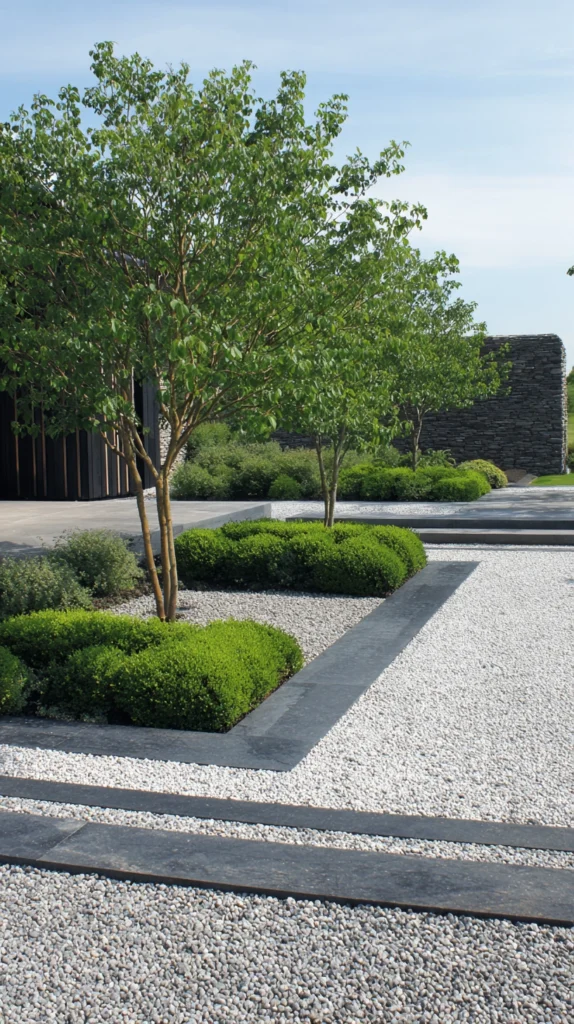
Crisp bed edges throughout — the detail that separates cared-for from chaotic.
The edge effect:
Without edges:
- Lawn blurs into bed
- Plants look unplanted (just appeared there)
- No visual boundary
- Space reads as unfinished
With crisp edges:
- Beds look designed
- Plants look placed
- Clean separation creates intention
- Space reads as maintained
The scale of impact:
Edging costs $200:
- Applied to entire backyard
- Makes $500 of plants look like $2,000 of plants
- No other $200 investment has this return
- Professionals edge for this reason
Edging materials:
Cor-ten steel (most charming):
- Rusts to warm brown naturally
- Thin profile (4mm)
- Curves for organic shapes
- Lasts forever
- $2–3 per linear foot
Black powder-coated steel:
- Clean and modern
- Remains black (does not rust)
- Crisp and precise
- $2–4 per linear foot
Aluminum:
- Lightweight
- Does not rust
- Bends to any shape
- $1.50–2.50 per linear foot
Natural stone edge:
- Fieldstone set on edge
- Most charming option for cottage style
- Free if stones available
- Irregular beauty
The bed shape:
Curved beats straight for charm:
- Gentle organic curves
- No sharp right angles
- Flows with garden not against it
- Mark with hose before cutting
The planting within edges:
Edges only work if beds are full:
- Mulch to 3 inches (no bare soil visible)
- Plants spaced to fill within two seasons
- Nothing wilting or dead
- Edge containing abundance = charming
Mulch choice:
- Fine bark (dark brown, most classic)
- Cocoa shell (dark, fragrant briefly)
- Gravel mulch (modern, drought areas)
- Always dark (makes plants pop)
Cost breakdown:
- Cor-ten steel edging (100 linear feet): $250
- Dark bark mulch (3 cubic yards): $90
- Total: $340
Most underrated charm investment. Every plant already in the ground looks better immediately.
13. An Arbor or Arch (Vertical Drama)
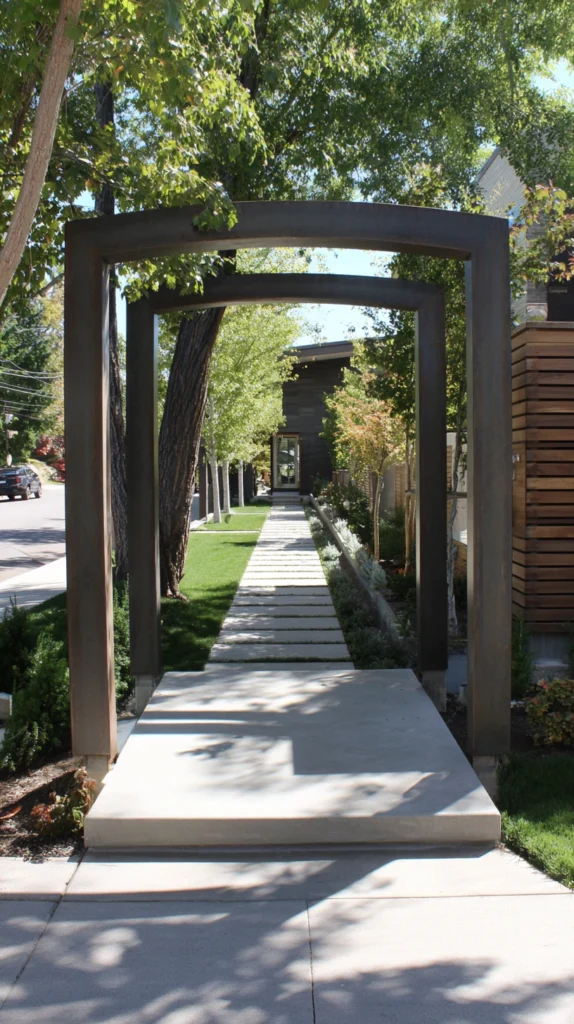
Freestanding arch or arbor — the vertical structure that adds height and romance.
Why vertical structures charm:
The height problem in most backyards:
- Everything at ground level
- No vertical interest
- Eye has nowhere to travel upward
- Space feels flat and wide
Arch or arbor fixes this:
- Height created instantly
- Eye drawn upward
- Sense of depth from distance
- Three-dimensional space created
Arch vs arbor:
Arch (single span):
- Spans a path or gate
- Frames a view or entrance
- Minimum footprint
- Easiest to install
Arbor (larger structure):
- Seating underneath
- Roof of beams or lattice
- Destination not just passage
- Bigger investment, bigger reward
Material options:
Metal arch:
- Most popular and practical
- Powder-coated black or green
- $45–120 depending on size
- Plants cover metal within two seasons
Cedar arch (DIY):
- Cut 4×4 posts and curved top
- Natural and warm
- More building skill required
- Most charming when well-made
Wrought iron (antique):
- Salvage yards and Craigslist
- $40–100 (often less than new)
- Aged and already charming
- Rust adds character (treat to prevent spread)
What to grow over it:
Roses (most charming):
- ‘New Dawn’ (pale pink, vigorous)
- ‘Zephirine Drouhin’ (thornless, fragrant)
- ‘Climbing Iceberg’ (white, reliable)
- Two plants, one each side, meet at top in year three
Clematis (fastest):
- ‘Jackmanii’ (purple, flowers first year)
- Combined with rose (two seasons together)
- Clematis through rose = two bloom times
- Classic combination
Annual climber (quickest cover):
- Sweet peas (fragrant, first season)
- Nasturtium (colorful, edible)
- Morning glory (fast, prolific)
- Annual fills arch while perennial establishes
The view it frames:
Always face the arch toward a view:
- Garden feature visible through it
- Path leads somewhere beyond
- Focal point framed
- Looking through arch = intentional view
Cost breakdown:
- Metal garden arch: $75
- Climbing rose (2): $55
- Clematis (1): $18
- Total: $148
My rose arch: Takes three years to look like the magazine version. Worth starting immediately. Charm compounds with time.
14. Outdoor Cushions and Throws (Softness That Invites)
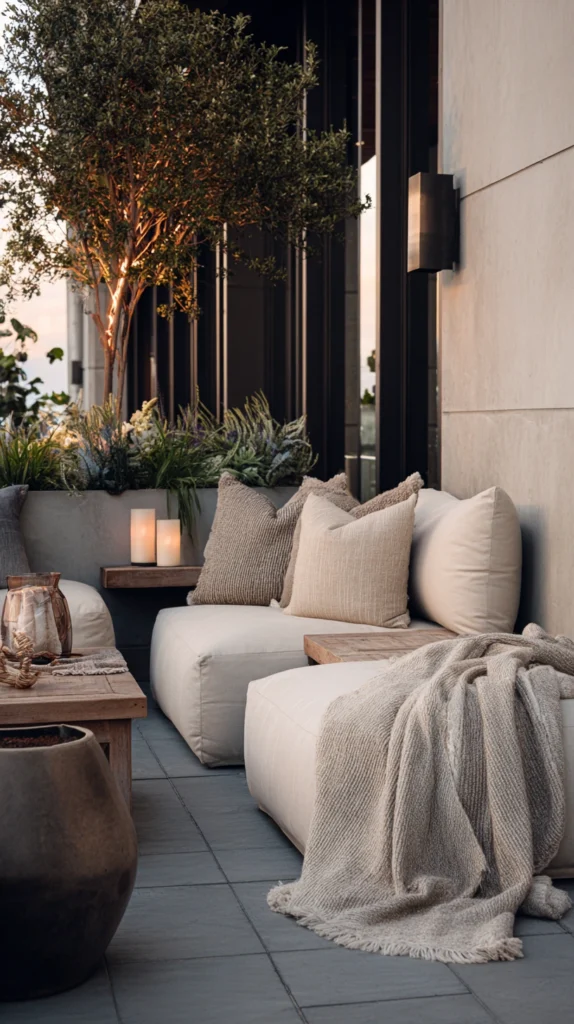
Quality outdoor soft furnishings — the layer that converts sitting near the backyard to staying in it.
Why softness drives outdoor use:
The hardness problem:
- Hard chairs = 20-minute maximum
- Comfortable chairs = hours
- Duration of stay determines value of backyard
- Cushions are the comfort investment
The direct relationship:
- Better cushions = longer stays
- Longer stays = more conversations
- More conversations = backyard earns its keep
- Cushions pay for themselves in quality of life
The outdoor cushion reality:
Budget cushions fail:
- Flatten within one season
- Mold in humid climates
- Fade in half a summer
- False economy every time
Quality cushions last:
- Sunbrella or equivalent fabric
- Fade-resistant (5+ year warranty)
- Quick-dry foam core
- Actual outdoor-rated product
What to spend:
- $30–60 per seat cushion (quality)
- $20–35 per back cushion
- $40–80 per large outdoor pillow
- Worth every cent vs cheap versions
The styling:
Base cushions (seat and back):
- Solid neutral (warm gray, cream, sage)
- Foundation for everything above
- Not the statement piece
- Background player
Accent pillows:
- Two patterns maximum in one space
- One geometric, one organic or botanical
- Same color temperature throughout
- Odd total number (3, 5, 7)
The throw blanket:
One per seating area:
- Draped casually over armrest or chair back
- Not folded neatly (too formal for charm)
- Cotton or outdoor-rated knit
- Practical on cool evenings (extends use)
The charm it creates:
- Nothing signals welcome like a throw
- Implied invitation to get comfortable
- Thoughtful detail guests notice
- Warmth of a living room brought outside
Seasonal storage:
The system that keeps cushions nice:
- Weatherproof deck box ($70–120)
- Cushions inside every night (takes 90 seconds)
- Or: bring-in-on-rain-only (acceptable)
- Deck box doubles as extra seating
Cost breakdown:
- Four quality seat cushions: $140
- Accent pillows (4): $80
- Two throw blankets: $50
- Deck storage box: $85
- Total: $355
My outdoor cushions: Upgraded from cheap to quality. Average time spent outside per session went from 25 minutes to 2+ hours. Comfort is not a luxury. It is the point.
15. A Focal Point Plant or Feature (The Thing People Notice First)
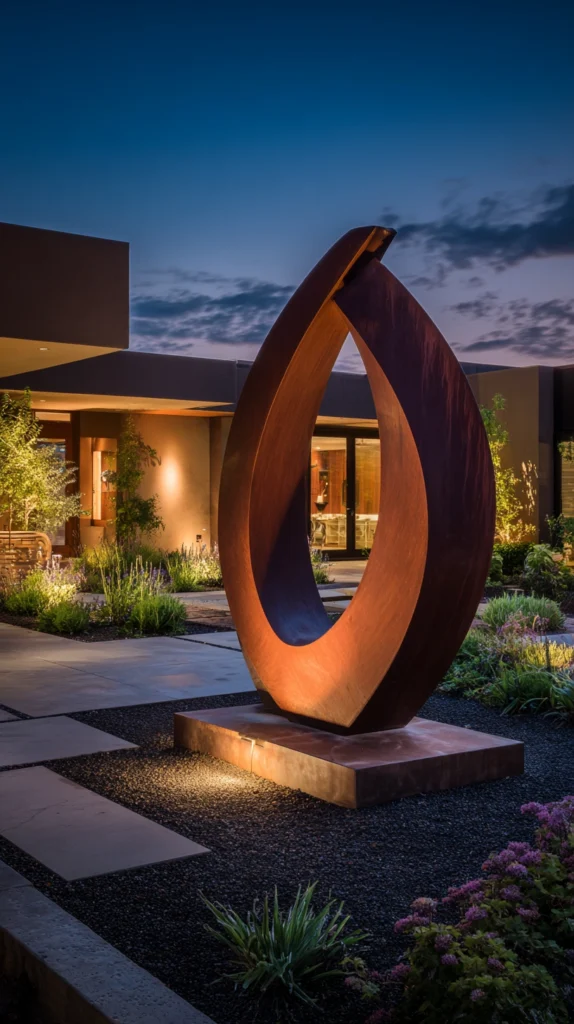
One deliberate focal point — the element every charming backyard has and most backyards lack.
Why focal points matter:
Without one:
- Eye wanders without landing anywhere
- Nothing to comment on
- Forgettable despite effort
- Sum of parts never coheres
With one:
- Eye lands immediately
- Something to comment on
- Memorable from first visit
- Everything else supports rather than competes
The rule:
- One focal point per outdoor zone
- Positioned to be seen on approach
- Everything arranged in relation to it
- Change nothing else until this is right
Focal point options:
The specimen tree:
Japanese maple:
- Multi-stem form (most beautiful)
- Autumn color (fiery red or orange)
- Year-round interest (bare branches in winter are beautiful)
- $80–200 in container
- Plant now and watch it become the backyard
Weeping cherry:
- Spring blossom (spectacular for two weeks)
- Elegant form year-round
- Grows relatively fast
- $60–150
Olive tree:
- Silver foliage (year-round charm)
- Mediterranean association
- Surprisingly hardy in zones 8+
- $80–200 depending on size
The statement planter:
When space is tight:
- Large planter (24-inch minimum) as focal point
- Quality container (not plastic)
- Dramatic plant inside (not a collection)
- One planter done well beats five done poorly
Container choices:
- Aged terracotta (classic)
- Concrete (modern, weighty)
- Glazed ceramic (color and character)
- Weathered oak barrel (cottage)
The sculptural element:
Not everyone wants a plant as focal:
- Stone sculpture (simple form)
- Large rock (placed deliberately)
- Architectural salvage (old window frame, wheel)
- Rusted metal feature
The found focal point:
- Large smooth rock positioned deliberately: $0
- Old stone birdbath from salvage: $20–50
- Antique watering can on pedestal: $15
- Found and placed beats bought and generic
Positioning the focal point:
Visible on first approach:
- Seen when entering the backyard
- Not discovered after exploration
- Immediate orientation
- First impression established
Framed by secondary elements:
- Two flanking plants (supporting)
- Lighting aimed at it (uplighting)
- Path leading toward it (arrival)
- Never isolated (context matters)
The seasonal focal point:
Changes with seasons:
- Spring: flowering tree or tulip display
- Summer: large dahlia or hydrangea in pot
- Autumn: ornamental grass at peak
- Winter: structural form and berries
One plant can do all seasons:
- Japanese maple: spring leaf, summer canopy, autumn fire, winter structure
- Best value focal point available
- Every season earns its place
Cost breakdown:
- Japanese maple (container): $120
- Quality planter (24-inch): $60
- Uplighting (2 spots): $25
- Path stones leading toward: $35
- Total: $240
My Japanese maple: Third year in the ground. Every autumn, people stop walking and look at it. That pause is the whole point.
What All 15 Ideas Share
Strip away the specifics:
They all add warmth:
- Warm light, warm materials, warm color
- Never cold, never clinical
- Temperature felt before analyzed
- Warmth is the foundation of charm
They all add intention:
- Nothing accidental
- Placed not landed
- Decided not defaulted
- Intention reads as care
They all work with the existing bones:
- No demolition required
- Works with what is there
- Additions not replacements (mostly)
- Accessible to any backyard
They all compound:
- Each one makes the others better
- String lights make the fire pit better
- Dark fence makes the climbing plant better
- Water feature makes the seating area better
- Add one and the next one calls to you
Getting Started This Weekend
The right starting sequence:
Not all 15 at once:
- Overwhelming
- Budget-breaking
- Results diluted across too many fronts
- One done properly beats five done partially
The weekend sequence that works:
This weekend (under $150):
- String lights: $28
- Outdoor rug: $85
- One large terracotta pot and plant: $35
- Total: $148
That is a charmed backyard in three items. Light, warmth from the ground, and something living at the right scale.
Month one additions:
- Paint the fence (dark)
- Add two more terracotta pots
- One lantern per surface
Month two:
- Define a gravel area
- Add cushions and a throw
- Install edging on beds
Month three:
- Plant a climber on the fence
- Add a water feature
- Choose the focal point plant
Choose by what bothers you most:
Backyard feels exposed: Gate (#7), climbing plants (#5), privacy screen Backyard dead after dark: String lights (#1), layered lighting (#9) Backyard feels unfinished: Edging (#12), gravel area (#3), rug (#8) Backyard has no personality: Focal point (#15), terracotta pots (#6), water feature (#10) Backyard not used in evening: Fire pit (#4), string lights (#1), cushions (#14) Backyard looks corporate: Weathered materials (#6), climbing plants (#5), arch (#13)
The honest truth about charm:
It does not come from spending. It comes from caring.
Dark fence paint costs $180 and signals care. Ten neglected plants cost $300 and signal the opposite.
Every idea on this list is available this month. Not when the budget is bigger. Not when the renovation is done. Not when life settles down.
The backyard is ready for this right now. So are you.