15 Hobbitcore Garden Ideas for a Magical Backyard
Read The Lord of the Rings for the first time at thirteen and felt, with complete conviction, that the Shire existed somewhere. Not as a place to visit. As a way of living that was possible if you chose it.
The round windows. The low ceilings and high gardens. The deep pantries and the green hills pressed close to the door. The sense that the house and the land were in conversation, neither dominating, both necessary.
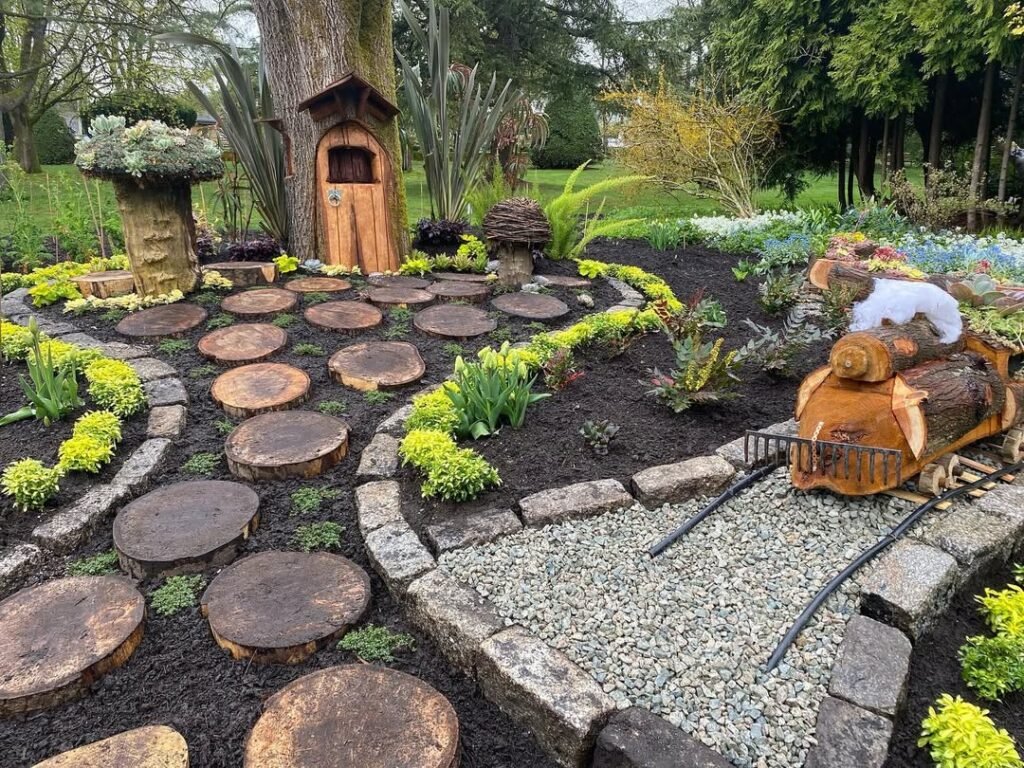
That quality — the domesticated wild, the cultivated magic, the home that has grown rather than been built — is what hobbitcore garden design is chasing. It is not about pointed doors and oversized furniture. It is about a garden that feels as if it has always been there, as if the house grew out of the hillside, as if the boundary between the cultivated and the natural was deliberately blurred until it disappeared.
Here are 15 ways to make that feeling happen in any backyard.
What Hobbitcore Garden Design Actually Is
Not just the aesthetic:
What it is not:
- A literal hobbit hole replica in the backyard
- Artificial mushrooms from a garden centre
- A single “fairy garden” feature surrounded by ordinary lawn
- A theme rather than a philosophy
What it actually is:
Abundance and abundance specifically:
- The Shire is full. Flowers everywhere. Vegetables in abundance. Fruit trees heavy. The fullness: essential.
- A sparse garden cannot be a hobbit garden
- The fullness: designed in, not accidentally achieved
The blurred boundary:
- The garden does not stop and the wild begin
- The cultivated and the untended are in conversation
- Wildflowers among the vegetables. Self-seeders welcomed. A path that has not been swept of leaves.
- The tended wildness: the most distinctive quality
Age and history:
- Hobbit gardens look established
- They look as though this family has been here for generations
- The weathered gate. The crooked path. The apple tree that has been here before anyone alive.
- Age cannot be purchased — but it can be suggested, accelerated, and designed for
The human scale:
- Hobbit gardens are intimate rather than grand
- The archways: just tall enough
- The paths: just wide enough for one
- The spaces: close and enclosed rather than open and expansive
- The intimacy: the opposite of the landscaped estate
Materials:
- Stone (always)
- Old wood
- Terracotta (mossy, aged)
- Thatch or living roof (if possible)
- Nothing synthetic
- Nothing new-looking
The Palette and Mood
The colours of the hobbit garden:
- Lush green (the dominant colour — always)
- Warm terracotta and aged clay
- Deep rose and old-fashioned pink
- Muted gold and honeyed amber
- Cream and warm white
- No bright primary colours (hobbit gardens are warm and muted, not cheerful in the primary colour sense)
The mood:
- Enclosed and intimate
- Abundant and slightly overwhelming
- Clearly loved and slightly overgrown
- The tended-but-not-manicured balance: the most important mood to achieve
1. The Moon Gate Entrance (The Portal)
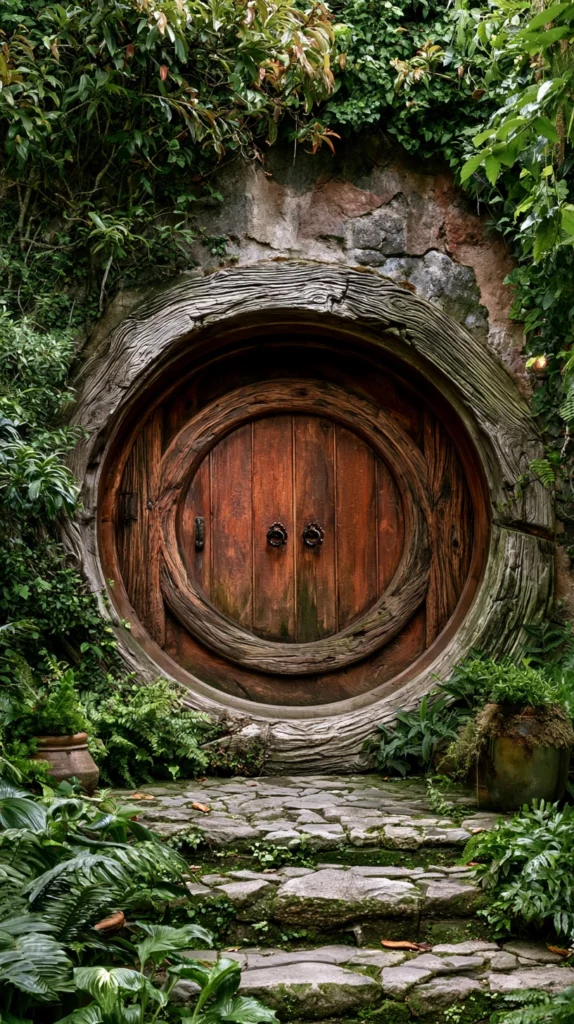
A circular gate or archway — the round form most associated with hobbit architecture — the entrance that signals a different world beyond it.
Why the circular form changes the garden:
The Tolkien reference:
- Round windows and round doors: the architectural signature of hobbit homes
- The circle: complete, natural, without the corners that interrupt flow
- In a garden setting: the circular arch does not look constructed — it looks grown
The psychological effect:
- A rectangular gate: a practical opening
- A circular arch or moon gate: a threshold
- The threshold: invites crossing differently from a simple opening
- Arriving at a circular arch: there is a decision moment, a pause, then a stepping-through
The types:
Moon gate (stone or brick, full circle):
- The most formal version
- A complete circle in a wall
- The wall visible around it: the frame
- Most commonly seen in Asian-inspired gardens — in a hobbit garden, the stone material makes it feel ancient rather than Oriental
Circular timber frame arch:
- Bent timber or circular welded frame
- Climbing plant growing over and through
- Less permanent than a stone moon gate
- The climbing plant softens it immediately
Bent willow arch:
- Living willow woven into a circular form
- Grows in place, becomes more itself over time
- The living material: the most hobbit-appropriate
- In three seasons: the willow so overgrown the circle is entirely made of plant
The climbing plants:
Over the circular arch:
- Roses: ‘The Generous Gardener’, ‘Rambling Rector’, ‘Wedding Day’
- Honeysuckle (fragrant — essential for arrival)
- Clematis (various)
- The plants: growing over the top and beginning to obscure the structure
The degree of obscuring:
- Summer: the arch barely visible under the plant
- Winter: the structure revealed
- Both: beautiful in different ways
- The hobbit garden: designed for both seasons
Cost breakdown:
- Circular timber frame: $80–150
- Or bent willow (DIY): $15–30
- Climbing rose: $25–40
- Honeysuckle: $15–20
- Total: $120–210
The circular arch in year two: the rose and honeysuckle meeting at the top. The frame: invisible. The archway: entirely made of flower and leaf. Someone standing at the entrance before walking through. This is what was intended.
Moon Gate Tips
The path through:
- The arch: only works if there is somewhere to arrive at
- A clear path on both sides: leading to and from the arch
- The destination on the far side: the reason to cross
- A focal point visible through the arch from the approaching side: the invitation
The lighting:
- Solar fairy lights woven into the climbing plant
- Visible through the plant from the approaching path at dusk
- The warm light glowing through the foliage: the most magical version of arrival
2. The Layered Cottage Border (The Shire’s Abundance)
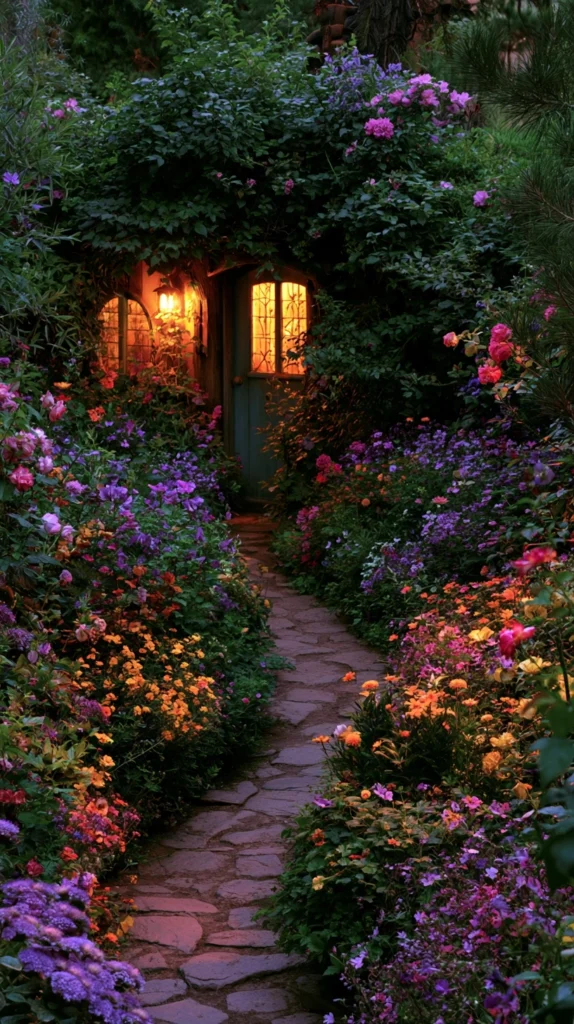
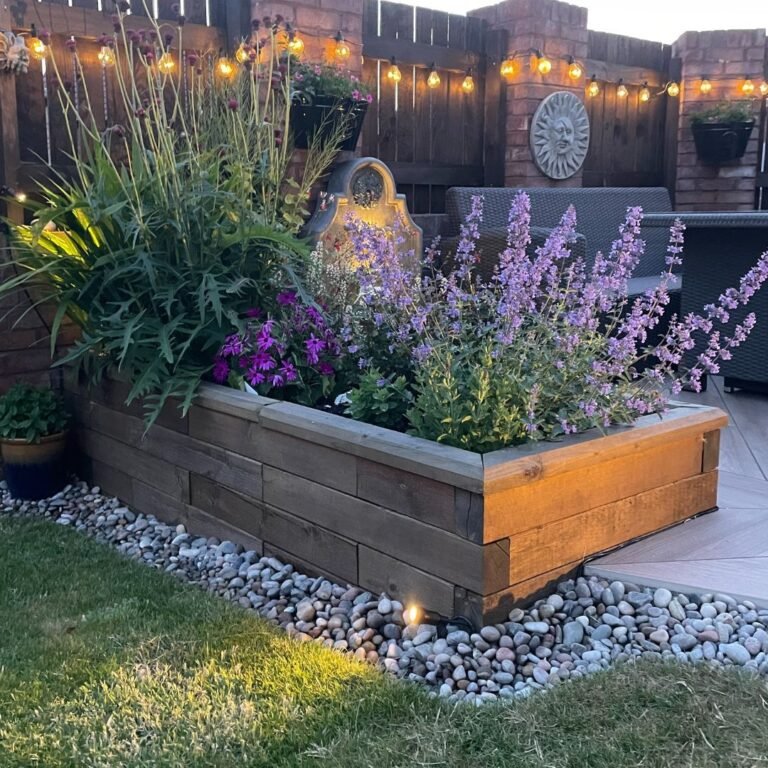
A deep, densely planted border in the traditional English cottage garden style — the closest approximation to the gardens of Bag End available to the modern gardener.
Why the cottage garden is the hobbit garden:
The Tolkien influence:
- Tolkien’s Shire gardens: directly inspired by the English countryside he knew
- The cottage garden tradition: exactly what he was describing
- The abundance of the cottage border: what the Shire’s gardens embody
- To create a hobbit garden: start by creating the authentic cottage garden
The density:
- Cottage borders: planted so densely that the soil is never visible
- The plants: growing into each other
- The self-seeders: welcomed wherever they appear
- The gardener’s role: guiding rather than controlling
The cottage border plants:
The classics (all earn their place):
- Delphiniums (the blue vertical — essential)
- Hollyhocks (the tall ancient-looking spike)
- Foxgloves (particularly in the half-shaded spots under trees)
- Peonies (the June moment)
- Old roses (heavily scented, quartered flowers — not modern hybrids)
- Sweet peas (on a wigwam or along a fence)
- Lupins (the striking architectural spike)
- Geraniums (cranesbill — the plant that fills every gap)
- Alchemilla (the lime-green foam that connects everything)
- Aquilegia (self-seeds prolifically — let it)
- Verbascum (the great mullein spike — ancient-looking)
- Aquilegia — worth mentioning twice, that’s how important self-seeding is here
The self-seeding principle:
Welcome everything that seeds itself:
- The annual poppy between the vegetables
- The foxglove in the shade of the rose
- The honesty (Lunaria) among the perennials
- The self-seeded plant looks placed by nature, not by the gardener
- Placed by nature: the most hobbit-appropriate planting of all
The structure within the abundance:
The border needs bones:
- Roses as structure
- Shrubs providing the permanent framework
- Perennials filling around them
- Self-seeders weaving through everything
- The bones are there — the abundance grows over them
Cost breakdown:
- Cottage border plants (establishing a new border): $80–150 per 10-foot section
- Seeds for self-seeding plants (aquilegia, poppy, foxglove): $10–15
- Total for a 30-foot border: $250–470
3. The Round-Top Door and Window Feature (The Architectural Signal)
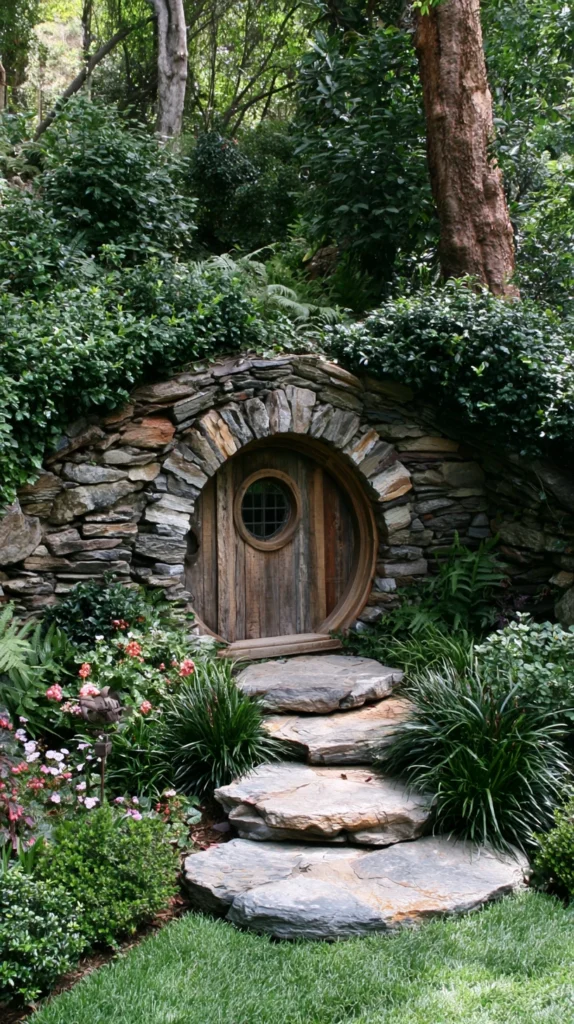
A round-topped door, gate, or window opening — on a garden building, summerhouse, or garden wall — the single architectural gesture most associated with hobbit homes.
Why the round top changes everything:
The association:
- Round-top door: the image from every Hobbit cover ever printed
- Even in a garden without any other hobbitcore element: a round-top door sends the signal
- The most direct possible reference
The applications:
Garden shed door:
- Replace a standard rectangular door with an arched-top one
- Or: paint an arch onto a flat door (the simplest version)
- The door in dark green or dark blue: specific and correct
Wall opening:
- An arched opening cut into a garden wall or dense hedge
- The view through: the focal point
- More open than a door: a framed window on the garden beyond
Garden building (the full commitment):
- A small summerhouse or shed with rounded door and possibly rounded window
- Dark painted timber
- Living roof (if possible — see Idea #4)
- The building that looks like it grew from the hillside
The paint colour:
Dark green:
- The standard for hobbit doors
- Recedes into the garden
- Feels ancient
- The colour: right for reasons that are difficult to articulate
Deep blue:
- More unexpected
- Bilbo Baggins’ own door: yellow (though green has become the cultural association)
- Any deep, non-bright colour: correct for the aesthetic
Deep red:
- More Dutch or cottage in reference
- Works for a gate rather than a door
- The rose trained over a deep red arched gate: maximally charming
The hardware:
Aged brass or black iron:
- Door handles, hinges, and fittings
- The aged quality: the hardware itself reads as old
- Shiny chrome: destroys the aesthetic in a single detail
- The hardware: worth getting right
Cost breakdown:
- Replacing an existing shed door with an arched top: $80–150 (DIY carpentry or builder)
- Painting and hardware: $30–50
- Or: painting an arch on an existing flat door: $10–15
- Total: $10–200 depending on commitment
4. The Living Roof (Growing Out of the Ground)
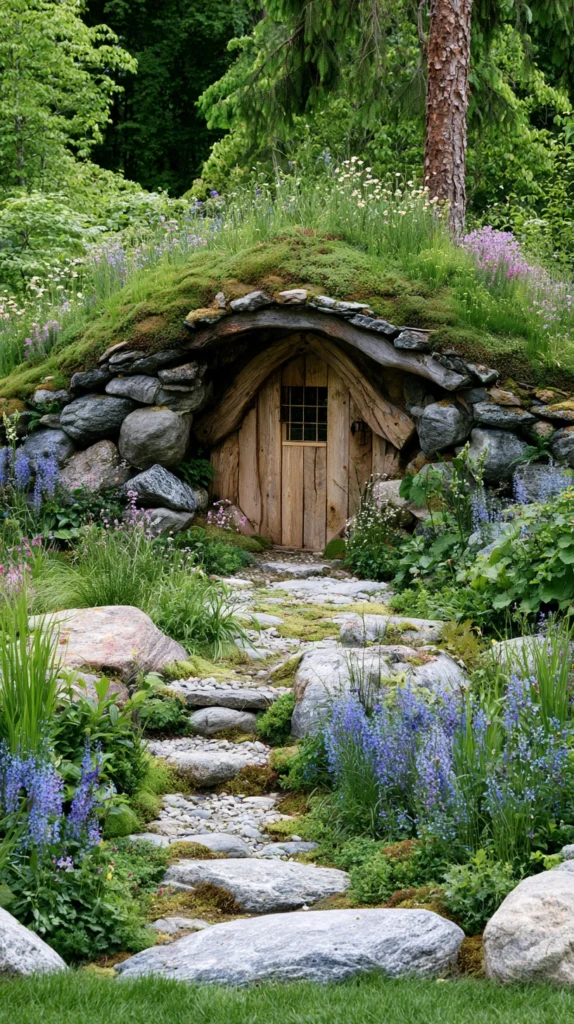
A garden structure — shed, seating area, or entrance — topped with a living roof of sedum, moss, and wildflowers — the element that blurs the boundary between the building and the earth.
Why living roofs are the most specific hobbit garden feature:
The dissolution of the building:
- A living roof: the building appears to emerge from the ground
- The roof growing: the structure reading as part of the landscape
- The boundary between built and grown: dissolved
- This is exactly the quality that makes Bag End feel like it grew from the hill
The ecology:
- A living roof: habitat for insects, birds, mosses, wildflowers
- The ecological function: part of the hobbit garden ethos
- The garden: taking part in something larger than itself
- The living roof: visible proof of that participation
The construction:
The substrate layers (from the structure up):
- Structural roof (timber, strong enough for the additional weight)
- Waterproof membrane (EPDM rubber, continuous)
- Root barrier (prevents roots penetrating the membrane)
- Drainage layer (lightweight aggregate or specific drainage board)
- Growing medium (specialist sedum/wildflower substrate — lighter than garden soil)
- Plants
The weight:
- A sedum living roof: approximately 10–15kg per square metre when saturated
- Most garden sheds: require structural reinforcement for this weight
- New structure built for the purpose: simpler than retrofitting an existing shed
- Consult a builder if in doubt about the existing structure
The plants:
Sedum roof (most common, most reliable):
- Sedum mat: rolls of pre-grown sedum
- Drought-tolerant (thrives with little water after establishment)
- Low maintenance (one cut per year if any)
- Various colours through the seasons: green in spring, pink and yellow in summer, orange in autumn
Wildflower and grass roof:
- More naturalistic appearance
- Wild grasses and meadow flowers
- More maintenance (occasional cutting)
- More ecological value (more diverse habitat)
- The more “Shire” aesthetic
Moss and sedum combination:
- The most ancient-looking
- Moss establishing where shaded and moist
- Sedum in the more exposed areas
- The two together: the ancient turf roof of a hobbit home
Cost breakdown:
- Sedum mat (per square metre): $25–40
- Waterproofing and drainage layers: $40–60 per square metre
- Structural assessment and reinforcement: highly variable
- Total for a small 2×3m shed roof: $350–600
5. The Winding Pebble or Cobble Path (The Journey to the Door)
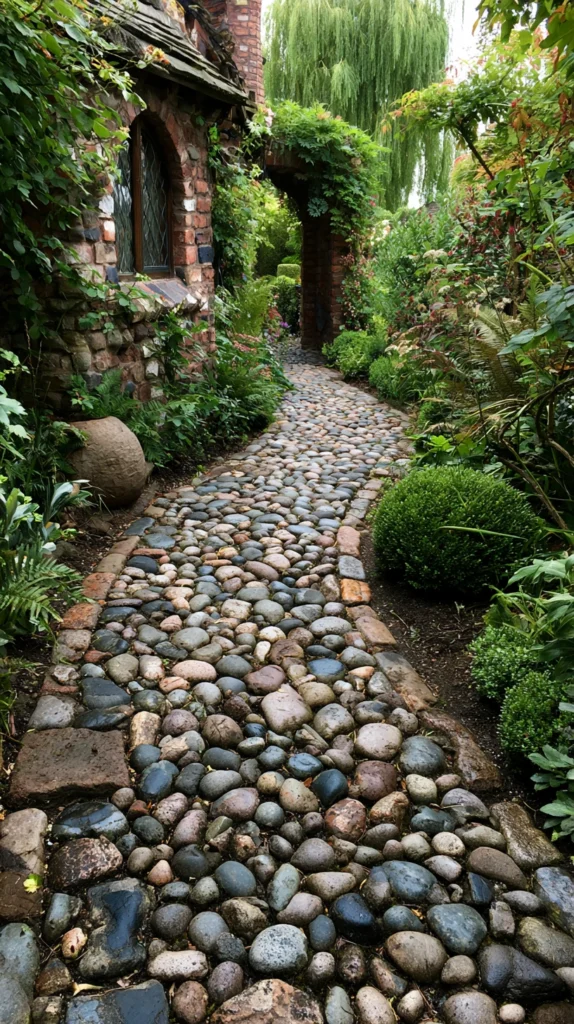
An irregular, winding path of cobbles, setts, or reclaimed stone — the path that suggests the house has been reached by many feet over many years.
Why the winding path is essential:
The worn quality:
- A straight path: efficient
- A winding path: a journey
- The winding: suggests the path was made by feet following the natural terrain, not by planning
- The naturalness: the hobbit quality
The material:
Reclaimed cobbles or setts:
- Already worn by previous use
- The variation in size: natural
- The worn surface: cannot be faked by any new material
- Salvage yards: the source
Irregular stone flags:
- Cut to no specific size
- Each piece different
- Set in sand with moss encouraged in the gaps
- The irregular: the charm
River pebbles (set in mortar):
- Smooth, rounded
- Set in decorative patterns or simply as a mass
- The mosaic path: laborious but beautiful
- Completely specific to whoever made it
The winding:
Follow the natural line:
- Do not impose a geometric curve
- Walk the path several times before marking it
- The natural walking line: the shape of the path
- A forced curve: looks designed. A natural curve: looks found.
Plants beside the path:
Encroaching on the path:
- Alchemilla spilling over the edges
- Thyme creeping between the stones
- Low chamomile in the gaps
- The plants: taking back what was briefly the path’s
- The path: defined but not absolute
The moss between:
Encouraged between the stones:
- Yogurt method on the path surface (as covered elsewhere)
- Or: simply allow it to establish in shaded sections
- The moss: the evidence of age
- Even one year of moss growth: the path looks older by ten
Cost breakdown:
- Reclaimed cobbles (per square metre): $30–60
- Or irregular stone flags: $25–45 per square metre
- Sand base and edging: $20 per metre
- Total for 10-metre path: $300–600
6. The Productive Kitchen Garden (The Hobbit’s True Relationship with Food)
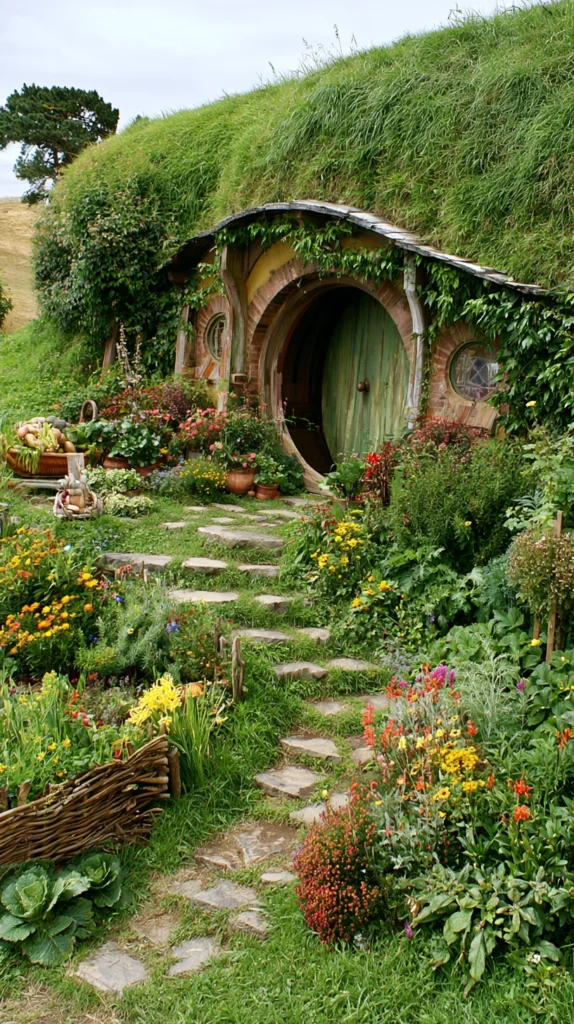
A generous, abundant kitchen garden — because hobbit culture is fundamentally a food culture, and the garden that does not produce is not a hobbit garden.
Why the kitchen garden is essential, not optional:
The Tolkien text:
- Hobbits: defined by their relationship to food
- Six meals a day (in some accounts)
- The Shire: a world of abundance, of produce, of good things grown and preserved and eaten
- A hobbit garden without a kitchen garden: missing the point entirely
The specific kitchen garden character:
Not neat rows:
- A hobbit kitchen garden: overflowing
- Vegetables and flowers together (as covered in the productive beauty sections of earlier articles)
- Self-seeders from the flowers among the vegetables
- The productive garden: looking as if it is trying to escape its boundaries
The traditional varieties:
What a hobbit kitchen garden grows:
- Broad beans (ancient, climbing, beautiful in flower)
- Runner beans (on tall wigwams — vertical architecture)
- Heritage tomatoes (more varied and interesting than modern varieties)
- Old potato varieties (the hobbit relationship with potatoes: fundamental)
- Root vegetables in abundance (parsnips, carrots, turnips)
- Pumpkins and squash sprawling beyond their allotted space
- Onion and garlic rows
- Endless herbs
The wigwam:
The structural element:
- Runner beans or sweet peas on tall cane wigwams
- The wigwam: the most immediately charming vertical element in any kitchen garden
- A circle of tall canes meeting at the top: ancient and beautiful
- The bean-covered wigwam: the defining image of the English kitchen garden
The productive chaos:
Plants allowed to run:
- Pumpkins allowed to sprawl beyond their bed
- Borage self-seeding between the rows
- Nasturtiums cascading over the path edge
- Courgette leaves enormous and tropical-looking
- The garden: growing with enthusiasm
Cost breakdown:
- Seeds for a full kitchen garden season: $30–50
- Canes for wigwams: $12
- Compost: $25–40
- Total: $67–102
7. The Apple and Fruit Tree Orchard (The Heart of the Shire)
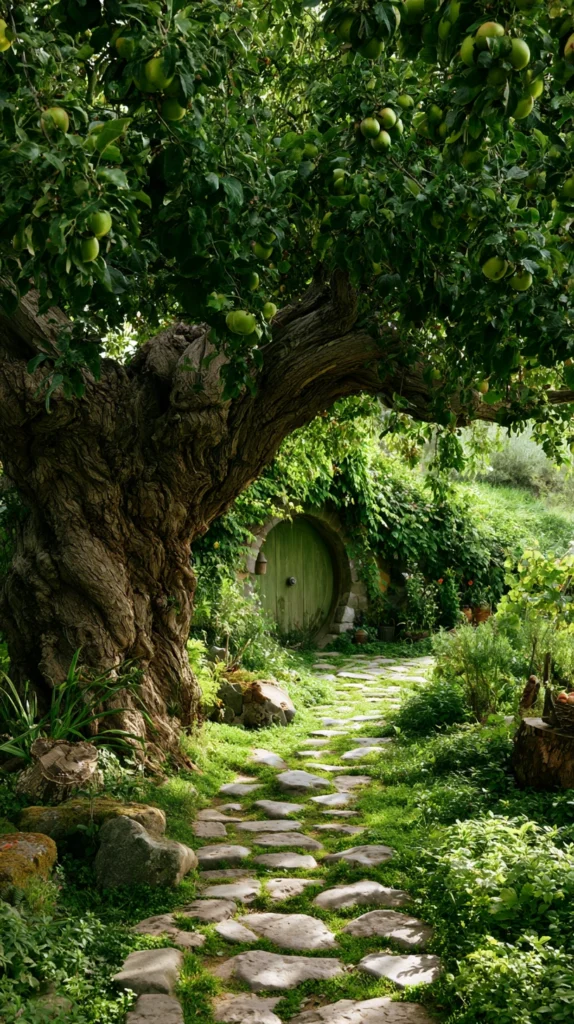
A small orchard or even a single gnarled apple tree — the tree that is the Shire’s most defining feature and the hobbit garden’s most important long-term investment.
Why fruit trees are the hobbit garden’s most important plants:
The age and character:
- An old apple tree: the most beautiful structure in any garden
- The gnarled branches, the lichen on the bark, the blossom, the fruit, the winter silhouette
- A tree that has been here a long time: the most powerful single indicator that a garden has been lived in
- A new garden: plant now. The tree in ten years: entirely transforms the garden.
The variety choice:
Heritage varieties (always for a hobbit garden):
- Modern apple varieties: bred for uniformity and storage
- Heritage varieties: bred for flavour, character, and variety — and they look more beautiful
- ‘Cox’s Orange Pippin’: the classic English dessert apple
- ‘Bramley’s Seedling’: the cooking apple that has been in English gardens for 200 years
- ‘Blenheim Orange’: large, characterful, delicious — the most Shire-appropriate apple
- ‘Discovery’: the first apple of the season (August), bright red
The multi-stem approach:
Instead of one upright tree:
- Two or three trees planted together
- They grow into each other over decades
- The result: looks like one ancient multi-stem tree
- The aged quality: achieved faster than a single tree develops it
- The orchard atmosphere: immediately present
The underplanting:
The traditional orchard floor:
- Long grass (not mown lawn)
- Wildflowers in the grass (cowslips, bugle, clover)
- Bulbs naturalised in the grass (daffodils, narcissus, snakeshead fritillary)
- The orchard: a meadow that happens to have trees
- Mown once a year (August, after the wildflowers have set seed)
The tree as a feature:
Seat beneath:
- A wooden bench or stone seat under the apple tree
- The tree: the shelter, the shade, the fallen apples in autumn
- The seat: the reason to go to this part of the garden
- The destination: the journey in the garden
Cost breakdown:
- Heritage apple tree (bare root, winter): $25–45
- Or two trees for multi-stem effect: $50–90
- Wildflower seed mix for understorey: $8
- Seat beneath: $60–120 (bench)
- Total: $118–218
8. The Stone Wall With Planting (The Boundary That Is Also a Garden)
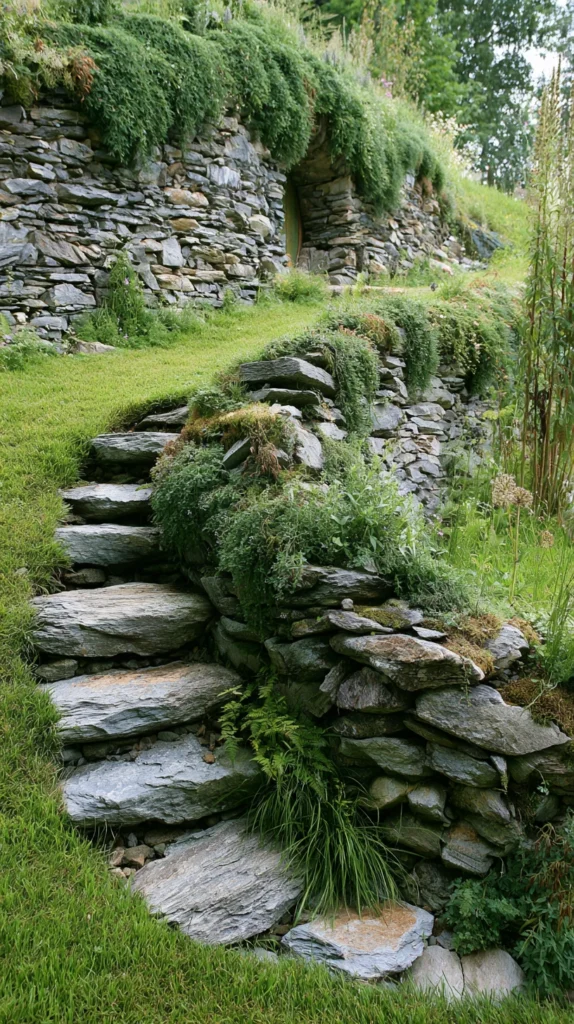
A drystone or mortared stone wall with creeping plants growing from its gaps — the structure that is half boundary and half garden.
Why stone walls are essential to the hobbit garden:
The material:
- Stone: the oldest building material
- The lichen and moss that accumulate on stone over years: the patina of time
- A new stone wall: needs time to acquire this
- A reclaimed stone wall: arrives with it
- The hobbit garden: uses reclaimed stone wherever possible
The planted wall:
Between the stones:
- Aubrieta (the purple cascade of spring)
- Wallflowers (fragrant, warm-toned, specifically between-stones habitat)
- Erigeron karvinskianus (the Mexican fleabane — white and pink daisies in gaps forever)
- Sedum (in the drier, sunnier gaps)
- Ferns (in the shadier, moister gaps)
- Ivy (rooting into the mortar)
- Creeping thyme (fragrant when brushed or crushed)
The moss on the faces:
Yogurt method on the stone face:
- A generous application of plain yogurt
- The moss establishes within 6–8 weeks
- The wall: appears to have been there for decades
- The wall’s age: apparent from the first summer
The drystone construction:
DIY or professional:
- Drystone walling: a skill but learnable
- Small sections: excellent DIY project
- No mortar required
- The stones: keyed together by weight and placement
- The wobble test: if it wobbles, move the stone
What grows on top:
The coping stones:
- Flat stones on top of the wall
- Often mossy on the surface
- Sedum and stonecrop in the gaps
- The top of the wall: a garden in miniature
The plants that overhang:
From the garden side:
- Alchemilla, overhanging the wall and softening the top edge
- Old roses reaching over
- The plants of the garden: spilling over the boundary
- The boundary: breached by the garden, as it should be
Cost breakdown:
- Reclaimed stone (per tonne): $100–200
- For a 10-foot low wall: approximately 1 tonne
- Total: $100–200 (DIY labour) or more with professional building
9. The Mushroom and Toadstool Feature (The Fairy Tale Detail)
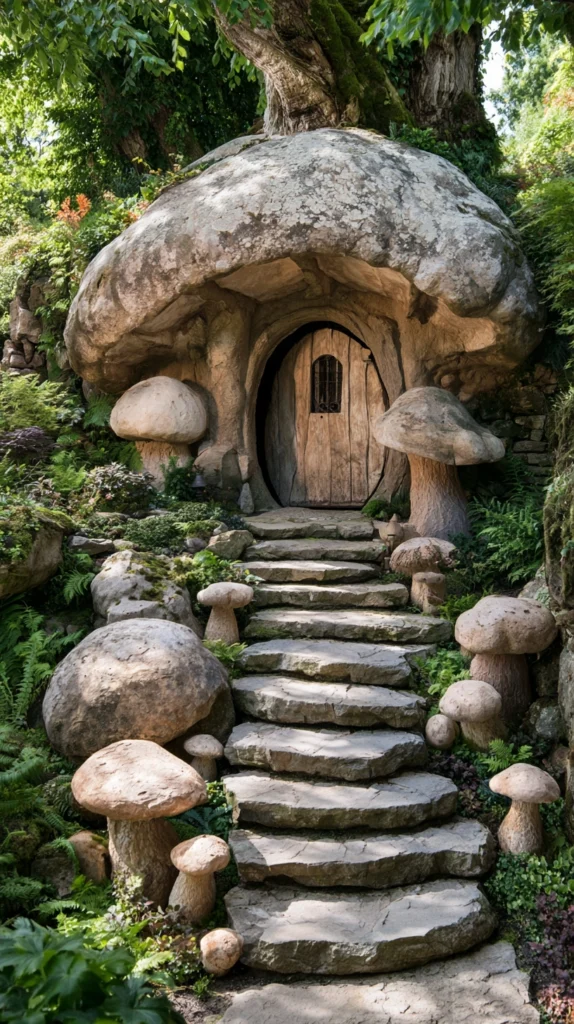
Planted mushroom logs, a dedicated mycelium bed, or carefully placed stone toadstools — the element that adds the fairy tale without the kitsch.
Why mushrooms are specifically hobbit:
The foraging tradition:
- Hobbits: foragers as well as cultivators
- Mushrooms: gathered from the fields
- A garden that grows edible mushrooms: genuinely in the spirit of the Shire
- Not a decorative mushroom: a productive one
The productive mushroom garden:
Inoculated logs:
- Hardwood logs (oak, beech, apple) inoculated with mushroom mycelium
- Wine cap, oyster, or shiitake
- Placed in a shaded, moist position
- First flush: 6–12 months
- Produces for several years
Wine cap mushroom bed:
- Scatter wine cap (Stropharia rugosoannulata) spawn on damp wood chip
- Under trees or in a shaded bed
- Large, beautiful red-capped mushrooms
- Prolific and easy
- The mushroom that looks most like a fairy tale mushroom: the most hobbit-appropriate productive option
The appearance:
- Wood chip mulch bed in a shaded corner
- The mycelium: invisible until the mushrooms emerge
- The emergence: the discovery
- Discovering mushrooms in the garden: the foraging experience replicated at home
The decorative (used sparingly):
Stone toadstools:
- Carved stone mushroom and toadstool forms
- In the garden: as if discovered rather than placed
- Partially hidden by planting: the discovery effect
- Three or four in a damp, mossy corner: the magical moment
The non-kitsch rule:
What makes it kitsch:
- Bright-coloured resin mushrooms
- Rows of identical pieces
- Placed prominently for display
- The “fairy garden” aesthetic
What makes it work:
- Stone or natural material
- Partially obscured by planting
- Discovered rather than presented
- The mushroom log or mycelium bed (functional): never kitsch
Cost breakdown:
- Mushroom spawn plugs for logs: $20
- Hardwood log (fallen branch): $0
- Wine cap spawn: $15
- Carved stone toadstools (2–3): $30–60
- Total: $65–95
10. The Water Feature With Moss and Fern (The Ancient Spring)
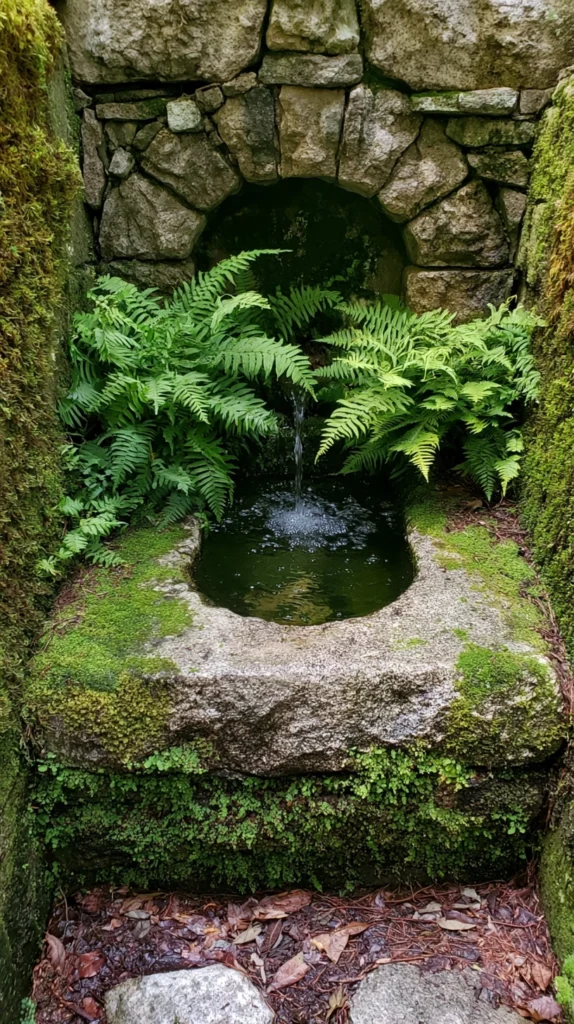
A simple stone water feature — a trough, a basin, or a spring — surrounded by ferns and moss — the element that makes a corner of the garden feel centuries old.
Why water in the hobbit garden is specifically about age:
The Tolkien water:
- The rivers and streams of the Shire: ancient, slow, clear
- Not designed water features: natural-looking water
- The spring bubbling from a stone: the image
- Not the contemporary fountain: the ancient source
The stone trough:
The most hobbit-appropriate water feature:
- Old stone animal troughs: instantly old
- Filled with water
- A tiny pump making the water circulate very gently
- Ferns growing immediately beside
- Moss growing on the stone surface
The plants:
Around the trough:
- Ostrich fern or royal fern (the large, architectural ferns)
- Hart’s tongue fern (evergreen, bold)
- Soft shield fern
- Primroses in spring (the Shire’s spring flower)
- Astilbe beside the water (feathery, moisture-loving)
On the trough itself:
- Moss cultivated on the stone
- Possibly a liverwort establishing
- Small fern in a crack
- The trough: a habitat as well as a vessel
The sound:
Barely audible:
- A tiny pump: a gentle trickle
- Not a dramatic cascade: a murmur
- The sound: suggests a natural source
- From a few feet away: might be a natural spring
The positioning:
In the shadiest, most enclosed corner:
- The corner that already feels like somewhere else
- The ferns: requiring shade
- The moss: requiring moisture
- The combination: the cool, enclosed, moss-and-fern corner of the garden
Cost breakdown:
- Old stone trough (salvage): $50–150
- Small submersible pump: $20–35
- Ferns (3–4 varieties): $35–50
- Total: $105–235
11. The Herb Wheel or Spiral (The Productive Magic)
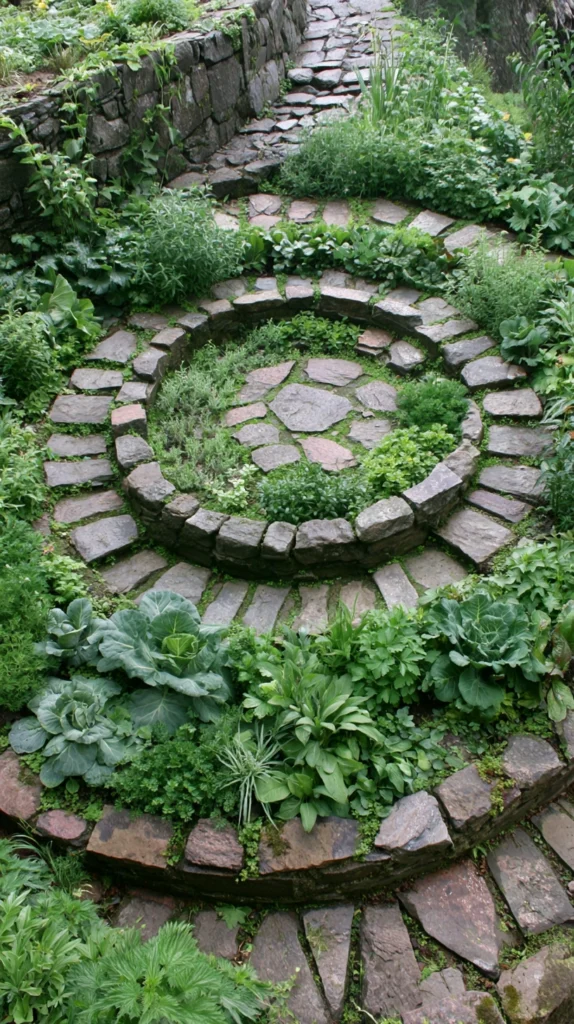
A circular or spiral herb garden — the design that references the ancient, productive kitchen traditions while being one of the most beautiful structures in any garden.
Why a circular herb garden is specifically hobbit:
The round form:
- The circle: the hobbit’s preferred shape
- A round herb garden: extending the circular motif from the door and gate into the planting
- Every circular element in the garden: reinforcing the aesthetic
The abundance of herbs:
What a hobbit kitchen would use:
- Thyme (extensively)
- Sage
- Rosemary
- Mint (every variety)
- Marjoram and oregano
- Lavender
- Chives
- Flat-leaf parsley
- Chamomile (for tea — Tolkien specifically mentions Bilbo’s chamomile tea)
- Pipeweed (in garden terms: a tall growing herb — perhaps not the original, but the spirit)
The herb spiral design:
The concept:
- A stone spiral, rising from ground level at the outer edge to approximately 2 feet at the centre
- Different microclimates created by the height and orientation
- Top (warmest, best drainage): Mediterranean herbs (rosemary, thyme, oregano)
- Middle: sage, marjoram
- Base (moister, more shaded): mint, chamomile, parsley
The stone:
The material:
- Field stones or reclaimed stone
- Dry-stacked (no mortar)
- The spiral: informally built, not perfectly geometrical
- The imperfection: the hobbit quality
The path around:
Stepping stones between the herb beds:
- Flat stones set in the ground
- Thyme growing between them
- The path: fragrant to walk on
Cost breakdown:
- Field stones (collected or purchased): $30–60
- Herb plants (10–12 varieties): $40–60
- Total: $70–120
12. The Beehive or Bee-Friendly Corner (The Thriving Ecosystem)
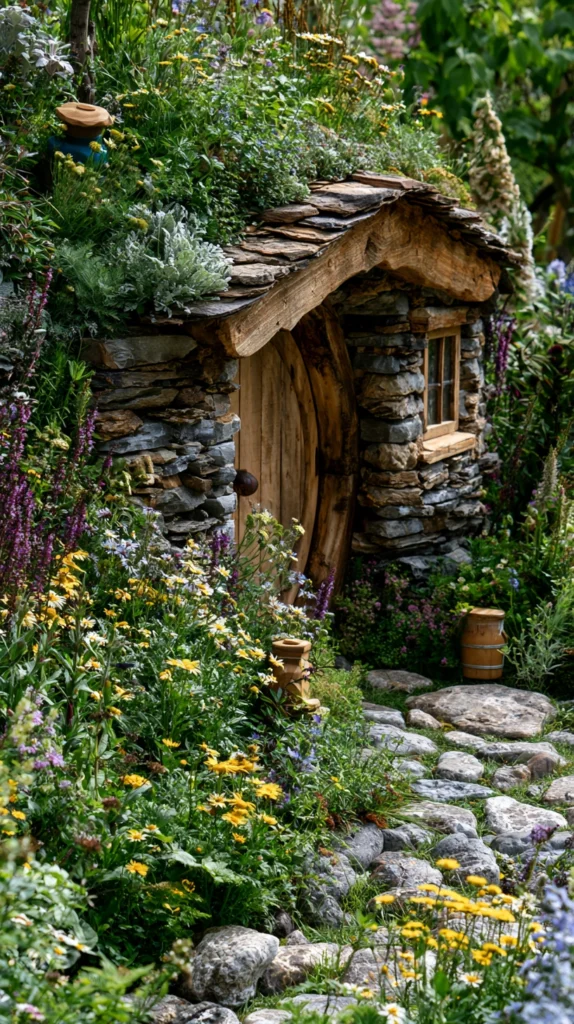
A beehive (managed or decorative), extensive bee-friendly planting, or a dedicated pollinator habitat — the feature that acknowledges the garden as part of something larger.
Why bees are specifically part of the hobbit garden:
The ecosystem of the Shire:
- The Shire is not just beautiful: it is ecologically alive
- Bees, birds, butterflies: visible in every description of the countryside
- A hobbit garden that is not alive with pollinators: missing the essential quality
- The garden: part of the natural world, not a display placed within it
The beehive:
A managed hive:
- The most authentic option
- Honey: the hobbit relationship with sweet things is fundamental
- The keeping of bees: a centuries-old country tradition
- Requires: training, investment ($600–1,500 for equipment), and the legal requirements of the region
The decorative skep:
The woven straw beehive (skep):
- The traditional form: a dome of coiled straw
- No longer used for managed beekeeping (bees cannot be inspected)
- Placed in the garden as a beautiful object
- Often a focal point in the kitchen garden
- Available in various sizes and qualities
- With a plant growing around its base: perfect
The bee hotel:
For solitary bees:
- A bundle of hollow stems or drilled wood blocks
- Red mason bees and leafcutter bees: the primary users
- Essential pollinators for the kitchen garden
- The bee hotel: the practical version of the same intention as the hive
The bee-friendly planting:
The pollinator plants:
- Borage (the most attractive to bees, self-seeds prolifically)
- Phacelia (the blue bee magnet)
- Alliums
- Single-flowered roses
- Lavender
- Foxgloves
- Verbena bonariensis
The whole-garden approach:
Every part of the hobbit garden should serve bees:
- The cottage border: rich in bee forage
- The kitchen garden: borage and phacelia between the vegetables
- The wildflower orchard floor: clover and cowslip
- The herb garden: the Mediterranean herbs in flower
Cost breakdown:
- Decorative skep (quality woven straw): $40–80
- Bee hotel: $15–30
- Bee-friendly plants (already in the garden for other reasons): minimal additional cost
- Total: $55–110
13. The Climbing Roses on Every Surface (The Shire’s Signature)
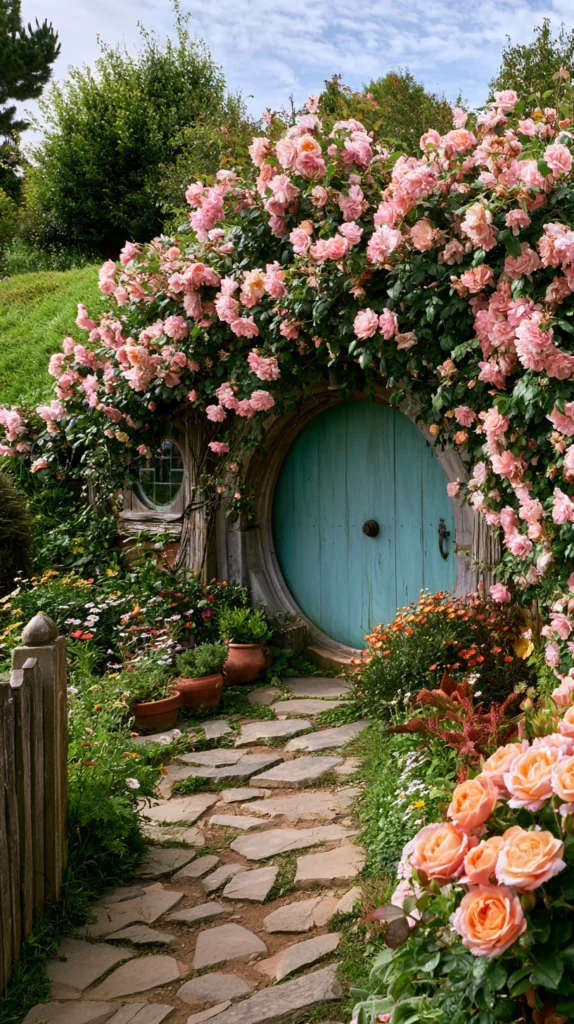
Climbing and rambling roses trained over walls, arches, fences, and buildings — the plant that defines the English cottage aesthetic and by extension the hobbit garden.
Why roses are the hobbit garden’s most important plant:
The Tolkien connection:
- Rosie Cotton: named for the rose
- The Rose is a recurring image in Tolkien’s world
- The traditional English cottage rose: the flower of the Shire
- A hobbit garden without roses: historically and aesthetically incomplete
The varieties:
For the hobbit garden (old varieties only):
Climbing:
- ‘Madame Alfred Carrière’: white, fragrant, shade-tolerant
- ‘Zéphirine Drouhin’: pink, thornless (important for paths and arches people walk under)
- ‘New Dawn’: blush pink, vigorous, repeat-flowering
- ‘Paul’s Himalayan Musk’: pale pink, huge rambler, for covering large structures
Shrub roses (for the border):
- ‘Gertrude Jekyll’: deep pink, deeply fragrant
- ‘Munstead Wood’: deep crimson, old-rose fragrance
- ‘Olivia Rose Austin’: soft pink, modern in habit but old-fashioned in appearance
- ‘The Mayflower’: clear pink, strongly scented
The fragrance requirement:
Non-negotiable for the hobbit garden:
- Hobbit gardens smell of flowers
- Modern roses: often bred for visual appearance at the expense of fragrance
- The varieties listed above: all strongly fragrant
- Check that any rose purchased is fragrant before buying
The abundance principle:
Multiple roses:
- Not one rose: many
- Climbing roses on every fence section
- A shrub rose at every border interval
- Roses on the garden building and on the gate and on the arch
- The abundance of roses: the signature of the Shire
The training:
Tie in regularly:
- Climbing roses: not self-supporting
- Training along fence wires or trellis
- Each new stem: tied in as it grows
- The stem at a low angle: encourages more flowers (vertical stems: flower at the tip only)
- Horizontal training: the most floriferous method
Cost breakdown:
- Three climbing roses: $60–90
- Two shrub roses for the border: $40–60
- Total: $100–150 for an initial planting, with more added each season
14. The Toadstool Ring and Wildflower Lawn (The Fairy Ring)
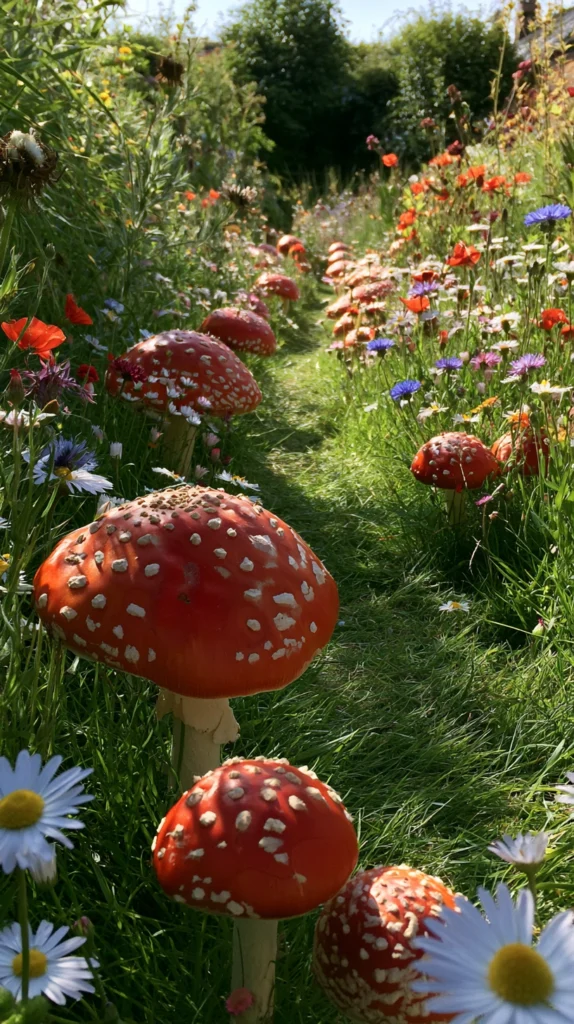
A section of the garden given to a wildflower lawn with a mown path through it — the space that removes the hard divide between the garden and the meadow.
Why a wildflower area is the hobbit garden’s most important spacial decision:
The Shire as a landscape:
- The Shire is not manicured
- The boundary between the garden and the surrounding country: deliberate but not harsh
- The wildflower area: the bridge between the cultivated garden and the wider landscape
- The transition: the most specifically “Shire” spatial quality
The fairy ring:
What it is in nature:
- A ring of mushrooms: caused by mycelium spreading outward from a central point over years
- Folk tradition: a place where fairies dance
- In a hobbit garden: the site of something enchanted
Creating the effect:
A mown circle in a wildflower lawn:
- The lawn: allowed to grow long in a roughly circular area
- The path: mown through it
- A mown circle within the longer grass: the suggestion of a clearing
- Stone toadstools in the longer grass around the edge: the fairy ring
- The discovered quality: essential (stumbled upon, not presented)
The wildflower lawn:
From existing lawn:
- Stop fertilising
- Introduce yellow rattle seed (parasitic on grass, weakens it, allows wildflowers to compete)
- Sow wildflower seed into scarified patches
- Allow to grow long through summer
- Cut in August, remove cuttings
From bare ground:
- Specific wildflower turf: rolled out like lawn turf
- Or: sow wildflower and fine grass mix directly
- Year one: establishing
- Year two: the meadow quality present
The plants in the wildflower lawn:
The Shire flora:
- Cowslip (primula veris)
- Oxeye daisy
- Ragged robin
- Meadow buttercup
- Clover (red and white)
- Bird’s-foot trefoil
- Knapweed
- Field scabious
- Snakeshead fritillary (in damper areas)
Cost breakdown:
- Yellow rattle seed: $5
- Wildflower seed mix: $8–15 for a significant area
- Carved stone toadstools for the ring: $30–60
- Total: $43–80
15. The Complete Hobbitcore Garden (All Elements in a Unified Vision)
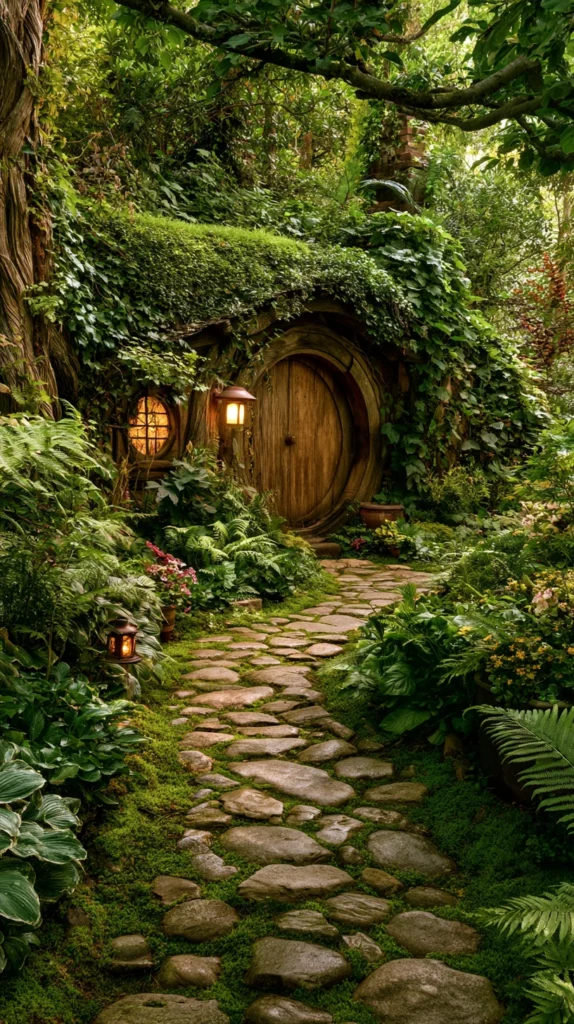
The full realisation of the hobbit garden aesthetic — when every element works together, the garden stops being a collection of features and becomes a place with a distinct character.
What makes the complete hobbit garden more than the sum of its parts:
Coherence:
- A moon gate, an apple tree, a cottage border, and a living roof — individually charming
- Together and in relationship to each other — a place with its own logic
- The coherence: the quality that makes visitors stop and want to understand what kind of person lives here
The atmosphere:
- Not achieved by any single feature
- Achieved by the accumulation of correct decisions
- The stone, the plant, the worn path, the rounded form, the fragrance, the age: together
- The atmosphere: felt before understood
The design principles applied to the whole garden:
Every hard surface: natural material
- Stone paths, stone walls, timber structures
- Nothing synthetic visible
- The rule: if it would look wrong in a painting of an English country garden in 1900, do not use it
Every boundary: soft
- No hard fence-to-garden edge
- Plants overhanging every wall and path
- The boundaries: present but not sharp
Every structure: partially hidden
- The moon gate: covered in roses
- The shed: behind the kitchen garden
- The stone wall: covered in moss and fern
- Structures revealed, not presented
Every plant: productive, fragrant, or wildlife-supporting
- The decorative: also functional
- The fruit trees: the flowers and the fruit and the wildlife
- The herbs: the scent and the cooking
- The roses: the fragrance and the hips and the bees
- Nothing in the hobbit garden is merely ornamental
The things to avoid:
The anti-hobbit list:
- Synthetic materials (plastic pots, artificial grass, composite fencing)
- Formal symmetry (the hobbit garden is asymmetric)
- Bare soil (every inch either planted or mulched)
- Uniformity (everything slightly different from everything else)
- New-looking anything (age and patina throughout)
- Empty space (the abundance: always)
The sequencing:
Year one (the bones):
- The moon gate arch (Idea #1)
- The apple tree planted (Idea #7)
- The cottage border started (Idea #2)
- The round-top gate or door (Idea #3)
- Climbing roses planted (Idea #13)
- Cost: $350–600
Year two (the filling):
- The kitchen garden established (Idea #6)
- The herb spiral or wheel (Idea #11)
- The stone path (Idea #5)
- The water feature (Idea #10)
- The mushroom feature (Idea #9)
- Cost: $400–700
Year three (the maturing):
- The living roof (Idea #4) if not yet done
- The wildflower lawn (Idea #14)
- The stone wall (Idea #8) extended
- The bee feature (Idea #12)
- The shed converted (Idea #5)
- Cost: $400–800
Year three and beyond:
The garden is now growing into itself:
- The apple tree is developing character
- The climbing roses have reached the top of the arch
- The moss is established on the stone
- The self-seeders are spreading without assistance
- The garden: becoming the thing it was designed to be
The principle that the hobbit garden embodies:
The garden designed for time:
- Not for the day it is planted
- For year three. Year five. Year ten.
- The plants that require years: planted first
- The plants that improve with age: favoured over those that need replacing
- The structures designed to weather: chosen over those that need repainting
- The garden: an investment in time, repaid continuously
Total cost over three years: $1,150–2,100 Annual maintenance thereafter: $50–100
The One Principle
Stated once, held throughout:
The hobbit garden is not designed to look like it belongs to someone who has read The Hobbit.
It is designed to look like it belongs to someone who lives the way hobbits live.
There is a difference. The first produces a theme park. The second produces a garden.
The theme park version: you see the references. The garden version: you feel the quality of life that the references describe.
The quality of life:
- Food grown here
- Beauty all around
- Age and history in the materials
- The natural world present and welcome
- Everything needed within reach
- The house and the garden: a single system
That quality of life: designed into the garden over time, plant by plant, stone by stone.
Not a single feature. Not a round door.
The whole garden, living the way hobbits live.
Getting Started This Weekend
The three immediate actions that begin the hobbit garden:
One: plant a climbing rose on the most visible fence or wall.
- Any old variety, any fragrant rose
- The rose that will be there in ten years, still growing
- The first permanent hobbit garden plant
Two: stop deadheading one part of the garden.
- Allow one section to self-seed
- The self-seeded plant: the first sign of the garden’s own will
- The garden beginning to design itself
Three: add one reclaimed stone object to the garden.
- A salvage yard stone pot, a cobble, a fragment of old building stone
- The first material of the correct kind in the correct place
Total cost: $25–40 for the rose. The rest: time and the decision to start.
The garden begins where the decision is made to let it be itself — to tend it but not control it, to plant for time rather than for now, to welcome the wildness at the edges as part of the design rather than a failure of maintenance.
That decision: free and available this weekend.