14 Fall Herb Garden Ideas for Kitchen-to-Garden Living
The distance between the kitchen and the herb garden is the distance between cooking with dried seasoning from a jar and cooking with something alive. Not metaphorically alive. Literally still growing when it is picked.
The difference in flavour is not subtle. A sprig of rosemary cut from a plant still growing in the cold garden in October: not comparable to dried rosemary from a packet purchased in July. The volatile oils still present. The fragrance still sharp. The flavour still itself.
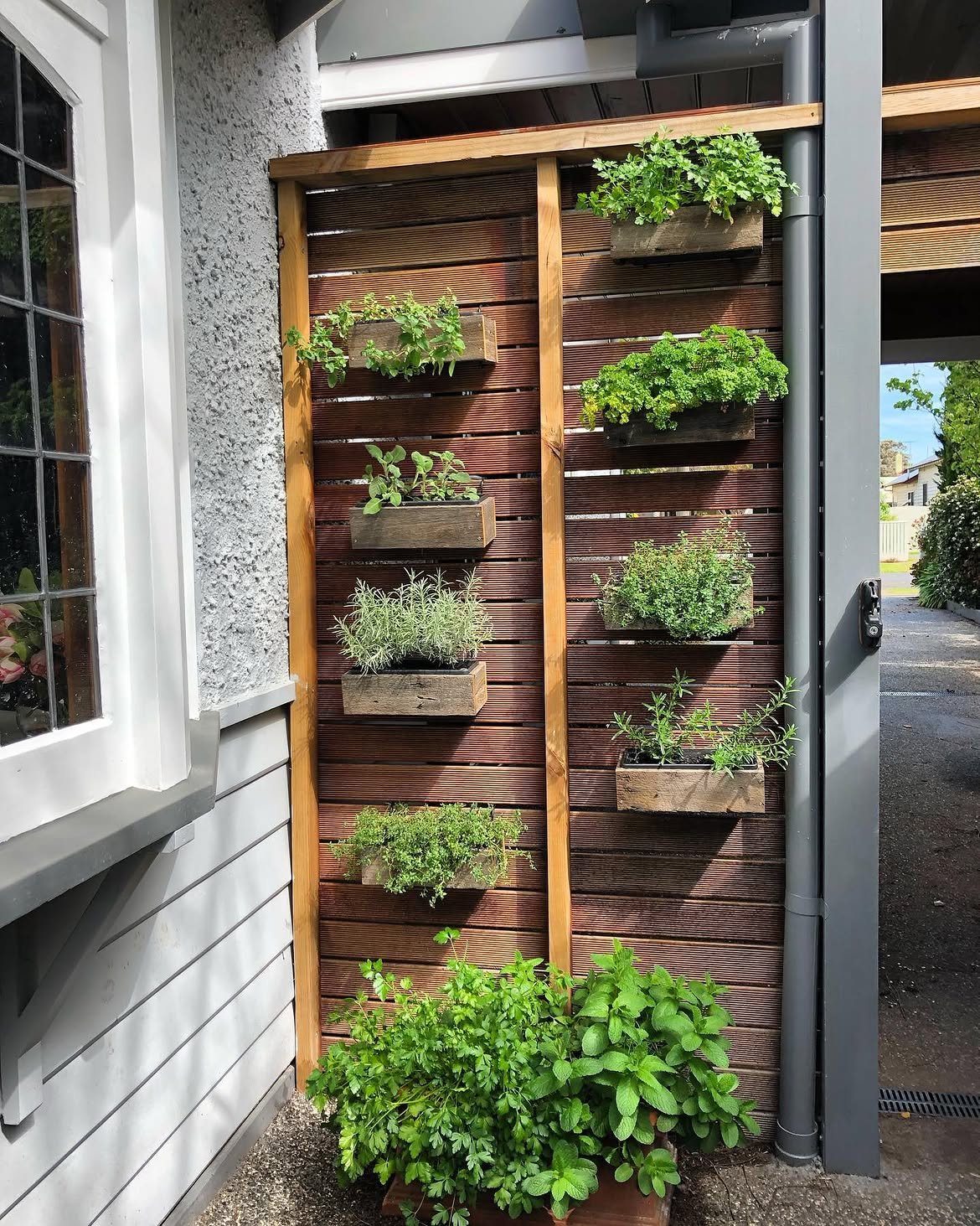
Autumn does not end the herb garden. For many of the most useful kitchen herbs, it improves them. The cool temperatures that close down the summer vegetables concentrate the essential oils in Mediterranean herbs. October rosemary is stronger than July rosemary. Autumn sage is more pungent than summer sage. The herbs that most define autumn cooking — the herbs for the roast, the stuffing, the slow braise — are at their most potent in exactly the season when they are most needed.
Here are 14 ideas for keeping the herb garden going through autumn and into winter, and for making the kitchen-to-garden journey easier to make daily.
Why Autumn Herbs Are Better Than Summer Herbs
The science of essential oil concentration:
Summer:
- Rapid growth (high water content, cell volume large)
- Essential oils diluted by volume
- The herbs: plentiful but milder
Autumn:
- Slower growth (lower water content)
- The same essential oil production in a smaller volume
- The concentration: higher
- The flavour: more intense per gram of herb
What this means in the kitchen:
The autumn roast:
- The herbs for roasting (rosemary, thyme, sage, oregano): Mediterranean in origin
- Mediterranean conditions: hot, dry, poor soil
- Autumn in the garden: moves toward Mediterranean conditions (less water, slower growth)
- The roasting herbs: specifically at their best for the roasting season
The herbs that improve with cold:
- Sage: more pungent after first cold nights
- Thyme: retains flavour through October and November
- Rosemary: evergreen and continuous, flavour deepened by cold
- Oregano: last harvest most intense
The herbs that need managing before cold:
- Basil: killed by first frost — take cuttings now
- Coriander: bolts easily, finish the season deliberately
- Chives: die back but the last harvest before die-back: intense
The Kitchen-to-Garden Principle
The herb garden that gets used:
The friction between kitchen and garden:
- In summer: outside anyway, easy to pick a herb
- In autumn: requires going outside specifically, in the dark, often in the cold
- The friction: the reason autumn herbs are not used as often as they should be
- Every idea on this list: either reduces that friction or brings the herbs closer to the kitchen
The zero-friction herb:
- A pot of herbs on the kitchen windowsill: picked without going outside
- A pot just outside the kitchen door: one step into the cold air
- The herb garden across the garden: requires a decision
The kitchen-to-garden approach:
- Some herbs always within the kitchen (windowsill herbs)
- Some herbs just outside the kitchen (the kitchen door pots)
- Some herbs in the garden (the larger productive planting)
- The system: graduated proximity based on how often each herb is used
1. The Windowsill Kitchen Herb Garden (Zero-Distance Growing)
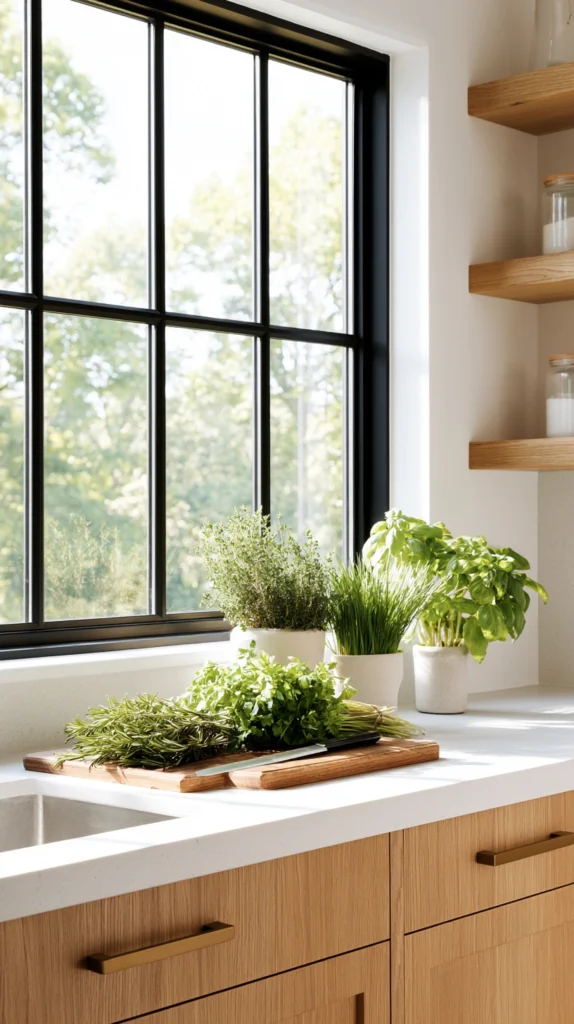
Herbs growing in pots on the kitchen windowsill — the most accessible herb garden, available without going outside.
Why the windowsill herb garden is specifically valuable in autumn:
The light:
- Autumn: dark earlier
- Going into the garden at 5pm: darkness
- Windowsill herbs: accessible regardless of the hour
- The evening meal: herbs picked without any outside journey
The warmth:
- The herbs: inside, protected from frost
- The tender herbs (basil, coriander): extended beyond their outdoor season
- The hardy herbs (rosemary, thyme): available without any protection
What grows well on a kitchen windowsill:
The top performers:
Basil:
- Needs the warmest, brightest position
- A south-facing kitchen window: adequate
- Nip regularly (prevents bolting)
- The summer herb extended into autumn by bringing it inside
Chives:
- More cold-tolerant than basil
- East or west-facing window: adequate
- Cut with scissors rather than pulling
- The mild onion: the everyday herb
Parsley (flat-leaf):
- The most useful and the most willing
- Any reasonable light
- Cut whole stems from the outside first
- The workhorse windowsill herb
Thyme:
- Mediterranean — needs as much light as possible
- South-facing best
- Drought-tolerant (the easiest to keep alive on a windowsill)
- The autumn roasting herb: always available
Mint (in a contained pot):
- Spreads invasively — always in its own pot (a critical detail)
- East or west-facing: tolerates less direct sun
- The tea herb: available daily
The light challenge:
Supplementing with a grow light:
- A small LED grow light above the windowsill
- The warm spectrum (not the blue-heavy options): grows herbs without the clinical quality
- 12–16 hours per day
- Basil specifically: doubles its productivity with supplemental light
The rotation system:
Herbs and light:
- If the kitchen window is not south-facing: herbs rotate in and out
- One week on the windowsill, one week in the best light in the house
- The rotation: keeps herbs healthier than a permanently dim position
Cost breakdown:
- Four herb plants for the windowsill: $14–20
- Appropriate pots (matching): $10–20
- Small LED grow light (optional): $20–35
- Total: $24–75
My kitchen windowsill in October: the rosemary and thyme for every autumn roast, reached for without moving from the stove. The basil that should have died in September: still producing on the windowsill in November. The daily herb without the daily journey outside.
Windowsill Tips
The overwatering problem:
- The most common windowsill herb failure
- Herbs on windowsills: dry out more slowly than outdoor herbs (no wind, less evaporation)
- The finger test: one inch of soil dry before watering
- The pot: must have drainage holes (soggy roots kill herbs faster than dry roots)
The haircut principle:
- Use the herbs regularly — the use is the maintenance
- An un-harvested herb: bolts, becomes woody, loses productivity
- The regular harvest: triggers new growth
- The herbs used every day: the healthiest herbs on the windowsill
2. The Herb Ladder (Vertical Windowsill Maximiser)
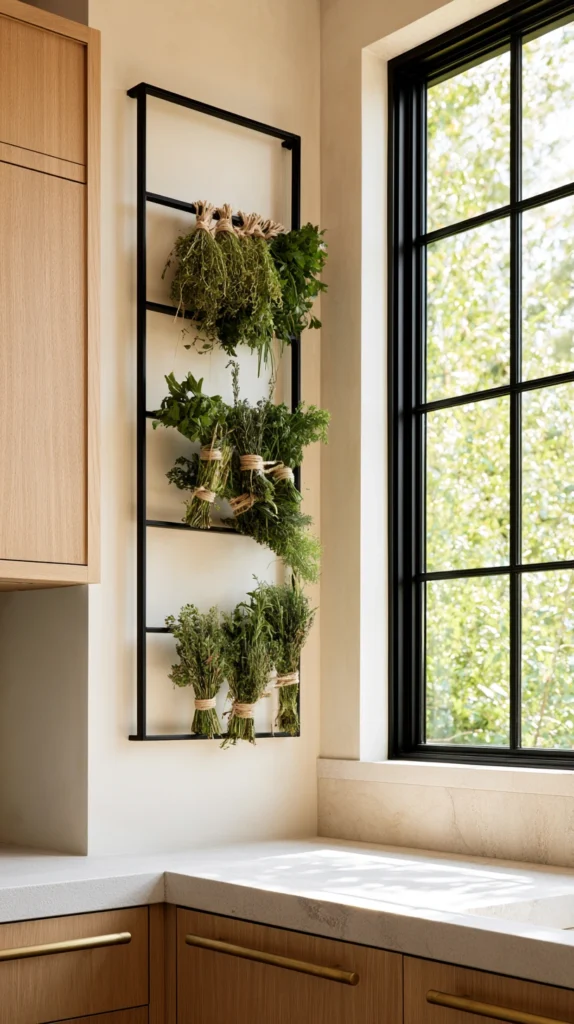
A tiered rack or ladder beside or near the kitchen window — the structure that multiplies the number of herbs available in the kitchen without requiring a larger windowsill.
Why the vertical approach:
The windowsill limitation:
- The standard kitchen windowsill: space for two to four small pots
- The number of herbs wanted for autumn cooking: often six to eight
- The herb ladder: multiples the available space by using the vertical
The types:
Tiered hanging shelf:
- Suspended from a ceiling hook or a tension rod
- Three tiers hanging at the window
- Each tier: two or three pots
- The total: six to nine herb pots in the footprint of a single windowsill
Freestanding plant ladder:
- A ladder-form display (available from garden centres and home stores)
- Against the wall beside the window
- Steps of varying depths: smaller pots on upper steps, larger on lower
- The display: also decorative
Wall-mounted grid:
- A metal grid mounted on the wall near the window
- Clip-on pot holders or S-hooks with pots hanging from the grid
- The grid system: flexible (rearrange as needed)
The height management:
Tall herbs at the bottom, low herbs at the top:
- Taller herbs (rosemary, tall basil) closer to the light source
- Low-growing herbs (thyme, creeping varieties) can tolerate lower light levels
- The assignment: by light need, not by aesthetics
Cost breakdown:
- Tiered hanging shelf: $20–35
- Or freestanding ladder: $30–50
- Total: $20–50
3. The Kitchen Door Herb Pots (The One-Step Garden)
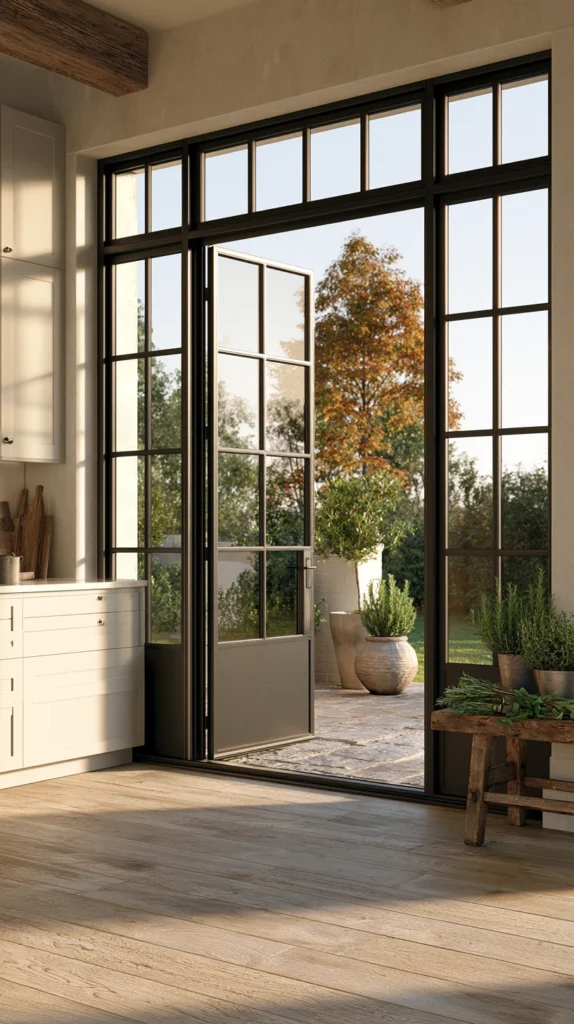
A collection of herb pots immediately outside the kitchen door — the herb garden that requires stepping outside but nothing more.
Why the kitchen door position is specifically valuable:
The friction reduction:
- The garden across the garden: a journey (especially on a cold October evening)
- The pots immediately outside the kitchen door: one step
- The friction: the difference between using the herb daily and not using it at all
- In October: one step into the cold is manageable. A walk across a dark garden: often not attempted.
The pot collection:
Grouping herbs at the kitchen door:
- Not one pot: a collection
- Three to five pots, grouped
- The grouping: looks designed, is more practically useful
- The single pot: easily missed. The grouped collection: the kitchen herb station.
The pots:
Matching terracotta:
- The warm autumn colour: appropriate
- Matching: the designed quality
- Terracotta: porous (drains well — important for Mediterranean herbs)
- The aesthetic: the kitchen herb garden looking like one designed thing, not objects left near the door
The plants:
The kitchen door selection:
- Rosemary (the most important autumn herb for the kitchen door)
- Sage (second most important for autumn cooking)
- Thyme (the versatile complement to both)
- These three: the autumn roasting herb collection
The cold weather performance:
All three of these are cold-hardy:
- Rosemary: hardy to approximately 10°F (-12°C) in well-drained soil
- Sage: hardy to approximately 0°F (-18°C) in a protected position
- Thyme: equally hardy
- The kitchen door pots: survive autumn and into winter in most temperate climates
The frost cloth for extreme cold:
- A piece of horticultural fleece draped over the pots on nights below 20°F (-7°C)
- The fleece: 4–5°F of protection
- Enough for most autumn cold snaps
The lighting at the kitchen door:
A small spotlight above:
- The herbs visible at night
- The walk to the pots: not in complete darkness
- The one step outside: better than stumbling in the dark
- The spotlight: an incentive to use the herbs after dark
Cost breakdown:
- Three herb plants (rosemary, sage, thyme): $18–25
- Three matching terracotta pots: $20–30
- Total: $38–55
4. The Hardy Herb Raised Bed (The Year-Round Outdoor Planting)
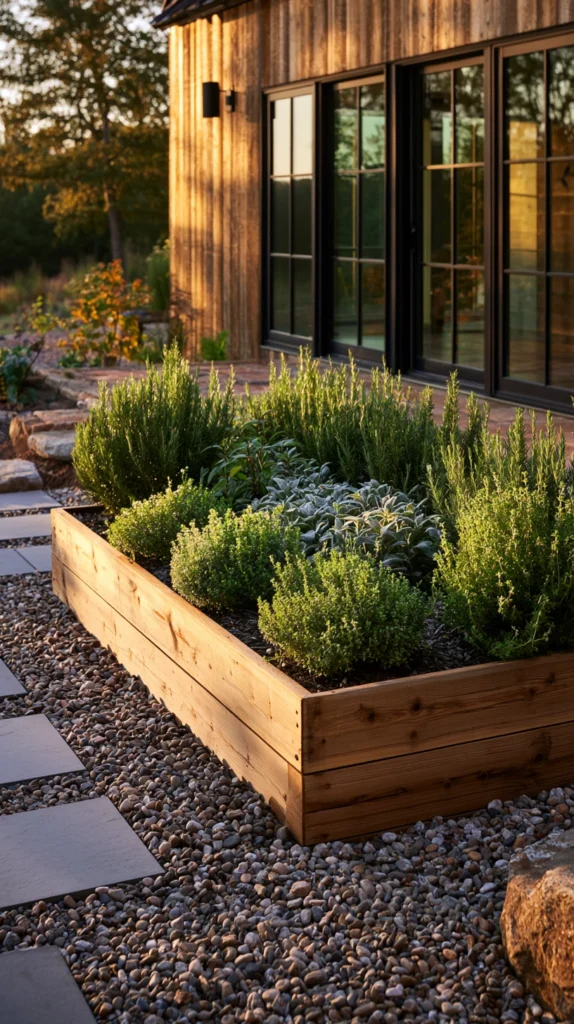
A dedicated raised bed planted with the hardiest herbs — the outdoor herb garden that produces through autumn and into winter.
Why a dedicated raised bed transforms herb productivity:
The drainage:
- Raised beds: superior drainage (roots never sitting in waterlogged soil)
- Mediterranean herbs: drought-tolerant — sensitive to waterlogging
- The raised bed: the cultivation condition that suits these herbs most
- The ground-level bed in heavy soil: the herbs that die in autumn
The soil:
- A raised bed filled with well-draining compost and grit (25% grit by volume)
- The grit: the drainage element
- Poor, free-draining soil: makes Mediterranean herbs stronger
- Rich, heavy soil: makes them lush and weak
The hardy herbs for the raised bed:
The reliably hardy:
- Rosemary: the cornerstone — plant one large established plant
- Thyme (common and lemon): ground-covering, productive, completely hardy
- Sage: the autumn workhorse
- Oregano: the summer herb that gives a strong final harvest in autumn
- Winter savory: less well-known, more cold-hardy than summer savory, peppery and persistent
The structural planting:
One large rosemary:
- A single established rosemary: the anchor plant
- At the back of the raised bed
- Two to three feet tall after two seasons
- The herb that provides structure even in winter
Thyme as ground cover:
- Between and around the other plants
- Spreads along the bed surface
- Flowers in spring, productive through autumn
- The carpet of the raised bed
The autumn harvest:
The last big harvest before winter:
- Late October or November: before any significant frost
- Cut back the sage and oregano by one-third (encourages new growth next spring)
- The harvest: dried or frozen (the abundance preserved)
- The herbs not cut: the remaining structure for winter
Cost breakdown:
- Raised bed (cedar, 4×4 feet): $80–120
- Six herb plants: $25–35
- Grit and compost: $20–30
- Total: $125–185
5. The Herb and Chilli Autumn Container (The Kitchen Pantry Pot)
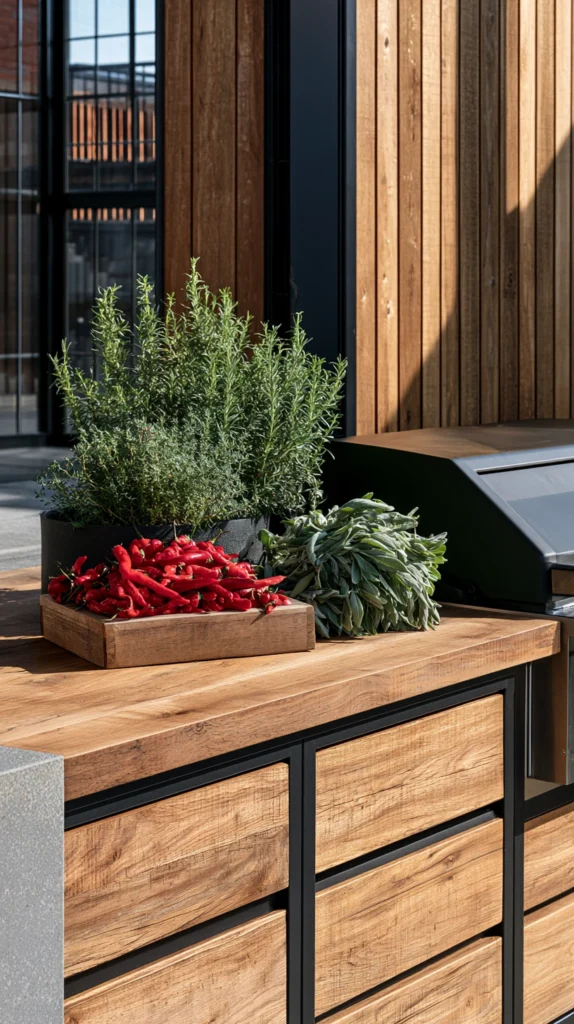
A large autumn container combining cooking herbs with small-fruited chilli plants — the productive pot that produces kitchen staples rather than just decoration.
Why chillies and herbs together:
The autumn chilli:
- Chilli plants: produce prolifically until the first frost
- In autumn: the last flush of fruit, often the most abundant
- The ripening chillies: turning red (the reddest and sweetest)
- Dried chillies: one of the simplest kitchen preserves
The combination:
- Herbs: the aromatic element
- Chilli: the heat element
- Together: the foundation of half the world’s cooking
- In one pot: the kitchen-to-garden principle applied to a whole category of flavour
The specific combination:
The Mediterranean container:
- Thyme and rosemary (low and spreading at the edge)
- Small hot pepper or sweet pepper plant (the tall element at the centre)
- The container: terracotta, generously sized
The Asian-influenced container:
- Thai basil (still going in a sheltered position until frost)
- A small bird’s eye chilli
- Coriander seeds sown beside (before they bolt)
- The pot: the flavour profile of Southeast Asian cooking
The chilli harvest:
Drying chillies:
- Thread through the stalk with a needle and twine
- Hang in a warm, airy kitchen to dry
- The drying: two to four weeks
- The dried chilli: the kitchen ingredient that lasts all winter
The kitchen decoration:
- The string of drying chillies hung above the kitchen window or from a beam
- The decoration: also the ingredient
- The honest kitchen: the food storage is also the aesthetic
Cost breakdown:
- Small chilli plant (from garden centre): $5–8
- Three herb plants: $14–20
- Large terracotta pot (12-inch+): $18–30
- Total: $37–58
6. The Cold Frame Herb Garden (The Season Extender)
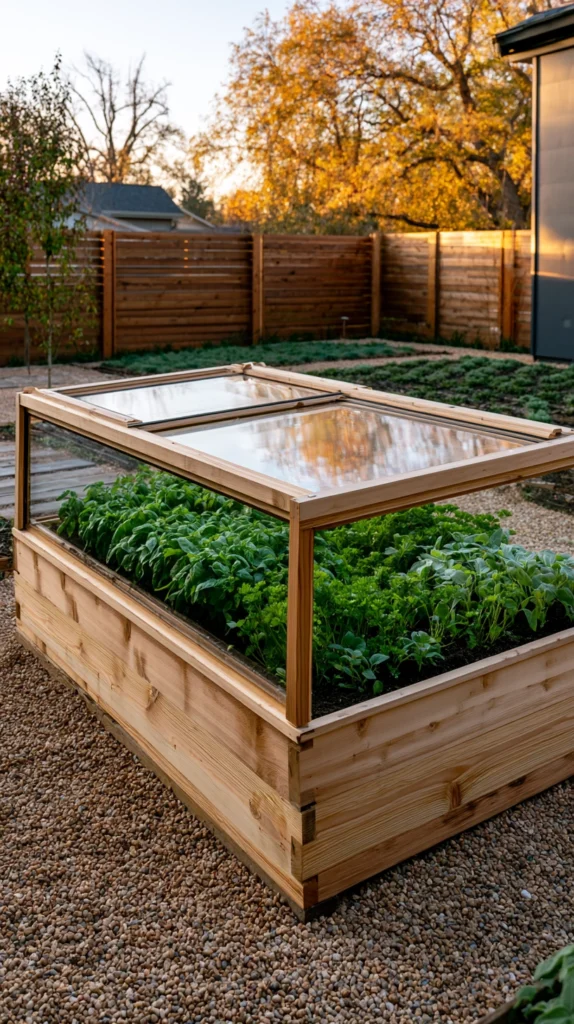
A simple cold frame over a herb bed — the structure that extends the productive season of tender herbs by six to eight weeks.
Why a cold frame specifically for herbs:
The temperature gain:
- A cold frame: 5–15°F warmer than outside conditions
- The exact amount: varies by design quality, sunshine, and whether ventilated or closed
- That temperature gain: keeps basil alive through October in most climates
- Keeps parsley productive through November
- Makes the difference between the herb garden closing in September and remaining open in November
The DIY cold frame:
The simplest version:
- An old window sash or storm window
- A wooden box or stacked bricks beneath
- The window: laid on top
- No construction beyond stacking
- Cost: approximately $0 if a spare window exists
The more permanent version:
- A cedar box with hinged polycarbonate lid
- Proportioned to fit one or two growing spaces
- The hinges: for ventilation management
- Available as a kit or built from basic materials
The ventilation management:
The cold frame overheats easily:
- Even in October: on a sunny day, the temperature inside can reach 100°F
- Open the lid on any day above 45°F outside (or when sunny regardless of temperature)
- Closed at night: the frost protection
- The management: 5 minutes morning and evening
What to grow inside the cold frame in autumn:
Extended herbs:
- Basil: kept productive through October in the cold frame
- Coriander: a fresh succession sowing inside the cold frame in September
- Parsley: productive through November with protection
- Sweet marjoram: protected from the early frosts that end its season
Cost breakdown:
- DIY cold frame (salvaged window): $0–25
- Purchased cold frame kit: $40–100
- Total: $0–100
7. The Autumn Herb Harvest and Drying Station (Preserving the Season)
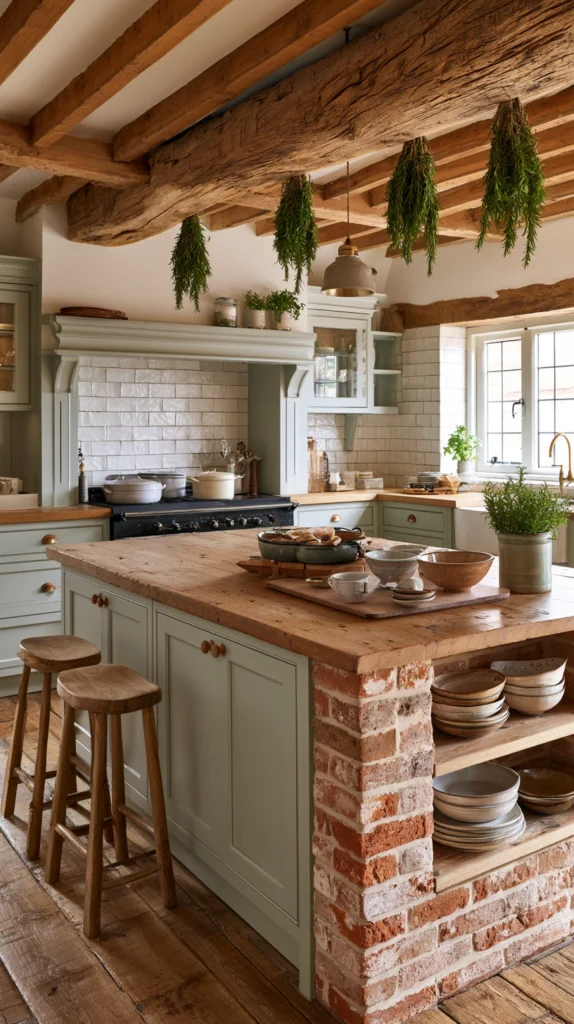
A dedicated space for drying, preserving, and storing the autumn herb harvest — the kitchen-to-garden link that runs in the other direction.
Why autumn is the drying harvest season:
The harvest timing:
- The herbs just before they flower: peak oil content
- Many herbs flower in late summer, then produce a second flush
- The second flush (autumn): the most concentrated of the year
- The harvest: timed to capture this
The drying method:
Air drying (the simplest and best for Mediterranean herbs):
- Cut stems 6–8 inches long
- Bundle (10–12 stems per bundle)
- Tie with twine
- Hang upside down in a warm, airy, dark location
- 1–2 weeks: fully dry
- The kitchen: the obvious location (the herb fragrance during drying: part of the kitchen experience)
The oven method (faster):
- Spread on a baking sheet
- Lowest oven setting (180°F / 80°C)
- One to two hours
- The speed: the advantage
- The colour retention: slightly less good than air-drying
What dries best:
Excellent:
- Rosemary: dries perfectly, flavour preserved
- Thyme: dries quickly, loses minimal flavour
- Oregano: dries and intensifies
- Sage: dries slowly but the result: excellent
- Bay leaves: must be dried before use (fresh bay is bitter; dried bay is the cooking ingredient)
Not suitable for drying:
- Basil: turns black, loses all volatile oils — freeze instead
- Coriander: freeze or use fresh — drying destroys the distinctive flavour
- Chives: freeze or infuse into oil — drying results in tasteless green flakes
The storage:
After drying:
- In a sealed glass jar
- Away from direct light (the oils degrade in light)
- Labelled with the herb and the harvest month
- The dried herb: superior to anything purchased in a packet
The display:
The hanging bundles as kitchen decoration:
- The bundles of drying herbs: beautiful as a kitchen feature
- The herb and the kitchen: in direct relationship
- The practical and the aesthetic: the same thing
The drying station:
A dedicated area:
- Hooks on the kitchen wall or ceiling beam
- Or: a wooden dowel hung between two hooks
- The bundles: hung in a row
- The herbs: drying while being looked at
Cost breakdown:
- Hooks and dowel for the drying station: $8–15
- Small glass jars for storage: $10–20
- Twine: $3
- Total: $21–38
8. The Herb Oil and Vinegar Making Station (The Kitchen Preservation)
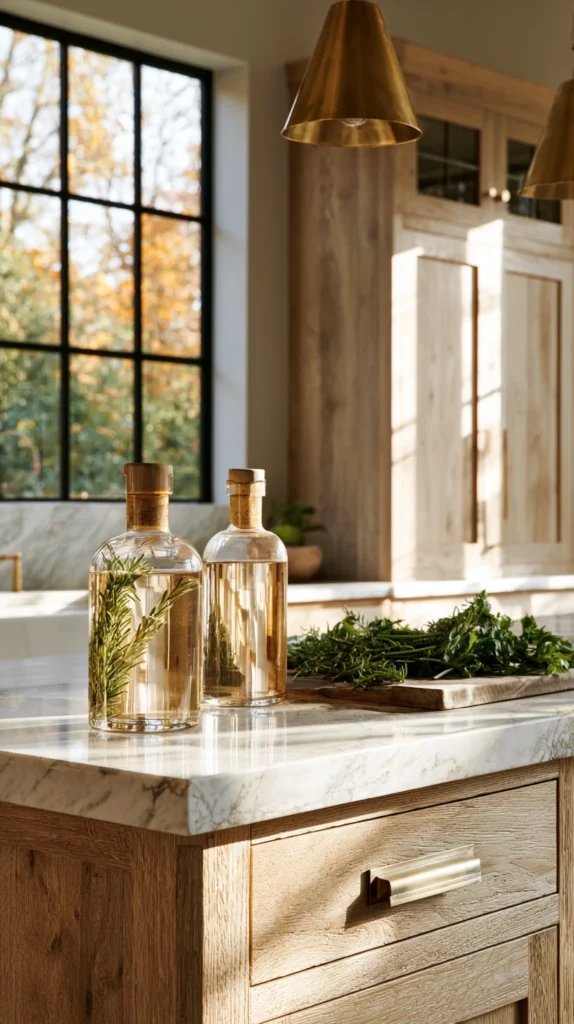
Making herb-infused oils and vinegars from the autumn harvest — the preservation that connects the kitchen garden to kitchen flavour all winter.
Why herb oils and vinegars are the autumn preservation:
The autumn abundance:
- The herbs at their most potent in autumn
- The olive oil or vinegar: captures that potency for winter use
- The product: available on the kitchen shelf when the garden is bare
The herb oil:
The safe method (avoiding botulism risk):
- Dried herbs (not fresh) in good quality olive oil
- Or: fresh herbs briefly heated in the oil to 250°F, then strained
- The raw fresh herbs in raw oil: a botulism risk (the wet anaerobic environment — not safe for home production)
- The dried herb method: safe and delicious
What works in oil:
- Rosemary: the most classic
- Thyme: delicate and aromatic
- Sage: more powerful — use sparingly
- Bay: adds depth and warmth
The herb vinegar:
The safe and simple method:
- Fresh herbs in white wine vinegar or apple cider vinegar
- The vinegar: acidic enough to preserve safely with fresh herbs
- Fill a jar with fresh herb sprigs
- Cover completely with vinegar
- Seal and store for 2–3 weeks before using
- Strain: the vinegar is the product
What works in vinegar:
- Tarragon vinegar: the classic (tarragon not covered in this article — worth adding to the garden)
- Thyme vinegar: complex and versatile
- Rosemary and garlic vinegar: the salad dressing base
- Chive vinegar: delicate, pink-tinted from the chive flowers if included
The kitchen station:
A small counter area:
- The jars set up and labelling
- The herbs gathered from the garden or drying bundles
- The oil or vinegar poured over
- The station: not a significant setup — a corner of the counter for an afternoon
The gift potential:
- Herb oils and vinegars: the kitchen garden’s most appreciated gift
- A bottle of rosemary oil made from garden rosemary: more personal than anything purchased
- The kitchen-to-garden connection: shared through the gift
Cost breakdown:
- Good olive oil (500ml): $8–15
- White wine vinegar: $4
- Small glass bottles or jars: $8–15
- Total: $20–34
9. The Indoor Herb Topiary (The Decorative Kitchen Herb)
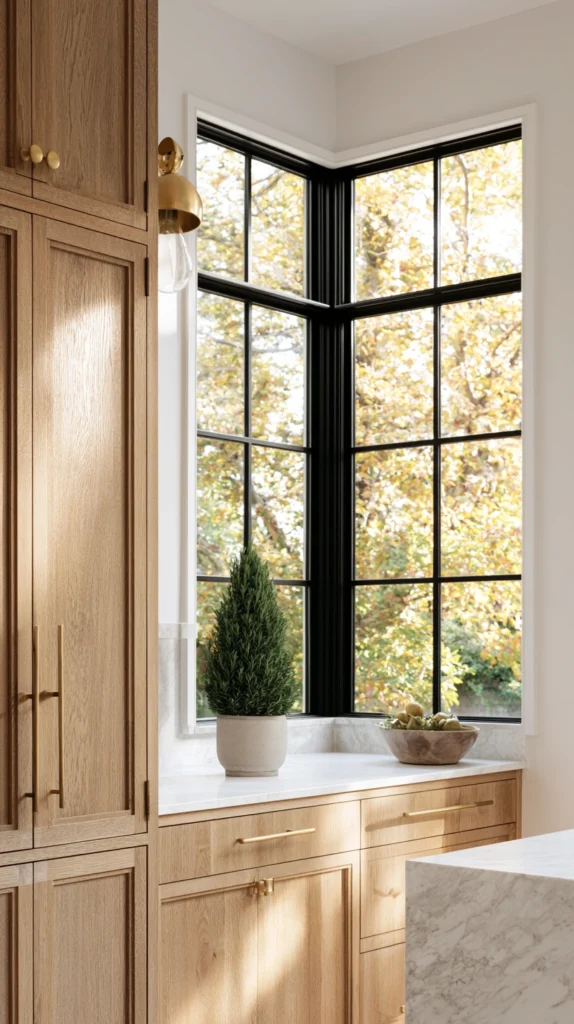
A small topiary bay or rosemary trained into a ball or cone shape — the kitchen herb that is also a design object.
Why topiary herbs are specifically relevant in autumn:
The ornamental and the functional:
- The herb garden moving toward its quieter season
- A clipped herb: evergreen, structural, beautiful in every month
- The topiary: the herb that is always beautiful regardless of season
- More beautiful in winter than a flowering annual
The bay topiary:
Bay (Laurus nobilis):
- The most traditional topiary herb
- Evergreen
- The leaves: the cooking ingredient (bay leaves for soups, stews, braises — the autumn cooking herbs)
- Trained as a standard (lollipop): the most classic form
- Clipped twice yearly to maintain the shape
The rosemary topiary:
- Rosemary clips as well as bay
- The round form: more casual
- The cone: dramatic
- More appropriate for a contemporary kitchen
The indoor care:
The challenge:
- Bay and rosemary: Mediterranean, requiring maximum light
- A south-facing window: essential for indoor topiary
- Without enough light: the topiary becomes leggy and loses its form
- Move outdoors in spring: the topiary benefits from outdoor conditions through summer
The autumn indoor period:
Bringing the topiary in for winter:
- The bay topiary: borderline hardy in many climates (to approximately 15°F / -9°C)
- The rosemary: more reliably hardy
- The topiary: brought inside at first hard frost in colder climates
- Inside: the kitchen decoration for the winter months
The pruning:
Twice yearly:
- Spring (after any threat of frost): the main shaping clip
- Autumn (before bringing inside): a light tidy
- The offcuts: the cooking ingredient
- The clip: the harvest
Cost breakdown:
- Bay standard topiary (small, from garden centre): $25–45
- Or rosemary topiary: $15–25
- Quality pot: $20–35
- Total: $35–80
10. The Autumn Herb Wreath (The Herb Display That Dries in Place)
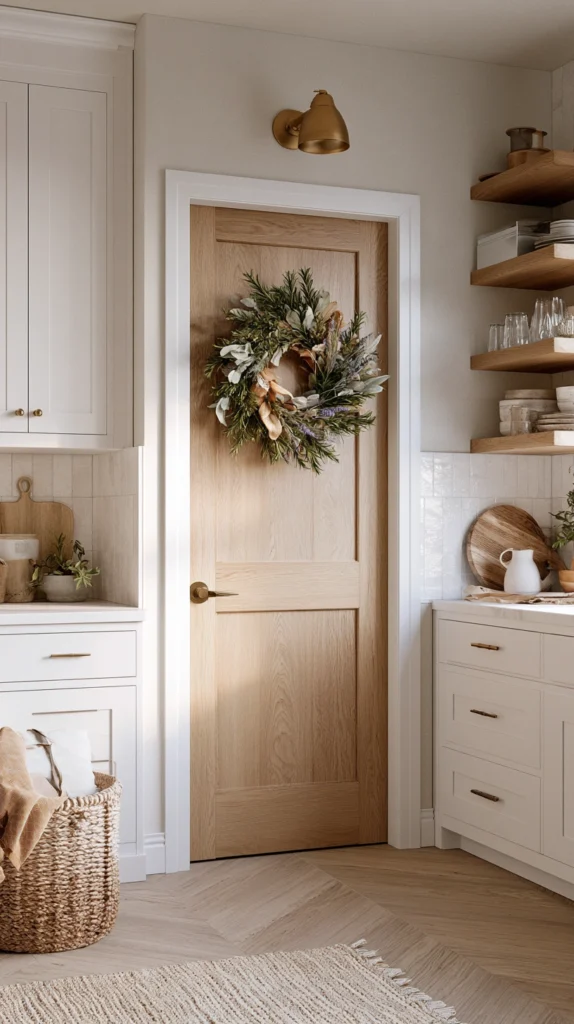
A wreath made from fresh garden herbs that dries as it hangs in the kitchen — the decoration that is also a six-month herb supply.
Why the herb wreath is the most honest kitchen decoration:
The honest decoration:
- The wreath made from herbs: not a decoration with a herb theme
- The wreath IS the herbs
- As it hangs and dries: it transitions from fresh decoration to dried cooking herb supply
- The most useful autumn kitchen wreath available
Making the herb wreath:
The base:
- A grapevine wreath base (purchased or made from garden vine)
- Or: a bundle-method wreath (herbs tied to a wire ring in overlapping bundles)
The herbs:
- Rosemary: the structural backbone (long, woody stems)
- Thyme sprigs: tucked into the base
- Sage leaves: distributed throughout
- Bay leaves: in clusters
- Lavender (if still any dried): the aromatic addition
The method:
The bundle method:
- Small bundles of mixed herbs
- Tied to the wire ring with floral wire
- Each bundle overlapping the previous (covering the tied ends)
- Continue around the entire ring
- The finished wreath: completely covered in herbs
The drying:
Hanging in the kitchen:
- The kitchen: warm and airy (the correct drying environment)
- 2–3 weeks: fully dry
- The wreath: transitions from green to muted grey-green
- The dried wreath: a pantry of cooking herbs hanging on the wall
The use:
- Strip herbs from the wreath as needed for cooking
- The wreath: gets lighter as the winter progresses
- By January or February: replaced with a fresh wreath from the frozen store, or from the plants beginning to grow again in spring
The kitchen aesthetic:
The herb wreath as kitchen art:
- On a hook on the kitchen wall or the back of the door
- The fragrance: particularly present in the first two weeks while drying
- The visual: the kitchen smelling and looking like the garden it is connected to
Cost breakdown:
- Grapevine wreath base: $8
- Herbs (from the garden): $0
- Floral wire: $3
- Total: $11
11. The Herb Tea Garden (The Therapeutic Autumn Planting)
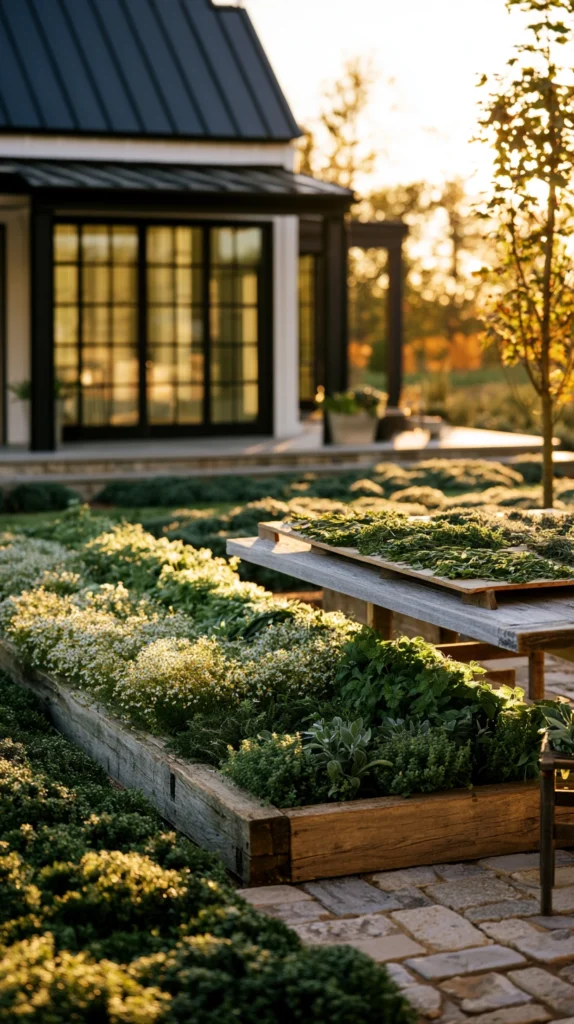
A dedicated collection of herbs grown specifically for herbal tea — the autumn planting that is also the winter medicine cabinet.
Why herbal teas are specifically an autumn project:
The seasonal drinks shift:
- Summer: cold drinks, fresh infusions
- Autumn: hot drinks
- The herbal tea: the autumn kitchen garden’s hot drink
- The plants harvested now: the teas drunk through winter
The tea herbs:
Chamomile (Chamaemelum nobile):
- The most traditional calming tea
- Grown as a low-spreading plant
- The flowers: harvested and dried
- Mild and apple-scented
- Harvest the flowers in late summer, dry through autumn
Lemon balm (Melissa officinalis):
- The lemon-scented member of the mint family
- Spreads freely (like mint — keep contained)
- Fresh or dried in hot water: immediately calming
- The autumn harvest: dried for the winter tea supply
Mint (Mentha):
- Any variety works for tea
- Spearmint: the sweetest
- Peppermint: the most medicinal
- Harvest before die-back: dry for the winter supply
Sage:
- Sage tea: one of the oldest medicinal teas
- Particularly useful for throat health (the traditional use)
- Available fresh from the garden through most of autumn
Thyme:
- Thyme tea: another traditional respiratory herb
- Available fresh through winter
- Can be drunk preventatively or therapeutically
The tea blend:
Creating a blended tea:
- Combine herbs that dry well and complement each other
- A simple blend: chamomile + lemon balm (the relaxation tea)
- Or: thyme + sage + honey (the warming throat tea)
- Store in a labelled glass jar
The harvest timing:
Before first frost:
- The last big chamomile harvest
- Cut lemon balm to the ground (it will return in spring)
- Cut mint to 2 inches (it will return)
- The cut material: dried for winter use
Cost breakdown:
- Chamomile, lemon balm, and mint plants: $16–24
- Drying materials (already set up from Idea #7): $0 additional
- Small glass jars for the dried tea blends: $10
- Total: $26–34
12. The Windowsill Herb Forest (The Indoor Herb Collection)
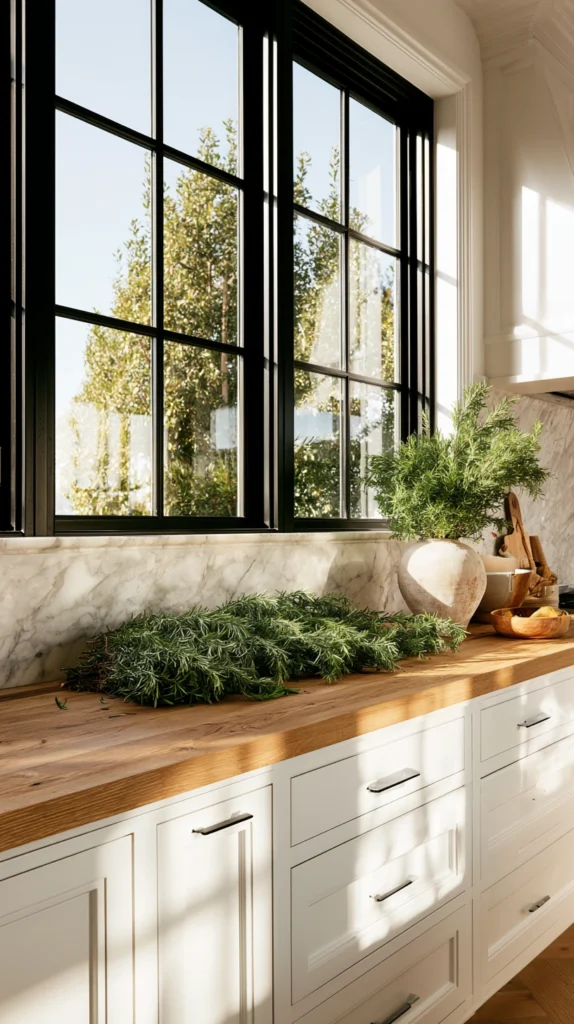
A curated collection of five or more herbs grown together on or near the kitchen window — the indoor herb garden that matches or exceeds the productive capacity of a small outdoor garden.
Why the windowsill herb forest works in autumn:
The critical mass:
- One herb pot: occasionally used
- Five or more herbs in a collection: the kitchen herb garden replicated inside
- The variety: the meal can be seasoned entirely from the collection
- The collection: the commitment to kitchen-to-garden living regardless of season
The collection design:
By cuisine:
Italian kitchen collection:
- Basil (the summer staple extended inside)
- Flat-leaf parsley
- Oregano
- Thyme
- A small rosemary
- Sage
- The Italian herb collection: almost every pasta, pizza, and roast covered
British autumn kitchen collection:
- Rosemary (for the lamb)
- Sage (for the sausages and stuffing)
- Thyme (for everything)
- Bay (for the braises)
- Flat-leaf parsley (for the sauce)
- The autumn roast dinner: entirely serviced
The display system:
The herb forest aesthetic:
- Not a row of identical small pots
- Different sized pots (the tallest herbs in the largest pots)
- Some pots elevated on books or small blocks
- The varied heights: the forest quality
The visual:
- From across the kitchen: a small garden
- The herbs: visible at the window
- The room: connected to something growing
The productivity:
From a five-herb windowsill collection:
- Three to four varieties available for each meal
- The cook: reaching for the herb rather than the jar
- The kitchen: smelling of herbs as they are handled
- The meal: better for it
Cost breakdown:
- Six herb plants: $22–32
- Varied pots: $25–40
- Total: $47–72
13. The Herb and Edible Flower Display (Autumn Beauty and Flavour)
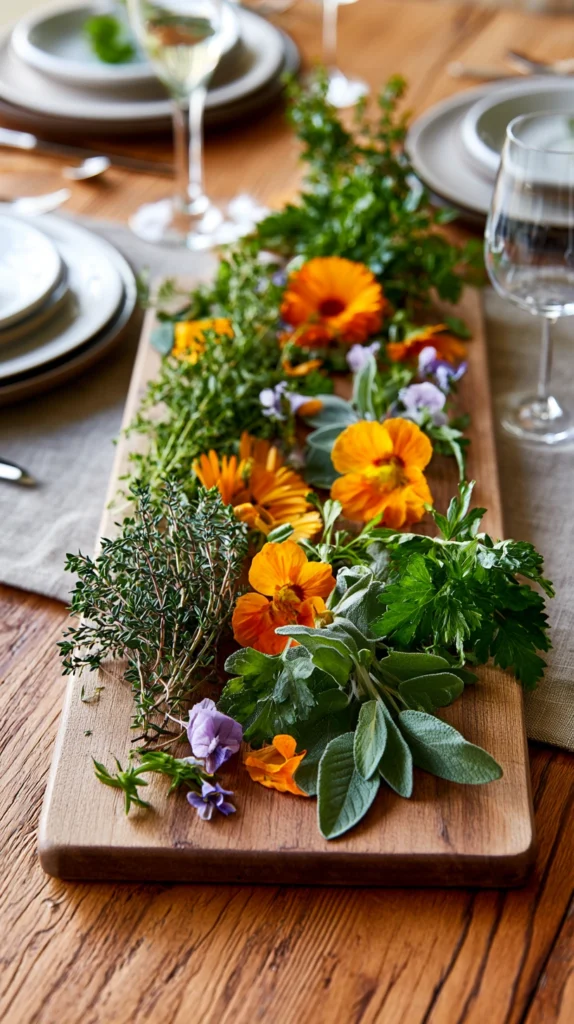
A container or bed combining culinary herbs with late-flowering edible flowers — the display that produces both flavour and beauty through the autumn.
Why edible flowers belong in the autumn herb garden:
The edible flower category in autumn:
Nasturtium (Tropaeolum):
- Still flowering prolifically in autumn (until first frost)
- Leaves: peppery, used in salads and as garnish
- Flowers: vivid orange and yellow, edible and beautiful
- Seeds: pickled as a caper substitute
- The nasturtium: the most useful autumn edible flower
Viola and pansy:
- The cold-weather flowering plants
- Available from garden centres from September
- The flowers: edible (mild and beautiful)
- The most commonly used edible flower for autumn decoration
Borage (Borago officinalis):
- The star-shaped blue flower
- The last blooms often in October
- The flowers: the garnish for drinks and desserts
- The taste: mild cucumber
- Self-seeds prolifically for next year
Calendula (pot marigold):
- Still flowering in October
- The petals: the cooking ingredient (added to soups, breads, and egg dishes)
- The colour: vivid orange — the autumn palette
- Also medicinal (skin-soothing)
The combination:
Herbs and edible flowers together:
- Thyme and nasturtium: the herb spilling through the flower
- Parsley and viola: the green and the jewel
- Sage and calendula: both autumnal in colour
- The combination: the beauty of the garden and the function of the kitchen
The display use:
On the table:
- The container at the centre of the table (as suggested in the autumn dining article)
- Flowers picked directly as garnish for the meal
- The table: the garden in miniature
Cost breakdown:
- Nasturtium seeds or plants: $3–8
- Viola or pansy pots (2): $10
- Calendula: $4–6
- Combined with existing herbs: $0 additional for herbs
- Total: $17–24
14. The Complete Kitchen-to-Garden Herb System (All Elements Working Together)
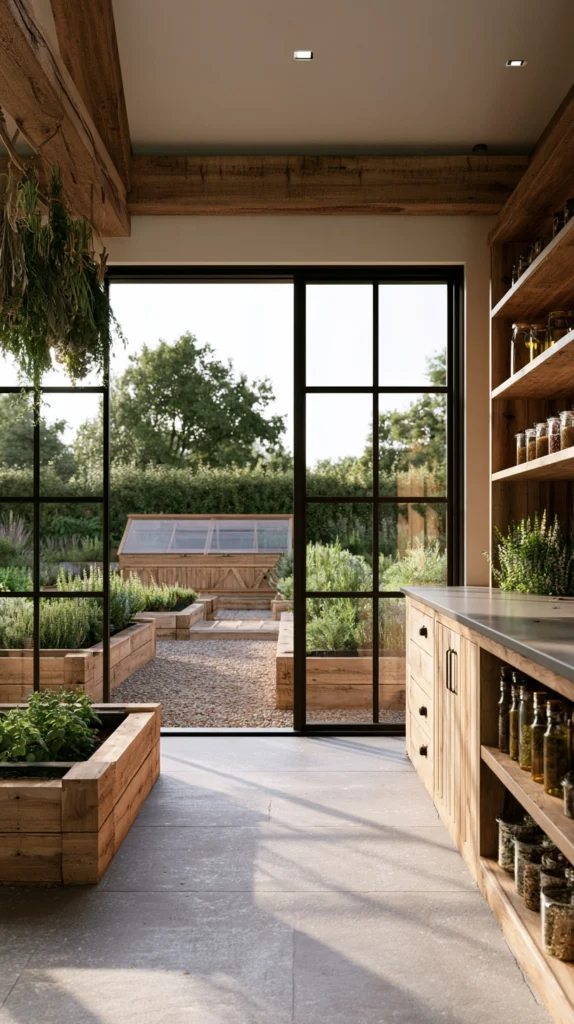
The full kitchen-to-garden herb system — windowsill herbs, kitchen door pots, and outdoor beds, all in productive conversation with each other — the complete approach to autumn herb growing.
What the complete system provides:
The layers:
Layer one (the kitchen windowsill — zero friction):
- Basil, chives, parsley, mint (Idea #1)
- Available without going outside
- Used for: the daily meal, the quick garnish, the tea at 10pm
- Maintained: the windowsill herb forest (Idea #12)
Layer two (the kitchen door — one step):
- Rosemary, sage, thyme (Idea #3)
- The autumn roasting herbs
- Used for: the Sunday roast, the Tuesday braise, the Thursday soup
- One step outside — manageable in October and November
Layer three (the outdoor raised bed or garden — the garden journey):
- The productive planting (Idea #4)
- The cold frame for extended growing (Idea #6)
- The tea garden (Idea #11)
- Used for: the larger harvest, the drying and preserving
- The garden journey: made when it is light and there is purpose
Layer four (the kitchen — preservation):
- The drying station (Idea #7)
- The herb oils and vinegars (Idea #8)
- The tea blends (Idea #11)
- The herb wreath (Idea #10)
- The kitchen: receiving from the garden, storing, displaying
The autumn herb calendar:
September:
- Bring tender herbs inside (basil)
- Set up the windowsill collection
- Make herb oils and vinegars while the herbs are at peak
- Plant the cold frame succession (coriander, parsley)
October:
- The rosemary, sage, and thyme: at peak flavour
- Make the herb wreath
- Dry the last of the summer herbs
- Plant any autumn additions (chives, parsley)
November:
- The kitchen door pots: the primary herb source
- The cold frame: still producing
- The dried herbs: coming into use
- The herb teas: the daily ritual
December and beyond:
- The windowsill: the only fresh herb source in most climates
- The dried stores: the winter pantry
- The herb oils and vinegars: the autumn’s flavour in every winter meal
The cost of the complete system:
Starting from nothing:
- Windowsill herbs: $24–75
- Kitchen door pots: $38–55
- Raised bed: $125–185
- Cold frame: $0–100
- Drying station: $21–38
- Total: $208–453 for the full system
Starting with some existing infrastructure:
- Adding the windowsill collection: $24–75
- Adding the kitchen door pots: $38–55
- The drying station: $21–38
- Total: $83–168 for the essential additions
The Principle Behind All 14 Ideas
The kitchen-to-garden principle stated plainly:
The herb garden that gets used regularly: the one that is close.
Not close in distance necessarily — close in friction. The herb on the windowsill that can be pinched off while the pasta is boiling: that herb gets used every day. The herb across the garden in the dark in October: that herb gets used on weekend afternoons and not at all on weekday evenings.
Every idea on this list either brings the herbs closer to the kitchen or makes the kitchen more capable of receiving and preserving what the garden produces.
The result: a kitchen that smells of growing things in October. A cook who reaches for fresh herbs rather than dried jars. A garden used daily, not visited occasionally.
The autumn herb garden that succeeds — that is actually used, that produces meals noticeably better than they would otherwise be, that extends the kitchen garden beyond the summer vegetables — is the one designed for the friction of October. Not the ideally placed garden designed for June.
Design it for October. Use it daily from now until the ground freezes. The summer herbs: the reward. The autumn herbs: the daily working relationship.
Getting Started This Weekend
The three-part autumn herb start:
One: buy rosemary, sage, and thyme.
- Put them in matching terracotta pots
- Place them immediately outside the kitchen door
- The kitchen door herb collection: operational from the first meal
Two: bring a pot of parsley and a pot of chives onto the kitchen windowsill.
- Already growing in the garden or purchased from a garden centre
- The zero-friction herbs: immediate
Three: cut a bundle of any herb currently growing and hang it to dry.
- Any herb — the drying station needs no equipment
- A piece of twine and a hook: the beginning
- The first bundle hanging: the kitchen-to-garden connection made visible
Total cost: under $50. Time: one Saturday morning.
The herb garden that does not serve the kitchen in autumn serves only as a reminder that summer is over. The herb garden that does serve the kitchen in autumn: the ongoing conversation between the cook and the garden that makes cooking in every season what it should be.