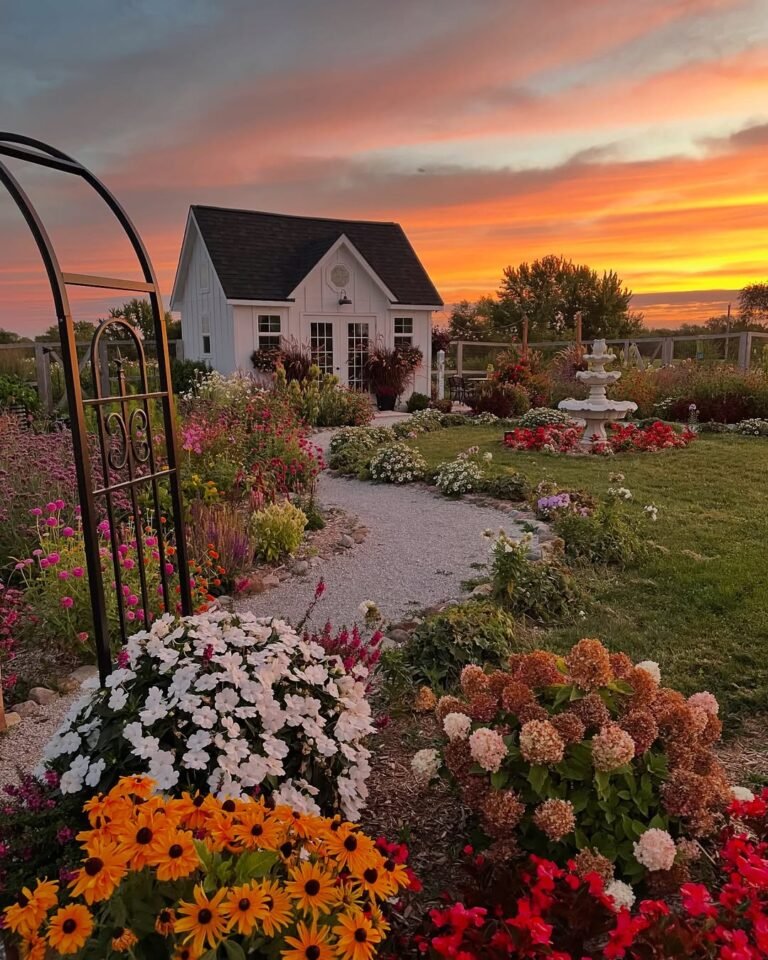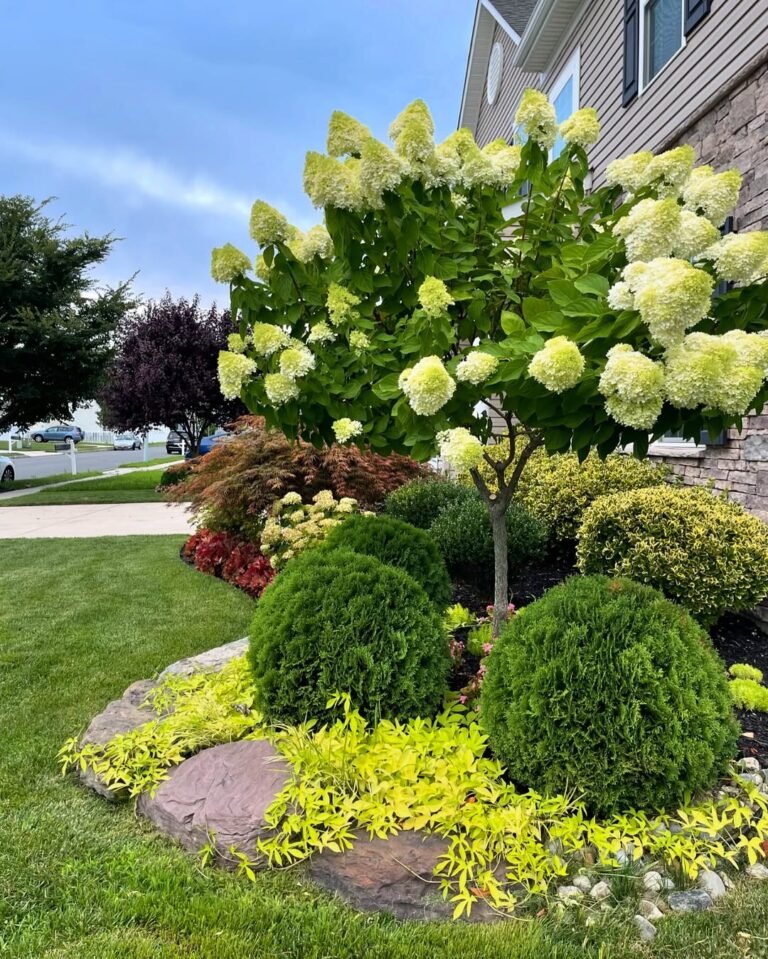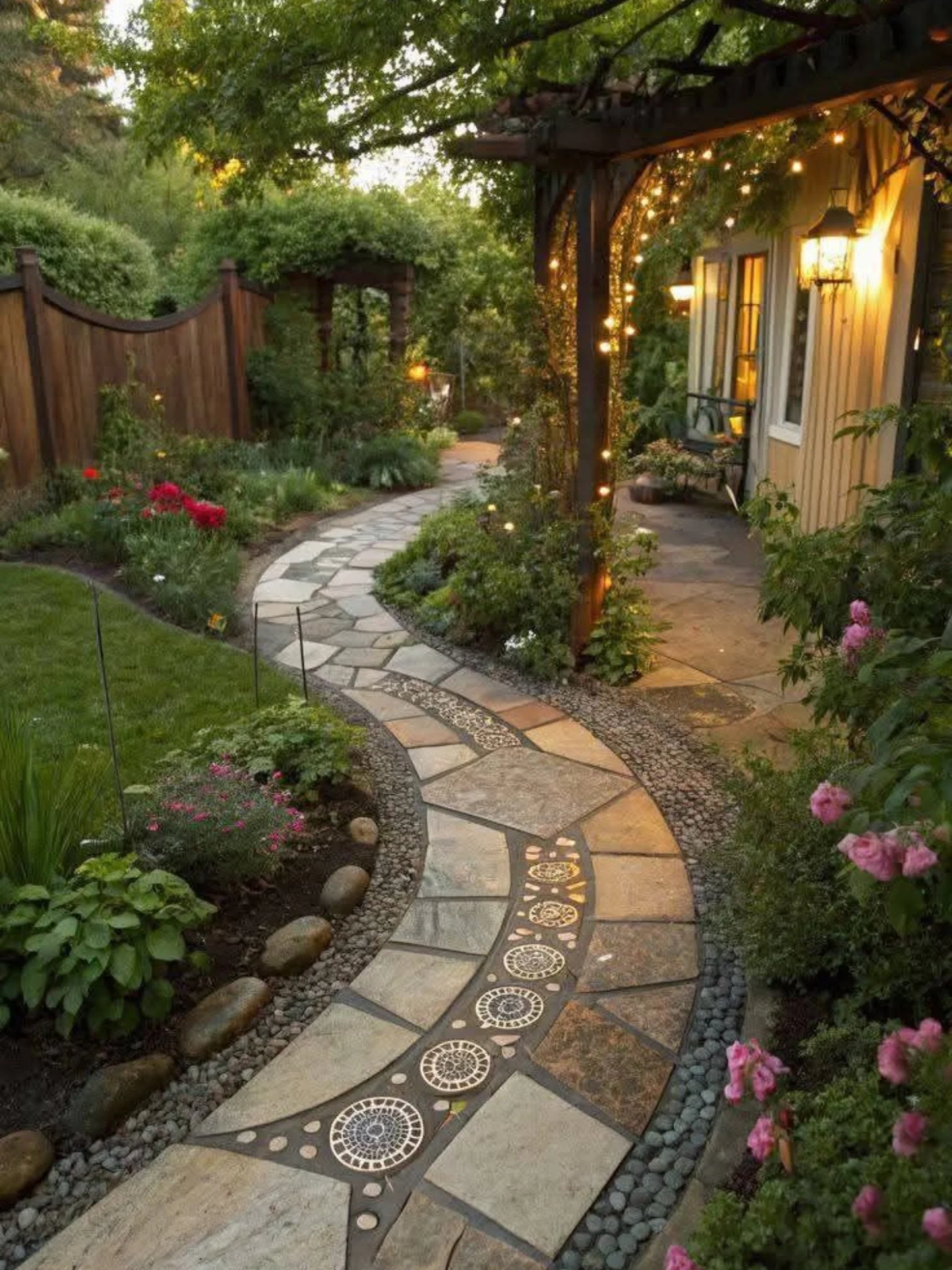
13 Fall Garden Path and Walkway Decor Ideas
The path is the first experience of the garden. Not the borders. Not the seating area. Not the focal point at the far end.
The path. The thing walked on to get to everything else.
In summer it barely registers — the eye moves past it to the flowers and the lawn and the things growing. In autumn it becomes the experience itself. The fallen leaf on the stone. The lantern at the edge casting warm light over the wet cobble. The mum in a terracotta pot at the bend, giving a reason to turn that corner.
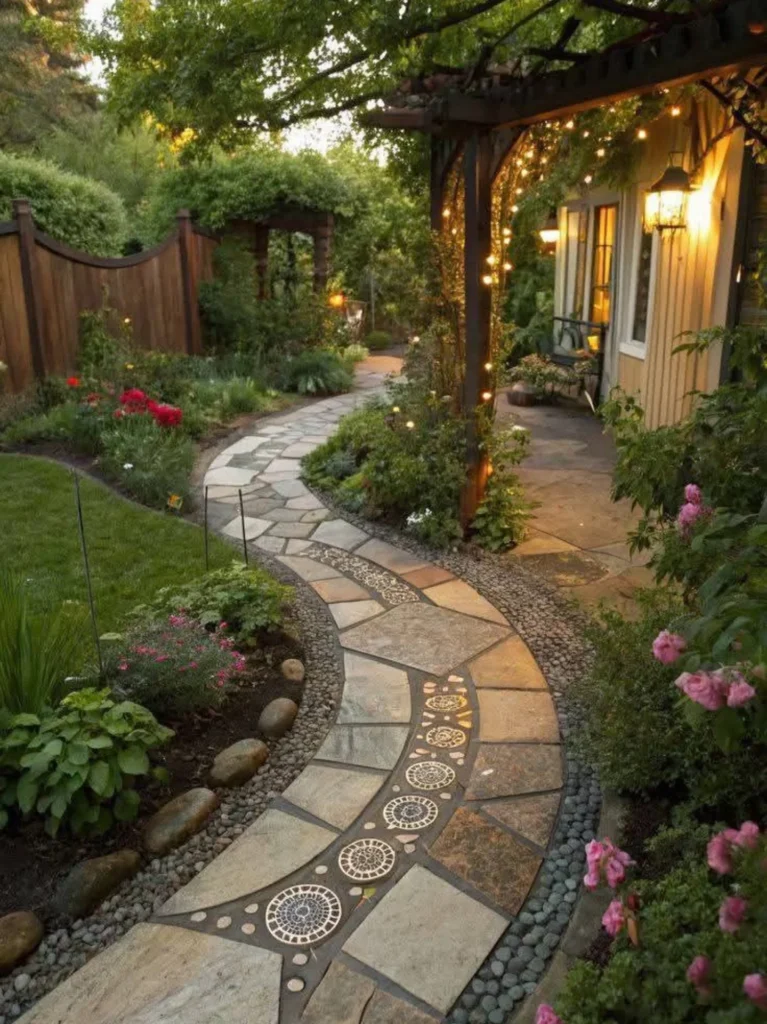
The autumn path is different from the summer path in the same way the autumn garden is different from the summer garden: it requires design to reach its potential. The summer path benefits from the abundance surrounding it. The autumn path must carry some of that weight itself — the decoration, the warmth, the reason to walk it.
Here are 13 ways to dress the path for autumn and make the walk itself the destination.
Why Autumn Is the Path’s Season
The specific qualities of autumn that the path expresses:
The light:
- Low-angle autumn sun: the light that rakes across a stone surface and reveals every texture
- A rough cobble in July midday light: flat
- The same cobble in October 4pm light: extraordinary — every surface shadow visible, the stone alive
- The path in autumn light: better than in any other light
The leaves:
- Fallen leaves on a path: the image of the season
- Whether cleared or left (a design choice), the leaf on the path is an autumn path marker
- The leaf-strewn path: immediately seasonal without any additional decoration
- The leaf: free
The moisture:
- Autumn: more rain
- Wet stone: changes colour, deepens, becomes darker and more saturated
- A pale limestone path in dry summer: pleasant
- The same path wet in October: deep, warm, rich
- The moisture: the autumn path’s free upgrade
The darkness:
- Dark at 5pm or earlier
- The unlit path: unused after dark
- The lit path: the most-used garden element after dark
- The path in autumn: requiring lighting to function
- The lit path: the path at its most beautiful
The Path as Journey
What the path communicates before anything is placed on it:
The width:
- A narrow path: urgent (get there quickly)
- A generous path: leisurely (there is time to look)
- Autumn path decoration: most effective on a generous path where the walker has time to notice it
The line:
- Straight path: the eye reaches the destination immediately
- Curved path: each bend reveals something new
- Autumn decoration: works best on curved paths (each bend a new discovery)
The material:
- Cobbles and irregular stone: the most autumn-appropriate material (texture catches the light, holds moisture, ages beautifully)
- Concrete: the least autumn-appropriate (flat, cold, uniform)
1. The Lantern-Lined Path (The Warm Guide)
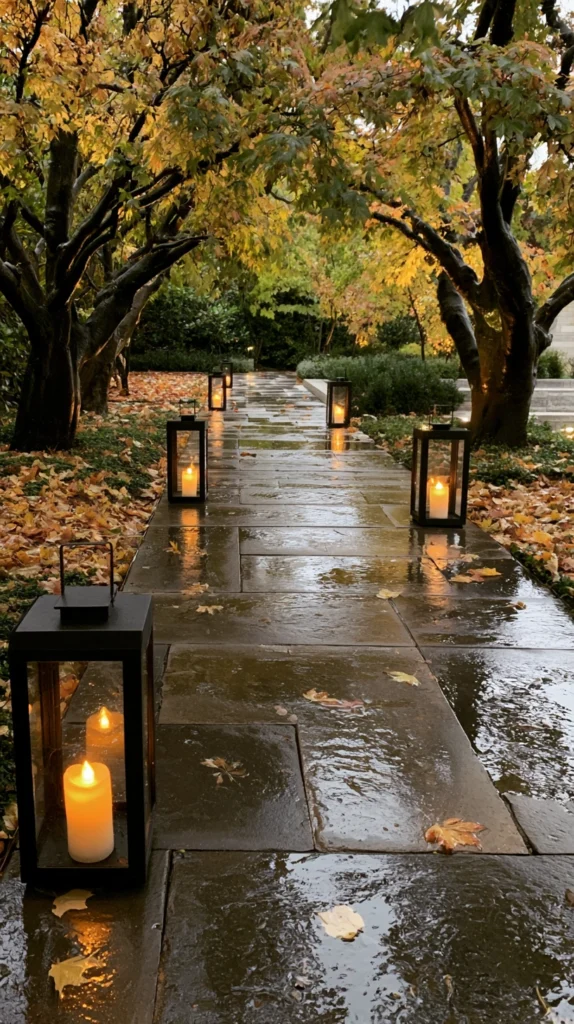
Matching lanterns placed at intervals along both sides of the path — the autumn decoration that is also the safety feature that makes the path usable in the early dark.
Why lanterns on a path do more than light it:
The ceremonial quality:
- A lantern-lined path: something worth walking toward
- The lanterns: the announcement that the destination is prepared for your arrival
- The undecorated path: you walk to get somewhere
- The lantern-lined path: the walking is the experience
The matching principle:
All the same lantern:
- Not varied lanterns mixed: one lantern, repeated
- The repetition: the design
- The consistency: the composition
- Six varied lanterns: cluttered. Six matching lanterns: a feature.
The finish:
- Matte black: the most versatile and the most autumn-appropriate
- Aged copper or bronze: the most specifically autumnal
- Galvanised: the most rustic
- All three are correct — choose one and repeat it
The placement:
Both sides (most ceremonial):
- Lanterns on both sides of the path at equal intervals
- The symmetry: the formal welcome
- For a front path or an entrance: the most appropriate version
One side only (most casual):
- Lanterns along one side
- Less formal, more naturalistic
- For a garden path (not an entrance path): often the better choice
The spacing:
- 3–4 feet between lanterns
- The pools of light overlapping slightly
- No complete darkness between lanterns
- The warm continuum: the path lit end to end
The inside the lantern:
Flameless LED candle with timer:
- Set to come on at 4:30pm (or the local dusk time)
- Always ready when darkness arrives
- No manual management
- The garden always dressed for the evening
Real candle (for occasions):
- Tea lights or pillar candles for specific evenings
- Lit before guests arrive
- The ritual of lighting: part of the occasion
- Real flame: the warmth quality flameless cannot fully replicate
The autumn botanical addition:
At the base of each lantern:
- A small terracotta pot with ornamental kale
- Or: a pumpkin placed beside the lantern
- Or: a few fallen leaves arranged (honestly, not artificially)
- The botanical beside the light: the combination of living and glowing
Cost breakdown:
- Eight matching matte-black lanterns: $100–130
- Flameless LED candles with timers (8): $55–70
- Total: $155–200
My lantern-lined path: guests arriving at 6pm in October. The lanterns already on. The path glowing amber in both directions. Nobody walked past them without commenting.
Lantern Path Tips
The height:
- Lanterns placed at ground level: the light pools at and below walking height
- This: the correct autumn path lighting (intimate, low)
- A lantern elevated on a post or bracket: a different effect (more visibility, less intimacy)
- For a path through a garden: the ground-level lantern
The base:
- Lanterns on gravel: stable
- Lanterns on a lawn edge: a small tile or flat stone beneath (prevents the lantern sinking)
- The lantern must sit flat: a tilted lantern looks accidental
2. The Potted Mum Boulevard (The Colour Corridor)
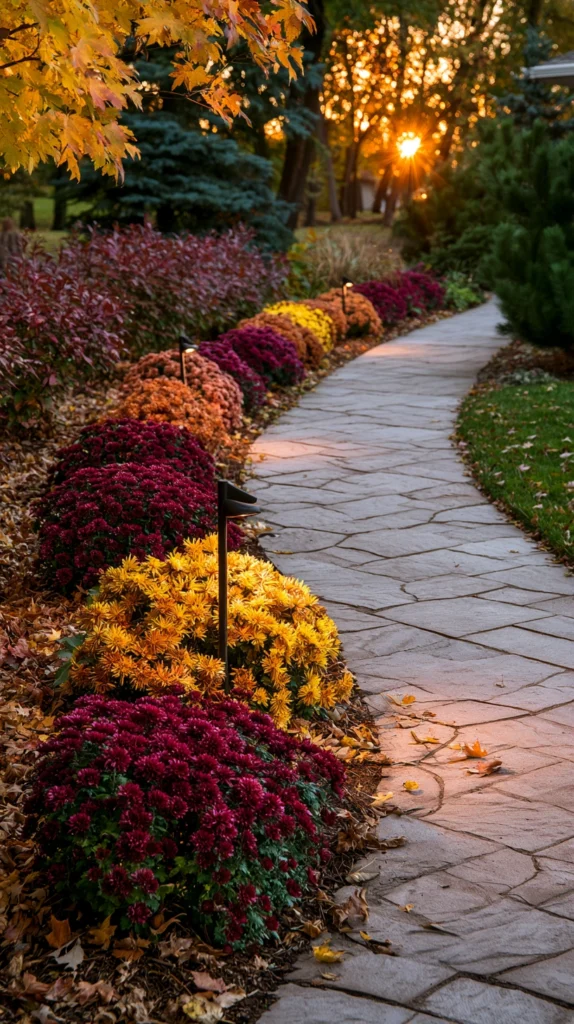
Terracotta pots of chrysanthemums placed at regular intervals along the path — the seasonal colour treatment that makes the walk itself visually rich.
Why potted mums transform a path:
The colour:
- Most autumn paths: surrounded by fading green, brown, and the neutrals of stone
- A pot of copper or burgundy mum at each turn: colour where colour was absent
- The warm colour against the cool grey of the stone path: the seasonal contrast
The repetition:
- A single mum pot: an afterthought
- Mum pots at regular intervals: a design decision
- The decision: visible in the rhythm
- The rhythm: the design
The terracotta pot:
Always terracotta for this application:
- The warm orange-clay: part of the autumn palette
- The terracotta + the chrysanthemum + the stone path: three materials all autumnal
- The cohesion: without any additional decision
The pot sizes:
The same size throughout:
- Not varied sizes mixed along the path
- One size, repeated
- The consistency: what makes it a designed feature rather than random placement
Suggested size for most paths:
- 10–12 inch terracotta pot
- Large enough to be noticed at walking pace
- Small enough not to obstruct the path
- The balance: presence without obstacle
The mum colour:
One colour, or two alternating:
- One colour throughout: the most cohesive
- Two alternating (copper and burgundy, for example): the most dynamic
- Three or more: approaching a jumble
- The path decoration: fewer colours, more coherent
The spacing:
At bends and focal points:
- Not evenly distributed on a straight path
- Placed where the eye would naturally land: bends, the path end, beside a gate
- At every bend: the mum that reveals the next section of path
- The mum as punctuation: marking the stops and turns
The longevity:
Six to eight weeks:
- A healthy purchased mum: flowers for 6–8 weeks in autumn conditions
- Plant new mums in the same pots as the originals finish
- Or: plant the mums in the ground after flowering (many will return next year)
Cost breakdown:
- Six terracotta pots (10-inch, if not owned): $30–45
- Six cushion chrysanthemums (varied warm colours): $40–55
- Total: $70–100
3. The Fallen Leaf Feature (The Free Decoration)
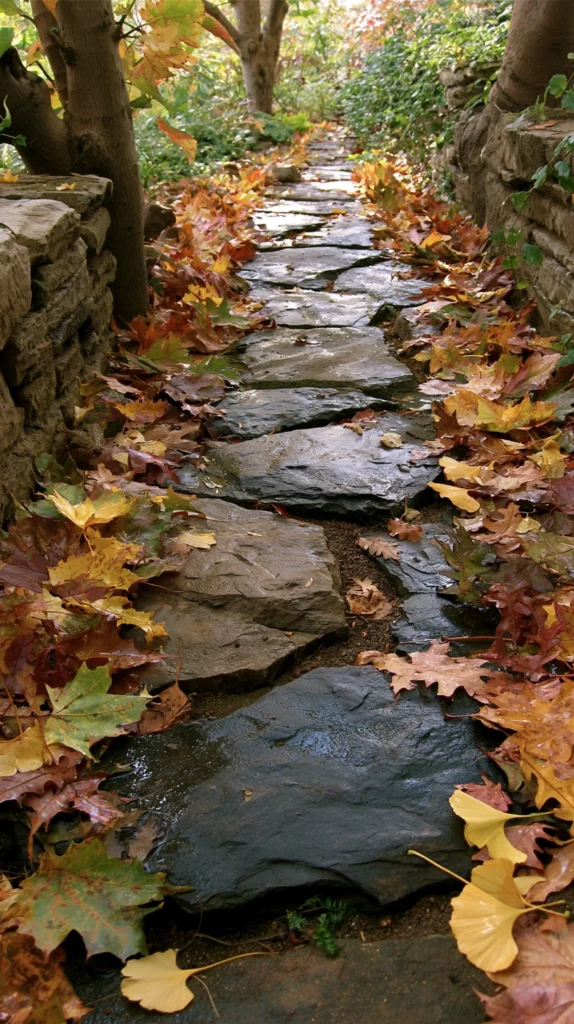
Fallen leaves gathered and used deliberately as path decoration — the most seasonal, most free, and most authentically autumnal path treatment.
Why using fallen leaves as design is not neglect:
The distinction:
- Fallen leaves scattered by wind without arrangement: the path needs clearing
- Fallen leaves gathered and arranged with intention: a design decision
- The intention: what makes the difference between a neglected path and a decorated one
- Often: very little physical difference between the two. All the difference: the intention.
The uses:
The leaf border:
- Fallen leaves raked to both edges of the path
- The path surface: clear
- The edges: thick with leaves
- The path: clean and defined, bordered by the season’s detritus
- The design: using what is already there
The deliberate scatter:
- A selection of the best leaves (most colour, most interesting shapes)
- Scattered across a section of the path
- Not all leaves: the curated version
- The curated scatter: the design decision made visible
The leaf arrangement:
- At a corner or focal point: a small arrangement of leaves
- Largest leaves at back, smaller in front
- As if placed rather than fallen
- The deliberate arrangement: the design signal
The colour palette:
Using the leaves the garden provides:
- Red (maple, liquidambar, cherry)
- Gold (ginkgo, honey locust, pear)
- Orange (acer, sweet gum, serviceberry)
- Brown (oak, beech — the longest-lasting)
- The colour: free and specific to the garden
The mixing with other elements:
Leaves beside lanterns:
- A handful of leaves arranged beside each lantern
- The combination: the warm light and the fallen colour
- The lantern and the leaf: both autumn symbols
Leaves among the pumpkins:
- As described in the pumpkin display article
- The leaf: the connector between pumpkins and the garden around them
- Free and naturalistic
Cost breakdown:
- The leaves: $0
- The time to gather and arrange: 20 minutes
- Total: $0
The most powerful autumn path decoration costs nothing. The difference between a beautiful autumn path and an ordinary one: not money. The intention to look at what is already there and use it deliberately.
4. The Pumpkin and Gourd Path Accent (The Harvest on the Way)
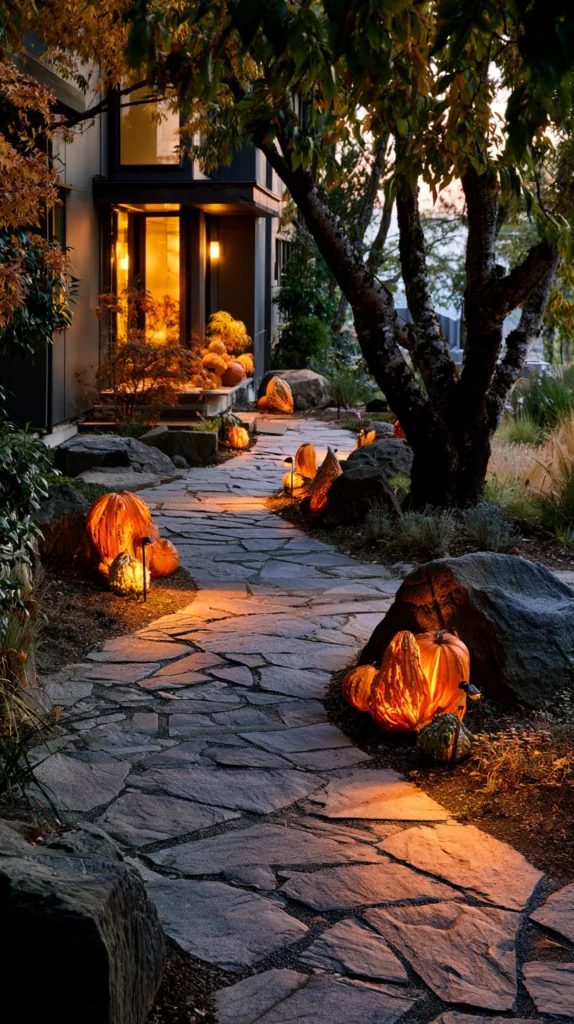
Pumpkins and gourds placed at key points along the path — the seasonal objects that mark the path’s turning points.
Why pumpkins work specifically as path markers:
The scale:
- A pumpkin is large enough to register at walking pace
- Not so large that it obstructs
- The scale: exactly right for path-side placement
The seasonal specificity:
- Pumpkins: only in October and November
- The path marked with pumpkins: unmistakably this specific month
- The seasonal specificity: the point
The placement:
At the path entrance (most visible position):
- A grouping of three to five pumpkins at the point the path begins
- The entry marker: the season announced before the walk begins
- Varied sizes (one large, two medium, two small): the grouping principle
At bends:
- One or three pumpkins on the inside of each bend
- The reason to slow down and notice the turn
- The pumpkin: guiding the walker’s attention
At the path end:
- The largest pumpkin at the destination
- The reason the walk was worth taking
- The focal point that the path leads to
The combination with lanterns:
- Pumpkins beside lanterns (from Idea #1): the combination
- The warm light of the lantern on the orange skin of the pumpkin
- The amber-on-orange: the autumn palette at its most specific
The combination with mum pots:
- A pumpkin nestled beside a mum pot
- The flower and the fruit: the harvest aesthetic
- Together: more specific to the season than either alone
Cost breakdown:
- Five to seven pumpkins (farmers market, varied sizes): $20–35
- Total: $20–35
5. The Harvest Bundle Decoration (Corn, Wheat, and Dried Botanicals)
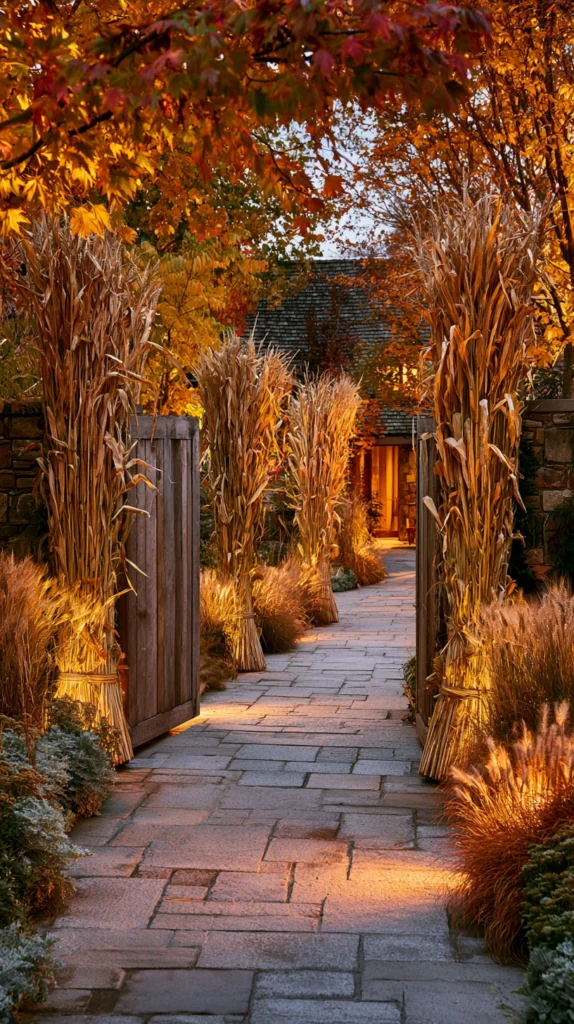
Bundles of dried corn stalks, wheat sheaves, and autumn botanical materials placed beside or flanking the path — the harvest display that references the agricultural calendar.
Why harvest materials work as path decoration:
The vertical element:
- Most path decoration: horizontal (lanterns, pots, pumpkins)
- Corn stalks and wheat sheaves: vertical
- The tall bundle: visible from a distance along the path
- The eye: drawn toward it before reaching it
The material:
Dried corn stalks:
- Available with dried husks and often dried ears attached
- Tall (4–6 feet): the most dramatic vertical
- Bundled and tied with twine: secured to a fence post or gate post
- The traditional harvest symbol
Wheat sheaves:
- Smaller and more elegant than corn
- Available in natural gold and in dyed versions (stick to natural)
- Bundled and displayed horizontally (across a pot or doorstep) or vertically
- More formal than corn: suits a more refined entrance
Dried grasses:
- From the garden: miscanthus plumes, pennisetum seed heads, stipa
- Cut and gathered into a bunch
- Placed in a weatherproof vase or container beside the path
- The most garden-specific version (using what the garden itself produces)
The placement:
Gate post or entrance flanking:
- One bundle each side of the gate: the symmetrical entrance
- Tied to the post or secured in a heavy pot
- The harvest welcoming: at the arrival point
At path turns:
- A tall corn bundle on the outside of a path bend
- The vertical: the reason to look toward the bend before reaching it
Combined with the pumpkin:
- A bundle of corn leaning against a hay bale
- Pumpkins at the base
- The full harvest composition at a single point on the path
Cost breakdown:
- Two bundles of dried corn stalks: $15–25
- Two wheat sheaves: $10–18
- Dried grass from the garden: $0
- Total: $25–43
6. The Topiary and Clipped Shape Path Feature (The Formal Autumn Garden)
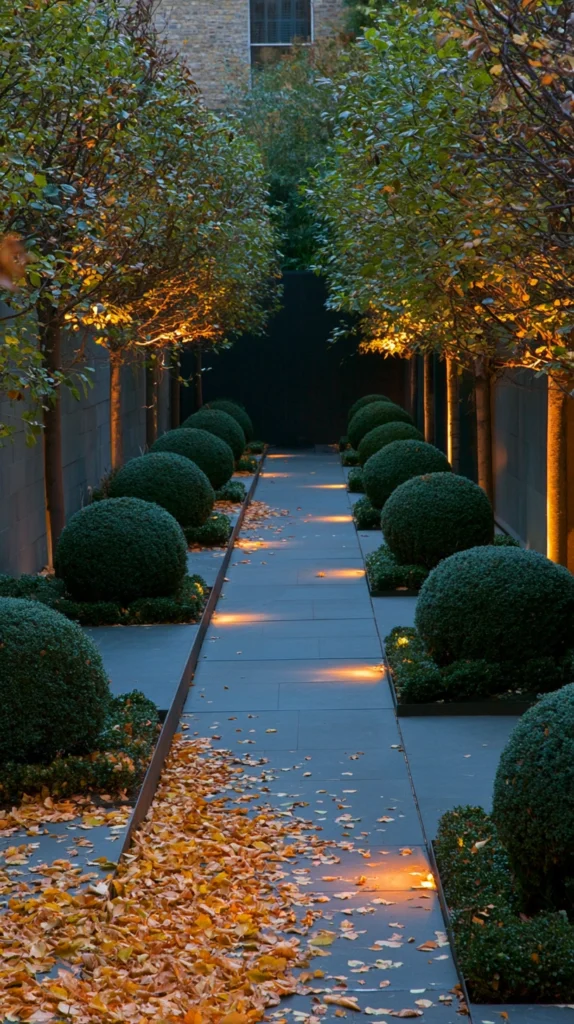
Small clipped topiary or box balls placed along the path — the formal autumn garden treatment that uses structure where flowers are no longer available.
Why clipped shapes belong in the autumn path:
The evergreen in autumn:
- Most plants: declining or finished in autumn
- Evergreen clipped shapes: unchanging — the constants in the seasonal flux
- The path lined with clipped balls or cones: the same in October as in May
- The permanence: specifically beautiful when everything around it is temporary
The formal contrast:
The autumn contrast:
- Fallen leaves, spent plants, the decay of the season: soft and irregular
- A row of clipped box balls: precise and permanent
- The contrast: the formal and the wild in dialogue
- The formal clipped shape: more beautiful against the autumnal informality than in any other season
The plants:
Box (Buxus):
- The classic topiary plant
- Clipped into balls, cones, or spirals
- Evergreen: visible all year
- Box blight: a consideration (Ilex crenata or Taxus as alternatives)
Ilex crenata (Japanese holly):
- Clips identically to box
- More blight-resistant
- Good alternative for all box applications
- Slightly slower-growing
Small yew cones:
- The darkest evergreen
- The most formal
- Long-lived
The path placement:
In matching pots, at intervals:
- One clipped ball or cone, in a pot, at each defined point
- The pots: all matching (dark glazed ceramic or simple terracotta)
- The clipped shape: in the pot, not planted in the ground
- The mobility: the shapes can be moved and rearranged
Alternating with the mum pots (from Idea #2):
- A clipped ball, then a mum pot, then a clipped ball
- The alternation: formal structure (permanent) and seasonal colour (temporary)
- The pattern: the path composed like a sentence with nouns and adjectives
Cost breakdown:
- Three small clipped box or ilex balls (4–6 inch diameter): $30–55
- Matching terracotta or ceramic pots (3): $25–40
- Total: $55–95
7. The Bark Chip Refresh (The Sensory Path Upgrade)
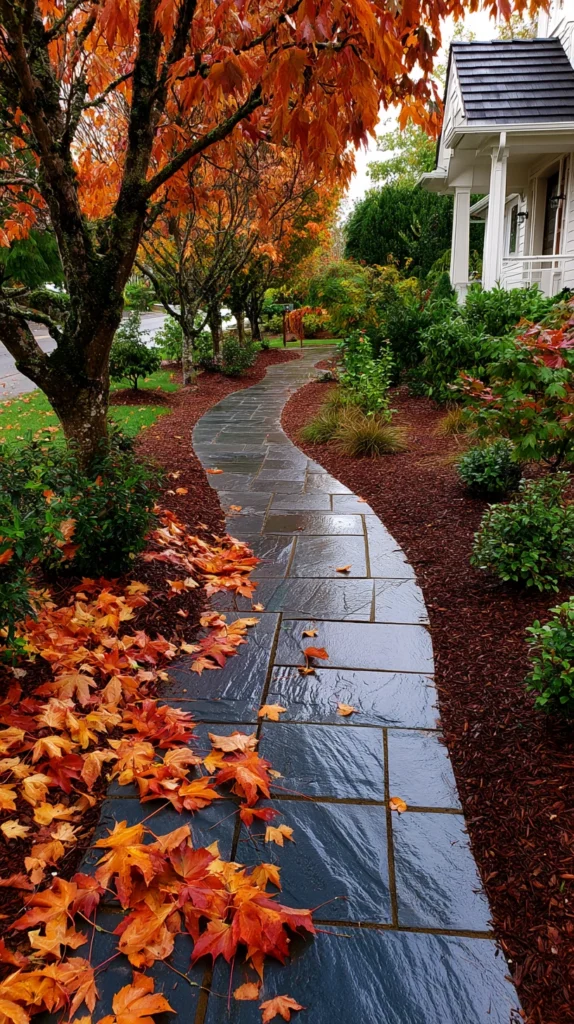
A fresh application of dark bark mulch on a bark or mulch path, or added to the edges of a hard path — the sensory autumn path treatment.
Why bark chip has a specific autumn quality:
The sound:
- The crunch of bark underfoot: specific and pleasing
- The wet bark after rain: a different, muffled quality
- The autumn path: experienced through the feet and ears as well as the eyes
The smell:
- Fresh bark: a specific forest-floor fragrance
- After rain: the fragrance intensified
- Petrichor (rain on soil) combined with fresh bark: the most evocative autumn garden smell
- The path: the point at which this smell is most concentrated (the shoes bring it up)
The dark colour:
Fresh dark bark:
- The autumn path renewal: visible immediately
- Dark bark: deepens further when wet
- The contrast between the dark path and the orange-red fallen leaves: the seasonal palette in two natural materials
The application:
For an existing bark or mulch path:
- Clear the old material (rake off the faded surface)
- Apply fresh dark bark chip: 3-inch depth
- The renewal: the path looks fresh even as the season becomes more rugged around it
For the edges of a hard path:
- A mulched border on each side of a stone or paving path
- The dark mulch: frames the path
- The plant material on the mulch: the autumn planting visible against the dark border
The garden connection:
The path as part of the garden:
- The same mulch as the beds: the path connected to the planting
- Materiall continuity: the path belongs to the garden, not just serves it
- The leaf that falls onto the mulched path edge: indistinguishable from the bed beside it
Cost breakdown:
- Dark bark mulch (one cubic yard for a significant refresh): $40–60
- Total: $40–60
8. The Candle Post Light (The Warm Guide)
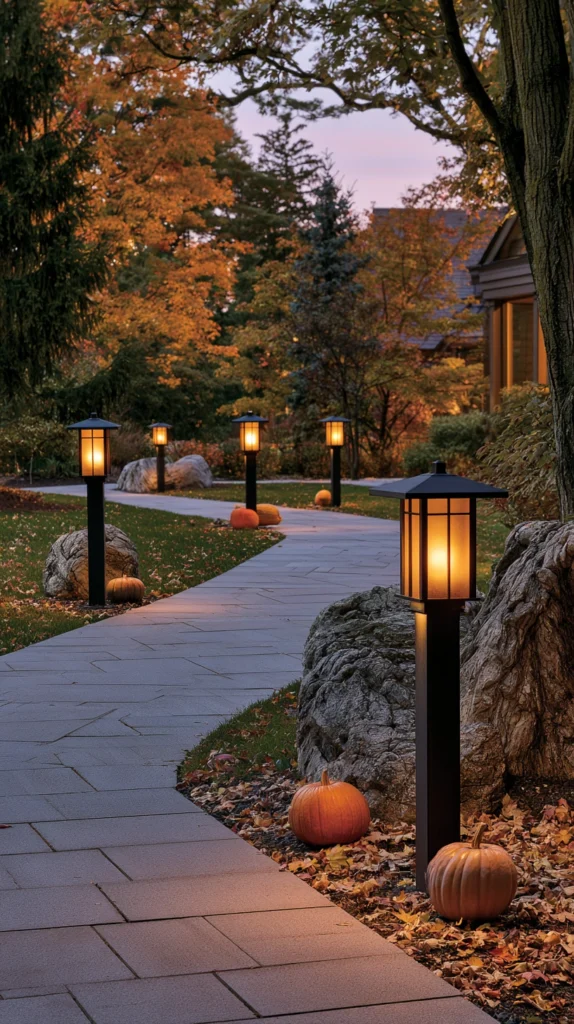
Solar or wired post-mounted lanterns at intervals along the path — the more permanent lighting version of the ground-level lantern.
Why post-mounted lights differ from ground-level lanterns:
The height:
- Ground-level lanterns: intimate, low, only lighting the immediate path surface
- Post-mounted (36–48 inches): lighting the path and the decoration beside it
- The height: the path decoration visible in the light as well as the path surface
The permanence:
- Post-mounted lights: installed rather than placed
- The installation: signals permanent garden investment
- The autumn decoration around permanent post lights: the seasonal overlay on permanent infrastructure
The solar post light:
The practical choice:
- No wiring required
- Placed at any position on the path
- Quality has improved significantly
- Warm white available (check before buying: some solar defaults to cool white)
- Timer function built in to most modern solar post lights
The wired option:
For existing infrastructure:
- If path lighting was already planned during any garden renovation: low-voltage wired post lights
- More reliable than solar
- Consistent output regardless of weather
- More permanent and more beautiful
The autumn decoration around the post:
At the base:
- A terracotta pot with seasonal planting (mums, ornamental kale)
- Or: a pumpkin resting against the post base
- Or: a harvest bundle leaned against the post and secured with twine
- The decoration: integrating the post into the autumn display
Cost breakdown:
- Four solar post lights (quality, warm white): $80–120
- Total: $80–120
9. The Autumn Wreath on the Garden Gate (The Path’s Beginning)
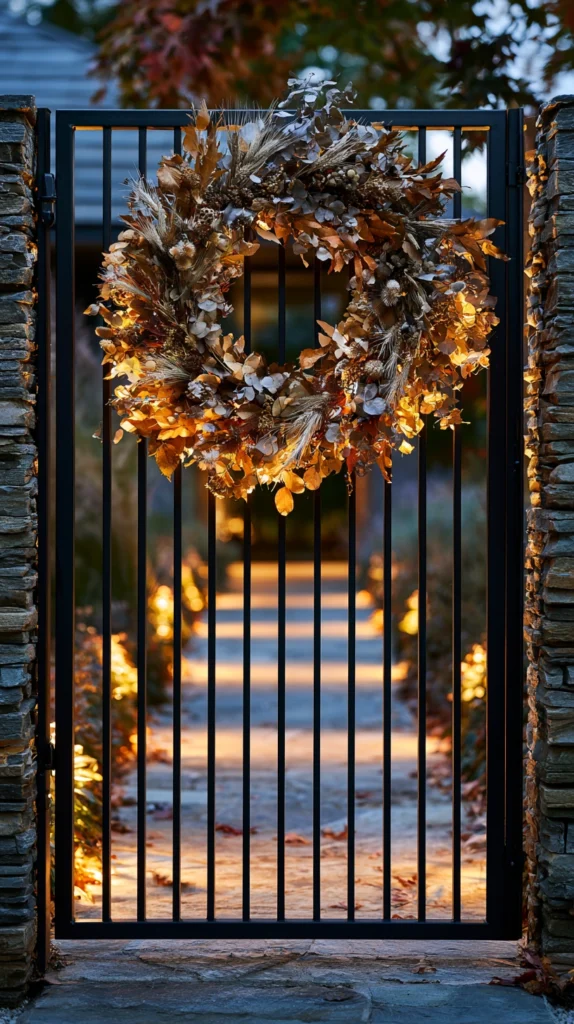
An autumn wreath hung on the garden gate or the point where the path begins — the signal that the path has been dressed.
Why the beginning of the path matters most:
The first impression:
- The wreath: seen before anything else on the path
- It sets the expectation for what follows
- A beautifully dressed gate: the path beyond it worth walking
- The bare gate: the path behind it less anticipated
The transition signal:
The gate as threshold:
- The sound of the latch closing behind
- The click: the transition from the street to the garden
- The wreath: the visual signal of that transition
- A gate with a wreath: signals more clearly than a bare gate that something awaits within
The autumn wreath materials:
From the garden:
- Seed heads from the garden’s own plants
- Dried grasses
- Rosehips
- A few sprigs of evergreen
- The wreath: the garden’s autumn self-portrait
From a market or garden centre:
- Dried botanicals in autumn tones
- Grapevine base
- Dried cotton, eucalyptus, seed heads
- More polished than the foraged version
The DIY version:
Making it:
- A grapevine wreath base (available from any craft store)
- Materials from the garden (dried seed heads, grasses, rosehips)
- Pushed into the grapevine and secured with floral wire
- An afternoon’s project
- More personal than purchased: the most appropriate quality for a garden gate
Cost breakdown:
- Grapevine wreath base: $8
- Botanical materials (some from garden): $8–15
- Total: $16–23
10. The Stone and Boulder Accent (The Geological Anchor)
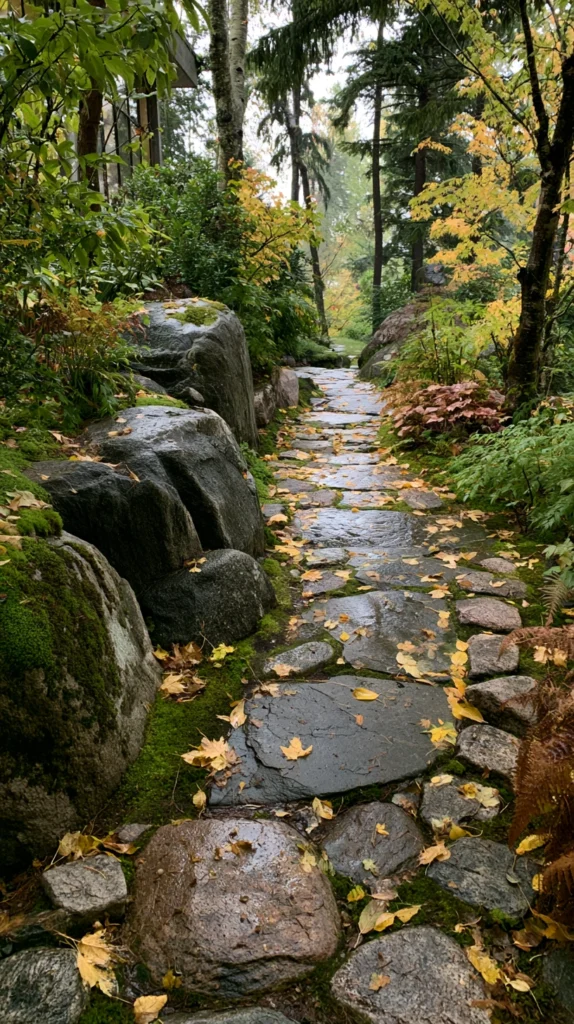
Large smooth boulders or decorative stones placed beside the path — the permanent natural elements that ground the seasonal decoration.
Why stones and boulders belong in autumn path design:
The permanence among the temporary:
- The mum will finish. The pumpkin will decay. The leaf will blow away.
- The stone: unmoved and unchanged
- The stone beside the seasonal decoration: the constant
- The contrast between permanence and impermanence: specifically beautiful in autumn (the season of transition)
The Japanese garden influence:
The placed stone:
- In Japanese garden design: stones are placed with intent
- Each stone: with a specific character and placed to express that character
- The placed stone: not a background element but a design element
- In the autumn garden: this philosophy applied to the path
The types:
River-rolled boulders:
- Smooth, rounded, heavy
- The most peaceful stone form
- Grouped in odd numbers beside the path
- Partially buried (sitting in the ground, not resting on top): the natural appearance
Textured field stones:
- Rough, weathered, irregular
- The character of outdoor stone
- The lichen and moss they carry: the age signal
- The most garden-appropriate stone for a cottage or naturalistic path
The placement:
Partially buried:
- A third of the stone below ground
- The stone: appearing to have been there for years
- The natural integration: the opposite of a stone placed on the surface (which reads as an object rather than a feature)
In a group:
- Three stones of different sizes grouped together
- The group: a composition
- Near a lantern or mum pot: the stone as the natural element within the decorated path
The moss:
- Stones in the garden: encourage moss naturally
- The yogurt method (as covered in other articles): accelerates this
- A mossy stone: the most beautiful path companion
Cost breakdown:
- Two to three boulders or large stones (delivered, landscape supplier): $30–80
- Total: $30–80
11. The Herb and Fragrant Plant Path Border (The Scented Walk)
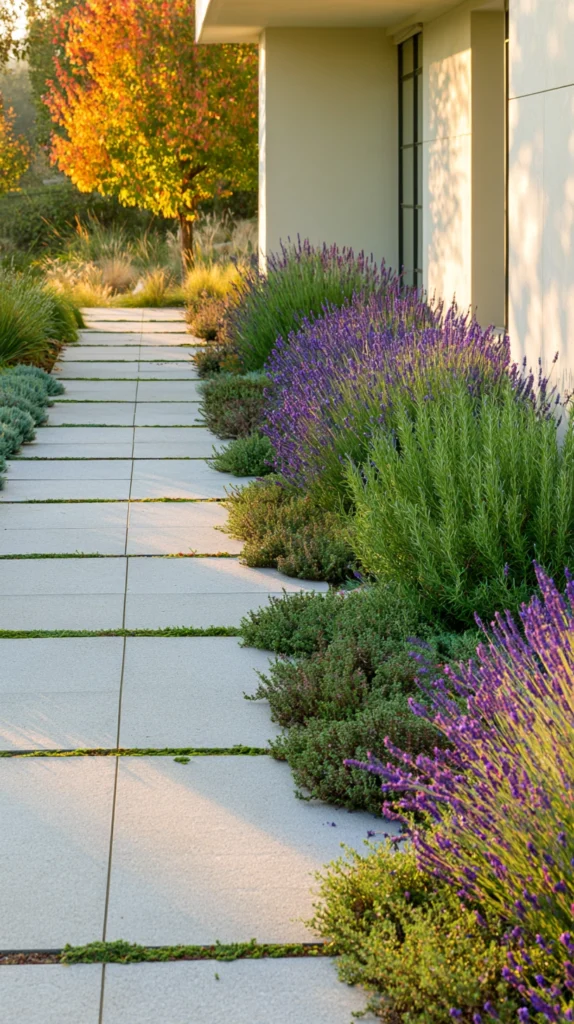
Low fragrant plants — lavender, rosemary, thyme — planted or placed in pots along the path edges — the autumn path decoration experienced through the nose as well as the eye.
Why a fragrant path is specifically autumn:
The distillation:
- Cool temperatures: concentrate essential oils in herbs (as established in the vegetable garden and autumn garden articles)
- Autumn lavender and rosemary: more intensely fragrant than their summer equivalents
- The scent of crushed thyme underfoot in October: the autumn garden smell at its most complex
The brushing:
The experience of the scented path:
- A narrow path with lavender or rosemary at both edges: the plants brush the legs
- The brushing: releases the scent
- The walk: a fragrant experience
- The scent: the memory of this particular walk
The autumn herbs still active:
Still fragrant in autumn:
- Rosemary: year-round fragrance, more concentrated in cool
- Thyme: still present and fragrant into October
- Lavender: finished flowering but the foliage still fragrant
- Sage: grey-green, fragrant when handled
In containers (more flexible):
- Rosemary in terracotta pots placed at path edges
- Thyme in low pots at the path’s edge (the brushing effect even in containers)
- The mobile fragrant border: moved with the season
The combination with other path decoration:
- Rosemary beside a lantern: the light on the silver-green foliage
- Lavender beside a mum pot: the silver of the lavender and the copper of the mum
- The fragrant and the decorative: the multisensory path
Cost breakdown:
- Two rosemary plants in terracotta: $16
- Three thyme plants: $12
- Total: $28
12. The Seasonal Painted Stone Markers (The Personal Touch)
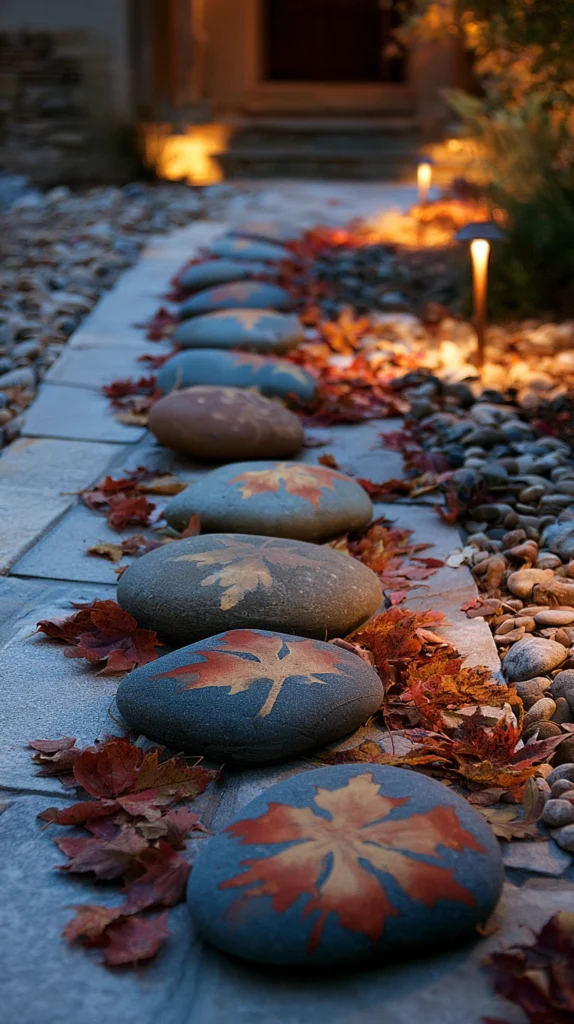
Stones painted with seasonal motifs or simply painted a warm colour, placed along the path — the handmade detail that is the most personal of all path decorations.
Why hand-painted stones are specifically appropriate for the autumn garden:
The handmade quality:
- The autumn garden is not a designed display: it is a cared-for place
- The handmade: evidence of care
- A painted stone: unmistakably made by someone for this garden
- The commercial: general and portable. The handmade: specific and permanent.
The motifs:
Seasonal (but not literal):
- A leaf (simple, elegant)
- A simple mushroom or toadstool
- An abstract line in autumn colours (ochre, rust, terracotta)
- The letter or number of the house
- These are suggestions: what is painted is specific to the person painting
The paint:
- Outdoor acrylic (seals to the stone surface)
- Apply a clear sealant after (extends life significantly)
- In the style the painter has: not the style of someone else
The stones:
- Smooth river stones (the most paintable surface)
- Large enough to be seen at walking pace (palm-size minimum)
- Flat enough to rest without rolling
- Collected from a riverbed, a beach, or purchased from a garden centre
The placement:
Among other path decoration:
- A painted stone beside a lantern: the handmade beside the mass-produced
- At the path entrance: the first thing seen
- Beside a pumpkin or mum pot: the small detail within the larger display
The autumn colours:
Warm and muted:
- Ochre, rust, warm brown, dusty orange
- The autumn palette in a brushstroke
- The stone: contributing to the colour composition of the path
Cost breakdown:
- River stones (bag of mixed sizes): $8
- Outdoor acrylic paint (warm tones): $12
- Clear sealant: $5
- Total: $25
13. The Complete Autumn Path (All Elements Working Together)
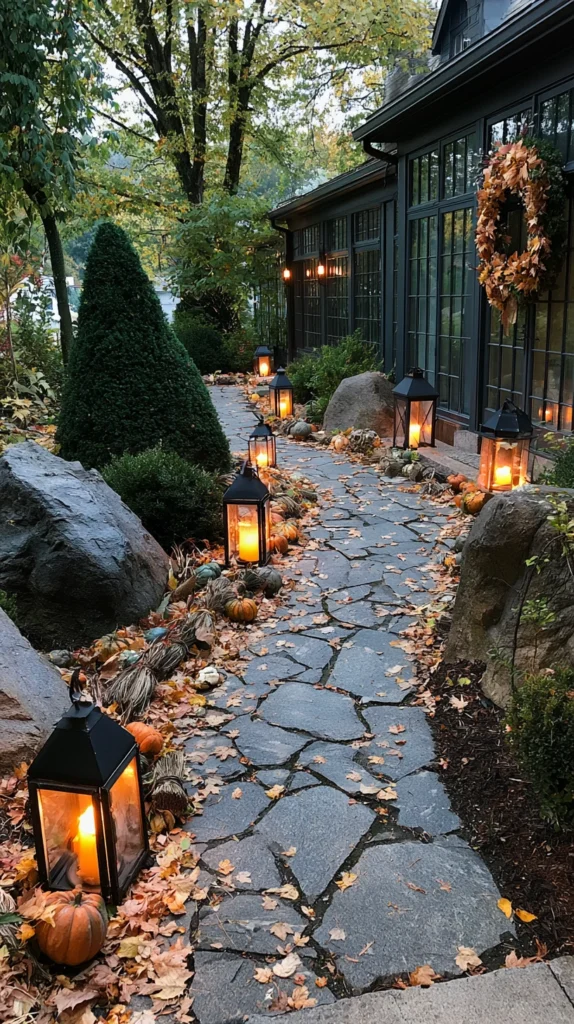
The full autumn path treatment — multiple elements at different scales and positions along the path — the display that makes the walk itself the reason to go outside.
What the complete autumn path includes:
The start (the arrival experience):
- The autumn wreath on the gate (Idea #9)
- A grouping of three pumpkins at the gate base (Idea #4)
- A corn bundle tied to each gate post (Idea #5)
- Two lanterns flanking the gate entry (Idea #1)
- The arrival: immediately seasonal, immediately dressed
The path itself:
First section (from the gate to the first bend):
- Four lanterns on alternating sides, spaced 3–4 feet apart
- Two terracotta mum pots (copper chrysanthemums) at the midpoint
- Bark mulch on the path edges (Idea #7)
- River stones beside the first lantern (Idea #10)
At the first bend:
- A large pumpkin or grouping of three (Idea #4)
- Harvest bundle leaned against the fence at the bend (Idea #5)
- Painted stone at the base of the bend lantern (Idea #12)
The path continuation:
- Two more lanterns
- Fragrant rosemary in terracotta pots at the path edges (Idea #11)
- Fallen leaves arranged at the path edge between the rosemary pots (Idea #3)
- A clipped topiary ball in a dark pot (Idea #6): the formal element among the seasonal
The path end (the destination):
- The fire circle or seating area (lit and warm before anyone walks toward it)
- A final lantern pair flanking the arrival into the seating area
- The destination: revealed at the path end, having been worth the walk
The sensory experience of the walk:
What is experienced, in order:
The gate:
- The wreath (sight)
- The latch clicking shut (sound)
- The pumpkins and corn bundle (sight)
The first section:
- The warm amber light from the lanterns (sight)
- The crunch of bark underfoot (sound and touch)
- The mum pots (colour, sight)
The bend:
- The harvest bundle (sight and texture if touched)
- The pumpkin grouping (sight)
- The turn revealing the next section (a gentle surprise)
The second section:
- The rosemary brushing the legs (touch and scent)
- The lavender fragrance if any is present
- The painted stone at the path edge (personal discovery)
The arrival:
- The fire or warm seating area (sight, warmth, the sound of the fire)
- The destination: the reward for the walk
The walk: a journey. The decoration: the details of the journey.
The cost of the complete autumn path:
Starting with no lanterns or pots:
- Lanterns and flameless candles: $155–200
- Mum pots: $70–100
- Pumpkins and gourds: $20–35
- Harvest bundles: $25–43
- Wreath: $16–23
- Bark mulch: $40–60
- Stones: $8–30
- Rosemary in pots: $16
- Clipped topiary (one): $35–55
- Painted stones: $25
- Total for a complete new setup: $410–587
Starting with existing lanterns and pots:
- Pumpkins and gourds: $20–35
- Harvest bundles: $25–43
- Wreath: $16–23
- Bark mulch: $40–60
- Painted stones: $25
- Rosemary: $16
- Total refreshing an existing path with seasonal additions: $142–202
The Minimum Viable Autumn Path Under $50
Two seasonal additions that transform any path:
One: six matching lanterns with flameless candles on timers ($80–100):
- Already covered: the highest-impact path element
- But if the full set is not possible this season:
Two to three pumpkins and a corn bundle ($35–45):
- Placed at the path entrance (or at the single most visible point)
- The seasonal announcement: made
One autumn wreath on the gate ($16–23):
- The transition signal: always visible
Total: $51–68 for the core seasonal path decoration.
The lanterns, as a further investment: the path usable and beautiful after dark. Everything before that investment: still worth doing.
The Path Tells the Story
Before any decoration, after any decoration:
The undecorated path:
- This garden is tidy
- Someone maintains it
- It leads somewhere
The decorated autumn path:
- This garden is alive in autumn
- Someone is here and cares about this specific season
- The walk is worth taking
- The destination has been prepared
The difference between these two readings: a wreath, some lanterns, terracotta pots of mums, a few pumpkins, and some fallen leaves arranged rather than cleared.
The cost: modest. The reading: entirely different.
The path is the first experience of the garden. In autumn, it is also the best reason to go into it. Dress it accordingly.