12 Garden Lantern and Solar Light Setups That Glow Like a Summer Festival Night
I walked through a neighbours garden at dusk once and stopped completely. Nobody asked me to stop. The garden did.
String lights in the trees. Lanterns along the path. Candles in jars on every surface. The whole thing glowing warm amber from ground to canopy. Felt like arriving somewhere special rather than standing in a suburban back garden.
Spent the rest of that summer working out exactly what was happening and how to recreate it. Not the fixtures specifically. The principles behind them.
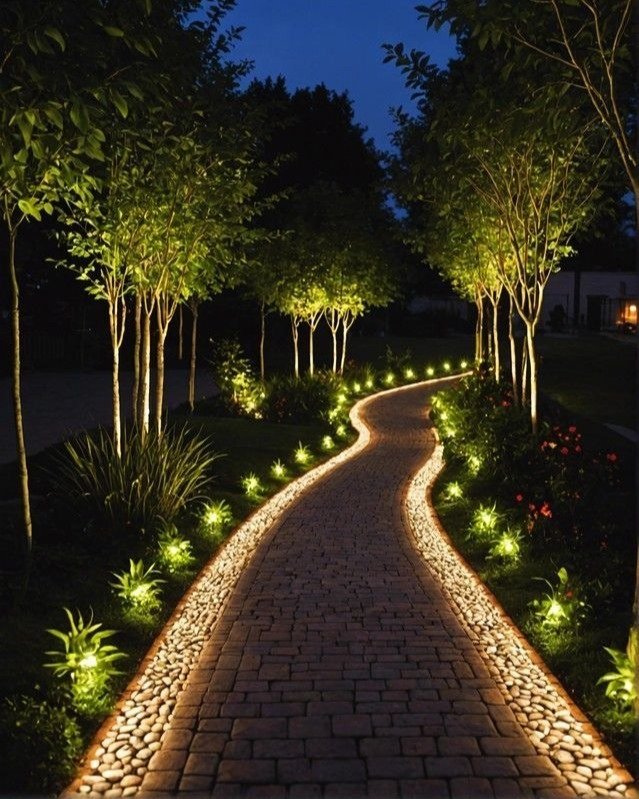
Here are 12 lighting setups built on those principles — each one capable of producing that stopped-in-your-tracks moment every single evening.
Why Evening Gardens Feel More Beautiful Than Daytime Ones
Not an accident:
Daylight shows everything equally:
- Good design visible
- Clutter visible
- Weeds visible
- Nothing hidden
- Everything competing
Warm evening light does something different:
- Illuminates selectively
- Shadows hide what should be hidden
- Warm glow enhances what should be seen
- Depth and mystery added
- Same garden: completely different world
The festival quality specifically:
What summer festivals feel like:
- Warm light from multiple low sources
- Darkness between the sources
- Movement (flames, people)
- Warmth felt before seen
- The sense of something worth arriving at
Every element translates to home gardens:
- Multiple low warm light sources: lanterns and stake lights
- Darkness between: intentional not accidental
- Movement: real flames or quality flicker
- Warmth before sight: lighting on when you arrive
- Worth arriving at: designed not random
The one rule that overrides everything:
Colour temperature.
Every beautiful evening garden image uses warm light. 2200K–2700K. Amber to warm white. Every image that looks cold, clinical, or wrong uses cool white above 3000K.
This is not aesthetic preference. It is the physics of how warm light interacts with organic materials. Green plants glow gold-green. Wood warms to honey. Stone softens to amber. Cool light bleaches all of this to hospital white.
Check the packaging before buying anything. The number must be under 2700K. Non-negotiable.
The Three Layers That Create Festival Light
Every setup on this list uses some combination:
Layer one — Canopy (high, overhead):
- String lights
- Pendant lanterns hung from beams
- Fairy lights in trees
- Creates the ceiling of the outdoor room
Layer two — Eye level (surfaces and mid-height):
- Table lanterns
- Shepherd’s hook lanterns
- Hanging lanterns at arm height
- Creates the main illuminated zone
Layer three — Ground (low, floor level):
- Path stake lights
- Floor-level lanterns
- Uplights at base of plants
- Candles in jars on the ground
One layer: functional but flat. Two layers: interesting. Three layers: the festival garden. Every time.
1. The String Light Canopy With Dangling Pendants (The Classic Done Fully)
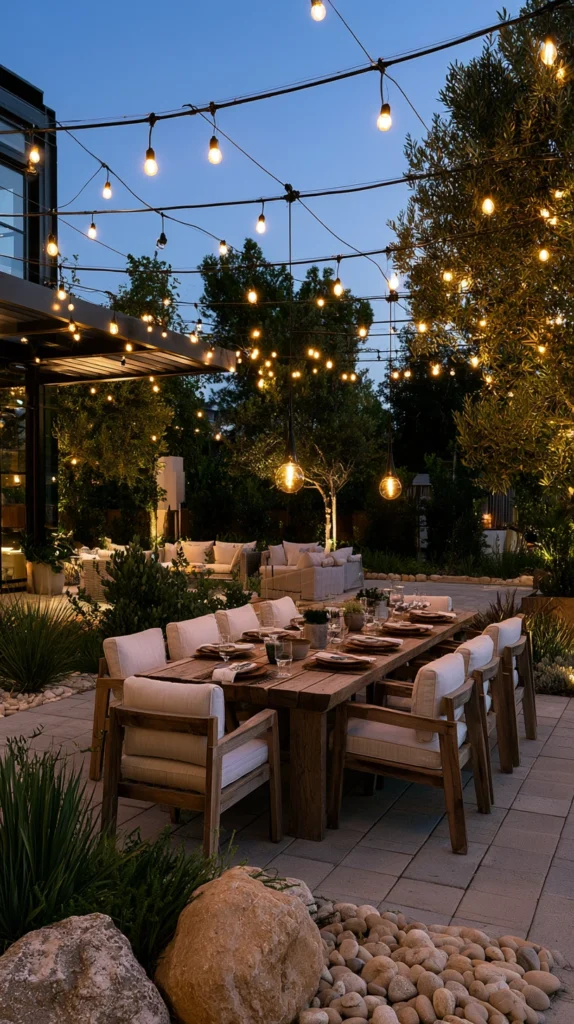
Full overhead string light grid with individual pendants dropping down — the setup that creates a glowing ceiling and intimate spots beneath it simultaneously.
Why this is the benchmark:
The grid creates the room:
- Overhead coverage
- Defined boundary above
- Space enclosed without walls
- Eye stays within the warm zone
The dangling pendants create the moments:
- Individual pools of light within the grid
- Each pendant: a spotlight on what is below
- Dining table: pendant drops directly over
- Reading chair: pendant drops beside
- Specific illumination within ambient warmth
Building it:
The grid:
Post placement:
- Four posts minimum
- 8–10 feet apart
- 8 feet high (clearance underneath)
- Concrete-footed (or heavy freestanding bases)
Light runs:
- Parallel lines 12 inches apart
- Warm Edison or globe bulbs (2700K)
- Turnbuckles on each run (keeps lines taut)
- Timer switch: on at dusk, off at midnight
The pendants:
Hung from the grid lines:
- One pendant per ‘room’ within the grid
- Over the dining table: 30 inches above surface
- Over the seating: 36 inches above cushions
- Pendant is a vintage Edison socket with bulb ($8–12 each)
- Or small lantern hung from S-hook on grid line
Pendant placement rule:
- Pendant must be lower than grid by 18 inches minimum
- Too close to grid: looks like accident
- Well below: looks deliberate
- Pendants at the same height as grid: no depth created
Cost breakdown:
- String lights (100 feet, 2 strands): $55
- Four cedar posts: $48
- Concrete for posts: $20
- Edison pendant sockets (3): $30
- Timer switch: $12
- Turnbuckles (8): $16
- Total: $181
My canopy with pendants: first evening on after installation. Sat under it at the dining table at 9pm on a Wednesday. An evening that would have been inside became the best evening of that week. The pendants made the table feel claimed.
String Light Tips
The sag destroys the effect:
- Loose string lights: careless appearance
- Taut string lights: deliberate installation
- Turnbuckle on each run: tighten to right tension
- Check and adjust each spring
The timer is not optional:
- Manual switching: forgotten, space unused on the evenings it matters
- Timer set to dusk: garden always ready
- Always ready: always used
- Used daily: investment justified immediately
2. The Mason Jar Candle Path (The Festival Floor Trail)
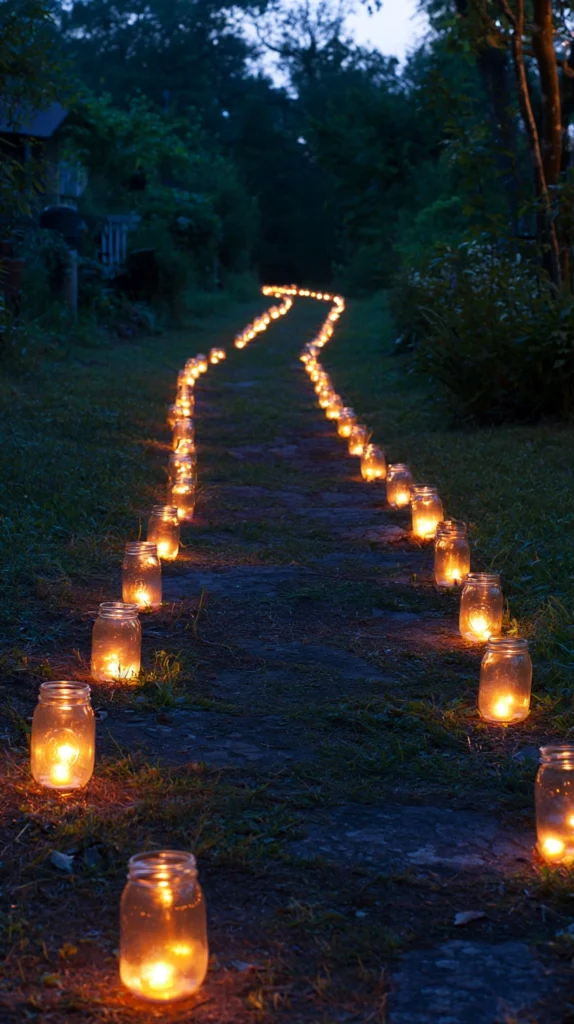
Glass jars with candles or LED candles lining a garden path — the ground-level glow that makes any path feel like the entrance to somewhere memorable.
Why jar paths create festival atmosphere:
The repetition:
- Single lantern: functional
- Row of jars: atmosphere
- The repetition transforms individual objects into a design
- Twenty jars: not twenty candles — one illuminated journey
The accessible glow:
- Light at ground level
- Eyes naturally look down when walking
- Ground-level warm light: noticed immediately
- Overhead light: sometimes missed entirely
The low cost of the effect:
- Mason jars: $1–2 each
- Pillar candles or LED tea lights: $0.50–1 each
- Total per jar: under $3
- Twenty jars: under $60
- Effect: far beyond the cost
Building the jar path:
The jars:
Standard mason jar (most classic):
- 16 oz regular mouth
- Widely available and affordable
- Clear glass only (coloured glass kills the warm glow)
- Aged or frosted: beautiful variation
Aged effect:
- Rub outside with wire wool lightly
- Or dip top third in diluted white paint, wipe off
- Slightly frosted: glow diffuses (more atmospheric than clear)
- Takes five minutes, transforms the jar
Filling the jar:
Sand or gravel at base:
- 1 inch of sand inside each jar
- Stabilises candle
- Prevents tipping
- Neutral and effective
Or: smooth pebbles:
- 2 inches of river pebbles
- Beautiful when lit from above by candle
- Pebbles visible through glass (decorative)
- Candle sits on top of pebbles
The candle choice:
Real pillar candle:
- Most atmospheric
- Actual flame movement
- Lit before guests arrive (ritual)
- Extinguish before leaving (discipline)
LED tea light with timer:
- No fire risk
- Comes on at dusk automatically
- Realistic flicker (quality brands)
- Permanent outdoor installation possible
Placement:
Even spacing (formal path):
- Same distance between every jar
- Measured, not estimated
- Precise spacing: confident design
- Uneven spacing: accidental appearance
Alternating sides:
- Left, right, left, right
- Creates zig-zag of light
- Eye follows the alternation
- Journey more dynamic than single-side
Clusters at path entrance and end:
- Three jars together at start
- Three jars together at destination
- Single jars along the run
- Signals: begin here, arrive there
Cost breakdown:
- Twenty mason jars: $25
- LED tea lights with timer (20): $30
- River pebbles for bases: $8
- Total: $63
The jar path on a still August evening: walked down it and understood why people get married in gardens. That quality of light on a familiar path makes it unfamiliar in the best possible way.
3. The Shepherd’s Hook Lantern Avenue (Elegant Standing Light)
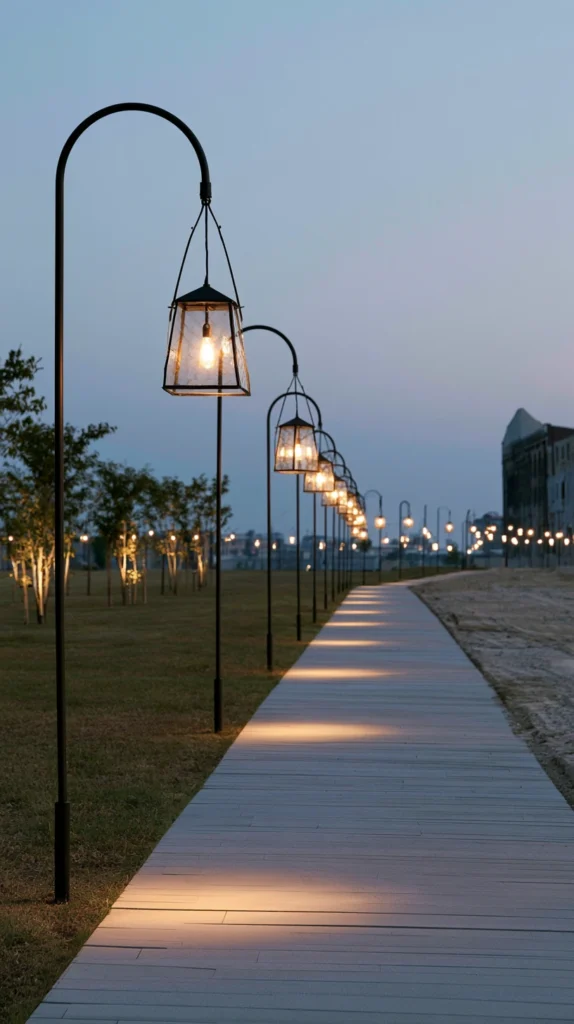
A row of shepherd’s hooks with hanging lanterns along a border or path — the standing light source that adds height, movement, and warm pools at eye level.
Why shepherd’s hook lanterns create festival quality:
The height:
- Lantern at 5 feet: eye level when standing
- Warm glow at face height
- Light experienced not just seen from below
- Intimate with the light source
The movement:
- Lanterns hang and sway slightly in breeze
- Movement is aliveness
- Aliveness is what festival light has that garden centres do not
- Still light: decorative. Moving light: alive.
The avenue effect:
- Series of hooks in a line
- Each with hanging lantern
- Creates an avenue of light
- Journey through the garden defined by light
The hooks:
Standard shepherd’s hook:
- 60–72 inch height (most versatile)
- Single hook or double hook
- Powder-coated black (most compatible)
- Push into ground easily
- $8–15 each
Heavy-duty shepherd’s hook:
- More stable (does not tip in wind)
- Wider base spread
- Worth extra $5 for exposed positions
- $15–22 each
The lanterns:
Matching throughout:
- All same shape, all same finish
- Matte black most compatible
- Consistent rhythm along avenue
- Mixed lanterns: busy not designed
Size to hook scale:
- Lantern diameter: roughly one-third of hook height
- Hook at 66 inches, lantern 8–10 inches diameter
- Proportionate relationship
- Too small: lost on the hook. Too large: unbalanced.
Spacing:
3–4 feet apart:
- Pools of light overlap slightly
- No complete darkness between
- Festival continuity
- Too far apart: pools isolated, atmosphere breaks
Cost breakdown:
- Shepherd’s hooks (6): $75
- Matching lanterns (6): $70
- Flameless candles with timer (6): $45
- Total: $190
The avenue along the border: six hooks, six lanterns, all amber at dusk. The border that I rarely walked along became the first place guests went after dark. Light creates destination.
4. The Tree Fairy Light Wrap (Nature as Lighting Structure)
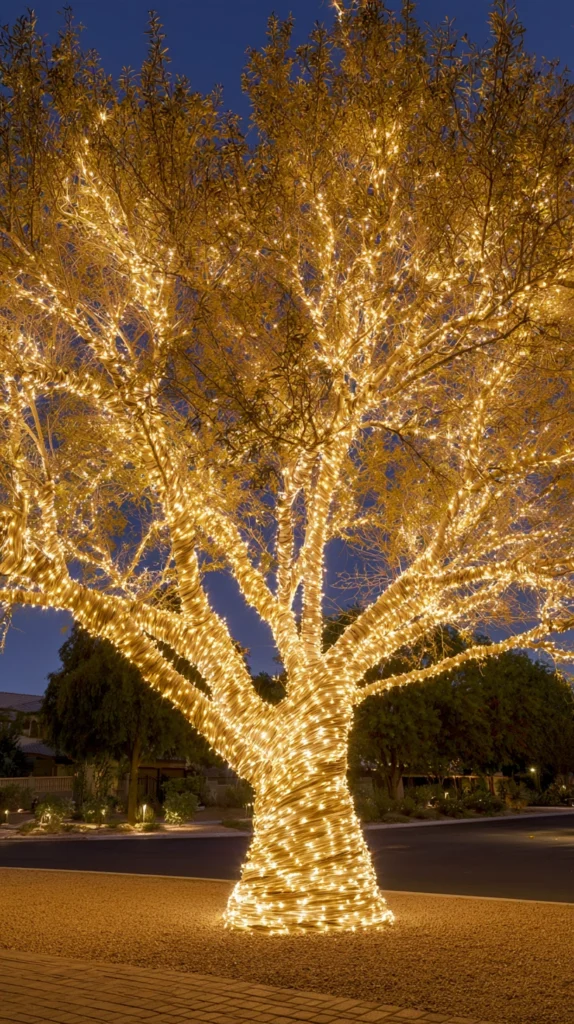
Warm fairy lights wrapped around tree trunks and through branches — the setup that turns mature trees into glowing focal points.
Why tree lighting creates festival atmosphere:
The tree as amplifier:
- Fairy lights alone: pretty but small
- Same lights in tree: massive glowing structure
- Tree becomes the light source
- Entire canopy illuminated
The shadow play:
- Leaves lit from beneath or within
- Shadows projected outward onto surrounding garden
- Moving with wind: animated
- Still air: patterns. Breezy: movement.
The organic unpredictability:
- No two trees respond the same
- Each tree creates unique light pattern
- Organic quality impossible to replicate artificially
- Most photographed garden light effect available
The wrapping technique:
Trunk wrapping:
- Start at base, spiral upward
- Even spacing between spirals (4–6 inches)
- Stop at first main branching
- Connection: trunk glows as pillar of light
Branch weaving:
- Follow main branches outward
- Weave through secondary branches
- Dense wiring creates solid glow
- Sparse wiring creates dotted outline
Canopy hanging:
- Hang strands downward from branches
- Like glowing Spanish moss
- Drapes and moves in wind
- Most festival-like tree treatment
The fairy light product:
Copper wire fairy lights:
- Thin and nearly invisible in daytime
- Very flexible (follows any branch)
- Warm white (2700K always)
- Battery or solar option (no cords)
- $12–20 per 33-foot strand
Mains-powered (for permanent installation):
- More reliable than battery
- Low-voltage transformer
- Safe and permanent
- More effort to install: worth it for large trees
Multiple trees:
- Wrap every tree in the garden
- Consistent treatment throughout
- Garden becomes a grove of glowing trees
- Festival quality immediate
Cost breakdown:
- Copper wire fairy lights (3 strands, 33 feet each): $45
- Solar-powered option (no transformer needed): $50
- Timer plugs if mains-powered: $12
- Total: $45–62
My wrapped oak: ordinary tree during the day. After dark, from the kitchen window: a glowing thing in the garden that makes the garden feel like it is celebrating something. Every evening.
Fairy Light Tree Tips
The takedown problem:
- Lights wrapped in living tree: branches grow through them
- Annual removal and re-wrap recommended
- Or: weave loosely so growth accommodated
- Copper wire: most forgiving as branches thicken
Battery life:
- Timer extends battery significantly
- 6 hours on per night: 3–4 weeks per battery set
- Solar: indefinite (with sufficient daily light)
- Rechargeable batteries: most sustainable approach
5. The Floating Candle Pond or Bowl (Still Water and Flame Combined)
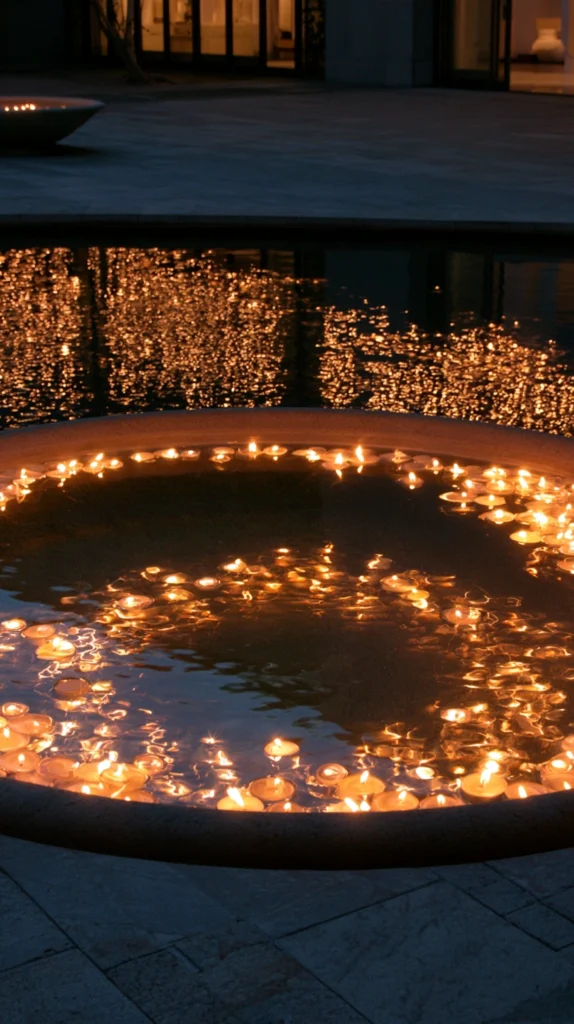
Floating candles or waterproof LED lights in a large bowl or garden pond — the most hypnotic single-object light setup available.
Why floating light creates festival magic:
The reflection:
- Flame on water: reflected
- One flame becomes two
- Every ripple creates new reflections
- Still water: perfect mirror of the flame
The stillness:
- Water naturally draws the eye
- Lit water: completely captivating
- Combination of two primally interesting things
- Guests always drift toward it
The impermanence:
- Floating candles move slowly
- Position changes all evening
- No two moments identical
- The garden is never the same twice
The vessel:
Large glazed ceramic bowl (most beautiful):
- 20-inch diameter minimum
- Filled with water
- Dark interior glaze (reflection quality)
- $40–80
Galvanized stock tank (most modern):
- Large scale (2-foot diameter minimum)
- Reflective interior
- Industrial aesthetic
- $20–40 for small versions
Garden pond (permanent):
- Any existing pond accepts floating candles
- Works immediately with no additional cost
- Floating candles bought and placed
- Most dramatic scale
The candles:
Real floating candles:
- Most atmospheric
- Flame movement in still air
- Light breeze: move slowly across water
- Lit before guests arrive: by the time they reach it, perfect
LED floating lights:
- Waterproof disc lights
- Colour-changeable (but use warm white only)
- Reusable indefinitely
- No fire management
- $8–15 for a set of six
Surrounding the bowl:
Low plants at base:
- Ground cover growing up to bowl
- Bowl embedded in garden, not placed in it
- Transition from vessel to garden: seamless
Additional lanterns nearby:
- Low lanterns flanking the bowl
- Warm light at ground level
- Bowl not isolated: part of a composition
- Multiple light sources: depth and dimension
Cost breakdown:
- Large glazed ceramic bowl: $55
- Floating LED lights (pack of 6): $12
- Ground cover plants around base: $20
- Two flanking lanterns: $25
- Total: $112
Still evenings in August: bowl lit, not a breath of wind. Reflections perfect. Guests stood around it without speaking for three minutes. The combination of flame and water silences people.
6. The Solar Stake Light Meadow (A Field of Stars at Ground Level)
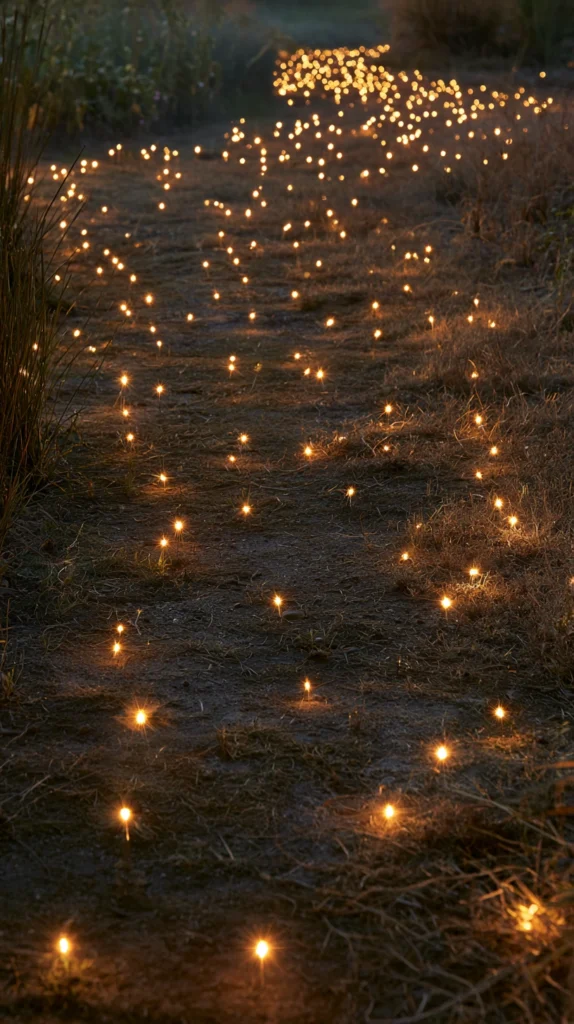
Dozens of solar stake lights distributed through planting — the setup that turns a garden border into a field of individual warm glowing points.
Why massed stake lights create festival atmosphere:
The quantity effect:
- One stake light: useful
- Five stake lights: a path
- Thirty stake lights through a border: a meadow of light
- Quantity transforms the category
The ground star effect:
- Each stake: a point of warm light
- From seating area: points distributed through planting
- Looks like stars fallen into the garden
- Night-festival quality that nothing else creates
The solar advantage here:
No wiring:
- Each stake independent
- Place anywhere plants grow
- No cable management
- Easiest installation on this list
No ongoing cost:
- Solar charges during day
- Burns all evening from stored energy
- $0 per year to run
- Replace every 2–3 seasons (battery degradation)
The product quality matters:
What to avoid:
- Cheapest $1–3 stake lights
- Dim output, unreliable timer
- Fails within weeks
- Looks sad rather than festive
What to buy:
- $8–15 per unit (Nekteck, GIGALUMI, or similar)
- Larger solar panel (more charge, more hours)
- Longer stake (stable in ground)
- Warm white (verify before buying — many default to cool)
Placement:
Through the planting:
- Among flowers and low shrubs
- Stakes pushed in at varied depths
- Some deeper (lower light point), some shallower
- Irregular distribution: natural not lined up
The density required:
- One stake per 2–3 square feet of border
- Dense enough for ‘meadow’ effect
- Sparse placement: isolated dots (less effective)
- Count the area and order accordingly
Mixed with taller plants:
- Stake among grasses (light through grass blades)
- Stake among lavender (light below flower heads)
- Stake among echinacea (light at stem height)
- Plant and light working together
Cost breakdown:
- Twenty quality solar stake lights: $160
- Or thirty: $240
- No installation cost
- No running cost
- Total: $160–240
The border at 9pm in July: thirty lights distributed through lavender, echinacea, and grasses. From the seating area: the border glowed. Not uniformly — unevenly, individually, warmly. The garden was awake.
7. The Festoon Light Zig-Zag (Movement Overhead)
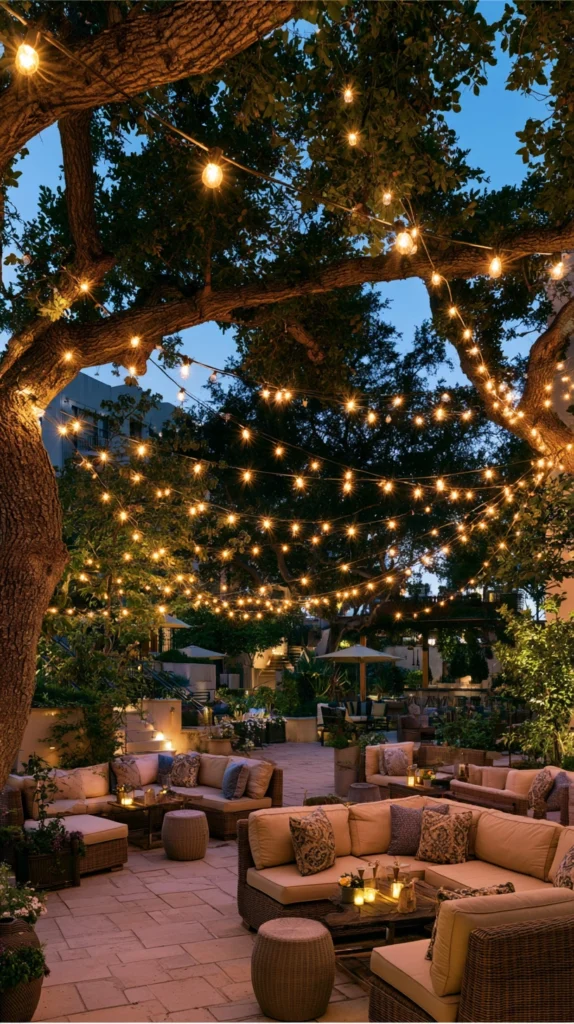
Festoon lights run in zig-zag pattern rather than grid — the looser, more festival-like version of overhead lighting that suggests movement and irregularity.
Why zig-zag differs from grid:
Grid overhead:
- Formal and geometric
- Room-like quality
- Deliberate and structured
- Beautiful for dining
Zig-zag overhead:
- Asymmetric and relaxed
- Festival tent quality
- Suggests spontaneity
- Beautiful for lounging and gathering
The festival tent association:
- Music festivals: lights strung informally overhead
- No perfect geometry
- Abundant and casual
- The zig-zag recreates this
Building the zig-zag:
Attachment points:
- Not a grid of posts (too formal)
- Use what exists: trees, fence posts, shed corners
- The irregular attachment points create the zig-zag naturally
- Work with what is there
The run:
- One continuous strand
- Anchor at first point
- Run to second point at different height and angle
- Continue to third (different again)
- The irregular heights create the movement
Height variation:
- Some points at 8 feet, some at 10, some at 7
- Variety creates the festive drape
- Same height throughout: loses the quality
- Different heights: the strand hangs in natural curves
The bulb:
G40 globe bulbs:
- Round, warm, substantial
- Most festival-like bulb shape
- More presence than Edison per bulb
- $15–25 per 25-foot strand
Oversized S14 bulb:
- Larger and more dramatic
- Spaced further apart (more darkness between)
- Festival main stage quality
- $20–30 per 25-foot strand
Mixing bulb sizes:
- Different strands with different bulb sizes
- Zig-zagged at different heights
- Maximum informality and warmth
- Full festival canopy
Cost breakdown:
- Two strands G40 festoon lights (50 feet): $40
- One strand S14 oversized (25 feet): $25
- Timer switch: $12
- Total: $77
The zig-zag over the seating area: less perfect than a grid and more alive because of it. The irregular swags move slightly in any breeze. The imperfection is the point.
8. The Lantern Cluster Ground Installation (Floor-Level Festival Scene)
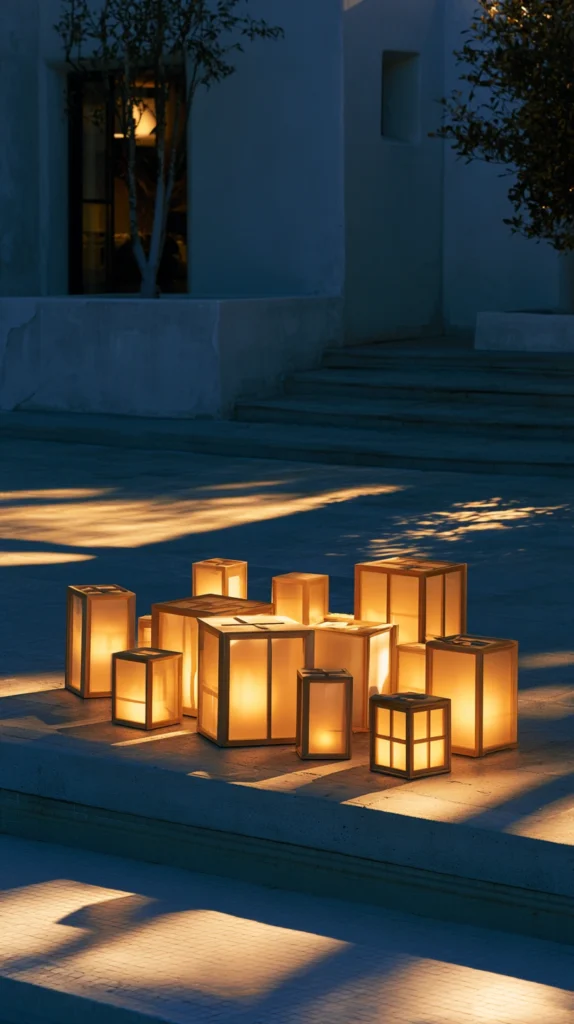
A large grouping of varied lanterns arranged directly on the ground — the setup that creates a scene rather than just illumination.
Why a ground-level lantern cluster is different:
It is a composition not a light source:
- Individual lanterns: functional
- Grouped at varied heights on the ground: a still life
- A still life that glows: art
- Art in a garden: destination
The scene quality:
- By day: an interesting grouping of objects
- At dusk: those objects begin to glow
- By full dark: an entirely different thing
- The transition through dusk: worth watching
Building the cluster:
The quantity:
- Minimum five lanterns
- Seven or nine for full impact
- Fewer: isolated objects not a scene
- The scene requires density
The heights within the cluster:
Varying from floor to 24 inches:
- Flat lantern trays directly on ground
- Short 6-inch lanterns
- Medium 12-inch lanterns
- Tall 20–24-inch lanterns
- Everything touching or nearly touching
The arrangement:
Tightest grouping at centre:
- Tallest lanterns at back
- Cascades lower toward front
- Overall form: pyramid from the side
- From above: irregular cluster
Position within the garden:
- Beside the seating, not central
- Like a campfire to the side of the gathering
- Approached and discovered
- Not placed where it blocks anything
Inside the lanterns:
Real candles (most atmospheric for this setup):
- The cluster glows with real flame
- Multiple flames at multiple heights
- Glow visible from 30 feet
- Lit as the ritual of beginning the evening
The flameless option:
- Timer-set for dusk
- All lanterns come on simultaneously (ritual automated)
- Consistent every night
- More practical for daily use
Mixed sizes from same source:
- Buy from same retailer: consistent finish
- All matte black or all aged brass
- Multiple sizes: check same family available
- Consistency within variety
Cost breakdown:
- Seven lanterns (varied heights, matte black): $95
- Flameless pillar candles with timer (7): $55
- Total: $150
The cluster beside the firepit: two warm light sources at the same end of the garden. The cluster of lanterns and the fire together. One end of the garden blazing with warmth. The other end in gentle darkness. That contrast is the whole experience.
9. The Candle Ladder or Shelf (Vertical Festival Display)
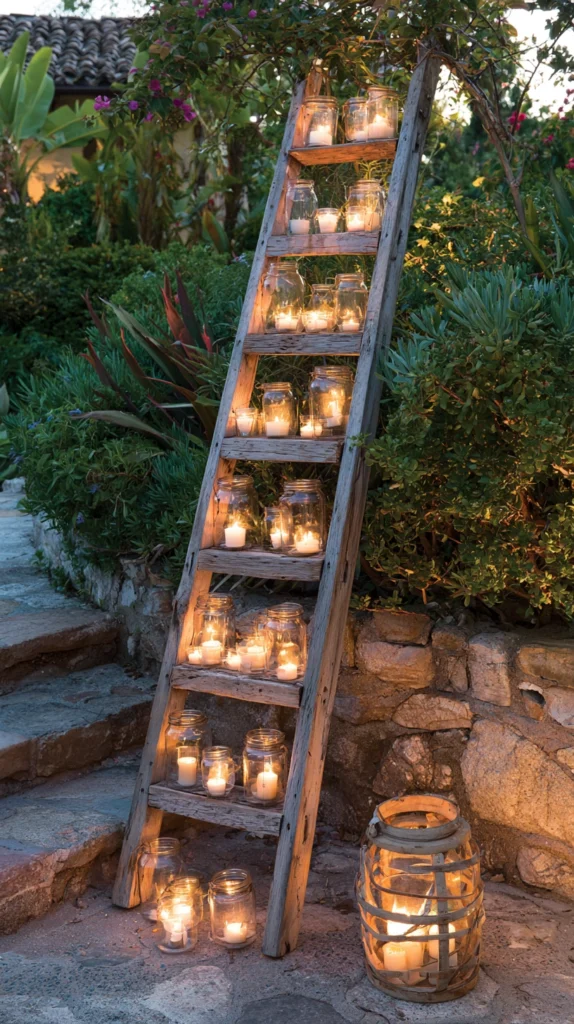
An outdoor ladder or tiered shelf holding candles and lanterns — the vertical light display that adds height to the festival atmosphere.
Why vertical light displays work:
The height dimension:
- Most outdoor lighting is low (path lights, ground lanterns)
- Or high (string lights, tree lights)
- Mid-height: often empty
- Vertical display fills the mid-height zone
The composition:
- Objects arranged vertically: naturally interesting
- Candles at varied heights on rungs: movement through height
- Each rung a different layer of light
- Composition that is also a light source
The ladder:
Vintage wooden ladder (most charming):
- Found at salvage yard or Craigslist ($15–30)
- Leaned against fence or wall
- Aged and belonging
- Weathers further outdoors (gets better)
A-frame ladder (freestanding):
- Stands without support
- Can be moved
- More stability in wind
- $20 new, less secondhand
What goes on each rung:
Candles and holders:
- Pillar candle on each rung (safe holders essential)
- Different heights of candle (lower on upper rungs for safety)
- Or: lanterns hung from rungs with S-hooks
- Each rung: one light source
Plants between rungs:
- Small trailing plant on a rung
- Ivy or tradescantia draped over
- Living element between the light elements
- Plant softens the hard ladder
Candle safety on rungs:
- Lanterns enclosing the flame (not open candle)
- Or LED candles specifically
- Ladder near fence: distance from combustibles
- Never leave real candle unattended on the rungs
Cost breakdown:
- Vintage ladder: $20
- Five small lanterns (hung from rungs): $50
- Flameless candles (5): $30
- Small trailing plant: $12
- Total: $112
The ladder against the dark fence: by day, an interesting object. By evening, a tower of warm light from ground to 6 feet. The fence behind it invisible. The light visible from every corner of the garden.
10. The Moroccan Lantern Cluster (Pattern and Amber Combined)
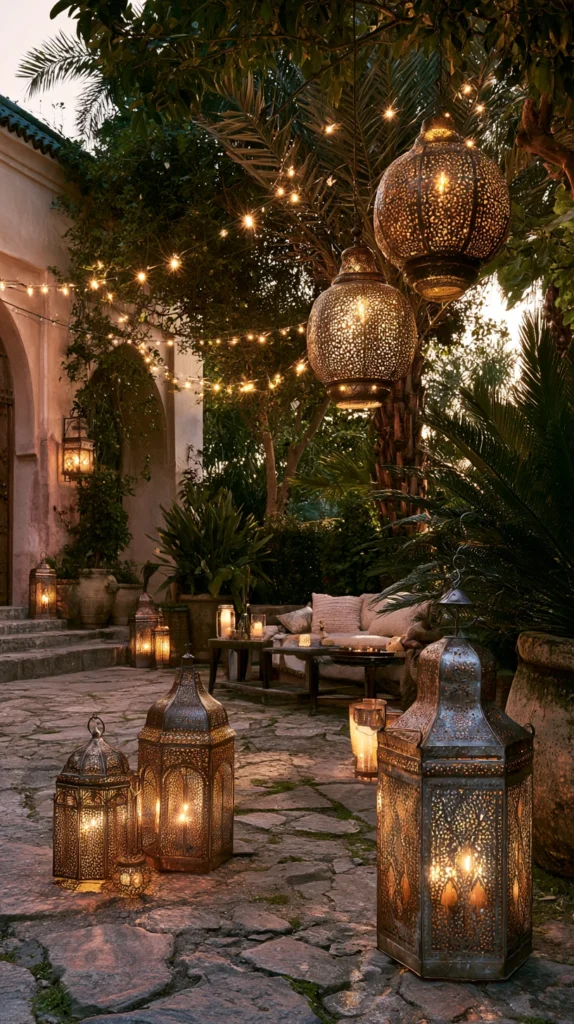
Pierced metal lanterns grouped together — the festival setup that casts geometric patterns across every surface at night.
Why pierced lanterns create festival quality:
The pattern projection:
- Solid lanterns: pools of warm light
- Pierced lanterns: pools of light plus patterns
- Patterns projected onto walls, ground, plants
- Garden covered in moving geometric light
The oriental festival reference:
- Night markets of Marrakech: lanterns everywhere
- Patterns on every surface
- Warm amber through metal piercings
- The most exotic outdoor light effect available
The pattern movement:
- Even slight air movement: lantern swings slightly
- Pattern shifts and moves across surfaces
- Flame flickers: pattern pulses
- Still light is dead. Patterned moving light: alive.
The lanterns:
Where to find:
- World Market: best selection, $20–45 each
- TJ Maxx/HomeGoods: irregular stock, good prices
- Amazon: search ‘Moroccan outdoor lantern’, $15–35
- Anthropologie: most beautiful, most expensive
The piercing pattern:
- Stars: most classic, most festival
- Geometric: contemporary and clean
- Arabesque: most elaborate projection
- All work: buy what is available in matching style
The grouping:
Floor cluster (most impactful):
- Five to seven lanterns on the ground together
- Pyramidal arrangement (tallest at back)
- All illuminated simultaneously
- Patterns cover the ground around and wall behind
Hung in tree:
- Three lanterns hung from branches
- Different heights within the tree
- Patterns project down onto ground
- Patterns project outward onto grass
Both together:
- Ground cluster plus hanging lanterns in tree
- Patterns overlap (floor and from above)
- Multiple light sources at multiple heights
- Full three layers from one type of fixture
Cost breakdown:
- Seven pierced Moroccan lanterns (varied heights): $140
- Pillar candles or flameless equivalents: $35
- Three hanging versions for tree: $60
- Total: $235
First night lit: neighbour called over the fence from the next garden: “what are you doing over there?” Patterns visible beyond the fence line. That is the test of a lighting setup — when it is visible and compelling from outside the garden.
11. The Gin and Tonic Jar Chandelier (Unexpected Hanging Display)
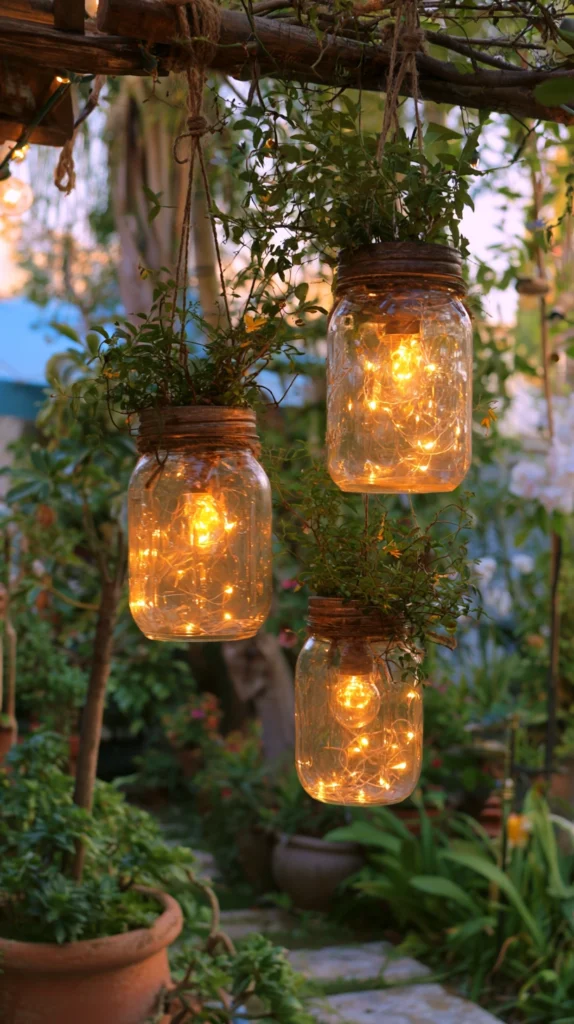
Glass jars wired together into a hanging cluster overhead — the handmade chandelier that costs almost nothing and photographs as if it cost a great deal.
Why a jar chandelier is unexpected and beautiful:
The material transformation:
- Mason jars: functional storage
- Same jars wired into a cluster and hung: art
- The context transforms the object
- Transformation is what charming design always does
The light quality:
- Glass diffuses candle or LED light
- Multiple small light sources at eye height
- The whole cluster glowing
- Each jar: a separate warm orb
Building it:
The jars:
- Six to twelve mason jars
- All same size (consistency) or varied (more organic)
- Clear glass only
- Wire loop around neck of each jar (for hanging)
Wiring the jars:
Individual wire loops:
- 18-gauge galvanised wire around each jar neck
- Loop formed and twisted tight
- Hanging wire extending from each loop
- All hanging wires gathered to one central point
The central point:
- S-hook or ring
- All jar wires gathered here
- Hung from pergola beam, tree branch, or hook
- Single suspension point for the cluster
Height variation within the cluster:
- Jars at different lengths from central ring
- Some short wires (jars hang high)
- Some long wires (jars hang low)
- Cluster hangs at different levels: three-dimensional
Inside the jars:
LED tea light (recommended):
- Flat in base of jar
- Timer-set
- No fire risk with glass around it
- Comes on every evening without action
Or: small pillar candle:
- Standing upright in jar
- Jar glass protects from wind
- Flame visible through glass
- Most atmospheric
Where to hang:
From pergola beam:
- Most stable position
- Hang over dining table (chandelier function)
- 30 inches above table surface
- Functional and beautiful simultaneously
From tree branch:
- More magical quality
- Moves slightly in wind
- Jars clink softly against each other
- Garden-as-theatre
Cost breakdown:
- Twelve mason jars: $15
- Galvanised wire (roll): $8
- LED tea lights with timer (12): $18
- S-hook and hanging ring: $5
- Total: $46
The lowest-cost setup on this list. Possibly the most responded to. Every guest asks where it was bought. It was made in an afternoon with things already in the house.
Jar Chandelier Tips
The wind problem:
- Jars moving in strong wind: they collide
- Loud glass-on-glass: not relaxing
- Avoid hanging in very exposed positions
- Or: space jars further apart on longer wires
Weatherproofing:
- Glass handles weather indefinitely
- Wire: galvanised resists rust (eventually rusts)
- LED tea lights: most are water-resistant
- Annual inspection: replace rusted wire before it fails
12. The Complete Festival Garden Setup (All Layers at Once)
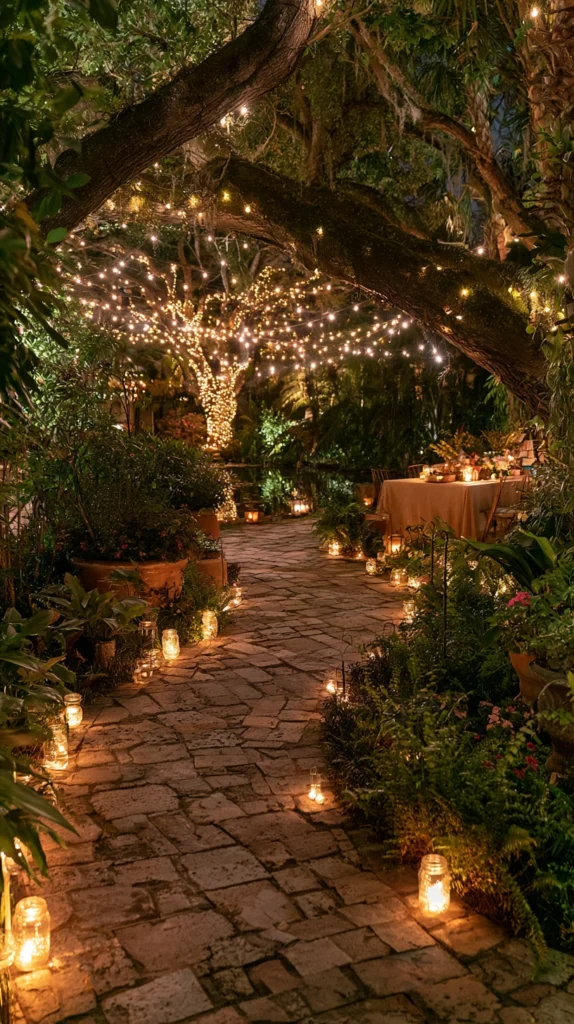
Every lighting category combined into one complete evening garden — the setup where the different layers work simultaneously to create the experience described at the beginning.
Why the complete setup is more than the sum:
Individual elements:
- String lights: the ceiling
- Jar candles: the path
- Lantern cluster: the scene
- Fairy lights in tree: the focal point
- Solar stakes in planting: the meadow
- Shepherd’s hooks: the avenue
Together:
- Every surface participating in the warmth
- Eye has no dark corner to rest in doubt
- Every zone glowing at the right level
- The garden stops announcing itself as a garden and starts feeling like an event
The design:
Starting from the house:
At the threshold (kitchen door to patio):
- Two shepherd’s hook lanterns flanking the exit
- Frame the moment of going outside
- Warm welcome before even stepping out
The patio:
- String light canopy overhead (Layer 1)
- Pendant drops over dining table
- Lantern cluster at patio edge (Layer 2)
- Mason jar path to garden (Layer 3)
The garden:
- Solar stakes through all planting
- Fairy lights in tree or trees
- Floating bowl at far end of path
- Mirror lit by a single uplight (reflects the lights above)
The result:
From the house at dusk:
- Warm canopy overhead
- Path glowing ahead
- Tree glowing at the end
- Every layer present
- The garden worth going out into
From within the garden:
- Ceiling of warm light
- Ground of warm points
- Surfaces covered in glow
- Nothing clinical or dark
- Somewhere
The automation that makes it all work:
Timer everything:
- All mains lights on one timer (dusk to midnight)
- All solar lights self-managing
- All flameless LED on timers (dusk trigger)
- Garden always ready when the evening is
The ritual of real candles:
- Jar path: lit manually before sitting
- Jar chandelier: lit manually for evenings
- Floating bowl: lit manually
- The manual lights are the ritual
- Ritual creates the beginning of the evening
Phased installation:
Week one ($77):
- Festoon zig-zag overhead (Idea #7)
- Three shepherd’s hook lanterns (partial Idea #3)
- Immediate festival quality with minimum investment
Week two ($63):
- Mason jar candle path (Idea #2)
- Ground layer added
- Three layers beginning
Week three ($160):
- Twenty solar stakes in planting (Idea #6)
- Meadow effect added to border
- Garden fully alive at night
Month two (remaining setups):
- Tree fairy lights
- Floating bowl
- Moroccan lantern cluster
- Jar chandelier
Total complete setup: approximately $700–900 depending on garden size.
But the first week: $77. The first evening of that first week: the festival quality is already present.
Cost breakdown:
- Phase one (festoon + hooks): $77
- Phase two (jar path): $63
- Phase three (solar stakes): $160
- Phase four (remaining): $400–600
- Total phased: $700–900
The One Principle That Runs Through All 12
The warm light rule stated once more:
Every setup on this list glows amber. Not white. Not blue-white. Amber.
2200K–2700K on every purchase. The temperature of candlelight. The temperature of campfire. The temperature the human nervous system has associated with warmth and safety since before recorded history.
This is not a design preference. It is the reason these setups work.
Buy cool white string lights: the effect described here does not happen. The same fixtures, the same positions, the same quantities — but cool white: a carpark, not a festival.
The number on the packaging is the most important decision made when buying any outdoor light.
Getting Started This Weekend
The two-item festival start under $80:
Festoon lights or Edison string lights (Idea #7 or #1): $40
- Run informally zig-zag overhead
- No posts required yet (use existing fence and shed corners)
- Timer switch from the first week
Five shepherd’s hook lanterns with flameless candles (Idea #3): $40
- Along the path or border edge
- Evenly spaced
- Coming on at dusk
Total: $80. Two layers: overhead and eye level. The garden is already different.
The jar chandelier for next weekend (Idea #11): $46
- Make from mason jars already in the house
- Hung from an existing beam or branch
- Third layer (mid-height composition)
Three weekends. Three layers. Under $130. Festival garden.
The evening that stops people in their tracks is one timer switch, one warm light temperature, and the decision to have more sources rather than brighter ones.
That decision costs less than a single garden centre visit. The result outlasts every season.