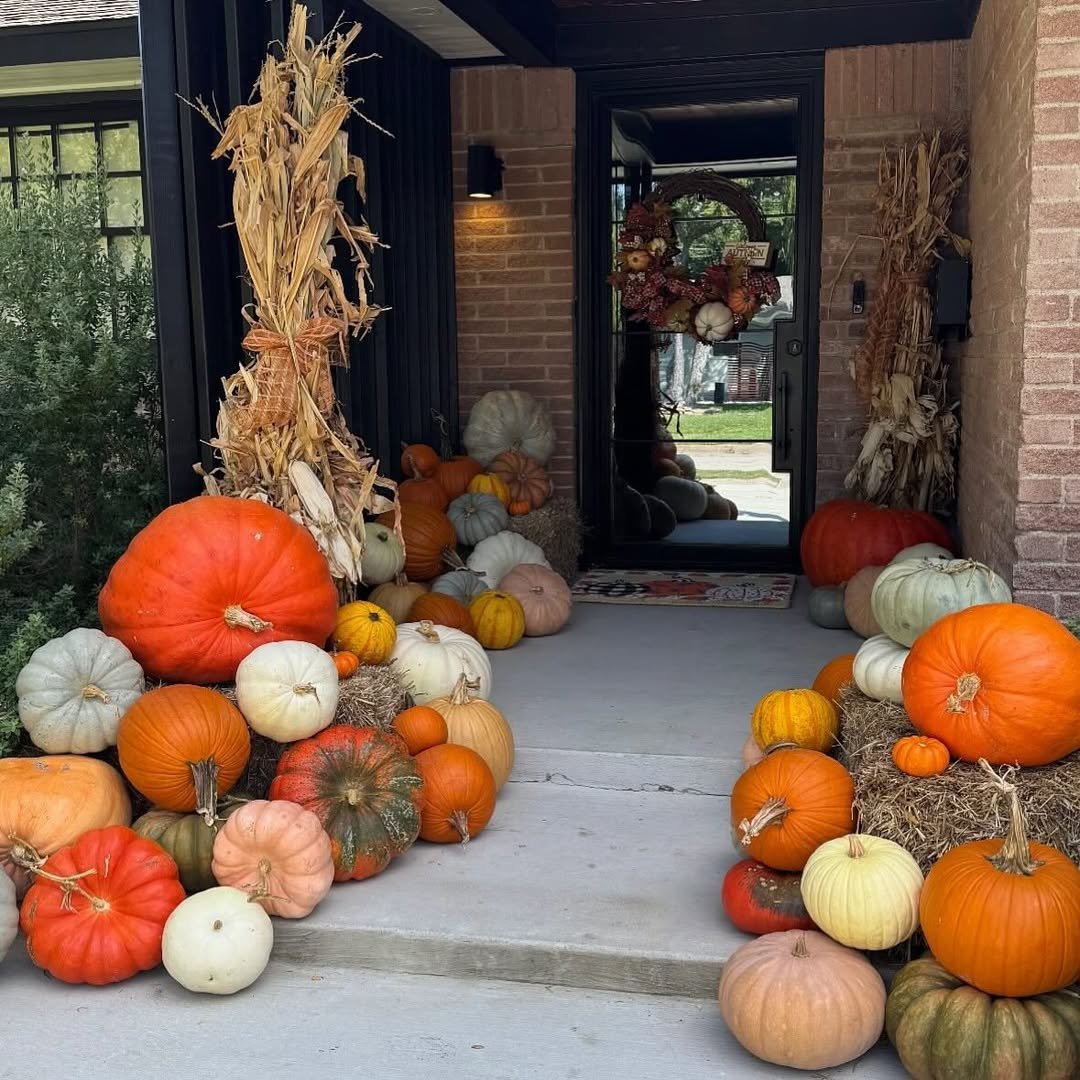
13 Pumpkin Patch Garden Display Ideas
Visited a farm stand in October once and stood at the entrance longer than I intended. Not because of the pumpkins specifically. Because of how they were arranged.
Hundreds of pumpkins, but the arrangement was not random. Colours grouped but not uniform. Heights built with crates and barrels. Dried corn and wheat around the edges. The whole thing: abundance organized just enough to feel curated without feeling artificial.
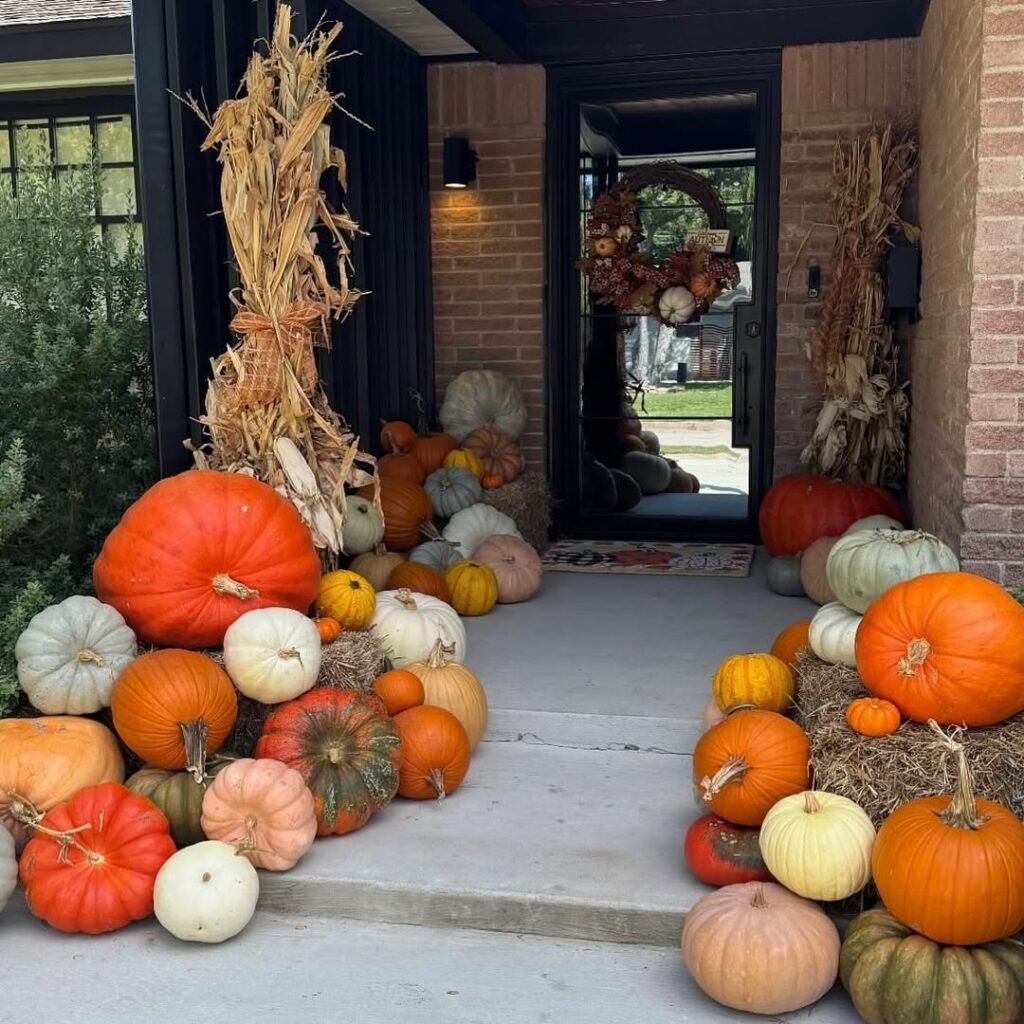
The difference between a pile of pumpkins and a pumpkin display is the same as the difference between ingredients and a meal. The materials are identical. What changes is the attention paid to how they sit together.
Here are 13 display ideas for every scale — from a single front step to a full garden corner — built on that attention.
What Makes a Pumpkin Display Work
The design principles applied to autumn’s most seasonal object:
Variety within cohesion:
- All orange pumpkins, identical size: monotonous
- Completely random mix with no relationship: chaotic
- The goal: variety in size and colour, but within a palette that coheres
- The palette: warm orange, cream, dusty green, deep red, striped — all belong together
Odd numbers:
- Three, five, seven: groups the eye reads as dynamic
- Two, four, six: the eye finds the symmetry and stops
- Odd numbers: the eye keeps moving through the arrangement
- The rule of three: the minimum effective grouping
Height variation:
- Flat arrangement at ground level: flat in every sense
- Height built with crates, barrels, logs, overturned buckets
- The variation: depth and dimension in what is otherwise a ground-level display
- The highest point: roughly one-third of the way through, not centred
Natural materials as connectors:
- Dried corn, wheat sheaves, straw bales, hay
- These: visually connect the pumpkins to each other
- Without connective material: pumpkins look placed individually
- With connective material: they look like they grew and settled together
Leave room:
- Not every inch filled
- Some open ground between groupings
- The negative space: makes each group more readable
- Crowded: reads as abundance. Over-crowded: reads as clutter.
The Pumpkin Palette
The colours available — and how they relate:
Classic orange (the anchor):
- The reference point all others are assessed against
- Used in quantity: the dominant colour
- Several varieties available in different orange depths (pale orange, bright, deep red-orange)
Cream and white:
- ‘Baby Boo’ (small, round, white)
- ‘Polar Bear’ (medium, smooth, cream)
- ‘Casper’ (large, pale cream)
- The lighter tones: lift the arrangement, prevent the orange from becoming heavy
Dusty blue-green:
- ‘Crown Prince’ (the most beautiful pumpkin available in this colour)
- ‘Queensland Blue’
- The cool tone: creates contrast and sophistication
- Used sparingly: the accent
Deep red-orange:
- ‘Rouge Vif d’Etampes’ (the Cinderella pumpkin — flat, deeply ribbed, red-orange)
- ‘Red Kuri’
- Darker and richer than standard orange: the “statement” pumpkin
Striped and unusual:
- ‘Candy Roaster’
- ‘Jarrahdale’ (grey with ribbing)
- Ornamental gourds (the most varied in shape and colour)
- These: the detail elements, not the foundation
1. The Stacked Crate Display (Height Without Scaffolding)
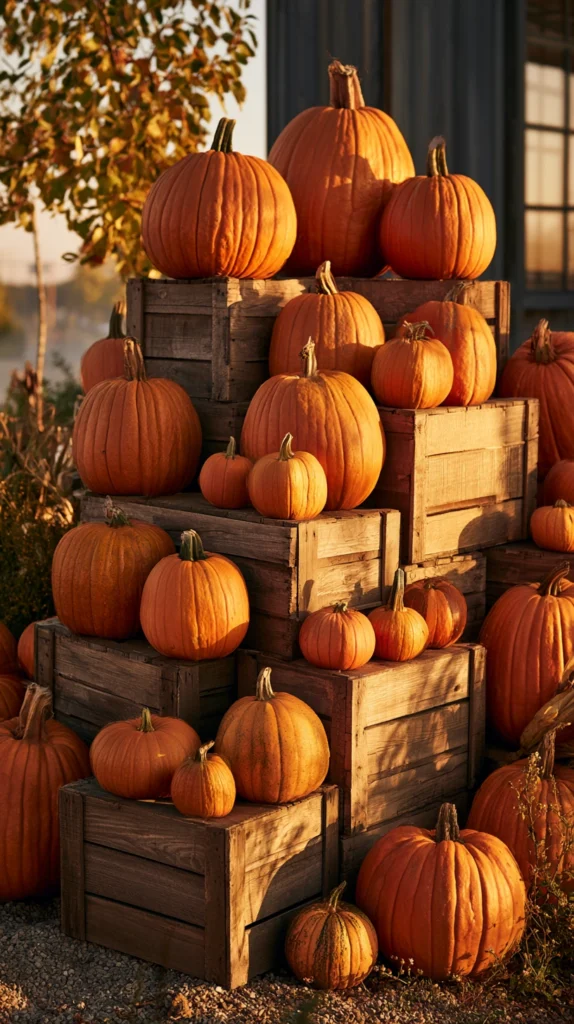
Wooden crates or fruit boxes stacked at different heights, with pumpkins arranged across the levels — the structure that gives a flat ground-level collection its third dimension.
Why stacked crates work:
The instant height:
- Pumpkins placed at ground level only: the arrangement reads as a floor-level pile
- Pumpkins at three heights: the arrangement reads as a structured display
- The crate: the simplest, most available way to create height
- Available free or nearly free (markets, grocers often discard them)
The market stall aesthetic:
- Wooden fruit crates: associated with markets and farm stalls
- The association: abundance, freshness, seasonal produce at its source
- Using these crates: activates the association without needing to explain it
The configuration:
Three-level arrangement:
- Stack 1: two crates stacked (highest point — back or off-centre)
- Stack 2: one crate (mid-level — near the front)
- Ground level: the base
- Three levels with varying heights: creates the “step” profile that reads as designed
What to place on each level:
Highest level (one or two large pumpkins):
- The “hero” pumpkins — the most dramatic or most beautiful
- Often the largest, or a particularly unusual colour
- Visible from the furthest distance
Mid level:
- Medium pumpkins, or a cluster of small ones
- A mix of colours: the variety visible at this height
Ground level:
- Gourds, the smallest pumpkins, ornamental corn
- The base: the connection to the ground
The crates as objects:
Natural wood:
- The warm, aged quality of old wood is part of the display
- Any lettering or markings on old crates: add character
- Sand or paint if a cleaner look is desired
Spray-painted crates:
- Dark green or black crates: dramatic backdrop
- White crates: bright and farmhouse-adjacent
- The crate colour: a design decision in itself
Cost breakdown:
- Reclaimed crates (free from markets): $0
- Or purchased wooden display crates: $8–15 each
- Pumpkin collection (see other ideas): varies
- Total crate cost: $0–45 for three crates
The farm stand effect at home: same three stacked crates, same pumpkins, different arrangement. The three levels changed the reading entirely.
Crate Display Tips
The stability concern:
- Stacked crates with pumpkins on top: heavier than they appear
- Ensure stacks are stable before adding heavy pumpkins
- Place heaviest pumpkins on the lowest level
- Test stability by pressing gently on the top before walking away
The crate contents:
- Fill the crates with straw before placing pumpkins
- The straw: fills the visual gaps between slats
- Also: acts as a non-slip base for the pumpkins
- And: looks correct for the farm-stand aesthetic
2. The Barrel and Hay Bale Arrangement (The Farm Aesthetic)
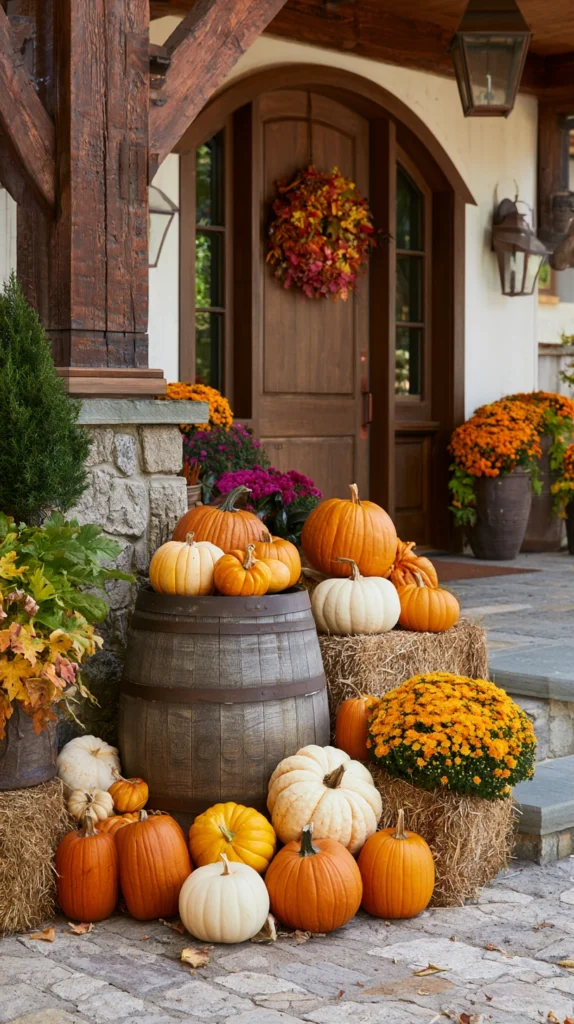
Old barrels and hay or straw bales as the structural elements, with pumpkins arranged around and on them — the rustic display that needs almost no design beyond the placement.
Why barrels and hay bales do the work themselves:
The instant context:
- A barrel or hay bale: the objects read as “farm” or “harvest” before anything is placed on or around them
- The context: already established when the pumpkins arrive
- The pumpkins: confirming rather than creating the setting
The scale:
- Hay bales: large enough to anchor a significant display
- A display that needs to be seen from a distance (a garden corner, a driveway entrance): hay bales provide the scale
- A barrel: taller than most other elements, creates the vertical without needing stacking
The arrangement:
The classic configuration:
- Two hay bales: one stacked on the other (height) or side by side (width)
- Barrel: beside or partially behind the bales
- Pumpkins: clustered at the base of both, on top of the bales, and between the barrel and bales
- Dried corn or wheat sheaves: leaned against the barrel
What the elements provide:
The hay bale:
- Ground-level mass
- Natural material that connects to autumn
- A flat surface for sitting pumpkins
- The connective texture between individual pumpkins
The barrel:
- The vertical anchor
- If hollow: can be filled with dried corn stalks, tall grasses, or wheat sheaves emerging from the top
- The most dramatic single element in this display type
Sourcing:
Hay or straw bales:
- Garden centres and farm supplies: widely available in autumn
- Often very affordable ($5–15 per bale depending on region)
- Straw bales (golden, cleaner): better for display than hay bales (which can be green and messy)
Barrels:
- Old whisky or wine barrels: available from farm stores, garden centres, eBay
- A genuine aged barrel: the most characterful option
- Display-only barrels (half barrels): sold at many garden centres
- Half barrels alone: suitable for planting, but also serve as display pedestals
Cost breakdown:
- Straw bale (1–2): $10–25
- Half barrel (if not already owned): $30–60
- Total structural elements: $40–85
3. The Doorstep Pyramid (The Scaled-Down Classic)
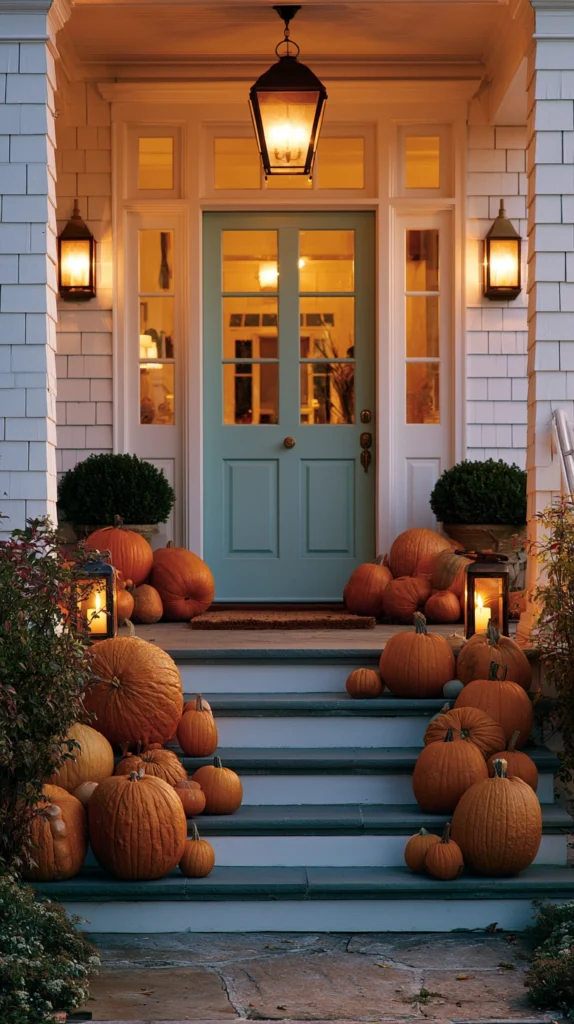
A grouping of five to nine pumpkins arranged on steps or a small porch — the most common version of pumpkin display done with the design principles applied.
Why doorstep displays deserve more attention:
The arrival experience:
- The front step or door: the first thing seen on approach
- A well-arranged doorstep display: signals that the interior will be equally considered
- A careless doorstep: undermines an otherwise well-kept home
The pyramid principle:
The loose pyramid:
- Largest pumpkin at the back or top
- Medium pumpkins in the middle tier
- Smallest pumpkins at the front and base
- The form: roughly pyramidal, but organic, not perfect
- No two pumpkins at exactly the same height
For a single step:
- One large pumpkin: the anchor
- Two medium: flanking or slightly in front
- Two to three small: clustered nearby
- Five pumpkins: the minimum for this to read as a display rather than objects placed on a step
For multiple steps:
- Each step: a tier in the pyramid
- Top step: largest pumpkins
- Middle steps: medium
- Bottom step and ground level: smallest and gourds
- The staircase itself: the structure that creates height without crates
The flanking elements:
Potted mums:
- The classic companion to pumpkins on steps
- Deep red, copper, or yellow chrysanthemums
- In matching terracotta pots
- Placed beside (not behind) the pumpkin grouping
Ornamental kale:
- As covered in the autumn garden article
- Deep purple-red rosettes
- In pots flanking the display
- Contrasts beautifully with orange pumpkins
Corn stalks:
- Tied in bundles and leaned against the door frame
- The vertical element in an otherwise horizontal arrangement
- The scale: in proportion to the door height
The colour palette for doorstep displays:
Coordinate with the door:
- Dark door (navy, forest green, black): cream and white pumpkins stand out dramatically
- Warm-toned door (red, orange, yellow): deep dusty green pumpkins contrast beautifully
- Natural wood door: any pumpkin palette — the warm wood complements all
Cost breakdown:
- Seven varied pumpkins (mixed sizes and colours): $20–35
- Two potted mums: $18
- Bundle of corn stalks (optional): $8
- Total: $46–61
4. The Monochromatic White and Cream Display (The Modern Pumpkin Garden)
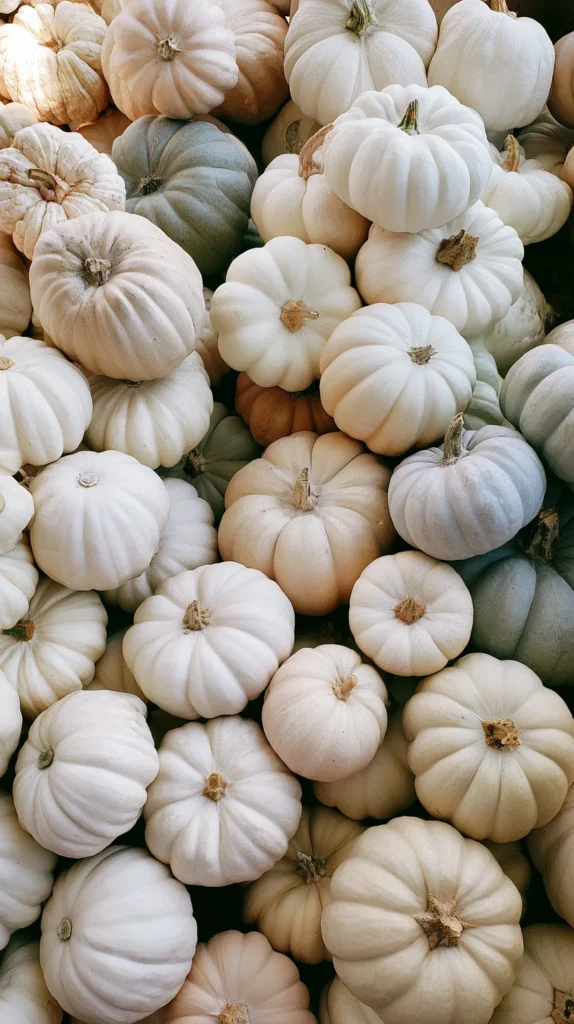
A collection using only white, cream, and pale grey pumpkins — the contemporary approach that prioritises sophistication over tradition.
Why a monochromatic palette elevates the display:
The restraint signal:
- A single-colour palette: requires confidence
- The restraint: reads as design literacy
- Traditional orange arrangements: anyone can assemble
- A carefully considered single-palette arrangement: a point of view
The visual effect:
White and cream pumpkins against a dark background:
- Dark fence, dark door, or deep green hedge
- The pale pumpkins: glow against the dark
- The contrast: maximises the visual impact of a quiet palette
White and cream in morning or evening light:
- Pale tones: catch low light dramatically
- The golden hour light on cream pumpkins: extraordinary
- The display: designed for the autumn light, not for midday overhead light
The varieties:
Small (for clusters and ground-level):
- ‘Baby Boo’: golf ball size, pure white, round
- ‘Snowball’: slightly larger, smooth
- ‘White Ghost’: medium, pure white
Medium:
- ‘Casper’: smooth, large, cream-white
- ‘Cotton Candy’: mid-sized, smooth
- ‘Lumina’: broad and flat, cream
For texture and interest:
- Warted/Bumpy varieties (‘Knucklehead’, ‘Warty Goblin’): in white or cream — the texture makes the palette interesting
- The texture: where visual interest comes from when colour is restricted
The combination with neutral botanical materials:
Silver and grey dried materials:
- Dried cotton stems
- Dried artichoke heads (grey-silver)
- Dusty miller foliage (if still available)
Pale grasses:
- Dried pampas or bunny tail grass
- The cream of the grass: matches the cream of the pumpkins
- The coordination: full-palette approach to the display
Cost breakdown:
- Five to nine white/cream pumpkins (mixed sizes): $25–50
- Dried botanical materials: $10–20
- Total: $35–70
5. The Colour-Blocked Arrangement (Curated Sections)
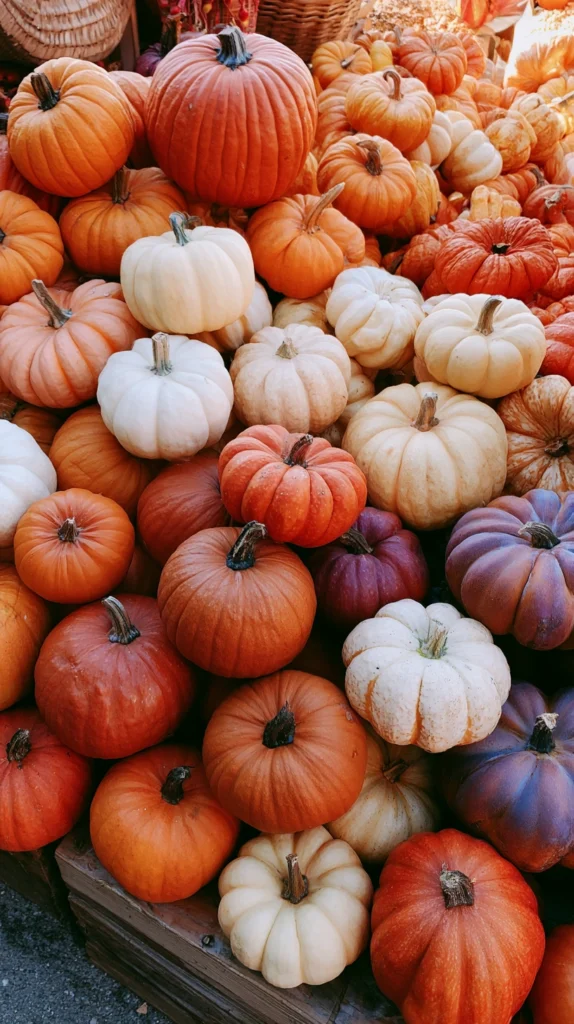
Pumpkins grouped by colour, so each section of the display has its own tonal identity — the approach that imposes order on a large collection without removing variety.
Why colour blocking works for large displays:
The legibility problem:
- A large mixed collection of varied colours, randomly arranged: a jumble
- The eye: cannot find a resting point
- Colour blocking: gives the eye a place to land in each section
- The overall display: varied. Each section: coherent.
The section approach:
Section one (orange):
- All the warm orange pumpkins
- Varied sizes and depths of orange
- The foundational section — most pumpkins, most central or most at the “anchor” end of the display
Section two (cream and white):
- The lighter section
- Often positioned at one end or one side
- Creates a visual breathing point in the display
Section three (deep and dark):
- Deep red, dusty green, or striped
- The accent section — fewer pumpkins but the most distinctive colours
- Often positioned at the other end from the cream section
- The visual bookend to the whole arrangement
The transitions:
Soft transitions between sections:
- Where orange meets cream: a few pumpkins with orange skin and cream patches, or a mix of the smallest pumpkins from each section
- The sections: not hard-edged like a paint chart
- Gradual colour transitions: the sections related, not separated
The height within each section:
Each section has its own height variation:
- Not one flat row of orange, then one flat row of cream
- Within each colour section: height variation (crates, ground level, a barrel in the orange section)
- The colour blocking: horizontal. The height variation: vertical.
- Both together: depth and dimension throughout the entire display
Cost breakdown:
- A larger collection for a colour-blocked display: typically 15–25 pumpkins
- Varied sizes, three colour families: $35–75
- Total: $35–75
6. The Naturalistic Ground Scatter (As If They Grew Here)
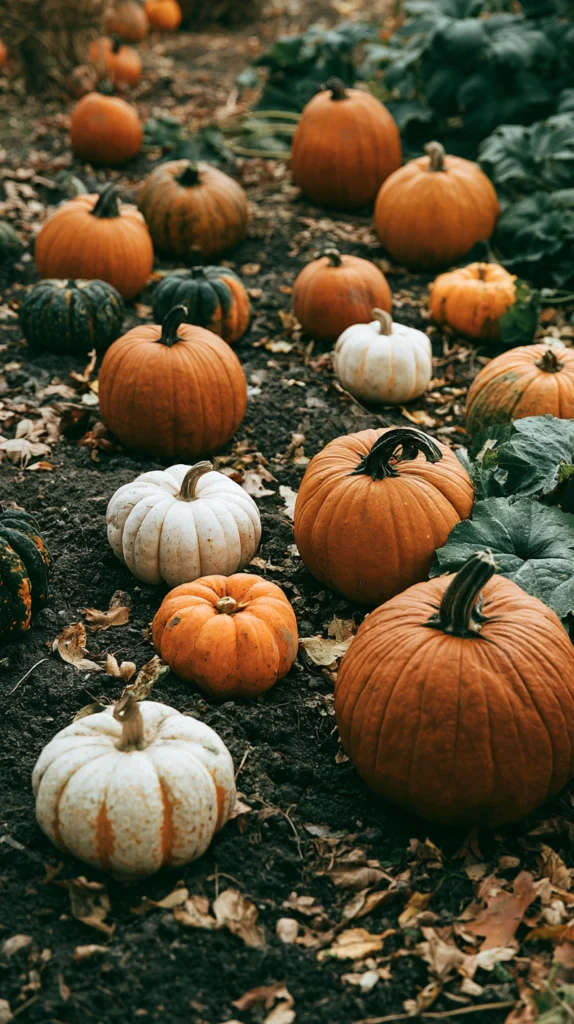
Pumpkins arranged on mulch or ground cover as if settled where they grew — the opposite of the structured approaches, and sometimes the most beautiful.
Why the “just grew here” effect works:
The authentic quality:
- A carefully structured display: beautiful, but visible as arranged
- A naturalistic scatter: creates the impression of encountering pumpkins in their natural state
- The impression: the garden that grew these things, not the garden that purchased them
- The authenticity: more powerful than any formal arrangement
Where this works:
A vegetable or kitchen garden:
- Pumpkins placed among the remaining autumn planting
- On the mulch of the kitchen garden beds
- As if some were not harvested — discovered in place
- The most convincing naturalistic display
A border with autumn planting:
- Nestled into the base of the autumn border planting
- Between the ornamental grasses and the seed heads
- The pumpkins reading as part of the garden’s autumn production
- The integration: plants and pumpkins as one composition
At the base of a large tree:
- On the fallen leaves at the tree’s base
- The tree’s roots partly visible: the pumpkins apparently resting among them
- Dark mulch or fallen leaves: the backdrop
The technique:
The randomness is designed:
- A truly random scatter: often looks abandoned
- A designed scatter: varied spacing, some pumpkins partially overlapping, some alone, orientations varied (not all stems up)
- Some: stem-side horizontal, as if rolling to rest
- Some: upside down (the bottom of a pumpkin, being rounder, rests differently than the top)
- The variety in orientation: part of what makes it convincing
The connective elements:
Fallen leaves:
- Scattered among the pumpkins
- Gathered from the garden itself
- The leaves: the most convincing naturalistic connector
- Free and entirely seasonal
Dried vines:
- If growing pumpkins: the dried vine is already there
- If not: a purchased length of dried grapevine, loosely wound among the pumpkins
- The vine: the narrative object — these pumpkins grew on this vine
Cost breakdown:
- Ten to fifteen pumpkins of varied sizes: $25–50
- Dried grapevine (if not from own garden): $5–10
- Total: $30–60
7. The Illuminated Pumpkin Display (After-Dark Interest)
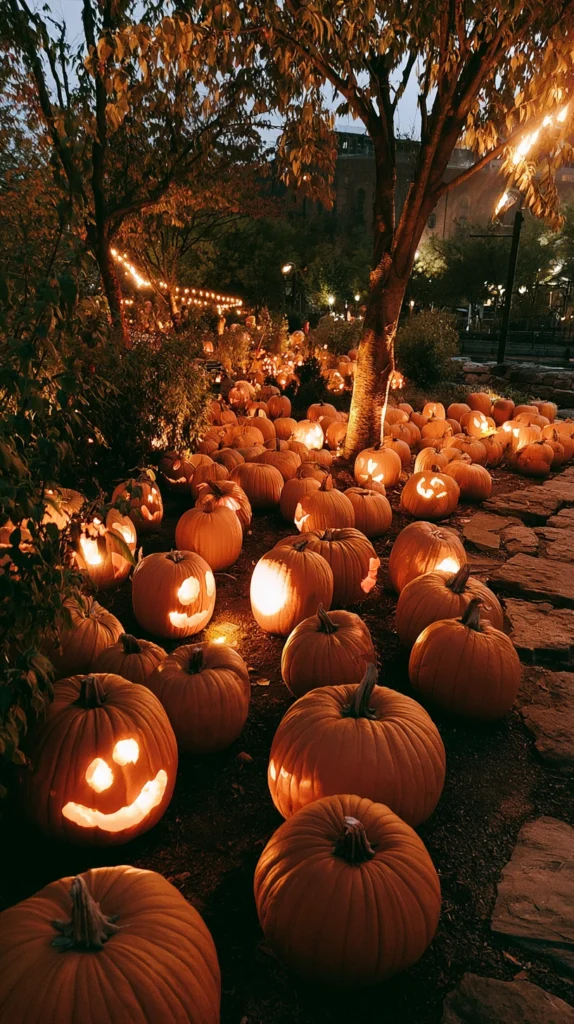
Candles, LED lights, or uplights within or behind the pumpkin display — the version designed for autumn evenings.
Why lighting transforms the display after 5pm:
The practical necessity:
- Dark by 5 or 6pm in late October
- An outdoor display without lighting: invisible after dark
- A display with lighting: the primary garden feature in the evening hours
- In autumn: the evening hours are the majority of the outdoor hours
The warmth amplification:
Warm amber through orange pumpkin skin:
- A candle inside a hollowed pumpkin: the classic jack-o’-lantern principle applied aesthetically
- Without carving: a candle inside an uncut pumpkin does nothing
- With small holes drilled (not carved faces): starlight patterns
LED fairy lights among the pumpkins:
- Not inside pumpkins: between them
- Warm white (2700K only — always)
- Nestled in straw or around the display’s base
- From a distance: the display appears to glow from within
Uplighting the display:
A solar spike light at the base:
- Aimed up and into the display
- The pumpkin colours illuminated from below
- Shadows projected upward onto the fence or wall behind
- The most dramatic evening version of a pumpkin display
Two or three directional spotlights:
- Positioned around the display’s perimeter
- Each aimed from a different angle
- Shadows crossing and creating depth
- The display: three-dimensional in evening light
The carved pumpkin within the display:
One or two carved, many uncarved:
- The carved pumpkins: the evening’s light sources within the display
- The uncarved: the structural and colour elements throughout
- The combination: both the display function (uncarved) and the light source function (carved)
- The ratio: mostly uncarved — the carving is the detail, not the whole
Cost breakdown:
- Solar spike uplights (2): $25
- Warm LED fairy light string: $12
- Tealight candles for carved pumpkins: $5
- Total: $42
8. The Wheelbarrow or Wagon Display (The Moveable Arrangement)
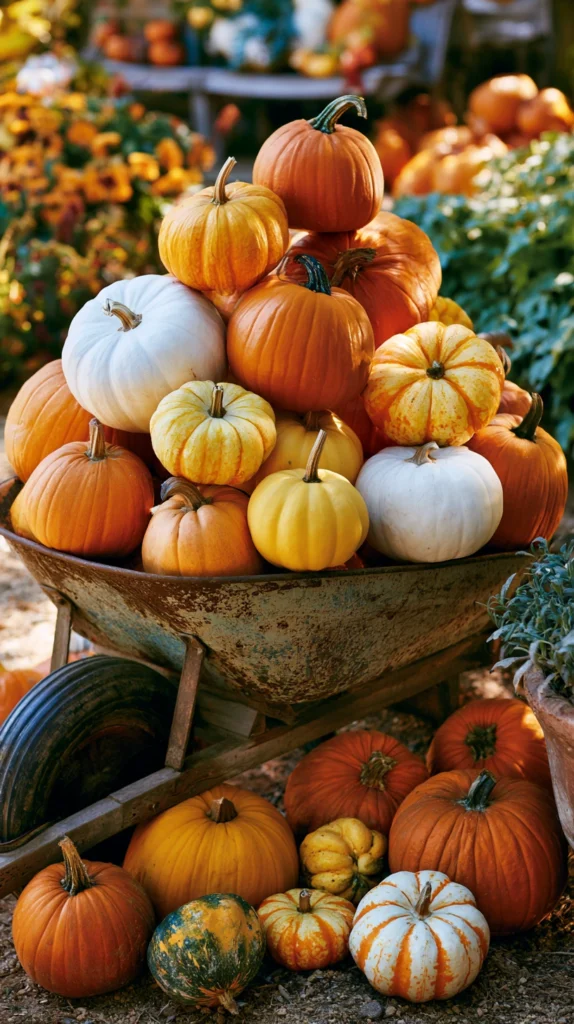
Pumpkins displayed in an old wheelbarrow, wooden wagon, or vintage cart — the contained display with built-in character.
Why a vessel transforms the arrangement:
The single object as display:
- A wheelbarrow full of pumpkins: one strong image
- No need for crates, bales, or additional structure
- The vessel itself: the structure
- The arrangement: simpler because the boundaries are defined by the vessel
The character the vessel brings:
Old wheelbarrow:
- Rusted metal or aged wood
- Patina: evidence of years of use
- The contrast between the utilitarian vessel and the seasonal abundance: the visual interest
- Found secondhand: often very inexpensive or free
Vintage wooden wagon:
- Weathered wood, iron wheels
- The most photogenic of the vessel options
- Particularly suitable for a driveway or entrance setting (the scale: right for a large space)
- Often found at farm supply stores or antique dealers
Garden cart (flat-bed):
- A large flat wooden sled or cart
- Can hold more pumpkins than a wheelbarrow
- More floor-display than vessel, but with defined edges
- The flatness: allows the arrangement to be seen from above (if the display is on an elevated surface or slope)
The arrangement within the vessel:
Fill the base with straw:
- Before pumpkins go in
- The straw: holds pumpkins level and fills visual gaps
- The straw: visible at the edges, confirming the vessel’s harvest-context
Overfilling is correct:
- A full-to-overflowing wheelbarrow: the image
- Some pumpkins: allowed to rest against the outside of the vessel as if they have spilled
- The overflow: the abundance signal
What else goes in:
- One bunch of dried wheat or corn: leaning against or emerging from the pumpkins
- A few gourds among the pumpkins: varied shapes within the vessel
- Dried corn: woven or scattered among the pumpkins
Cost breakdown:
- Old wheelbarrow (secondhand): $0–30
- Or vintage wagon (garden centre): $35–80
- Pumpkins and gourds (to fill): $20–40
- Straw: $5
- Total: $25–125 depending on whether the vessel is owned or purchased
9. The Garden Gate or Arch Display (The Framed Entry)
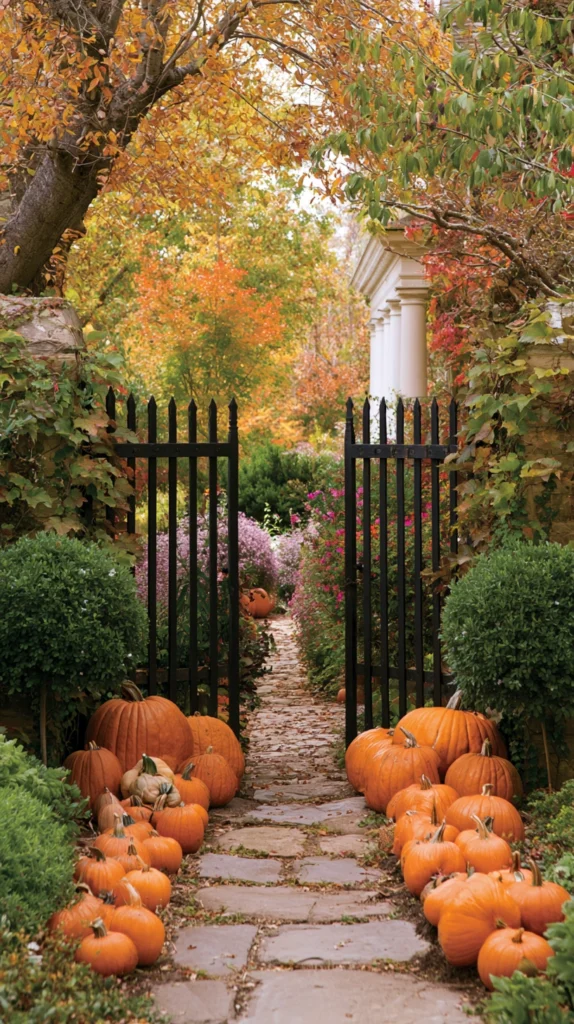
Pumpkins, gourds, and autumn botanicals arranged at and around a garden gate or archway — the display that marks the transition from one space to another.
Why gates and arches are natural display sites:
The threshold:
- A gate: the moment of crossing from outside to inside the garden
- An arch: the framed transition from one garden zone to another
- Both: already the most noticed point of the garden journey
- Decorating here: the most visible position, guaranteed to be seen
The height opportunity:
The arch:
- If a climbing plant is on the arch: dried botanicals, corn stalks, or bundles of wheat can be woven into the existing plant structure
- The arch: adds height to the display without any additional structure
- Pumpkins at the base; botanical materials at the height of the arch
The gate post:
- Hanging baskets or posies of dried materials on each gate post
- Pumpkins clustered at the base of each post
- Corn stalks flanking the gate opening, leaned against the posts and tied in place
The arrangement:
Symmetrical at the gate:
- One cluster of pumpkins each side of the gate
- Matching in volume, not necessarily in specific arrangement
- The symmetry: frames the entrance formally (suits a more traditional garden)
Asymmetrical at the gate:
- Larger grouping on one side, smaller accent on the other
- More contemporary and less expected
- The eye: travels from the larger grouping to the smaller, through the gate
Overhead at the arch:
- A swag of dried corn, wheat, and autumn botanicals hung above the arch
- The pumpkins: at the base
- The display: occupying the full height of the arch
The materials for hanging:
Dried corn husks (tied in a bundle):
- Classic autumn arch decoration
- Hangs and dries further in place
- The rustle in the wind: a sound element
Grapevine and dried botanicals:
- A grapevine wreath-style swag for the arch top
- Foraged autumn materials woven in
- The arch: becomes an autumn bower
Cost breakdown:
- Pumpkins for two gate posts: $15–25
- Dried botanical materials for arch: $10–20
- Twine and ties: $3
- Total: $28–48
10. The Straw Bale Seating Display (Function and Decor Together)
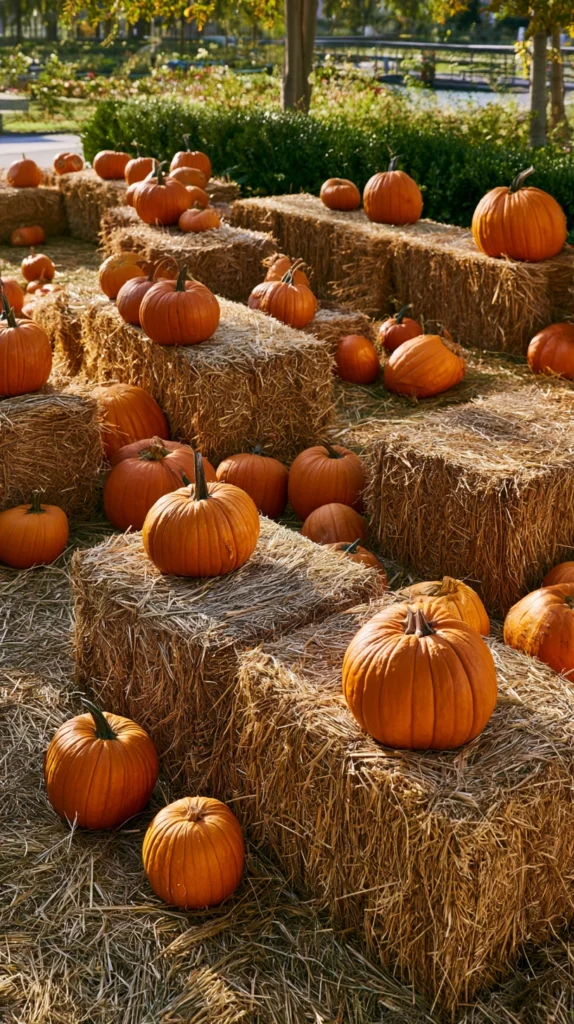
Straw bales arranged as seating, with pumpkin and gourd display integrated into the seating arrangement — the display that is also used.
Why functional display is better than purely decorative display:
The permission to interact:
- A purely decorative display: looked at, not touched
- A straw bale seating area: sat in, used
- The experience: the display is part of the autumn social space, not separate from it
- Guests interact with the arrangement rather than observing it at a distance
The configuration:
A U-shape or horseshoe:
- Three hay bales forming the seating (back bale and two sides, open front)
- Fire pit or chiminea in the open centre
- Pumpkins clustered at the outer corners and along the back bale
- The arrangement: the autumn fire circle
A flat row:
- Four or five hay bales in a line, functioning as a bench
- Pumpkins arranged at each end of the row, and dotting the spaces between seated guests
- Simple and highly functional for a harvest gathering
What goes on the bales themselves:
Not just seating — surfaces for display:
- Pumpkins on the bale surface, between where people will sit
- A bowl of apples or small gourds: accessible from the seating
- A lantern on the corner bale: the fire element within the seating arrangement
Cushions and comfort:
Straw bales are scratchy:
- A simple cushion or folded blanket on each bale: the comfort solution
- The blanket: also the warmth element
- The blanket in an autumn colour: completes the palette
- Available and in use from the moment guests sit
The scale:
This display requires space:
- Three hay bales as seating: requires at least a 12×12 foot area
- The fire in the centre: additional clearance (minimum 3 feet from bales)
- The display: for a garden with a proper area dedicated to it
Cost breakdown:
- Three to five straw bales: $15–40
- Cushions or blankets for seating: $30–50
- Pumpkins for the display: $20–35
- Total: $65–125
11. The Mixed Botanical and Pumpkin Vignette (Garden Style Display)
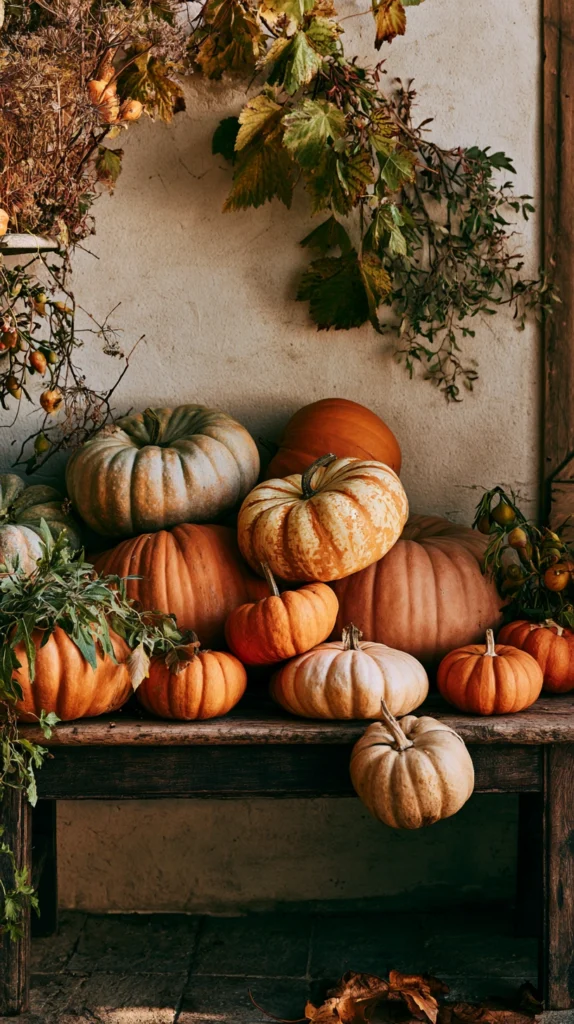
Pumpkins combined with autumn botanical materials — dried flowers, grasses, foliage, gourds — in a styled vignette — the approach that treats the pumpkin display as interior design applied outside.
Why mixing botanicals elevates the display:
The garden-to-display connection:
- Pumpkins alone: a seasonal object
- Pumpkins with autumn garden materials: a composition that references the whole season
- The display: the garden’s autumn self-portrait
What goes with pumpkins:
Dried grasses:
- Pampas plumes, dried miscanthus, stipa
- The height and movement: adds the dimension pumpkins alone cannot provide
- Placed in a vase or bucket within the pumpkin arrangement, or simply leaned against the backdrop
Preserved or dried autumn leaves:
- The fallen leaves of the garden, pressed or simply collected
- Scattered around the base of the arrangement
- The most obviously seasonal connector
Rosehips:
- The red berries of the rose after flowering
- Sprigs cut and placed among the pumpkins
- Bright red: a colour complement to the orange pumpkins and the warm botanical materials
Dried hydrangea heads:
- Papery, faded cream or blue-pink
- Placed directly among the pumpkins
- The scale: large enough to register in the arrangement
Acorns and conkers:
- Gathered from the garden or local trees
- Scattered at the base of the arrangement
- The smallest elements: the detail that rewards a close look
The table or surface display:
An outdoor table surface:
- A styled vignette on the outdoor dining table
- Centred, like an interior tablescape
- Pumpkins at varied heights (small pumpkins on a brick or upturned pot), botanical materials framing them
- The autumn table center: replacing summer’s candle arrangement
A garden bench:
- Three or five pumpkins arranged on a wooden garden bench
- Botanical materials between and around them
- The bench visible from the main seating area: a secondary focal point
Cost breakdown:
- Pumpkins and gourds: $15–30
- Dried botanical materials: $10–20
- Total: $25–50
12. The Children’s Interactive Pumpkin Patch Corner (A Space for Exploration)
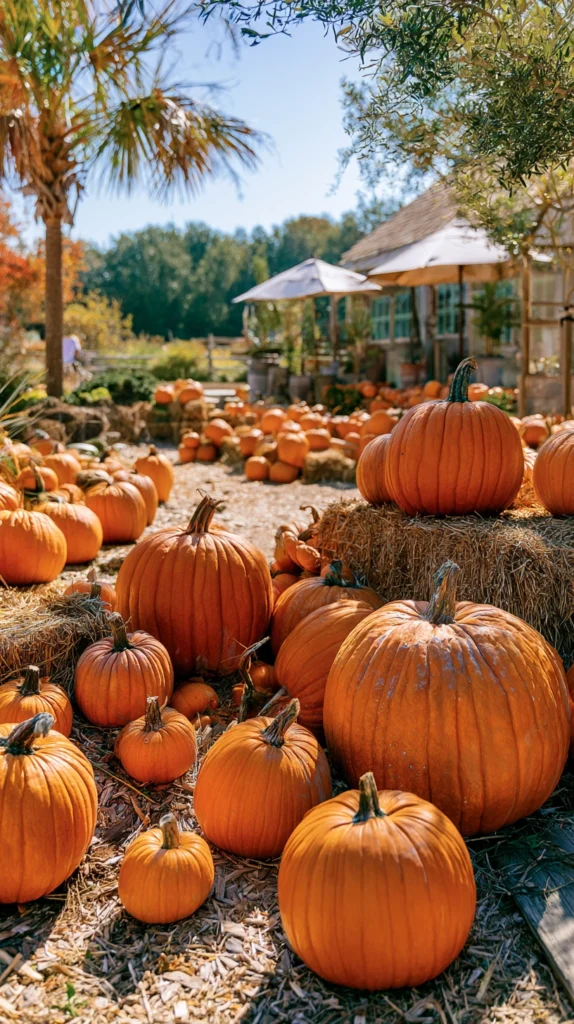
A dedicated corner of the garden filled with pumpkins and gourds at ground level, designed for children to explore and arrange — the display that is not a display at all, but an experience.
Why an interactive pumpkin corner is worth creating:
The child’s relationship with pumpkins:
- Children: drawn to pumpkins immediately (the size, the shape, the variety of colours)
- The desire to move them, stack them, hold them: immediate
- A display designed for adults only: a constraint on what children do naturally
- A children’s corner: gives them the full experience without creating anxious adults hovering over a “fragile” arrangement
The design:
Ground level entirely:
- No raised crates or barrels that create falls risk
- Everything: accessible at a child’s height
- The layout: the pumpkins arranged to be picked up and moved
Variety of sizes:
- Some small enough for a young child to carry (pie pumpkins, ‘Baby Boo’, small gourds)
- Some medium (for older children)
- Some large (for looking at, not lifting)
- The variety: for different ages and abilities
Gourds specifically:
- The bizarre shapes of ornamental gourds: endlessly fascinating for children
- Swan-neck gourds, turban gourds, bottle gourds
- The most varied and unusual shapes: here
- Children: will spend significant time with the gourds
The activities:
Pumpkin painting (not carving):
- Paint and brushes: provided at the corner
- Pumpkins painted rather than carved (safer for children, and the painted pumpkins become longer-lasting decorations)
- Acrylic craft paint: sticks to pumpkin skin well
- The painted pumpkins: displayed in the rest of the garden after
Pumpkin weighing:
- A simple kitchen scale
- The heaviest pumpkin: the competitive activity
- Free and requires no preparation
The arrangement around the perimeter:
A low hay bale border:
- Defines the “patch” area
- Low enough for children to step over (not a barrier, just a definition)
- The enclosed feeling: the patch is its own world
A wooden sign:
- ‘Pumpkin Patch’ or simply the year
- Made from a piece of reclaimed wood and paint or woodburning
- The entrance to the children’s corner: marked
Cost breakdown:
- Mixed pumpkins and gourds (emphasis on small and varied): $20–40
- Small hay bale border: $15
- Craft paint set: $8
- Total: $43–63
13. The Complete Autumn Garden Entry (All Elements Combined)
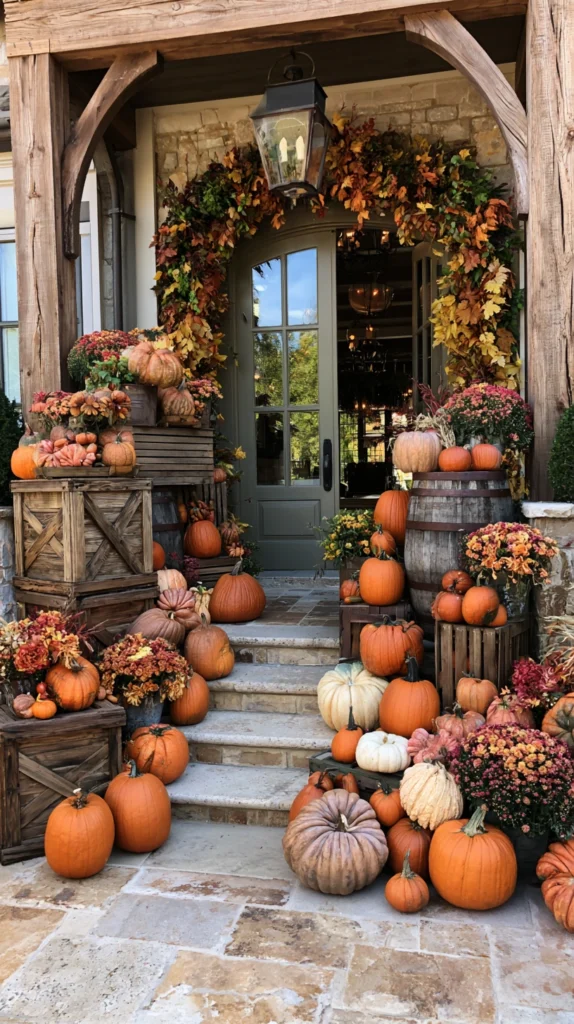
The full pumpkin patch display, combining structural elements, colour variety, botanical materials, lighting, and interactive features — the garden entry that stops visitors before they reach the door.
Why the complete display exceeds the sum of its parts:
Individual elements:
- A stack of pumpkins: seasonal
- A barrel: character
- Hay bales: abundance
- Lighting: warmth
- Botanical materials: texture
- All together: a destination, not a decoration
The complete entry design:
The structure:
- One barrel: the vertical anchor, positioned off-centre (left or right, not centred)
- Two hay bales: providing mass and seating level
- Crates (two to three): creating height levels on the opposite side from the barrel
- The structure: asymmetrical, creating a path through the display toward the entrance
The pumpkins across the structure:
A mixed palette:
- Orange (the dominant colour, 50% of pumpkins)
- Cream and white (30%)
- Deep red or dusty green (20%)
- The palette: warm but varied
Height allocation:
- Largest pumpkins: on the tall crate and leaned against the barrel base
- Medium pumpkins: on the single crates and hay bale surfaces
- Small pumpkins and gourds: at ground level and filling gaps
The botanical materials:
Dried corn stalks:
- Leaned in a bundle against the barrel
- Tied with twine at two points
- The height: reaching above the barrel
- The vertical line: breaking the horizontal spread of pumpkins
Wheat sheaves:
- Smaller bundles, placed at transitions between sections
- The connective texture between groupings
Fallen leaves and dried gourds:
- Ground-level scatter
- The carpet from which the display rises
The lighting for evening:
- Solar uplights (two or three): positioned around the display perimeter
- Warm LED fairy lights: nestled in the hay bale surfaces
- One or two carved pumpkins: the warm-glowing elements at dusk
- The display: available and beautiful from 5pm through the evening
The children’s element:
- One section at ground level: smaller pumpkins and gourds accessible and moveable
- Paint and brushes nearby: the interactive invitation
- The children’s zone: within the overall display, not separate from it
The entrance flanking elements:
- Two large terracotta pots with ornamental kale, each side of the gate or door
- An autumn wreath on the gate or door
- The entrance: prepared before the main display is reached
The maintenance:
Through October:
- Remove any pumpkins that begin to soften or mold
- Add fresh elements as others decline
- Carved pumpkins: last 1–2 weeks before beginning to collapse — plan their placement accordingly
Into November:
- Uncarved pumpkins: last 2–3 months outside in cool weather
- Straw and botanical materials: last indefinitely
- The display: refreshed as needed, not dismantled until December
Cost breakdown:
- Barrel (half barrel for display): $40
- Two straw bales: $20
- Three reclaimed crates: $0–25
- Pumpkins (20–25 varied): $45–75
- Dried corn stalks and wheat: $12
- Solar uplights (3): $30
- Warm LED fairy lights: $12
- Botanical materials: $10
- Autumn wreath and entry pots: $45
- Total complete display: $214–269
The complete entry in October: visitors pulled over to look from the road before reaching the gate. Not because of any single element. Because of the combined effect of everything landing together.
The Display That Stays All Season
Every pumpkin display fades if not maintained:
The replacement schedule:
- Carved pumpkins: typically begin to soften or collapse within 1–2 weeks
- Fresh carved pumpkins can be added as old ones decline
- Or: carved pumpkins used only in the final week of October, after spending October as uncarved display elements
The longevity of uncarved pumpkins:
- In cool, dry weather: 2–3 months
- With frost or excessive moisture: shorter
- A covered or partially sheltered position: extends life significantly
- Pumpkins that begin to soften: removed and replaced before they affect adjacent pumpkins
The seasonal extension:
Through November:
- Pumpkins that are still firm: remain in the display
- The hay, straw, dried botanical materials: continue to look correct
- Evergreen additions (sprigs of pine, holly emerging): bridge toward December
- The autumn display: extending rather than abruptly ending
Into December:
- The pumpkins: fully replaced with evergreen and winter botanical materials
- The structural elements (barrel, crates, hay bales): continue as the bones of a winter display
- The same structure: adapted for the next season
- The investment in structure: serving more than one display
Getting Started This Weekend
The minimum effective display under $50:
A wheelbarrow or three stacked crates: already owned or free from a local market
Seven pumpkins (varied colours and sizes): $15–25
- Two large (orange and cream)
- Three medium (orange, deep red, dusty green)
- Two small (white ‘Baby Boo’ or gourds)
One bunch of dried wheat or corn stalks: $5–8
Arrange: largest at the back and highest level, medium at mid level, small at the base and front. Lean the wheat against the backdrop. Let some pumpkins touch, leave some with space between. Odd numbers throughout.
Total: $20–33.
Two hours. The entrance transformed.
The pumpkins already know what they are doing. They have been the autumn’s signature object for as long as the season has had a visual language. The display just needs enough intention applied to let them do it properly.
That intention: available this weekend.